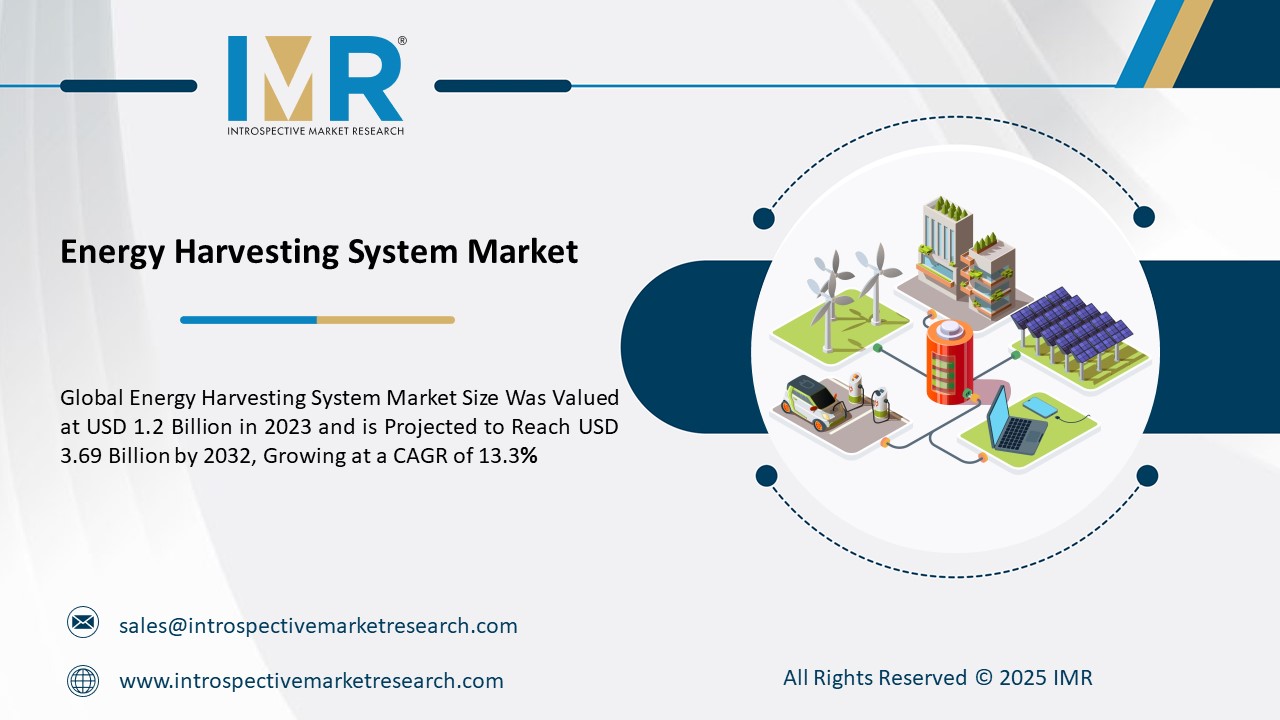
According to a new report published by Introspective Market Research, titled, Energy Harvesting System Market by Technology, Component, and Application, The Global Energy Harvesting System Market Size Was Valued at USD 1.2 Billion in 2023 and is Projected to Reach USD 3.69 Billion by 2032, Growing at a CAGR of 13.3%.The global energy harvesting system market is witnessing significant growth driven by the rising need for sustainable, maintenance-free power solutions across various industries. Energy harvesting systems capture ambient energy sources such as light, vibration, thermal, and radio frequency (RF) signals, converting them into usable electrical power. This technology minimizes dependence on conventional batteries, offering a reliable and eco-friendly power alternative.
As smart cities, IoT ecosystems, and industrial automation continue to expand, the adoption of self-powered devices has surged. Energy harvesting systems are increasingly being used in wireless sensors, wearable devices, and building automation systems. Moreover, advancements in microelectronics, ultra-low-power circuits, and nanomaterials are further improving efficiency and scalability, ensuring continued market expansion through 2032.
The Energy Harvesting System Market is segmented into Technology, Component, and Application.
-
By Technology: Light Energy Harvesting, Vibration Energy Harvesting, Thermal Energy Harvesting, and RF Energy Harvesting.
-
By Component: Transducers, Power Management Integrated Circuits (ICs), and Storage Devices.
-
By Application: Consumer Electronics, Building & Home Automation, Industrial, Transportation, and Healthcare.
A major growth driver for the energy harvesting system market is the increasing demand for battery-free and energy-efficient IoT devices. With the proliferation of wireless sensor networks and connected devices in smart environments, industries are focusing on self-sustaining power solutions that require minimal maintenance. Energy harvesting systems provide a clean and renewable source of energy that enhances device longevity and reduces operational costs.
An emerging opportunity lies in the integration of energy harvesting systems into smart city infrastructure and wearable technology. As governments and organizations worldwide invest in intelligent transportation, healthcare monitoring, and energy-efficient buildings, there is a growing need for sustainable power solutions. The miniaturization of sensors and advances in ultra-low-power electronics are expected to accelerate adoption across these sectors, fostering market growth.
Energy Harvesting System Market, Segmentation
The Energy Harvesting System Market is segmented on the basis of Technology, Component, and Application.
Technology
The Technology segment is further classified into Light Energy Harvesting, Vibration Energy Harvesting, Thermal Energy Harvesting, and RF Energy Harvesting. Among these, the Light Energy Harvesting sub-segment accounted for the highest market share in 2023. Solar and photovoltaic technologies are widely used for powering sensors and IoT devices, offering consistent energy conversion and long-term reliability.
Application
The Application segment is further classified into Consumer Electronics, Building & Home Automation, Industrial, Transportation, and Healthcare. Among these, the Industrial sub-segment accounted for the highest market share in 2023. The use of energy harvesting systems in predictive maintenance sensors, automation devices, and condition monitoring applications is rapidly increasing, reducing energy costs and improving operational efficiency.
Some of The Leading/Active Market Players Are:
- EnOcean GmbH (Germany)
- Texas Instruments Incorporated (USA)
- STMicroelectronics N.V. (Switzerland)
- Cypress Semiconductor Corporation (USA)
- Microchip Technology Inc. (USA)
- Powercast Corporation (USA)
- Linear Technology Corporation (USA)
- Cymbet Corporation (USA)
- Lord MicroStrain (USA)
- Fujitsu Limited (Japan)
- Bionic Power Inc. (Canada)
- Mide Technology Corporation (USA)
- other active players.
Key Industry Developments
- In April 2024, Texas Instruments unveiled a next-generation series of ultra-low-power energy harvesting ICs for smart sensor applications.
These ICs offer higher energy conversion efficiency and extended device lifetimes, catering to the growing demand for autonomous IoT systems. - In October 2023, EnOcean GmbH collaborated with a global automation company to introduce self-powered wireless sensors for smart buildings.
The partnership aims to enhance energy efficiency and sustainability across commercial and industrial infrastructure.
Key Findings of the Study
- Light energy harvesting dominated the market in 2023.
- The industrial segment led in application share.
- Rising IoT adoption is a primary growth driver.
- Technological advancements are enhancing system performance.
- North America and Europe are the leading regional markets.