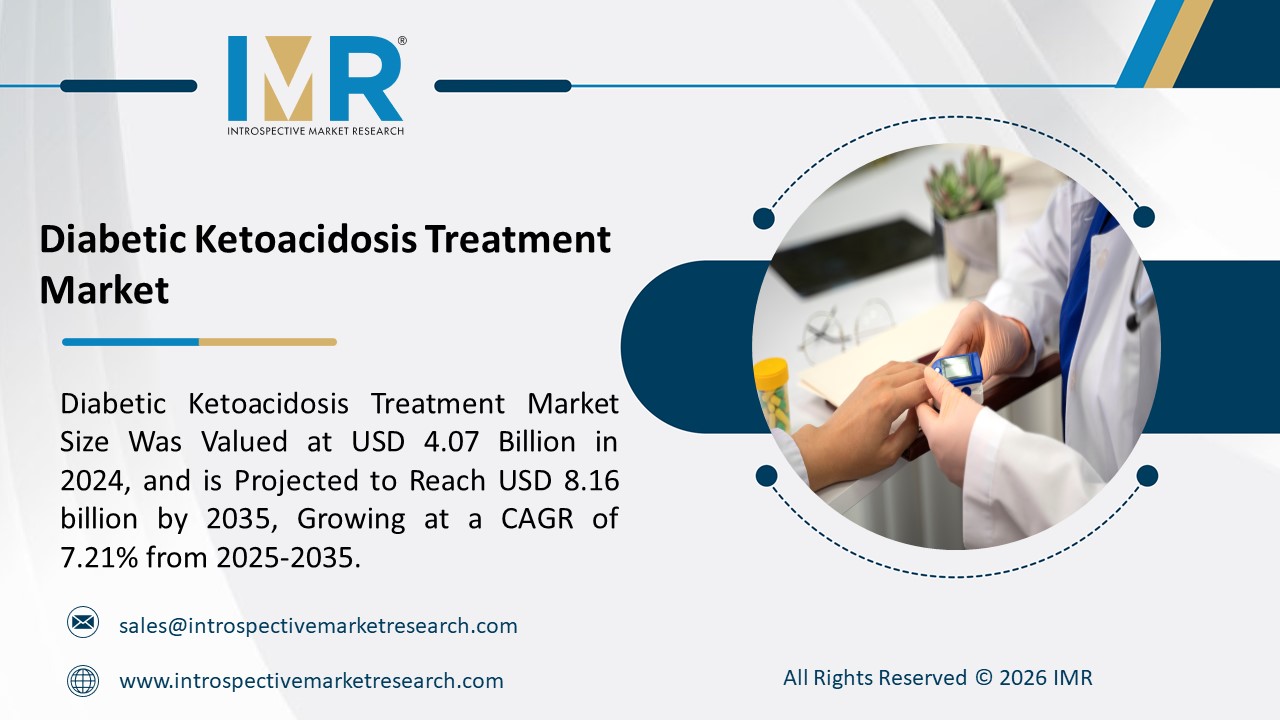
According to a new report published by Introspective Market Research, titled, “Diabetic Ketoacidosis Treatment Market by Drug Class, End-User, and Region,” The Global Diabetic Ketoacidosis Treatment Market Size Was Valued at USD 4.07 Billion in 2024 and is Projected to Reach USD 8.16 Billion by 2035, Growing at a CAGR of 7.21% From 2025–2035.
The Diabetic Ketoacidosis (DKA) Treatment market consists of emergency medical products and protocols used to manage this life-threatening complication of diabetes, primarily Type 1 diabetes. DKA treatment is not a single product but a standardized bundle of care involving rapid-acting insulin to reverse hyperglycemia and ketosis, intravenous fluids and electrolytes (especially potassium) to correct dehydration and imbalances, and continuous patient monitoring. The modern standard of care offers a decisive advantage over historical approaches through protocol-driven, rapid intervention in critical care settings, which significantly reduces mortality rates, shortens hospital stays, and prevents neurological complications like cerebral edema.
The principal growth driver for the diabetic ketoacidosis treatment market is the persistent and rising global incidence of Type 1 diabetes (T1D), coupled with the high rate of recurrent DKA episodes as a marker of suboptimal disease management. While Type 2 diabetes is more prevalent, T1D patients are at a much higher inherent risk for DKA. The incidence of T1D is increasing globally for reasons not fully understood, expanding the at-risk population. Furthermore, a significant proportion of DKA hospitalizations are preventable and occur due to issues like insulin omission, infection, or lack of access to care. Each of these preventable episodes triggers the full, resource-intensive DKA treatment protocol, creating a recurring and costly demand within healthcare systems that drives consistent market volume.
A significant market opportunity lies in the development and adoption of standardized, protocol-driven DKA management kits and digital tools for both hospital and transitional care. In hospitals, there is a move towards pre-packaged, standardized DKA treatment kits that bundle correct concentrations of insulin, fluids, and electrolytes with clear instructions to reduce medication errors and speed up treatment initiation. Beyond the hospital, a major opportunity exists in digital health platforms and connected devices that help prevent DKA. This includes continuous glucose monitors (CGMs) with predictive alerts for rising ketone risk, telehealth programs for high-risk patients, and transitional care apps that improve education and adherence post-discharge to prevent readmission. Companies that integrate treatment with prevention through technology can capture value across the care continuum.
Diabetic Ketoacidosis Treatment Market, Segmentation
The Diabetic Ketoacidosis Treatment Market is segmented on the basis of Drug Class, End-User, and Region.
Drug Class
The Drug Class segment is further classified into Insulin, Intravenous Fluids & Electrolytes, and Adjunctive Therapies. Among these, the Insulin sub-segment accounted for the highest market share in 2024. Insulin is the cornerstone pharmacotherapy for DKA, as it is required to switch off the pathological process of lipolysis and ketogenesis. The standard treatment involves a continuous intravenous insulin infusion until the acidosis is resolved. The universal and non-discretionary use of insulin in every single DKA case, along with the need for specific protocols and monitoring, makes it the fundamental and largest drug class segment in the market.
End-User
The End-User segment is further classified into Hospitals, Specialty Clinics, and Others. Among these, the Hospitals sub-segment, particularly emergency departments and ICUs, accounted for the overwhelming majority of the market share in 2024. DKA is a medical emergency that requires immediate, intensive monitoring and intervention that cannot be safely provided in an outpatient setting. Hospitalization is mandatory for almost all moderate to severe DKA cases to administer IV fluids, insulin drips, and frequent laboratory monitoring, ensuring hospitals are the exclusive and critical site for acute DKA treatment, driving virtually all product demand.
Some of The Leading/Active Market Players Are-
• Novo Nordisk A/S (Denmark)
• Eli Lilly and Company (US)
• Sanofi (France)
• Pfizer Inc. (US) [via its Hospira infusion products division]
• B. Braun Melsungen AG (Germany)
• Baxter International Inc. (US)
• Fresenius SE & Co. KGaA (Germany)
• and other active players.
Key Industry Developments
In January 2025, a consortium of major children’s hospitals published a landmark study on the implementation of a standardized, weight-based DKA treatment bundle across their networks. The protocol, which included pre-mixed fluid bags and a fixed insulin dosing algorithm, demonstrated a significant reduction in treatment errors, length of stay, and the incidence of hypokalemia, setting a new benchmark for inpatient DKA care quality.
In March 2024, a leading digital health company received FDA clearance for an algorithm update to its continuous glucose monitor (CGM) system designed to provide early alerts for potential DKA risk. The algorithm analyzes the rate and persistence of glucose rise to notify patients and caregivers hours before ketosis likely begins, aiming to shift intervention from emergency treatment to proactive prevention.
Key Findings of the Study
• The Insulin drug class and Hospitals end-user segment dominate the market.
• North America holds the largest market share, driven by high healthcare expenditure and a significant T1D population.
• The key growth driver is the increasing global incidence of Type 1 diabetes and recurrent DKA episodes.
• Major trends include the standardization of treatment protocols and the integration of CGM/digital tools for prevention.