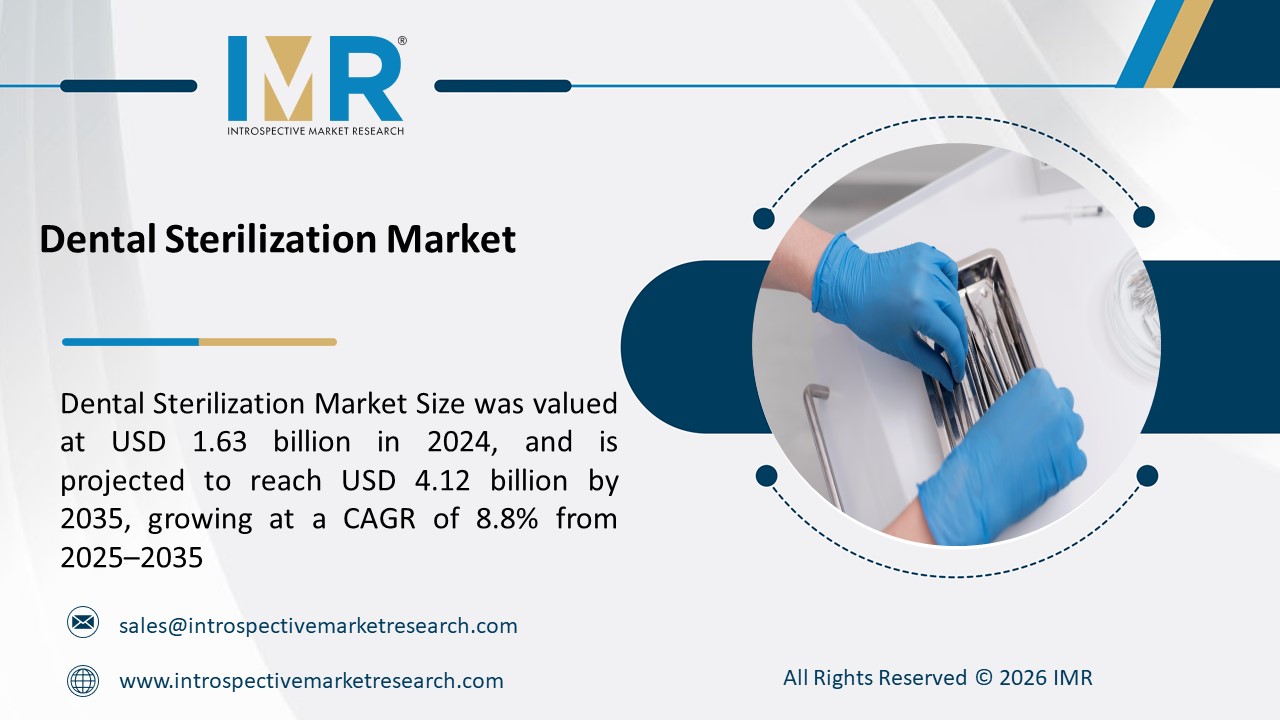
According to a new report published by Introspective Market Research, titled, “Dental Sterilization Market by Product, End-User, and Region,” The Global Dental Sterilization Market Size Was Valued at USD 1.63 Billion in 2024 and is Projected to Reach USD 4.12 Billion by 2035, Growing at a CAGR of 8.8% From 2025–2035.
The Dental Sterilization market encompasses a comprehensive range of equipment, consumables, and services dedicated to eliminating all microbial life from dental instruments to prevent infection transmission between patients. This includes autoclaves (steam sterilizers), instrument washers/disinfectors, ultrasonic cleaners, chemical disinfectants, packaging materials, and monitoring equipment. Modern dental sterilization offers a decisive advantage over basic disinfection or outdated methods by ensuring a verifiable, standardized level of safety known as sterility assurance level (SAL). Automated cycles with integrated monitoring provide consistent, reproducible results that are essential for compliance with stringent infection control protocols mandated by global health bodies.
The foremost growth driver for the dental sterilization market is the escalating global focus on and strict enforcement of infection prevention and control (IPC) standards in healthcare, driven by lessons from the COVID-19 pandemic. Regulatory agencies and accrediting bodies worldwide have significantly tightened guidelines for instrument reprocessing. Dental practices now face mandatory compliance with standards that require validated sterilization cycles, detailed process monitoring, and staff training documentation. This regulatory pressure, combined with heightened patient awareness and expectation of safety, makes investment in modern, reliable, and often automated sterilization equipment a non-negotiable operational necessity, driving consistent replacement and upgrade cycles across the entire dental industry.
A significant market opportunity lies in the adoption of advanced, connected "smart" sterilization technologies and the expansion of service-based models. Next-generation sterilizers equipped with IoT sensors and cloud connectivity enable remote monitoring of cycle data, predictive maintenance alerts, and automated compliance reporting, streamlining practice management. Furthermore, the growing trend of instrument reprocessing services offered by third-party providers presents a substantial growth avenue, particularly for small clinics that wish to outsource this complex, labor-intensive process. Companies that develop integrated ecosystems of smart hardware, consumables, and data management services can build recurring revenue streams and become indispensable partners in modern dental practice infection control programs.
Dental Sterilization Market, Segmentation
The Dental Sterilization Market is segmented on the basis of Product, End-User, and Region.
Product
The Product segment is further classified into Instruments and Consumables & Accessories. Among these, the Consumables & Accessories sub-segment accounted for the highest market share in 2024. This segment's dominance is due to its recurrent, high-volume nature. Consumables include sterilization pouches and wraps, biological and chemical indicators, disinfectants, cleaning solutions, and lubricants. These items are used in every single sterilization cycle and require constant replenishment, creating a predictable and continuous revenue stream. Their essential role in validating and completing the sterilization process, coupled with strict compliance requirements for single-use items, ensures this segment remains the volume and value leader in the market.
End-User
The End-User segment is further classified into Dental Clinics, Dental Hospitals, and Dental Academic & Research Institutes. Among these, the Dental Clinics sub-segment accounted for the highest market share in 2024. Dental clinics represent the vast majority of practice settings worldwide. Each independent or group practice, regardless of size, is a self-contained unit requiring a full sterilization setup. The sheer number of these clinics, combined with the universal, non-discretionary need for daily instrument processing to see patients, makes this end-user segment the largest and most critical driver of demand for both equipment (often smaller table-top units) and the ongoing flow of consumables.
Some of The Leading/Active Market Players Are-
• Dentsply Sirona (US)
• Danaher Corporation (US) [through its subsidiary, SciCan]
• Getinge AB (Sweden)
• Midmark Corporation (US)
• Planmeca Group (Finland)
• Matachana Group (Spain)
• Miele & Cie. KG (Germany) [Professional division]
• Tuttnauer (Israel)
• Hu-Friedy Mfg. Co., LLC (US)
• Nakanishi Inc. (Japan)
• Dürr Dental SE (Germany)
• and other active players.
Key Industry Developments
In March 2024, SciCan (Danaher) launched its new BRAVO! ecosystem of connected infection control devices. The system links autoclaves, ultrasonic cleaners, and instrument dryers to a central dashboard, providing real-time cycle status, compliance reporting, and maintenance alerts, aiming to simplify workflow and documentation for busy dental practices.
In January 2024, Dentsply Sirona announced a strategic partnership with a major dental service organization (DSO) to implement standardized, advanced sterilization protocols across hundreds of affiliated clinics. This partnership focuses on training, equipment standardization, and data-driven monitoring to ensure uniformly high levels of infection control, highlighting the trend toward centralized quality management in large dental networks.
Key Findings of the Study
• Consumables & Accessories and the Dental Clinics end-user segment are the market share leaders.
• North America holds the largest regional market share, driven by strict regulatory compliance and high procedural volumes.
• The key growth driver is the global strengthening and enforcement of infection prevention protocols.
• Major trends include the integration of IoT for smart sterilization and the growth of service-based reprocessing models.