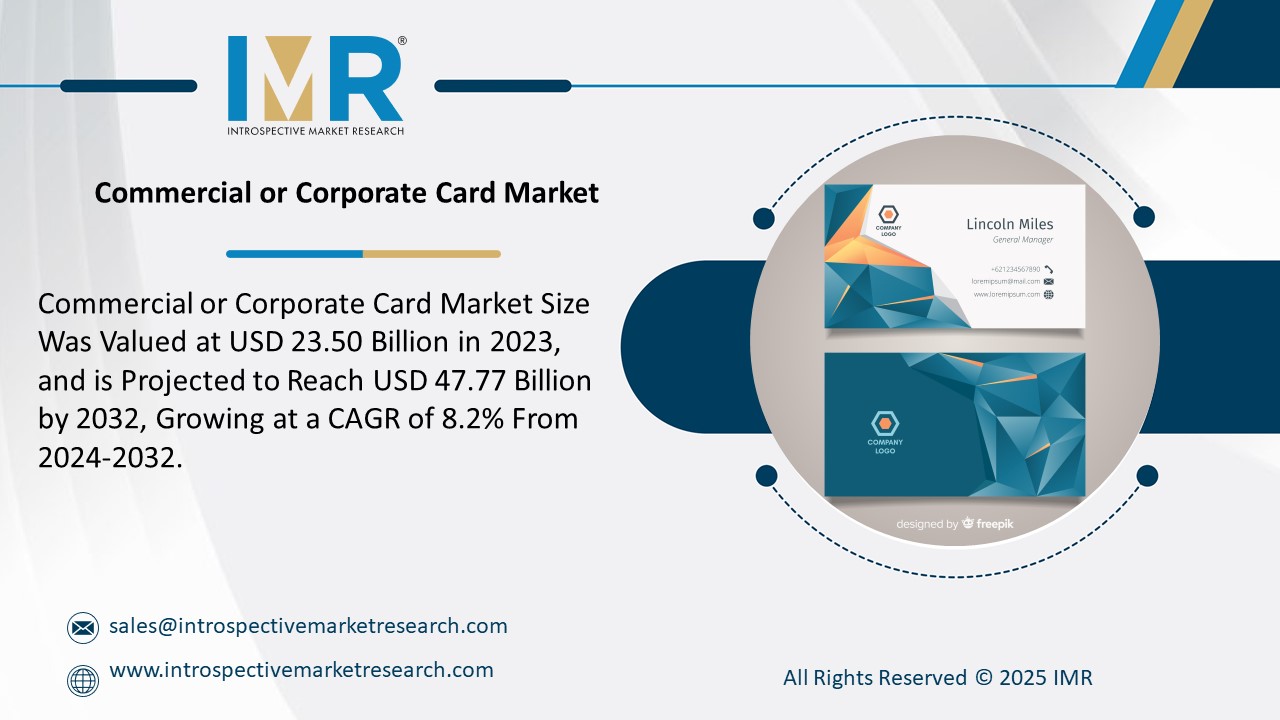
According to a new report published by Introspective Market Research, titled, Commercial or Corporate Card Market by Type, Card Network, and End-User Industry, The Global Commercial or Corporate Card Market Size Was Valued at USD 23.50 Billion in 2023 and is Projected to Reach USD 47.77 Billion by 2032, Growing at a CAGR of 8.2%.
The global Commercial or Corporate Card Market is gaining remarkable traction as businesses increasingly adopt digital payment solutions to streamline expense management, improve transparency, and enhance financial control. These cards, issued by financial institutions to companies or organizations, enable employees to make business-related purchases and payments without relying on cash or personal credit. Commercial cards offer multiple advantages such as simplified expense tracking, fraud prevention, and integration with enterprise accounting systems. Compared to traditional reimbursement processes, they reduce administrative burden and enhance operational efficiency. Growing corporate travel, the rise in business-to-business (B2B) spending, and the shift toward cashless economies are driving market expansion across sectors like IT, healthcare, logistics, and professional services.
As enterprises emphasize better control over company spending and employee transactions, demand for corporate card solutions with advanced analytics and spending controls is expected to surge globally. The emergence of fintech players and digital payment platforms is further accelerating innovation and adoption in this market. One of the primary growth drivers for the Commercial or Corporate Card Market is the increasing adoption of digital payment systems in corporate sectors. Businesses worldwide are focusing on automating their payment and expense management systems to improve transparency and reduce financial errors. Corporate cards offer integrated reporting tools that help organizations monitor spending patterns and enhance compliance with internal financial policies. Moreover, the widespread shift toward cashless transactions and the growing need for efficient cross-border payments are boosting the adoption of these solutions.
A major market opportunity lies in the integration of AI and analytics into corporate card platforms. Financial institutions and fintech companies are leveraging data-driven insights to offer customized spending controls, fraud detection, and predictive financial management tools. This technological enhancement provides greater value to businesses, enabling real-time tracking and control over employee expenditures. Additionally, emerging markets such as India, Brazil, and Southeast Asia present lucrative opportunities due to increasing digitization of SMEs and government initiatives promoting cashless economies.
Commercial or Corporate Card Market, Segmentation
The Commercial or Corporate Card Market is segmented on the basis of Type, Card Network, and End-User Industry.
Type
- The Type segment is further classified into Travel & Entertainment Cards, Purchasing Cards, and Fuel Cards. Among these, the Purchasing Card sub-segment accounted for the highest market share in 2023. Purchasing cards are widely used by companies for procurement-related payments, offering detailed transaction data and improving financial oversight. Their ability to reduce paperwork, accelerate payment cycles, and minimize fraud risk has made them the preferred choice among large enterprises and government organizations.
Card Network
- The Card Network segment is further classified into Visa, Mastercard, American Express, and Others. Among these, the Visa sub-segment accounted for the highest market share in 2023. Visa’s extensive global network, robust security infrastructure, and wide merchant acceptance make it the leading player in the corporate card space. Continuous technological advancements and partnerships with banks and fintech firms have further strengthened its market position.
Some of The Leading/Active Market Players Are
• American Express Company (U.S.)
• JPMorgan Chase & Co. (U.S.)
• Citigroup Inc. (U.S.)
• Bank of America Corporation (U.S.)
• Barclays PLC (U.K.)
• HSBC Holdings plc (U.K.)
• Wells Fargo & Company (U.S.)
• U.S. Bank (U.S.)
• Capital One Financial Corporation (U.S.)
• ICICI Bank Limited (India)
• Standard Chartered PLC (U.K.)
• Visa Inc. (U.S.)
• Mastercard Incorporated (U.S.)
• Commercial Bank of Dubai (U.A.E.)
• Deutsche Bank AG (Germany)
and other active players.
Key Industry Developments
-
In March 2024, American Express launched an enhanced Business Gold Card program offering AI-powered spend analytics for SMEs. The program aims to help businesses optimize spending categories, identify cost-saving opportunities, and manage budgets efficiently through intelligent insights and real-time expense tracking.
- In July 2023, Mastercard partnered with a major fintech startup to expand digital corporate card issuance for remote businesses. The collaboration focuses on virtual corporate card solutions that support online payments, automated reconciliations, and spending controls, empowering businesses to manage distributed teams effectively.
Key Findings of the Study
• Purchasing Cards dominated the market in 2023.
• Visa led the market among card networks.
• North America held the largest regional market share.
• AI integration and fintech collaborations are key growth trends.
• Rising demand for cashless and transparent business transactions drives growth.