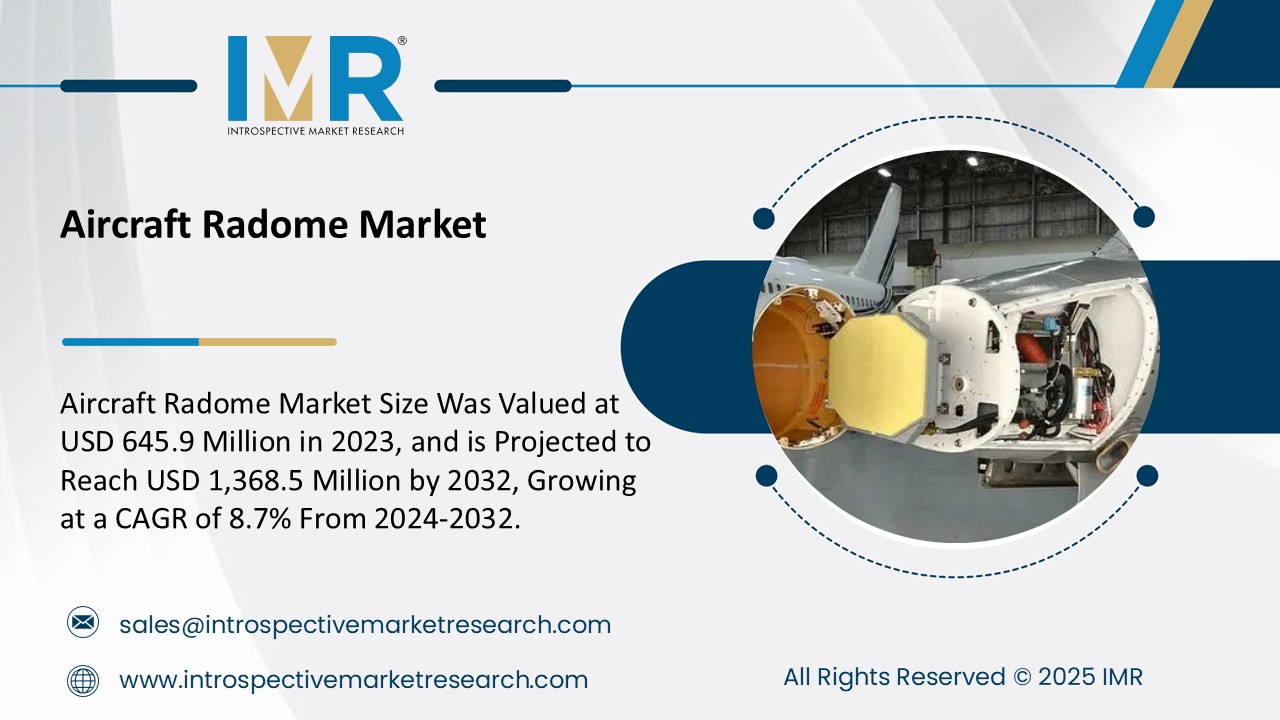
According to a new report published by Introspective Market Research, titled, Aircraft Radome Market by Material, Platform, and Application, The Global Aircraft Radome Market Size Was Valued at USD 645.9 Million in 2023 and is Projected to Reach USD 1,368.5 Million by 2032, Growing at a CAGR of 8.7%. The global aircraft radome market is experiencing steady growth due to the increasing demand for advanced communication systems and expanding military and commercial aviation sectors. A radome is a structural, weatherproof enclosure that protects radar or antenna systems on aircraft without interfering with electromagnetic signals. These enclosures are designed to withstand extreme environmental conditions while ensuring optimal signal transmission and reception.
With the increasing integration of satellite-based navigation, weather tracking, and surveillance systems in modern aircraft, the importance of radomes has grown substantially. The industry is witnessing advancements in lightweight composite materials that provide enhanced strength-to-weight ratios and improved aerodynamic performance. Moreover, rising global defense budgets, the growing demand for next-generation fighter jets, and increased airline deliveries are key contributors to market expansion. The rise of UAVs and space-based communication systems is expected to provide further momentum to the market.
The Aircraft Radome Market is segmented into Material, Platform, and Application. By Material, the market is categorized into (Glass Fiber, Quartz, Others). By Platform, the market is categorized into (Commercial Aircraft, Military Aircraft, UAVs). By Application, the market is categorized into (Radar, Sonar, Communication, Others).
One of the key growth drivers of the aircraft radome market is the surge in global air traffic and subsequent increase in aircraft fleet size. Commercial airlines are expanding their fleets to meet rising passenger demand, especially in emerging economies. This is prompting OEMs to invest in lightweight and fuel-efficient aircraft, which in turn increases the demand for advanced, aerodynamic radomes. These radomes enable seamless operation of satellite communications, in-flight entertainment, and real-time weather tracking systems—critical components of modern aircraft functionality.
A major market opportunity lies in the growing adoption of unmanned aerial vehicles (UAVs) for military and commercial purposes. UAVs require compact and highly durable radomes for real-time surveillance, communication, and navigation functions. As governments and private entities increase investments in drone technology for defense intelligence, border patrol, and delivery services, the demand for specialized radomes is expected to escalate significantly. Lightweight, multifunctional radomes with minimal electromagnetic interference are becoming essential for long-range, high-performance drone operations.
Aircraft Radome Market, Segmentation
The Aircraft Radome Market is segmented on the basis of Material, Platform, and Application.
Material
The Material segment is further classified into Glass Fiber, Quartz, and Others. Among these, the Glass Fiber sub-segment accounted for the highest market share in 2024. Glass fiber radomes are widely used due to their lightweight nature, high durability, and excellent electromagnetic transparency. They offer a cost-effective solution for commercial and military aircraft alike. Additionally, their ease of fabrication and compatibility with complex geometries make them highly adaptable for aerodynamic design, contributing to fuel efficiency and overall aircraft performance.
Platform
The Platform segment is further classified into Commercial Aircraft, Military Aircraft, and UAVs. Among these, the Military Aircraft sub-segment accounted for the highest market share in 2024. This dominance is attributed to increased defense spending across major economies and the procurement of new-generation fighter jets and surveillance aircraft. Radomes on military platforms play a vital role in high-speed operations, missile detection, and encrypted communication systems. The focus on stealth and operational efficiency in modern combat aircraft has led to continuous innovation in radome design and integration.
Some of The Leading/Active Market Players Are–
- General Dynamics Corporation (United States)
- L3Harris Technologies, Inc. (United States)
- Cobham Limited (United Kingdom)
- Saint-Gobain Performance Plastics (France)
- Meggitt PLC (United Kingdom)
- Nordam Group Inc. (United States)
- TransDigm Group Incorporated (United States)
- Jenoptik AG (Germany)
- The Gill Corporation (United States)
- Raytheon Technologies Corporation (United States)
- Ducommun Incorporated (United States)
- Composites Unlimited (United States)
- …and other active players.
Key Industry Developments
In June 2024, L3Harris Technologies unveiled a new composite radome solution for high-speed fighter aircraft.
The advanced radome offers improved electromagnetic performance and reduced radar cross-section, enhancing stealth capabilities. This innovation addresses increasing defense requirements for multifunctional and aerodynamic components in next-generation fighter jets.
In February 2024, Cobham Advanced Electronic Solutions announced a partnership with a leading drone manufacturer to develop specialized radomes for long-range UAVs.
The collaboration focuses on producing lightweight, weather-resistant radomes that support real-time data communication. These radomes will be used in both defense surveillance drones and commercial drone delivery systems.
Key Findings of the Study
- Glass fiber dominated the material segment due to high durability and affordability.
- Military aircraft led the platform segment with growing demand for stealth and surveillance.
- Rising air traffic and aircraft production fueled market expansion.
- Asia-Pacific and North America emerged as leading regional markets.
- UAV integration presents lucrative growth opportunities for radome manufacturers.