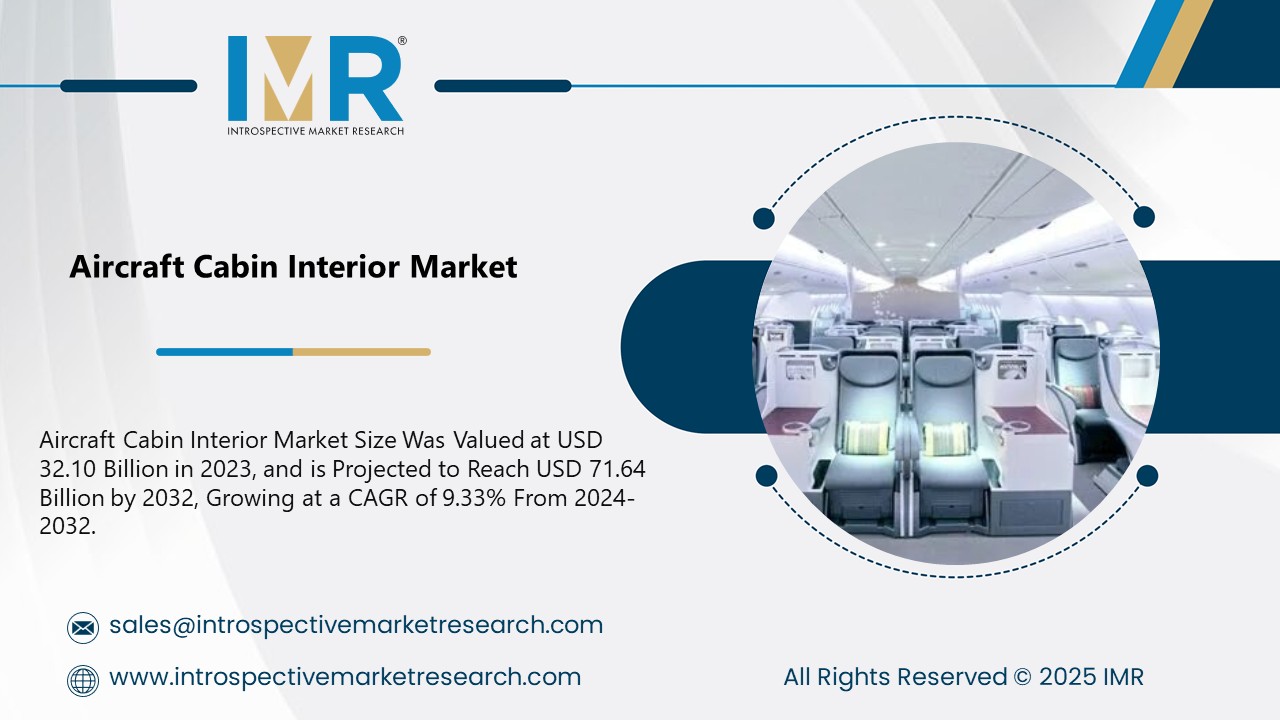
According to a new report published by Introspective Market Research, titled, Aircraft Cabin Interior Market by Aircraft Type, Component, and Material, The Global Aircraft Cabin Interior Market Size Was Valued at USD 32.10 Billion in 2023 and is Projected to Reach USD 71.64 Billion by 2032, Growing at a CAGR of 9.33%.The aircraft cabin interior market encompasses the design, manufacturing, and refurbishment of all components within an aircraft's cabin, from seating and galleys to in-flight entertainment systems, lighting, and lavatories. This specialized market is critical for ensuring passenger comfort, safety, and a premium travel experience across commercial, business, and even military aircraft. It involves sophisticated engineering and aesthetic design to create functional, lightweight, and durable interior solutions that meet stringent aviation regulations.
This market provides advanced solutions that significantly enhance the passenger journey, offering advantages such as improved ergonomics, personalized entertainment, enhanced connectivity, and aesthetically pleasing environments compared to older designs. It is essential for major industries like commercial aviation, business aviation, and maintenance, repair, and overhaul (MRO) services. The continuous focus on innovation aims to optimize space utilization, reduce aircraft weight for fuel efficiency, and elevate the overall in-flight experience.
A primary growth driver for the aircraft cabin interior market is the increasing demand for enhanced passenger comfort and premium travel experiences, particularly in the competitive commercial aviation sector. Airlines are constantly striving to differentiate themselves and attract high-value customers by investing in superior cabin aesthetics, ergonomic seating, advanced in-flight entertainment (IFE) systems, and improved connectivity options. This drive for passenger satisfaction leads to both new aircraft orders specifying customized interiors and significant retrofit projects for existing fleets. As air travel continues to expand globally, providing a comfortable and enjoyable cabin environment becomes crucial for airline profitability and brand loyalty, thereby fueling market growth.
A significant market opportunity lies in the burgeoning demand for lightweight and sustainable cabin interior components. With rising fuel costs and increasing environmental regulations, airlines are intensely focused on reducing aircraft weight to improve fuel efficiency and lower carbon emissions. This creates a strong incentive for manufacturers to innovate with advanced composite materials, lighter seat designs, and integrated, space-saving solutions. Furthermore, there's a growing emphasis on using recyclable, eco-friendly materials and sustainable manufacturing processes. Companies that can deliver high-performance, ultra-lightweight, and environmentally responsible interior products will be well-positioned to capitalize on this critical industry trend, meeting both economic and ecological
Aircraft Cabin Interior Market, Segmentation
The Aircraft Cabin Interior Market is segmented on the basis of Aircraft Type, Component, and Material.
Aircraft Type
- The Aircraft Type segment is further classified into Narrow-body Aircraft, Wide-body Aircraft, Business Jets, and Regional Aircraft. Among these, the Narrow-body Aircraft sub-segment accounted for the highest market share in 2023. Narrow-body aircraft, such as the Airbus A320 family and Boeing 737 series, dominate global airline fleets due to their high volume of deliveries and extensive use on short-to-medium haul routes. This high-volume production and consistent demand for cabin upgrades, refurbishments, and new installations directly translate into a larger market share for interior components. Airlines continually invest in enhancing narrow-body cabins to improve passenger comfort and maximize seat capacity, making this segment a significant driver for the overall market.
Component
- The Component segment is further classified into Seating, Lavatory, Galley, Lighting, Windows, Cabin Walls & Panels, and In-flight Entertainment & Connectivity (IFEC) Systems. Among these, the Seating sub-segment accounted for the highest market share in 2023. Aircraft seating represents the largest component segment due to its significant physical footprint within the cabin and its direct impact on passenger comfort and airline profitability. Airlines frequently invest in new, lighter, and more ergonomic seat designs to optimize cabin space, reduce fuel consumption, and enhance the passenger experience, from economy to first class. The continuous cycle of seat replacement, customization, and innovation, driven by passenger expectations and airline operational efficiency goals, solidifies its leading position.
Some of The Leading/Active Market Players Are-
- Safran S. A. (France)
- Collins Aerospace (US)
- Diehl Stiftung & Co. KG (Germany)
- Recaro Aircraft Seating GmbH (Germany)
- Jamco Corporation (Japan)
- STELIA Aerospace (France)
- Geven S.p.A. (Italy)
- Zodiac Aerospace (Safran Group) (France)
- Triumph Group, Inc. (US)
- FACC AG (Austria)
- Hong Kong Aircraft Engineering Company Limited (HAECO) (Hong Kong)
- Lufthansa Technik AG (Germany)
- SWS Certification Services (UK)
- AIM Altitude (UK)
- Aviointeriors S.p.A. (Italy)
- and other active players.
Key Industry Developments
- In January 2024, Collins Aerospace announced the introduction of its next-generation business class seat, featuring enhanced privacy, comfort, and integrated smart technology.This development addresses the growing demand for premium cabin experiences, offering airlines advanced solutions to differentiate their services and cater to high-value travelers seeking superior in-flight luxury and personal space.
- In November 2023, Recaro Aircraft Seating unveiled a new ultra-lightweight economy class seat designed to significantly reduce aircraft fuel consumption without compromising passenger comfort.This innovation highlights the industry's strong focus on sustainability and operational efficiency, providing airlines with a crucial tool to lower costs and meet environmental targets while maintaining a competitive passenger offering.
Key Findings of the Study
- Dominant segments: Narrow-body aircraft by type and Seating by component hold the largest market shares.
- Leading regions: Europe and North America are key markets, with Asia-Pacific showing strong growth in new aircraft deliveries.
- Key growth drivers: Demand for enhanced passenger comfort and increasing fleet modernization.
- Market trends: Strong focus on lightweight materials, sustainability, and advanced IFEC systems.
- The market is experiencing robust growth, driven by airline competition and technological innovation.