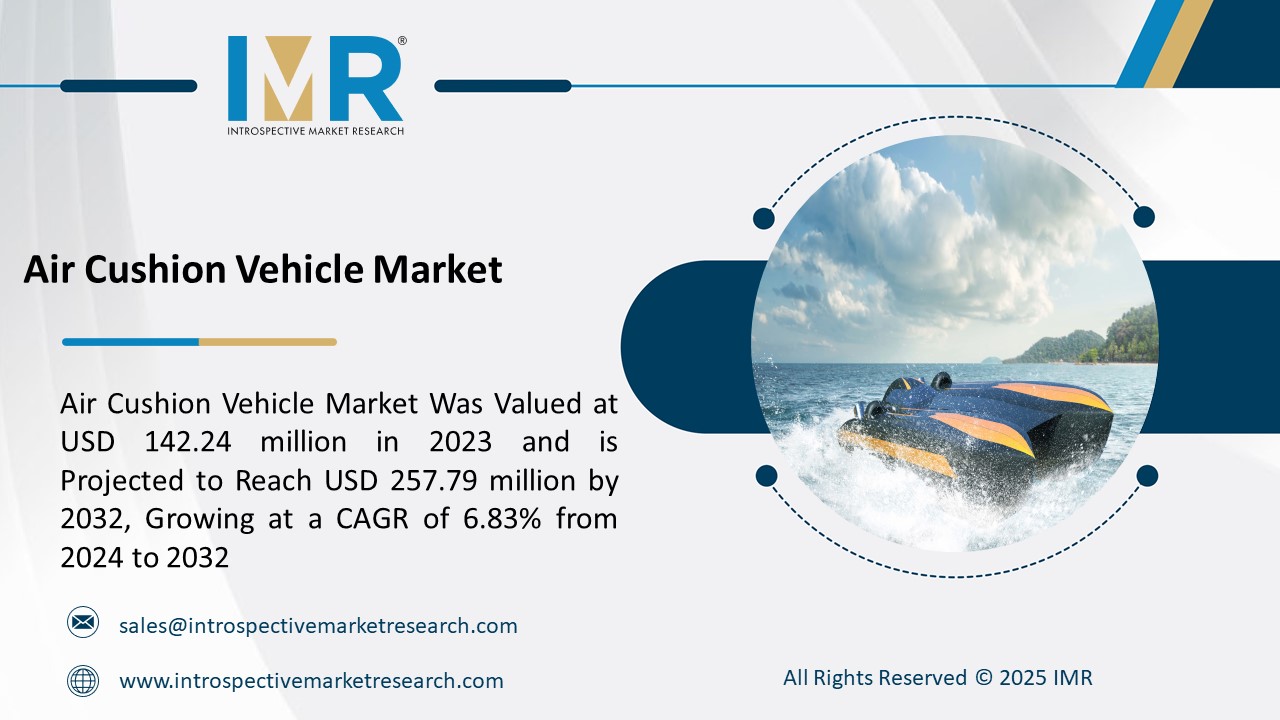
According to a new report published by Introspective Market Research, titled, Air Cushion Vehicle Market by Type (Hovercraft, Air-Cushion Pallets), Application (Commercial, Military, Recreation), and End-Use (Passenger Transport, Cargo Transport, Search and Rescue), The Global Air Cushion Vehicle Market Size Was Valued at USD 142.24 Million in 2023 and is Projected to Reach USD 257.79 Million by 2032, Growing at a CAGR of 6.83%. Air cushion vehicles (ACVs), commonly known as hovercraft, are unique modes of transport that travel over land, water, ice, and various other surfaces by hovering on a cushion of air generated by powerful fans. This innovative technology allows ACVs to overcome friction and obstacles, offering unparalleled versatility and access to otherwise inaccessible terrains. Their ability to operate seamlessly across different environments, without the need for traditional roads or waterways, provides a significant advantage over conventional transportation methods.
The primary uses of ACVs span a wide range of industries, including commercial operations for passenger and cargo transport, critical military applications for rapid deployment and reconnaissance, and recreational activities. Their amphibious capabilities make them ideal for search and rescue missions, coastal patrols, and disaster relief efforts, where speed and adaptability are paramount. As technology advances, the efficiency and performance of ACVs continue to improve, enhancing their appeal for diverse operational needs globally.
A key growth driver for the air cushion vehicle market is the increasing demand for efficient and versatile transportation solutions in diverse environments. ACVs offer unique capabilities for navigating challenging terrains, including marshlands, shallow waters, ice, and remote areas where conventional vehicles struggle. This versatility makes them indispensable for operations such as disaster relief, remote area access, and coastal surveillance, particularly in regions prone to extreme weather conditions or with limited infrastructure. The growing recognition of these operational benefits by governments and commercial entities worldwide is significantly boosting market expansion.
A significant market opportunity lies in the expanding application of air cushion vehicles in renewable energy projects, particularly in offshore wind farm maintenance and construction. ACVs can efficiently transport personnel and equipment over water and tidal flats, providing stable platforms for servicing turbines without extensive infrastructure development or environmental impact. Their ability to operate in shallow waters and sensitive ecosystems makes them a preferred choice for supporting the growth of offshore wind energy, presenting a substantial avenue for market players to innovate and expand their service offerings.
Air Cushion Vehicle Market, Segmentation
The Air Cushion Vehicle Market is segmented on the basis of Type, Application, and End-Use.
Type
-
The Type segment is further classified into Hovercraft and Air-Cushion Pallets. Among these, the Hovercraft sub-segment accounted for the highest market share in 2023. Hovercrafts are the most widely recognized form of air cushion vehicles, known for their ability to travel over land, water, mud, and ice by creating a cushion of air beneath them. This capability makes them highly versatile for a multitude of applications, including military operations, search and rescue, passenger transport, and environmental monitoring. Their unique design allows for reduced friction and high-speed transit across varied surfaces, offering significant advantages in accessibility and operational efficiency, especially in areas where traditional vehicles are impractical.
Application
-
The Application segment is further classified into Commercial, Military, and Recreation. Among these, the Military sub-segment accounted for the highest market share in 2023. Military applications represent a significant portion of the air cushion vehicle market due to the strategic advantages offered by ACVs. These vehicles are crucial for amphibious assault operations, rapid troop deployment, and logistics support in challenging coastal and riverine environments. Their speed, payload capacity, and ability to operate independently of established ports or airfields provide a critical edge in modern warfare and defense strategies. The ongoing modernization efforts by various naval forces continue to drive demand for advanced ACV technologies.
Some of The Leading/Active Market Players Are-
- Griffon Hoverwork (UK)
- Textron Systems (USA)
- Universal Hovercraft (USA)
- Neoteric Hovercraft, Inc. (USA)
- Hovertechnics (USA)
- Kongsberg Maritime (Norway)
- Rethink Robotics (USA)
- Aerohod (Russia)
- L-3 Communications (USA)
- Garden Reach Shipbuilders & Engineers Ltd (India)
- AirLift Hovercraft (Canada)
- Opcon (Sweden)
- Merwede Maritime Technologies (Netherlands)
- Jiangsu Jiaoyang Marine Technology (China)
- The British Hovercraft Company (UK)
- other active players.
Key Industry Developments
- In February 2023, Textron Systems announced the delivery of their next-generation Ship-to-Shore Connector (SSC) Landing Craft, Air Cushion (LCAC) 100 Class to the U.S. Navy. This delivery marks a significant milestone in modernizing the Navy's amphibious transport capabilities. The LCAC 100 class offers enhanced payload capacity and improved maintainability compared to its predecessors, crucial for supporting future military operations and expeditionary missions worldwide. This advancement demonstrates a continued commitment to leveraging air cushion technology for strategic defense needs.
- In September 2022, Griffon Hoverwork secured a contract to supply two 12000TD hovercraft to the Canadian Coast Guard. These new vessels are intended to replace aging equipment, enhancing the Coast Guard's ability to conduct search and rescue operations, icebreaking, and environmental response in challenging Canadian waters. The acquisition underscores the growing recognition of hovercraft as indispensable assets for maritime safety and environmental protection, offering superior performance in varied and often harsh conditions.
Key Findings of the Study
- The military application segment continues to dominate the Air Cushion Vehicle Market due to strategic demand.
- North America remains a leading region, driven by significant defense investments and technological advancements.
- Key growth drivers include increasing demand for versatile transportation in diverse environments and growing use in disaster relief.
- Market trends show a rise in commercial applications, particularly in offshore energy maintenance and specialized logistics.