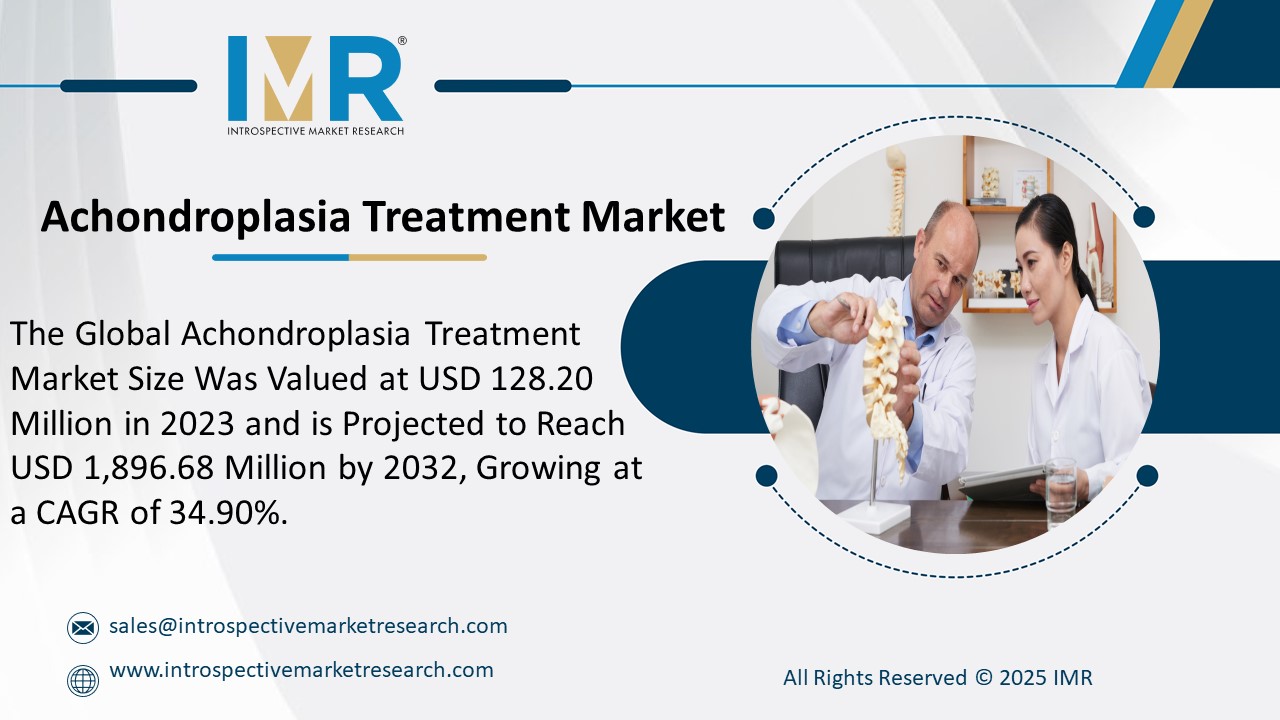
According to a new report published by Introspective Market Research, titled, Achondroplasia Treatment Market by Treatment Type, Route of Administration, and Region, The Global Achondroplasia Treatment Market Size Was Valued at USD 128.20 Million in 2023 and is Projected to Reach USD 1,896.68 Million by 2032, Growing at a CAGR of 34.90%. The global achondroplasia treatment market is undergoing a period of rapid transformation as new therapies emerge for this rare genetic disorder characterised by disproportionately short stature and skeletal abnormalities. Achondroplasia results from mutations in the FGFR3 gene, which restricts bone growth and development. Compared to traditional management approaches—such as observational care, physical therapy or limb-lengthening surgeries—novel pharmacological treatments and biologics offer targeted mechanisms of action, improved patient outcomes and reduced invasiveness.
With increasing awareness of achondroplasia, more accurate diagnoses and growing investment in rare disease research, the therapeutic pipeline has expanded significantly. The market is driven by both the unmet medical need in children and growing interest from biotechnology firms. As treatments move from experimental to commercial phases, hospitals, specialist clinics and paediatric endocrinology centres are expected to adopt these emerging options worldwide.
The Achondroplasia Treatment Market is segmented into Treatment Type, Route of Administration, and Region. By Treatment Type, the market is categorized into (Vosoritide & Other Peptide/Small Molecule Therapies, Human Growth Hormone (hGH) & Analogues, Surgical/Orthopaedic Interventions). By Route of Administration, the market is categorized into (Parenteral/Injections, Oral Therapies, Others). By Region, the market is categorized into (North America, Europe, Asia-Pacific, Latin America, Middle East & Africa).
A key growth driver for the achondroplasia treatment market is the increasing availability and regulatory approval of targeted therapies specifically designed for the condition. For many years, management of achondroplasia was limited to supportive care and surgical interventions. However, with innovations such as CNP-analogue therapies and FGFR3 pathway modulators entering late?stage development, the market is being reshaped. This shift is creating new demand among clinicians, gaining patient advocacy push and prompting payers to consider coverage options, thereby expanding market potential.
A significant market opportunity lies in the underserved paediatric and adolescent populations with achondroplasia and the expansion into emerging markets with growing rare-disease infrastructure. Given the high unmet need—especially for children with open growth plates—the introduction of first-in-class therapies offers considerable upside. Moreover, establishing distribution channels in Asia-Pacific and Latin America, where diagnosis rates are increasing and awareness is improving, presents a meaningful avenue for growth and geographical differentiation.
Achondroplasia Treatment Market, Segmentation
The Achondroplasia Treatment Market is segmented on the basis of Treatment Type, Route of Administration, and Region.
Treatment Type
The Treatment Type segment is further classified into Vosoritide & Other Peptide/Small Molecule Therapies, Human Growth Hormone (hGH) & Analogues, and Surgical/Orthopaedic Interventions. Among these, the Vosoritide & Other Peptide/Small Molecule Therapies sub-segment accounted for the highest market share in 2023. These therapies are leading because they target the underlying FGFR3 mutation pathway, offer measurable improvements in growth velocity in clinical trials, and represent the first true disease-modifying options rather than purely symptomatic care.
Route of Administration
The Route of Administration segment is further classified into Parenteral/Injections, Oral Therapies, and Others. Among these, the Parenteral/Injections sub-segment accounted for the highest market share in 2023. Injectable therapies dominate because many of the most advanced treatments currently under development and approved are administered via subcutaneous or intravenous routes, delivering greater bioavailability and enabling tighter clinical control in paediatric settings.
Some of The Leading/Active Market Players Are-
- BioMarin Pharmaceutical Inc. (USA)
- Ascendis Pharma?A/S (Denmark)
- BridgeBio Pharma Inc. (USA)
- QED?Therapeutics Inc. (USA)
- Pfizer Inc. (USA)
- Novartis?AG (Switzerland)
- Ipsen?S.A. (France)
- Teva?Pharmaceutical?Industries?Ltd. (Israel)
- F.?Hoffmann?La?Roche?Ltd (Switzerland)
- LG?Chem?Ltd. (South Korea)
- other active players.
Key Industry Developments
-
In June 2024, Ascendis Pharma?A/S announced presentation of Phase 2 data from its ACcomplisH trial evaluating TransCon CNP in children with achondroplasia. The trial results showed promising growth outcomes and safety signals, marking one of the most advanced next-generation therapies targeting the FGFR3 pathway. This milestone underscores the accelerating investment in novel paediatric treatments and may pave the way for filing submissions in major markets.
- In March 2023, BioMarin Pharmaceutical Inc. received acceptance of its supplemental New Drug Application (sNDA) from the U.S.?Food?and?Drug?Administration (FDA) to expand use of Vosoritide (Voxzogo®) for younger children with achondroplasia. This approval pathway expansion is critical in broadening market access and improving long-term growth trajectories for the therapy. It also reflects regulatory momentum and increasing recognition of early intervention in skeletal dysplasias.
Key Findings of the Study
- Peptide/small-molecule therapies (e.g., vosoritide) lead the market due to targeted mechanism and first-mover status.
- Injectable (parenteral) administration dominates, reflecting current treatment formats.
- North America remains the largest regional market, with increasing expansion into Asia-Pacific.
- Rising awareness, improved diagnostics and orphan-drug approvals drive growth.
- Addressing unmet paediatric and emerging market needs presents significant opportunity