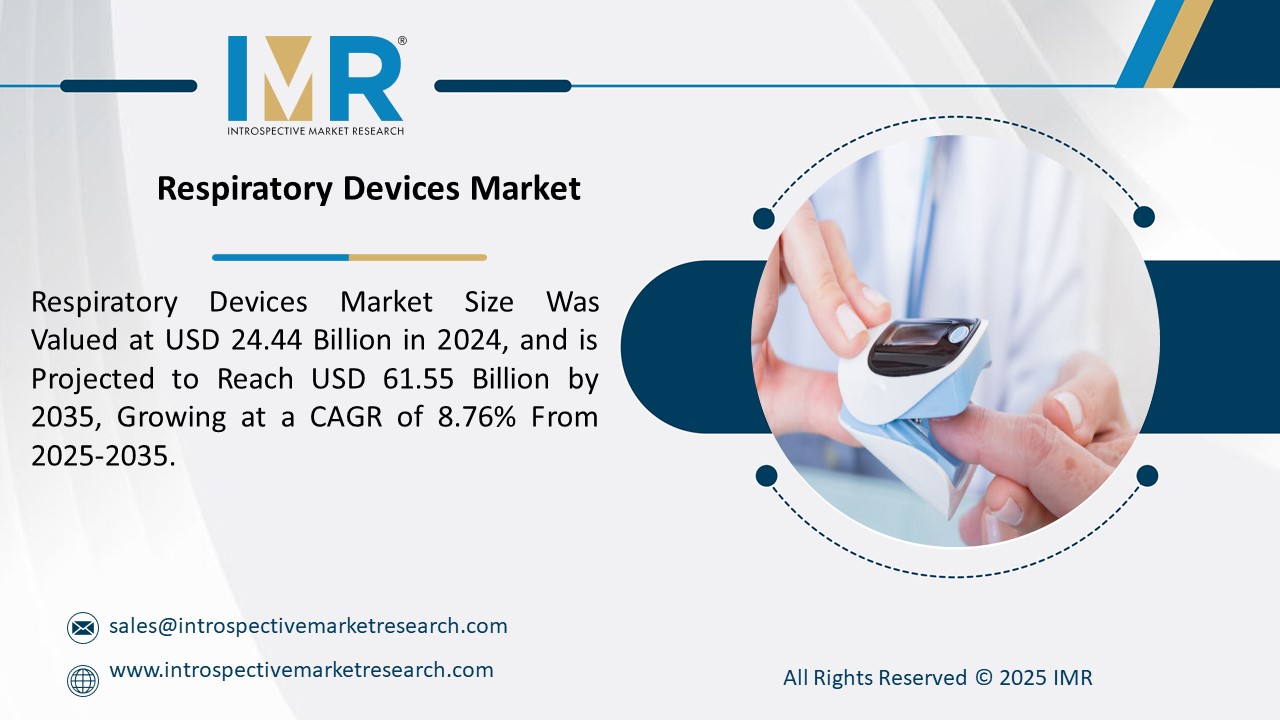
The global Respiratory Devices Market was valued at approximately USD 24.44 billion in 2024 and is projected to reach USD 61.55 billion by 2035, reflecting a compound annual growth rate (CAGR) of 8.76% over 2025-2035. This growth is powered by mounting incidence of respiratory conditions, growing ageing populations, and increasing demand for advanced therapeutic and monitoring devices.
Respiratory devices include product categories such as ventilators, oxygen concentrators, nebulizers, inhalers, CPAP/BiPAP systems and related monitoring equipment. These devices offer significant advantages over traditional supportive care by enabling treatment in hospital and home-care settings, improving patient comfort, enhancing mobility, and reducing hospital stay lengths. As such, they find major applications in hospitals, home-care settings, ambulatory care centres and long-term care facilities, across major disease indications like asthma, chronic obstructive pulmonary disease (COPD), sleep apnea and infectious respiratory diseases.
With healthcare systems globally under pressure from chronic respiratory disease burdens and acute respiratory events (such as pandemics), the respiratory devices market is coming into sharper focus for both device manufacturers and healthcare providers aiming to deliver improved patient outcomes, adopt remote monitoring and enable home-based therapies.
One of the key growth drivers for the Respiratory Devices Market is the rising prevalence of chronic respiratory diseases such as COPD, asthma and sleep-apnea as populations globally are ageing and exposure to air pollution and tobacco smoking remains high. Device adoption is further supported by advancements in technology, greater at-home care demand and increasing reimbursement support in developed markets. For instance, enhancements in monitoring and connectivity features are enabling devices to offer better patient compliance and enable remote management, thereby accelerating device deployment.
A significant market opportunity lies in the expansion of home-care respiratory devices and portable monitoring solutions, which facilitate treatment outside traditional hospital settings. With healthcare providers increasingly shifting toward outpatient and tele-health models, manufacturers have the chance to develop compact, user-friendly devices that integrate with digital health platforms. Emerging markets in Asia-Pacific, Latin America and Middle East & Africa also provide strong growth potential due to rising healthcare infrastructure investment, growing middle-class populations and increasing awareness of respiratory care.
Detailed Segmentation
The Respiratory Devices Market is segmented on the basis of By Device Type, By End User.
By Device Type
- Capnography is a leading respiratory monitoring technology that is widely used in healthcare settings worldwide. Its unprecedented capacity to offer real-time feedback on a patient's ventilation condition by detecting the amount of carbon dioxide in exhaled air is likely the reason for its broad acceptance. This continuous, non-invasive monitoring method gives medical professionals vital information on how the respiratory system functions, enabling prompt treatments and better patient outcomes.
By End User
- Clinics have a great deal of power because they are the main end-users that manage the greatest portion of Chronic Obstructive Pulmonary Disease (COPD), particularly those that specialize in respiratory care or pulmonary medicine. These specialty clinics, which provide a range of services catered to the individual needs of COPD patients, are essential centers for the all-encompassing care of these patients. Compared to more general healthcare settings, clinics have the advantage of having concentrated expertise, which enables more efficient and targeted COPD diagnosis and treatment. Clinics have the breadth of expertise necessary to manage the difficulties of COPD, including its different subtypes and comorbidities, under the direction of committed respiratory experts.
Some of The Leading/Active Market Players Are
- Philips Healthcare (Netherlands)
- Medtronic plc (Ireland)
- ResMed Inc. (US)
- Fisher & Paykel Healthcare Ltd. (New Zealand)
- Drägerwerk AG & Co. KGaA (Germany)
- GE Healthcare (US)
- Smiths Medical (UK)
- Teleflex Incorporated (US)
- Hill-Rom Holdings, Inc. (US)
- Hamilton Medical AG (Switzerland)
- Other Active Players
Key Industry Developments
- In May 2025, ResMed Inc. acquired VirtuOx, a leading independent diagnostic testing facility for sleep, respiratory, and cardiac conditions. This move strengthens ResMed’s diagnostics and home-care offering, enabling greater service integration between device manufacturing and diagnostic support.
- In March 2025, Drägerwerk unveiled its NIOSH-certified ProAir closed-circuit breathing apparatus (CCBA), designed to supply continuous oxygen for up to four hours, targeting emergency and transport applications. The launch underscores increasing focus on advanced respiratory support in acute and mobile settings.
Key Findings of the Study
- Therapeutic devices (ventilators, oxygen concentrators, PAP devices) are dominant segments.
- North America remains the leading region, with Asia-Pacific showing fastest growth.
- Growth is driven by higher prevalence of respiratory diseases, ageing populations and rising home-care demand.
- Trend toward home-based monitoring and tele-health integration is accelerating device adoption.