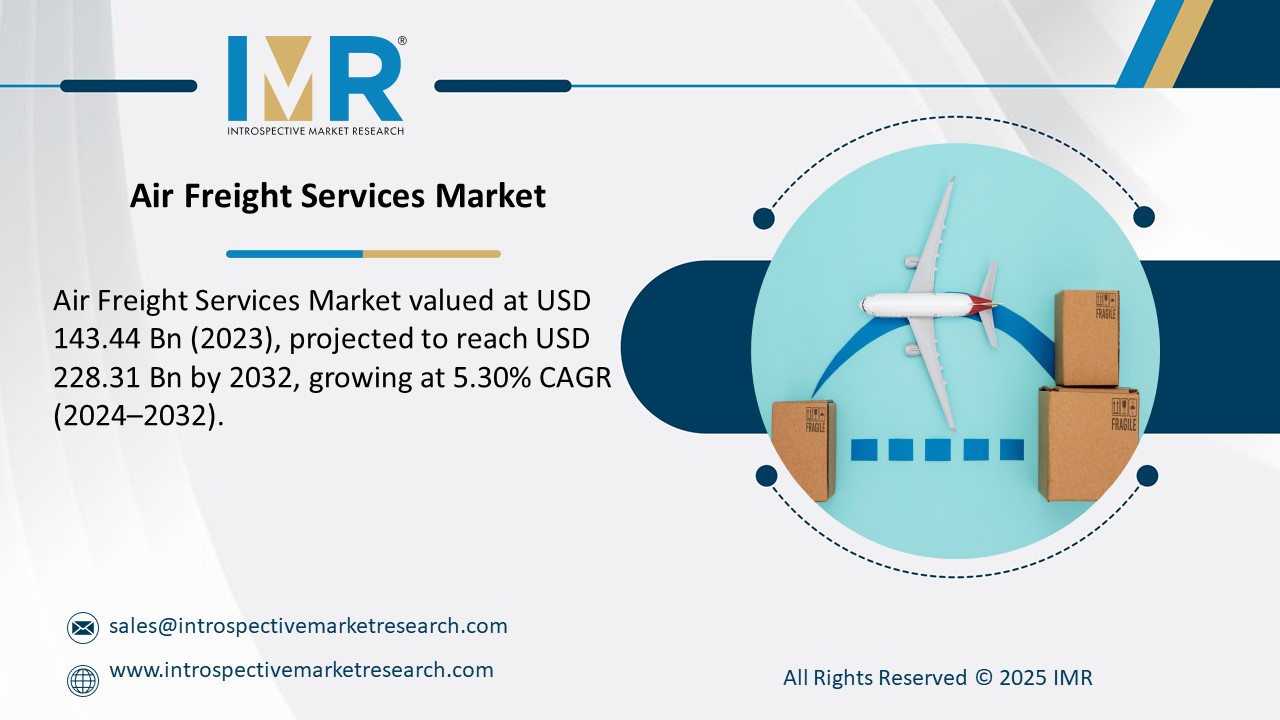
The air freight services market plays a pivotal role in global trade, offering fast and reliable transportation of goods across international and domestic routes. Unlike traditional sea or land freight, air freight services enable businesses to move high-value, time-sensitive, and perishable goods with efficiency and precision. The increasing focus on supply chain optimization and the rising demand for e-commerce deliveries have accelerated market growth. Furthermore, global economic expansion, along with the development of advanced logistics networks and digital freight management systems, is reshaping the market. Airlines are adopting fuel-efficient fleets and integrating AI-based tracking solutions to ensure real-time visibility, safety, and sustainability in operations. These developments are driving the air freight industry toward enhanced performance and customer satisfaction.
One of the key growth drivers of the air freight services market is the rapid expansion of global e-commerce. Online retailers are increasingly relying on air freight to ensure fast delivery of products across regions, especially for international shipments. The need for quick replenishment, real-time tracking, and high service reliability has encouraged the integration of advanced logistics networks and AI-driven air cargo management systems, enhancing the overall efficiency of supply chains. A major opportunity lies in the integration of sustainable aviation technologies and green logistics practices. Airlines and logistics companies are investing in biofuel usage, carbon offset programs, and lightweight aircraft designs to reduce emissions. Additionally, the adoption of digital freight booking platforms and blockchain-based cargo tracking offers transparency and cost efficiency, presenting lucrative opportunities for service providers and investors in the coming years.
Air Freight Services Market, Segmentation
The Air Freight Services Market is segmented on the basis of Service Type, End User, and Region.
Service Type
- The Service Type segment is further classified into Express, Regular, and Charter. Among these, the Express sub-segment accounted for the highest market share in 2023. Express air freight services are primarily chosen for time-sensitive shipments, ensuring next-day or same-day delivery across regions. With the rise in cross-border e-commerce and urgent medical supply deliveries, express services have become a key contributor to market revenue growth.
End User
- The End User segment is further classified into Retail & E-commerce, Automotive, Healthcare, Manufacturing, and Others. Among these, the Retail & E-commerce sub-segment accounted for the highest market share in 2023. The global shift toward online shopping has created immense pressure on logistics providers to deliver faster and more efficiently. E-commerce giants are partnering with air freight operators to support last-mile delivery, cross-border trade, and fulfillment center operations worldwide.
Some of the Leading/Active Market Players Are:
• DHL Express (Germany)
• FedEx Corporation (United States)
• UPS Airlines (United States)
• Cathay Pacific Cargo (Hong Kong)
• Qatar Airways Cargo (Qatar)
• Emirates SkyCargo (UAE)
• Cargolux Airlines (Luxembourg)
• Korean Air Cargo (South Korea)
• China Airlines Cargo (Taiwan)
• Singapore Airlines Cargo (Singapore)
• Lufthansa Cargo (Germany)
• ANA Cargo (Japan)
• Turkish Cargo (Turkey)
• Etihad Cargo (UAE)
• Japan Airlines Cargo (Japan)
and other active players.
Key Industry Developments
- In April 2024, FedEx launched a new AI-powered route optimization platform to enhance operational efficiency across its global air cargo network. This digital system leverages predictive analytics to improve fuel usage, reduce transit time, and optimize aircraft load management, leading to improved sustainability and lower operational costs.
- In September 2024, Qatar Airways Cargo introduced a carbon offset program for customers, allowing them to neutralize emissions associated with their shipments. This initiative supports the company’s sustainability goals and aligns with global carbon neutrality targets, attracting eco-conscious clients from diverse industries.
Key Findings of the Study
• Express segment dominated the market in 2023.
• Retail & E-commerce emerged as the leading end-use industry.
• Asia-Pacific holds a significant share due to rising trade and e-commerce growth.
• Sustainability and digitalization are shaping market evolution.
• Increasing cross-border trade continues to fuel air freight demand.