




Vegan Cosmetics Market Overview
Global Vegan Cosmetics Market size was valued at USD 19.43 Billion in 2023 and is projected to reach USD 31.73 Billion by 2032, growing at a CAGR of 5.6% from 2024 to 2032
Vegan cosmetics are free of any animal products and their byproducts. Traditional animal-derived components like honey, beeswax, lanolin, collagen, elastin, etc. are swapped out with ones made from plants or minerals. Vegan populations have a huge need for and popularity with vegan cosmetics. Vegan skincare, hair care, makeup, and color cosmetics come in a wide variety of designs and are readily available on the market.
Since the 1970s, animal testing has been a major ethical concern for the public when it comes to the use of animals in the cosmetics business. Large-scale public awareness campaigns have been ongoing for many years and have contributed to the revision of products, the development of new methods, and the preservation of animal life. Consumers should be worried about more than just the animals used for testing, as supplies of cosmetics and toiletries often contain items made from animals, including sheep, insects, beavers, and even whales. Globally, however, there was a 175% growth in vegan cosmetic launches between 2014 and 2019. According to estimates, more than 80% of the new vegan products introduced in the UK in 2020 fell into the beauty area. According to a study by Cosmetify in 2019, 9% of British women now exclusively purchase vegan cosmetics, up 47% over the previous year. Furthermore, 39% of these consumers aren't vegans at all. As a result, a growing number of consumers that place a strong emphasis on sustainability are supporting the concept of veganism as it quickly becomes mainstream within the cosmetics industry. In this regard, the market will rise over the forecast period as cruelty-free cosmetics are encouraged to be developed by cosmetics companies worldwide.

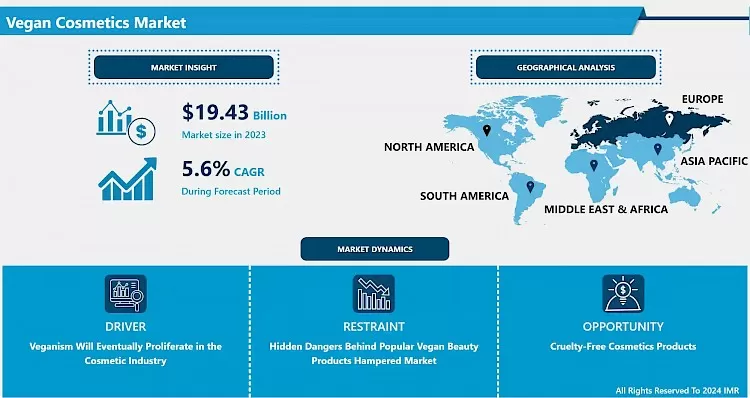
Market Dynamics And Factors For Vegan Cosmetics Market
Drivers:
Veganism Will Eventually Proliferate in the Cosmetic Industry
For being a minority idea, veganism is quickly gaining popularity in the cosmetics sector. Cosmetic companies are being forced to reconsider the manufacturing processes utilized for their products due to the enormous number of consumers who are concerned with sustainability. In addition, a production revamp is probably in store as long as manufacturers want to increase sustainability. Modern customers are more informed than ever before thanks to expanding informational access and rising internet usage. In addition to this, escalating environmental issues and the depletion of natural resources are leading to a significant change in their behavior. As a result, research shows that the popularity of veganism is growing and is unlikely to stop. The impact of this trend is being felt in the cosmetics sector as consumers who care about the environment look for more cruelty-free products and make sustainable decisions. Globally, especially in North America and Europe, consumer concern over animal testing is growing. A growing number of U.S. states have been proposing a ban on the import and distribution of such cosmetics over the years, even though animal-tested cosmetics are prohibited in Europe. In this regard, Illinois, Nevada, and California were three of the American states that enacted a ban on the importation and sale of cosmetics that were subjected to animal testing in 2020. Additionally, several animal rights organizations, such as the Humane Society and Cruelty-Free International, work to convince more American states to enact such restrictions. The demand for products free of animal experimentation will increase throughout the projection period, which is good news for vegan cosmetic companies.
Restraints:
Hidden Dangers Behind Popular Vegan Beauty Products Hampered Market
Vegan beauty is frequently included in the larger natural beauty business, which had a 2017 market value of £124 million. Between February 2017 and January 2018, sales of natural beauty products, including brands that are organic and naturally derived, increased by 16%, outpacing the growth of the overall beauty market (up 7%). However, natural beauty and vegan beauty are not interchangeable terms. In certain cases, it's very different. A simple approach to easily greenwash a product is to slap a vegan-friendly label on it. Yes, many businesses that claim to be "cruelty-free" may not use animal products or conduct animal testing, but they frequently nevertheless include highly toxic substances that are harmful to your health. This is particularly true of color cosmetics, which frequently contain hazardous heavy metals like lead, chromium, cadmium, blue or red lake colorants, Aluminium, and chromium that bio-accumulate in the body. Nanoparticles, which are particularly dangerous because no one is sure how much harm they can do to the environment and human tissues, may also be present in vegan food.
Opportunity:
Cruelty-Free Cosmetics Products
Concern over products that support social, environmental, or ethical concerns has grown during the past few years. Consumers are becoming more concerned with the environmental effects of their purchases and the conditions in which the goods were created and manufactured. More than ever, consumers are aware of the methods of manufacturing, the environmental impact of products, and other details, such as how product testing affects the welfare of animals. Due to the latter, new product alternatives that combine necessary product characteristics with ecological and ethical aspects are being created and promoted. The market for cruelty-free cosmetics is anticipated to expand at enticing rates, creating numerous chances for businesses involved in the cosmetic industry.
Segmentation Analysis Of Vegan Cosmetics Market
By Product, the skin care segment held a dominant share of the market over the forecast period. Numerous studies also imply that vegan skincare products are well-liked in markets around the world. For instance, Australian Creams, a Sydney-based organic and cruelty-free cosmetic brand, outperformed nine Chinese cosmetic brands to take the top spot as the most trusted Australian brand in China in 2018, according to a survey conducted by Digital Crew Pty. Ltd., an Australian online marketing service provider, and Monash University, a Melbourne-based public research university. Over the anticipated timeframe, domestic brands will likely be introduced to Asian nations thanks to the growing habit of Chinese students, visitors, and residents in Australia giving inexpensive cosmetics as gifts to friends and family.
By Distribution Channel, Hypermarkets/Supermarkets remain a prominent distribution channel for vegan cosmetics worldwide. Although the COVID-19 pandemic produced significant disruptions in the offline distribution market, current advances and product distribution trends indicate that offline distribution will resume its prioritization during the post-COVID-19 pandemic. It is the most popular location for customers to purchase cosmetics and provides access to a variety of vegan cosmetic goods that are unavailable elsewhere. The rise of the vegan cosmetics business is being fueled by the accessibility of vegan cosmetics in hypermarkets.
Now that we know there is a growing demand in the vegan beauty industry globally, what do consumers want?
The top product categories that customers are most likely to buy that are labeled as being cruelty-free are face lotion/skincare and shampoo/conditioner, which are tied for first place. Making products in these categories will thus have the highest acceptance rate from consumers wishing to veganize their beauty routines if product line development is on your brand's horizon.
Regional Analysis Of Vegan Cosmetics Market
Due to growing consumer knowledge of the negative effects of some substances, such as paraben and Aluminium compounds found in skincare, hair care, and deodorants, the demand for natural and organic goods has increased throughout the European region. Many European consumers favor one brand above others due to its natural and ethical formulation. In the last several years, sales of vegan beauty products have significantly expanded in the United Kingdom. Because of this, there has recently been an increase in demand for secure, all-natural, and vegan cosmetics. The purchases are made based on therapeutic features, longer-lasting protection, and efficacy. The market has shown a clear desire for vegan ingredients. As a result, the majority of businesses have begun to introduce products with natural ingredients, such as premium botanical ingredients inspired by plants and those that have several functions. As an illustration, in 2019 Avon United Kingdom introduced a collection of vegan skincare and cosmetics called Distillery.
The Asia Pacific is anticipated to witness the most significant growth over the forecast period. Asian emerging markets will probably stimulate the entry of new competitors shortly. Additionally, current industry developments point to the profitable business potential for established and upcoming brands in Asian nations. For instance, Taiwan outlawed animal experimentation on cosmetics as of October 21, 2019. Taiwan joined the fast-growing global movement against cosmetics cruelty thanks to this new regulation as well. The elimination of cosmetics testing on animals has a huge impact on the market for items that are vegan-certified.
It is expected that North America will experience significant growth shortly. The market for vegan cosmetics in North America, which is dominated by the United States, is being propelled by the growing acceptance of all-natural cosmetics. On a broad scale, the rising number of working women and the exploding number of beauty salons in North American nations push cosmetic companies to accomplish the regional expansion. Numerous domestic firms, such as Ama Sea Beauty, Clarisma, and Elevate CBD Cosmetics, are headquartered in the United States.
Top Key Players Covered In Vegan Cosmetics Market
- Arbonne(U.S.)
- Bare Blossom (Canada)
- PHB Ethical Beauty Ltd (U.K.)
- Billy Jealousy (U.S.)
- Ecco Bella(US)
- Emma Jean Cosmetics (U.S.)
- Modern Minerals Makeup (US)
- MuLondon Organic (UK)
- Nature’s Gate (India)
- Pacifica (US)
- Nutriglow Cosmetics (India)
- GABRIELCOSMETICS (U.S.)
- Natur'Alley Ltd (Japan)
- GoNature Sp. z o.o. (Poland)
- Seraphine Botanicals (U.S)
- Plum (India)
- Disguise Cosmetics (India)
- COTY INC. (U.S.)
- G&M Cosmetics (Australia), and Other Major Players.
Key Industry Development In The Vegan Cosmetics Market
In November 2021, A South Korean consumer goods company, LG Household & Health Care Ltd, added seven new items to their vegan makeup product lineup for the Belif x VDL brand. The business promotes its brand's products as having vegan certification from the Korea Agency of Vegan Certification and Services.
In January 2021, On Christmas, Elf announced this launch in India, and on January 8th, 2021, it happened. The company sells a variety of items, from skincare to different kinds of makeup. Their entire line, including their beauty brushes, is vegan. Animal fur, mostly from minks, is used to manufacture the majority of beauty brushes on the market.
|
Vegan Cosmetics Market |
|||
|
Base Year: |
2023 |
Forecast Period: |
2024-2032 |
|
Historical Data: |
2017 to 2023 |
Market Size in 2023: |
USD 19.43 Bn. |
|
Forecast Period 2024-32 CAGR: |
5.6% |
Market Size in 2032: |
USD 31.73 Bn. |
|
Segments Covered: |
By Product |
|
|
|
By Distribution Channel |
|
||
|
By Region |
|
||
|
Key Market Drivers: |
|
||
|
Key Market Restraints: |
|
||
|
Key Opportunities: |
|
||
|
Companies Covered in the report: |
|
||
1.1 Scope and Coverage
Chapter 2:Executive Summary
Chapter 3: Market Landscape
3.1 Market Dynamics
3.1.1 Drivers
3.1.2 Restraints
3.1.3 Opportunities
3.1.4 Challenges
3.2 Market Trend Analysis
3.3 PESTLE Analysis
3.4 Porter's Five Forces Analysis
3.5 Industry Value Chain Analysis
3.6 Ecosystem
3.7 Regulatory Landscape
3.8 Price Trend Analysis
3.9 Patent Analysis
3.10 Technology Evolution
3.11 Investment Pockets
3.12 Import-Export Analysis
Chapter 4: Vegan Cosmetics Market by Product (2018-2032)
4.1 Vegan Cosmetics Market Snapshot and Growth Engine
4.2 Market Overview
4.3 Skin Care
4.3.1 Introduction and Market Overview
4.3.2 Historic and Forecasted Market Size in Value USD and Volume Units
4.3.3 Key Market Trends, Growth Factors, and Opportunities
4.3.4 Geographic Segmentation Analysis
4.4 Hair Care
4.5 Makeup
4.6 Other Products
Chapter 5: Vegan Cosmetics Market by Distribution Channel (2018-2032)
5.1 Vegan Cosmetics Market Snapshot and Growth Engine
5.2 Market Overview
5.3 Hypermarkets/Supermarkets
5.3.1 Introduction and Market Overview
5.3.2 Historic and Forecasted Market Size in Value USD and Volume Units
5.3.3 Key Market Trends, Growth Factors, and Opportunities
5.3.4 Geographic Segmentation Analysis
5.4 e-Commerce
5.5 Specialty Stores
5.6 Departmental Stores
5.7 Other Distribution Channels
Chapter 6: Company Profiles and Competitive Analysis
6.1 Competitive Landscape
6.1.1 Competitive Benchmarking
6.1.2 Vegan Cosmetics Market Share by Manufacturer (2024)
6.1.3 Industry BCG Matrix
6.1.4 Heat Map Analysis
6.1.5 Mergers and Acquisitions
6.2 MOLEY ROBOTICS
6.2.1 Company Overview
6.2.2 Key Executives
6.2.3 Company Snapshot
6.2.4 Role of the Company in the Market
6.2.5 Sustainability and Social Responsibility
6.2.6 Operating Business Segments
6.2.7 Product Portfolio
6.2.8 Business Performance
6.2.9 Key Strategic Moves and Recent Developments
6.2.10 SWOT Analysis
6.3 ABB GROUP
6.4 CAFÉ X
6.5 KUKA ROBOTICS
6.6 MOTOMAN ROBOTICS
6.7 STÄUBLI GROUP
6.8 MISO ROBOTICS
6.9 MECHANICAL CHEF
6.10 PICNIC
6.11 ADMATIC SOLUTIONS (ROBOCHEF)
6.12 THE WILKINSON BAKING COMPANY
6.13 CHOWBOTICS
6.14 KARAKURI LTDCREATOR
6.15 BRIGGO INCDENSO ROBOTICS
6.16 FANUC ROBOTICS AMERICA
6.17 APPLIED ROBOTICS
6.18
Chapter 7: Global Vegan Cosmetics Market By Region
7.1 Overview
7.2. North America Vegan Cosmetics Market
7.2.1 Key Market Trends, Growth Factors and Opportunities
7.2.2 Top Key Companies
7.2.3 Historic and Forecasted Market Size by Segments
7.2.4 Historic and Forecasted Market Size by Product
7.2.4.1 Skin Care
7.2.4.2 Hair Care
7.2.4.3 Makeup
7.2.4.4 Other Products
7.2.5 Historic and Forecasted Market Size by Distribution Channel
7.2.5.1 Hypermarkets/Supermarkets
7.2.5.2 e-Commerce
7.2.5.3 Specialty Stores
7.2.5.4 Departmental Stores
7.2.5.5 Other Distribution Channels
7.2.6 Historic and Forecast Market Size by Country
7.2.6.1 US
7.2.6.2 Canada
7.2.6.3 Mexico
7.3. Eastern Europe Vegan Cosmetics Market
7.3.1 Key Market Trends, Growth Factors and Opportunities
7.3.2 Top Key Companies
7.3.3 Historic and Forecasted Market Size by Segments
7.3.4 Historic and Forecasted Market Size by Product
7.3.4.1 Skin Care
7.3.4.2 Hair Care
7.3.4.3 Makeup
7.3.4.4 Other Products
7.3.5 Historic and Forecasted Market Size by Distribution Channel
7.3.5.1 Hypermarkets/Supermarkets
7.3.5.2 e-Commerce
7.3.5.3 Specialty Stores
7.3.5.4 Departmental Stores
7.3.5.5 Other Distribution Channels
7.3.6 Historic and Forecast Market Size by Country
7.3.6.1 Russia
7.3.6.2 Bulgaria
7.3.6.3 The Czech Republic
7.3.6.4 Hungary
7.3.6.5 Poland
7.3.6.6 Romania
7.3.6.7 Rest of Eastern Europe
7.4. Western Europe Vegan Cosmetics Market
7.4.1 Key Market Trends, Growth Factors and Opportunities
7.4.2 Top Key Companies
7.4.3 Historic and Forecasted Market Size by Segments
7.4.4 Historic and Forecasted Market Size by Product
7.4.4.1 Skin Care
7.4.4.2 Hair Care
7.4.4.3 Makeup
7.4.4.4 Other Products
7.4.5 Historic and Forecasted Market Size by Distribution Channel
7.4.5.1 Hypermarkets/Supermarkets
7.4.5.2 e-Commerce
7.4.5.3 Specialty Stores
7.4.5.4 Departmental Stores
7.4.5.5 Other Distribution Channels
7.4.6 Historic and Forecast Market Size by Country
7.4.6.1 Germany
7.4.6.2 UK
7.4.6.3 France
7.4.6.4 The Netherlands
7.4.6.5 Italy
7.4.6.6 Spain
7.4.6.7 Rest of Western Europe
7.5. Asia Pacific Vegan Cosmetics Market
7.5.1 Key Market Trends, Growth Factors and Opportunities
7.5.2 Top Key Companies
7.5.3 Historic and Forecasted Market Size by Segments
7.5.4 Historic and Forecasted Market Size by Product
7.5.4.1 Skin Care
7.5.4.2 Hair Care
7.5.4.3 Makeup
7.5.4.4 Other Products
7.5.5 Historic and Forecasted Market Size by Distribution Channel
7.5.5.1 Hypermarkets/Supermarkets
7.5.5.2 e-Commerce
7.5.5.3 Specialty Stores
7.5.5.4 Departmental Stores
7.5.5.5 Other Distribution Channels
7.5.6 Historic and Forecast Market Size by Country
7.5.6.1 China
7.5.6.2 India
7.5.6.3 Japan
7.5.6.4 South Korea
7.5.6.5 Malaysia
7.5.6.6 Thailand
7.5.6.7 Vietnam
7.5.6.8 The Philippines
7.5.6.9 Australia
7.5.6.10 New Zealand
7.5.6.11 Rest of APAC
7.6. Middle East & Africa Vegan Cosmetics Market
7.6.1 Key Market Trends, Growth Factors and Opportunities
7.6.2 Top Key Companies
7.6.3 Historic and Forecasted Market Size by Segments
7.6.4 Historic and Forecasted Market Size by Product
7.6.4.1 Skin Care
7.6.4.2 Hair Care
7.6.4.3 Makeup
7.6.4.4 Other Products
7.6.5 Historic and Forecasted Market Size by Distribution Channel
7.6.5.1 Hypermarkets/Supermarkets
7.6.5.2 e-Commerce
7.6.5.3 Specialty Stores
7.6.5.4 Departmental Stores
7.6.5.5 Other Distribution Channels
7.6.6 Historic and Forecast Market Size by Country
7.6.6.1 Turkiye
7.6.6.2 Bahrain
7.6.6.3 Kuwait
7.6.6.4 Saudi Arabia
7.6.6.5 Qatar
7.6.6.6 UAE
7.6.6.7 Israel
7.6.6.8 South Africa
7.7. South America Vegan Cosmetics Market
7.7.1 Key Market Trends, Growth Factors and Opportunities
7.7.2 Top Key Companies
7.7.3 Historic and Forecasted Market Size by Segments
7.7.4 Historic and Forecasted Market Size by Product
7.7.4.1 Skin Care
7.7.4.2 Hair Care
7.7.4.3 Makeup
7.7.4.4 Other Products
7.7.5 Historic and Forecasted Market Size by Distribution Channel
7.7.5.1 Hypermarkets/Supermarkets
7.7.5.2 e-Commerce
7.7.5.3 Specialty Stores
7.7.5.4 Departmental Stores
7.7.5.5 Other Distribution Channels
7.7.6 Historic and Forecast Market Size by Country
7.7.6.1 Brazil
7.7.6.2 Argentina
7.7.6.3 Rest of SA
Chapter 8 Analyst Viewpoint and Conclusion
8.1 Recommendations and Concluding Analysis
8.2 Potential Market Strategies
Chapter 9 Research Methodology
9.1 Research Process
9.2 Primary Research
9.3 Secondary Research
|
Vegan Cosmetics Market |
|||
|
Base Year: |
2023 |
Forecast Period: |
2024-2032 |
|
Historical Data: |
2017 to 2023 |
Market Size in 2023: |
USD 19.43 Bn. |
|
Forecast Period 2024-32 CAGR: |
5.6% |
Market Size in 2032: |
USD 31.73 Bn. |
|
Segments Covered: |
By Product |
|
|
|
By Distribution Channel |
|
||
|
By Region |
|
||
|
Key Market Drivers: |
|
||
|
Key Market Restraints: |
|
||
|
Key Opportunities: |
|
||
|
Companies Covered in the report: |
|
||
Frequently Asked Questions :
The forecast period in the Vegan Cosmetics Market research report is 2024-2032.
Arbonne (U.S.), Bare Blossom (Canada), PHB Ethical Beauty Ltd (U.K.), Billy Jealousy (U.S.), Ecco Bella (US), Emma Jean Cosmetics (U.S.), Modern Minerals Makeup (US), MuLondon Organic (UK), Nature’s Gate (India), Pacifica (US), Nutriglow Cosmetics (India), GABRIELCOSMETICS (U.S.), Natur'Alley Ltd (Japan), GoNature Sp. z o.o. (Poland), Seraphine Botanicals (U.S), Plum (India), Disguise Cosmetics (India), COTY INC. (U.S.), G&M Cosmetics (Australia), and Other Major Players.
The Vegan Cosmetics Market is segmented into Product, Distribution Channel, and region. By Product, the market is categorized into Skin Care, Hair Care, Makeup, Other Products. By Distribution Channel, the market is categorized into Hypermarkets/Supermarkets, e-Commerce, Specialty Stores, Departmental Stores, Other Distribution Channels. By region, it is analyzed across North America (U.S.; Canada; Mexico), Europe (Germany; U.K.; France; Italy; Russia; Spain, etc.), Asia-Pacific (China; India; Japan; Southeast Asia, etc.), South America (Brazil; Argentina, etc.), Middle East & Africa (Saudi Arabia; South Africa, etc.).
Vegan cosmetics are free of any animal products and their byproducts. Traditional animal-derived components like honey, beeswax, lanolin, collagen, elastin, etc. are swapped out with ones made from plants or minerals. Vegan populations have a huge need for and popularity with vegan cosmetics.
Global Vegan Cosmetics Market size was valued at USD 19.43 Billion in 2023 and is projected to reach USD 31.73 Billion by 2032, growing at a CAGR of 5.6% from 2024 to 2032


