




Vacuum Flask Market Synopsis:
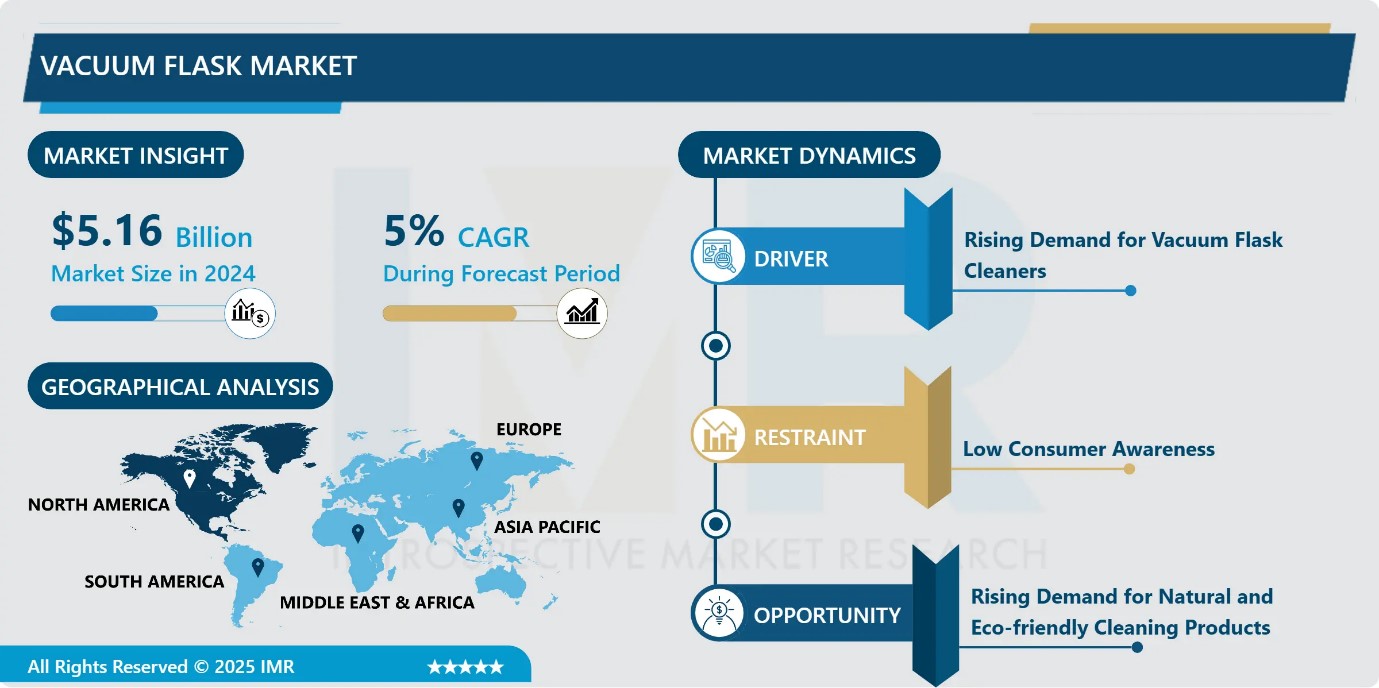
Vacuum Flask Market Size Was Valued at USD 5.16 Billion in 2024, and is Projected to Reach USD 8.83 Billion by 2035, Growing at a CAGR of Approximately 5% From 2025–2035.
The vacuum flask market focuses on the production and sale of insulated containers designed to keep drinks hot or cold for long periods. These flasks are popular for their convenience, especially among people with active lifestyles or those who commute regularly. In 2024, the market was valued at around USD 5.16 billion and is expected to grow to about USD 8.83 billion by 2035, with an annual growth rate of nearly 5%.
This growth is mainly due to rising health awareness, the popularity of reusable drinkware, and the increasing demand for eco-friendly alternatives to single-use plastic bottles. Many consumers now prefer vacuum flasks made from materials like stainless steel and glass, which are both durable and safe.
Market trends show a growing interest in stylish, portable designs and smart features like temperature indicators. The rise of e-commerce has also made it easier for consumers to find a wide range of options online. As sustainability and functionality continue to drive consumer choices, the vacuum flask market is expected to expand steadily in the coming years.
Vacuum Flask Cleaner Market Growth and Trend Analysis:
Vacuum Flask Market Growth Driver- Rising Demand for Vacuum Flask Cleaners
- A vacuum flask cleaner is a cleaning tool or solution designed specifically to clean the inside of vacuum flasks, bottles, or thermoses. These flasks are often difficult to clean with regular brushes or soap due to their narrow necks and insulated walls. Vacuum flask cleaners include specially shaped brushes, long-handled sponges, or bottle-cleaning tablets that remove stains, odours, and bacteria. They help maintain hygiene, preserve the taste of beverages, and extend the lifespan of flasks. As people use vacuum flasks for coffee, tea, or water regularly, having a dedicated cleaner has become both a practical and essential household item.
- The vacuum flask cleaner market is growing due to the rising use of reusable flasks and bottles. As more people shift to eco-friendly lifestyles and avoid disposable plastic bottles, the demand for flask maintenance products is increasing. The health-conscious population also prefers clean, germ-free bottles for daily use. E-commerce platforms have made it easier for consumers to find specialized cleaning tools and products. With more people working and studying from home, there's increased usage of thermoses and travel mugs further boosting the market. Innovations in design, material, and functionality are also contributing to the steady growth of the vacuum flask cleaner segment.
- The rising demand for natural and eco-friendly cleaning products. Many consumers prefer cleaners made from non-toxic, biodegradable ingredients that are safe for health and the environment. Brands can also offer smart, multi-use cleaning tools or electric-powered mini scrubbers that clean efficiently. Offering vacuum flask cleaners as part of a "hydration care kit" along with bottles and brushes could attract health-conscious customers. There’s also a growing opportunity in travel and outdoor segments, where people want easy-to-carry cleaning options for flasks and bottles during camping, trekking, or road trips.
Market Limiting Factor - Low Consumer Awareness
- One major restraint is low consumer awareness. Many users still try to clean their vacuum flasks using traditional tools or soap and water, unaware of better cleaning alternatives. As a result, they may not see the value of buying a separate flask cleaner. Additionally, in price-sensitive markets, consumers might hesitate to spend extra on specialized tools. Some also believe that regular cleaning methods are enough, leading to slower adoption of these products. This lack of awareness and perception of non-essential spending slows down market penetration, especially in rural areas and among older customer groups.
Market Expansion Opportunity - Rising Demand for Natural and Eco-friendly Cleaning Products
- A key opportunity in this market is the rising demand for natural and eco-friendly cleaning products. Many consumers prefer cleaners made from non-toxic, biodegradable ingredients that are safe for health and the environment. Brands can also offer smart, multi-use cleaning tools or electric-powered mini scrubbers that clean efficiently. Offering vacuum flask cleaners as part of a "hydration care kit" along with bottles and brushes could attract health-conscious customers. There’s also a growing opportunity in travel and outdoor segments, where people want easy-to-carry cleaning options for flasks and bottles during camping, trekking, or road trips
Market Challenge and Risk- Flask Sizes and Designs
- A big challenge is the variety in flask sizes and designs, which makes it hard to create one cleaning product that fits all. Some bottles are too narrow, too tall, or have complex lids, making them hard to clean without the right tool. Manufacturers must design flexible or adjustable products, which adds to production cost and complexity. Another challenge is ensuring durability some cheap cleaners break quickly or wear out, creating customer dissatisfaction. Maintaining product quality while keeping costs low is difficult. Competing with unbranded or low-cost alternatives in local markets also adds to the challenge for established brands
Vacuum Cleaner Market Segment Analysis:
Vacuum Cleaner Market is segmented based on Type, Application, End-Users, and Region
By Type, Vacuum Cleaner segment is expected to dominate the market during the forecast period
- The vacuum flask market is divided into different types, including bottles, food jars, travel mugs, and beverage containers. Among these, bottles made up the largest share of the market in 2023. This is mainly because more people are focusing on living healthier lives. They are paying more attention to staying hydrated and drinking beverages like water, tea, and coffee throughout the day. Vacuum insulated bottles are especially popular because they keep drinks hot or cold for a long time, making them very convenient. This useful feature is expected to increase the demand for bottles even more in the future.
- Another important segment in the vacuum flask market is travel mugs. This segment is expected to grow quickly over the next few years. The reason for this is the rising need for easy-to-carry drink containers among people with busy lives, especially those living in cities. Travel mugs are perfect for people who are always on the go, such as commuters, workers, or travellers. These mugs allow users to carry their favourite hot or cold drinks wherever they go. Whether it’s during a morning commute, a busy workday, or while traveling, travel mugs offer a reliable way to stay hydrated.
- In short, bottles are currently the most popular type of vacuum flask, mainly due to the growing trend of healthy living and the need to drink more fluids during the day. Their ability to keep beverages at the desired temperature for a long time makes them very useful. At the same time, travel mugs are also becoming more popular, especially among city dwellers with active lifestyles. Their portable design and temperature control features make them a great choice for people who want their drinks to stay hot or cold while they’re on the move.
- Both types are expected to continue growing in demand as people look for practical and efficient ways to stay hydrated.
By End User, Vacuum Cleaner Market segment held the largest share in 2024
- The vacuum flask market is expected to earn a lot of money from different types of users. This growth is mainly due to the rising need for products that keep drinks hot or cold and are easy to carry. In 2023, the market is valued at about $3.14 billion, showing steady demand across various uses.
- A large part of this demand comes from households, as more people want to keep their drinks at the right temperature for longer. The commercial sector, including cafes and restaurants, also relies on vacuum flasks to serve beverages more efficiently and keep them at the right temperature. The industrial sector is another important area. In industries, vacuum flasks help transport temperature-sensitive materials safely, keeping them hot or cold as needed.
- Looking ahead, the market is expected to grow to around $4.7 billion by 2035. This growth is driven by changing consumer habits, more interest in outdoor activities, and a rising awareness of environmentally friendly products. However, there are still some challenges. For example, changes in the cost of raw materials can affect how vacuum flasks are made and sold.
- Overall, the vacuum flask market has many different uses and plenty of room for new ideas and improvements. As more people focus on convenience, sustainability, and performance, this market is likely to keep growing.
Vacuum Cleaner Market Regional Insights:
- North America leads the market mainly because of its large customer base and strong demand for good-quality thermal products. North America reaching $1.45 billion and region is growing rapidly due to increasing urban development, higher incomes, and changing lifestyles. One of the key reasons the vacuum flask market is expanding is because more people are becoming aware of eco-friendly products. Vacuum flasks are reusable and reduce the need for single-use plastic bottles, making them more popular. Also, new technologies and designs are making flasks more effective and attractive to consumers.
- However, the market does face some challenges. These include competition from other types of containers and price-sensitive consumers, especially in developing regions. Despite these challenges, the overall outlook for the vacuum flask market is positive. With growing interest in sustainable living and innovation in product features, there are many opportunities for further growth, especially in emerging markets. The vacuum flask market is steadily growing around the world, driven by changing consumer habits, better product designs, and a push toward more eco-conscious choices.
Vacuum Flask Market Active Players:
- Alfi (Germany)
- Avanti (USA)
- Bodum (Switzerland)
- Borosil (India)
- CamelBak (USA)
- Cello (India)
- Contigo (USA)
- Corkcicle (USA)
- EMSA (Germany)
- Felsen (Germany)
- Finum (Germany)
- Golmate (China)
- Hydro Flask (USA)
- Kent (India)
- Klean Kanteen (USA)
- La Gourmet (Malaysia)
- Lock & Lock (South Korea)
- Milton (India)
- Nalgene (USA)
- Pinnacle (India)
- SIGG (Switzerland)
- Stanley (USA)
- S'well (USA)
- Tervis Tumbler (USA)
- Thermos (USA)
- Tiger Corporation (Japan)
- Tupperware (USA)
- Vaya (India)
- Wonderchef (India)
- Zojirushi (Japan)
- Other active players
|
Vacuum Cleaner Market |
|||
|
Base Year: |
2024 |
Forecast Period: |
2025-2035 |
|
Historical Data: |
2018 to 2023 |
Market Size in 2024: |
USD 5.16 Billion |
|
Forecast Period 2025-35 CAGR: |
5% |
Market Size in 2035: |
USD 8.83 Billion |
|
Segments Covered: |
By Type |
|
|
|
By End-User
|
|
||
|
By Material
|
|
||
|
By Insulation Type
|
|
||
|
By Distribution Channel
|
|
||
|
By Region |
|
||
|
Growth Driver: |
|
||
|
Limiting Factor |
|
||
|
Expansion Opportunity |
|
||
|
Challenge and Risk |
|
||
|
Companies Covered in the Report: |
Alfi (Germany), Avanti (USA), Bodum (Switzerland), Borosil (India), CamelBak (USA), Contigo (USA)and Other Active Players. |
||
Chapter 1: Introduction
1.1 Scope and Coverage
Chapter 2:Executive Summary
Chapter 3: Market Landscape
3.1 Market Dynamics and Opportunity Analysis
3.1.1 Growth Drivers
3.1.2 Limiting Factors
3.1.3 Growth Opportunities
3.1.4 Challenges and Risks
3.2 Market Trend Analysis
3.3 Industry Ecosystem
3.4 Industry Value Chain Mapping
3.5 Strategic PESTLE Overview
3.6 Porter's Five Forces Framework
3.7 Regulatory Framework
3.8 Pricing Trend Analysis
3.9 Intellectual Property Review
3.10 Technology Evolution
3.11 Import-Export Analysis
3.12 Consumer Behavior Analysis
3.13 Investment Pocket Analysis
3.14 Go-To Market Strategy
Chapter 4: Vaccum Flask Market by Type (2018-2035)
4.1 Vaccum Flask Market Snapshot and Growth Engine
4.2 Market Overview
4.3 Bottles
4.3.1 Introduction and Market Overview
4.3.2 Historic and Forecasted Market Size in Value USD and Volume Units
4.3.3 Key Market Trends, Growth Factors, and Opportunities
4.3.4 Geographic Segmentation Analysis
4.4 Food Jars
4.5 Travel Mugs
4.6 Beverage Containers
Chapter 5: Vaccum Flask Market by Material (2018-2035)
5.1 Vaccum Flask Market Snapshot and Growth Engine
5.2 Market Overview
5.3 Stainless Steel
5.3.1 Introduction and Market Overview
5.3.2 Historic and Forecasted Market Size in Value USD and Volume Units
5.3.3 Key Market Trends, Growth Factors, and Opportunities
5.3.4 Geographic Segmentation Analysis
5.4 Glass
5.5 Plastic
5.6 Others
Chapter 6: Vaccum Flask Market by Insulation Type (2018-2035)
6.1 Vaccum Flask Market Snapshot and Growth Engine
6.2 Market Overview
6.3 Single-wall
6.3.1 Introduction and Market Overview
6.3.2 Historic and Forecasted Market Size in Value USD and Volume Units
6.3.3 Key Market Trends, Growth Factors, and Opportunities
6.3.4 Geographic Segmentation Analysis
6.4 Double-wall
6.5 Triple-wall
Chapter 7: Vaccum Flask Market by Distribution Channel (2018-2035)
7.1 Vaccum Flask Market Snapshot and Growth Engine
7.2 Market Overview
7.3 Online Retail
7.3.1 Introduction and Market Overview
7.3.2 Historic and Forecasted Market Size in Value USD and Volume Units
7.3.3 Key Market Trends, Growth Factors, and Opportunities
7.3.4 Geographic Segmentation Analysis
7.4 Offline Retail
Chapter 8: Vaccum Flask Market by End User (2018-2035)
8.1 Vaccum Flask Market Snapshot and Growth Engine
8.2 Market Overview
8.3 Household
8.3.1 Introduction and Market Overview
8.3.2 Historic and Forecasted Market Size in Value USD and Volume Units
8.3.3 Key Market Trends, Growth Factors, and Opportunities
8.3.4 Geographic Segmentation Analysis
8.4 Commercial
8.5 Industrial
Chapter 9: Company Profiles and Competitive Analysis
9.1 Competitive Landscape
9.1.1 Competitive Benchmarking
9.1.2 Vaccum Flask Market Share by Manufacturer/Service Provider(2024)
9.1.3 Industry BCG Matrix
9.1.4 PArtnerships, Mergers & Acquisitions
9.2 ALFI (GERMANY)
9.2.1 Company Overview
9.2.2 Key Executives
9.2.3 Company Snapshot
9.2.4 Role of the Company in the Market
9.2.5 Sustainability and Social Responsibility
9.2.6 Operating Business Segments
9.2.7 Product Portfolio
9.2.8 Business Performance
9.2.9 Recent News & Developments
9.2.10 SWOT Analysis
9.3 AVANTI (USA)
9.4 BODUM (SWITZERLAND)
9.5 BOROSIL (INDIA)
9.6 CAMELBAK (USA)
9.7 CELLO (INDIA)
9.8 CONTIGO (USA)
9.9 CORKCICLE (USA)
9.10 EMSA (GERMANY)
9.11 FELSEN (GERMANY)
9.12 FINUM (GERMANY)
9.13 AND GOLMATE (CHINA). OTHER MAJOR PARTICIPANTS ARE HYDRO FLASK (USA)
9.14 KENT (INDIA)
9.15 KLEAN KANTEEN (USA)
9.16 LA GOURMET (MALAYSIA)
9.17 LOCK & LOCK (SOUTH KOREA)
9.18 MILTON (INDIA)
9.19 NALGENE (USA)
9.20 PINNACLE (INDIA)
9.21 AND SIGG (SWITZERLAND)
9.22 STANLEY (USA)
9.23 S'WELL (USA)
9.24 TERVIS TUMBLER (USA)
9.25 THERMOS (USA)
9.26 TIGER CORPORATION (JAPAN)
9.27 TUPPERWARE (USA)
9.28 VAYA (INDIA)
9.29 WONDERCHEF (INDIA)
9.30 ZOJIRUSHI (JAPAN)
9.31 OTHER ACTIVE PLAYERS
Chapter 10: Global Vaccum Flask Market By Region
10.1 Overview
10.2. North America Vaccum Flask Market
10.2.1 Key Market Trends, Growth Factors and Opportunities
10.2.2 Top Key Companies
10.2.3 Historic and Forecasted Market Size by Segments
10.2.4 Historic and Forecast Market Size by Country
10.2.4.1 US
10.2.4.2 Canada
10.2.4.3 Mexico
10.3. Eastern Europe Vaccum Flask Market
10.3.1 Key Market Trends, Growth Factors and Opportunities
10.3.2 Top Key Companies
10.3.3 Historic and Forecasted Market Size by Segments
10.3.4 Historic and Forecast Market Size by Country
10.3.4.1 Russia
10.3.4.2 Bulgaria
10.3.4.3 The Czech Republic
10.3.4.4 Hungary
10.3.4.5 Poland
10.3.4.6 Romania
10.3.4.7 Rest of Eastern Europe
10.4. Western Europe Vaccum Flask Market
10.4.1 Key Market Trends, Growth Factors and Opportunities
10.4.2 Top Key Companies
10.4.3 Historic and Forecasted Market Size by Segments
10.4.4 Historic and Forecast Market Size by Country
10.4.4.1 Germany
10.4.4.2 UK
10.4.4.3 France
10.4.4.4 The Netherlands
10.4.4.5 Italy
10.4.4.6 Spain
10.4.4.7 Rest of Western Europe
10.5. Asia Pacific Vaccum Flask Market
10.5.1 Key Market Trends, Growth Factors and Opportunities
10.5.2 Top Key Companies
10.5.3 Historic and Forecasted Market Size by Segments
10.5.4 Historic and Forecast Market Size by Country
10.5.4.1 China
10.5.4.2 India
10.5.4.3 Japan
10.5.4.4 South Korea
10.5.4.5 Malaysia
10.5.4.6 Thailand
10.5.4.7 Vietnam
10.5.4.8 The Philippines
10.5.4.9 Australia
10.5.4.10 New Zealand
10.5.4.11 Rest of APAC
10.6. Middle East & Africa Vaccum Flask Market
10.6.1 Key Market Trends, Growth Factors and Opportunities
10.6.2 Top Key Companies
10.6.3 Historic and Forecasted Market Size by Segments
10.6.4 Historic and Forecast Market Size by Country
10.6.4.1 Turkiye
10.6.4.2 Bahrain
10.6.4.3 Kuwait
10.6.4.4 Saudi Arabia
10.6.4.5 Qatar
10.6.4.6 UAE
10.6.4.7 Israel
10.6.4.8 South Africa
10.7. South America Vaccum Flask Market
10.7.1 Key Market Trends, Growth Factors and Opportunities
10.7.2 Top Key Companies
10.7.3 Historic and Forecasted Market Size by Segments
10.7.4 Historic and Forecast Market Size by Country
10.7.4.1 Brazil
10.7.4.2 Argentina
10.7.4.3 Rest of SA
Chapter 11 Analyst Viewpoint and Conclusion
Chapter 12 Our Thematic Research Methodology
12.1 Research Process
12.2 Primary Research
12.3 Secondary Research
Chapter 13 Case Study
Chapter 14 Appendix
14.1 Sources
14.2 List of Tables and figures
14.3 Short Forms and Citations
14.4 Assumption and Conversion
14.5 Disclaimer
|
Vacuum Cleaner Market |
|||
|
Base Year: |
2024 |
Forecast Period: |
2025-2035 |
|
Historical Data: |
2018 to 2023 |
Market Size in 2024: |
USD 5.16 Billion |
|
Forecast Period 2025-35 CAGR: |
5% |
Market Size in 2035: |
USD 8.83 Billion |
|
Segments Covered: |
By Type |
|
|
|
By End-User
|
|
||
|
By Material
|
|
||
|
By Insulation Type
|
|
||
|
By Distribution Channel
|
|
||
|
By Region |
|
||
|
Growth Driver: |
|
||
|
Limiting Factor |
|
||
|
Expansion Opportunity |
|
||
|
Challenge and Risk |
|
||
|
Companies Covered in the Report: |
Alfi (Germany), Avanti (USA), Bodum (Switzerland), Borosil (India), CamelBak (USA), Contigo (USA)and Other Active Players. |
||


