




Retail Touch Screen Display Market Synopsis:
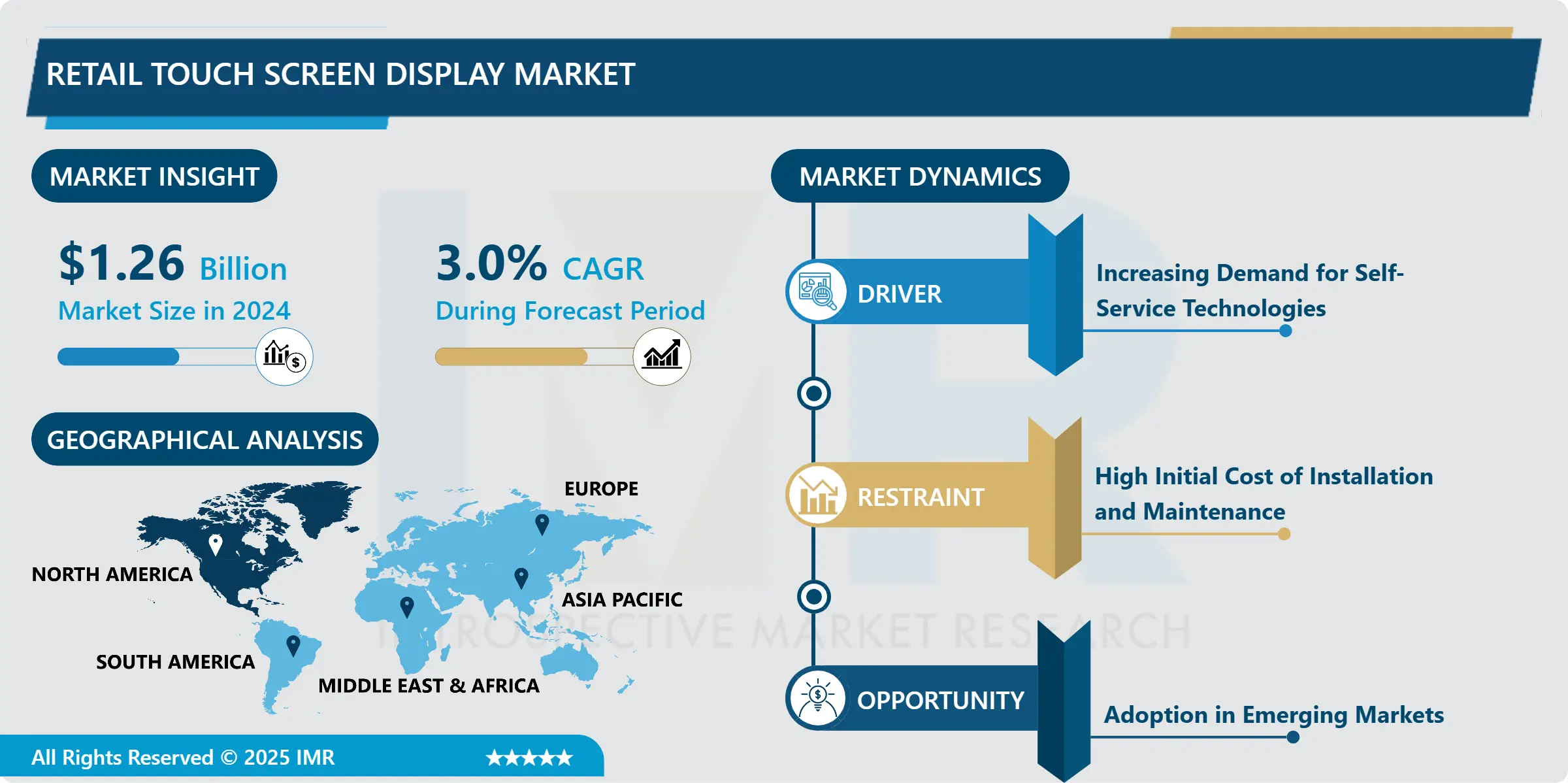
Retail Touch Screen Display Market Size Was Valued at USD 1.26 Billion in 2024, and is Projected to Reach USD 1.74 Billion by 2035, Growing at a CAGR of 3.0% from 2025-2035.
The retail touch screen display market is growing steadily as more stores adopt digital technologies to improve customer experiences and streamline operations. Touch screen displays are used in various retail applications such as self-checkout kiosks, digital signage, interactive product displays, and point-of-sale (POS) systems. These tools help retailers reduce wait times, offer better product information, and create more engaging shopping environments.
One of the key drivers of this market is the increasing demand for self-service options. Customers today prefer quick and convenient shopping experiences, and touch screens enable them to browse, select, and pay without assistance. At the same time, retailers benefit by reducing labour costs and boosting efficiency.
Advances in touch screen technology such as multi-touch capabilities, higher resolution, and more durable materials are also encouraging retailers to upgrade their systems. As e-commerce continues to influence in-store expectations, retailers are using interactive displays to create experiences that combine the best of both online and offline shopping.
Although the market shows promise, there are challenges. High installation costs and maintenance issues can slow adoption, especially for small businesses. Additionally, touch screens need to be reliable and durable to handle constant use. Overall, the retail touch screen display market is set to grow as digital transformation continues in the retail sector and customer expectations evolve.
Retail Touch Screen Display Market Growth and Trend Analysis:
Retail Touch Screen Display Market Growth Driver - Increasing Demand for Self-Service Technologies
-
One of the biggest reasons retail stores are using more touch screen displays is because customers now expect faster and more convenient shopping experiences. People don’t like waiting in long lines or asking for help for every small task. That’s where self-service technologies come in. Self-service options, like self-checkout kiosks, allow shoppers to scan and pay for their items on their own. This not only saves time for the customer but also helps the store run more smoothly, especially during busy hours. Touch screen displays make this process simple and user-friendly, even for people who are not very tech-savvy.
- Besides checkout, many stores now use interactive displays to help customers find products, check prices, learn about promotions, or place orders for items not available in-store. This gives shoppers more control and improves their overall experience. For retailers, self-service tools also reduce the need for extra staff, which lowers costs. Instead of having employees do repetitive tasks, they can focus on helping customers with more complex needs.
- As more people get used to using technology in their daily lives from smartphones to tablets, they are also more comfortable using touch screens in stores. This comfort and convenience are leading more retailers to invest in self-service solutions powered by touch screen displays. Overall, the demand for self-service technologies is a major force behind the growth of the retail touch screen display market.
Retail Touch Screen Display Market Limiting Factor - High Initial Cost of Installation and Maintenance
-
One of the main challenges limiting the growth of the retail touch screen display market is the high cost of setting up these systems. For many small and medium-sized retailers, purchasing and installing touch screen displays especially in multiple locations can be expensive. The cost includes not only the hardware itself but also software integration, employee training, and potential changes to store layout.
- In addition to setup costs, ongoing maintenance can also be a concern. Touch screens installed in high-traffic retail environments are used constantly and can wear out or get damaged. Regular maintenance or repairs may be needed, which adds to the long-term expenses. For large retail chains, these costs might be manageable, but for smaller businesses with limited budgets, they can be a major barrier. This slows down adoption, especially in regions or markets where profit margins are already tight.
- Furthermore, technology evolves quickly. Retailers may hesitate to invest in expensive systems that could become outdated in a few years. This concern about long-term value and return on investment also holds back some businesses from adopting touch screen solutions. Overall, while touch screen displays offer many benefits, the high upfront and ongoing costs remain a key factor limiting their widespread use in the retail sector.
Retail Touch Screen Display Market Expansion Opportunity - Adoption in Emerging Markets
-
A major opportunity for the retail touch screen display market lies in the growing adoption of digital technologies in emerging markets, such as countries in Asia-Pacific
- Latin America, and Africa. As retail infrastructure improves and consumer spending increases in these regions, more retailers are modernizing their stores with digital tools including touch screen displays. Government initiatives supporting digital transformation and smart city development are also encouraging businesses to invest in self-service technologies. Additionally, as smartphones and digital payment systems become more common in these regions, customers are more open to using interactive displays in stores. This creates a strong opportunity for market expansion beyond mature economies.
Retail Touch Screen Display Market Challenge and Risk - Cybersecurity and Data Privacy
-
One significant challenge and risk in this market is the growing concern over cybersecurity and data privacy. Many touch screen systems are connected to networks and collect customer information during transactions, loyalty program sign-ups, or feedback surveys. If these systems are not properly secured, they can become targets for hackers, leading to data breaches and loss of customer trust. As more retailers adopt internet-connected displays and integrate them with their broader IT systems, the risk of cyberattacks increases. Ensuring strong security, regular software updates, and compliance with data protection laws is critical but not all retailers have the resources or knowledge to manage these risks effectively.
Retail Touch Screen Display Market Segment Analysis:
Retail Touch Screen Display Market is segmented based on Type, Application, End-Users, and Region
By Type, Retail Touch Screen Display Segment is Expected to Dominate the Market During the Forecast Period
-
Capacitive touch screens are one of the most popular types of touch screens used today. You’ll find them in smartphones, tablets, and many retail devices. These screens work by detecting the electrical signals from your finger when you touch them. They don’t need pressure to respond, so using them feels fast and smooth.
- In the retail world, capacitive touch screens are used in self-checkout machines, point-of-sale (POS) systems, and interactive kiosks. Because they respond quickly and accurately to touch, customers can use them easily without any confusion. They also support multi-touch, meaning the screen can detect more than one finger at a time just like when you pinch to zoom on your phone.
- These screens also show bright and clear images, which makes them perfect for displaying product details, promotions, and menus. As a result, capacitive touch screens have become the most commonly used type in retail settings
By Application, Retail Touch Screen Display Segment Held the Largest Share in 2024
-
Touch screen displays have become a standard feature in modern consumer electronics. Devices like laptops and tablets now commonly include touch functionality, allowing users to tap, swipe, scroll, and zoom directly on the screen. This has made using technology more intuitive and engaging, especially for younger and tech-savvy consumers. Smart televisions are also adopting touch capabilities, particularly in commercial environments such as showrooms, shopping malls, and interactive retail displays. These displays allow customers to browse products, view demos, or explore content in a more interactive way.
- Although smartphones and smart wearables like smartwatches aren’t used directly as part of retail display systems, they have had a huge influence on user behaviour. Because people use touch screens every day on their personal devices, they now expect a similar level of interactivity when they shop in stores. This shift in consumer expectations is pushing retailers to adopt touch screen technologies such as self-service kiosks, interactive product finders, and digital signage to match the ease and familiarity of personal gadgets.
- As a result, the widespread use of touch screens in consumer electronics is not only shaping customer habits but also driving the growth and innovation of touch screen display solutions in the retail market. Retailers who adapt to these expectations can create more engaging, efficient, and modern shopping experiences.
Retail Touch Screen Display Market Regional Insights:
North America is Expected to Dominate the Market Over the Forecast Period
-
North America is one of the leading regions in the global retail touch screen display market. Its dominance is largely driven by the early and widespread adoption of advanced digital technologies across the retail sector. Retailers in the region have been quick to integrate touch screen displays into their operations, especially for improving customer service and streamlining sales processes.
- The United States, in particular, is at the forefront. Major retail chains and supermarkets across the country have heavily invested in self-checkout kiosks, point-of-sale (POS) terminals, interactive product finders, and digital signage to enhance in-store efficiency and customer engagement. Consumers in the U.S. are also very familiar with using technology in their daily lives, which makes them more receptive to touch-based systems in stores.
- Additionally, the region benefits from strong infrastructure, high internet penetration, and access to leading technology providers. Retailers are also investing in omni-channel strategies, blending in-store and online shopping experiences, with touch screen displays playing a central role. Overall, North America's strong digital foundation, high consumer expectations, and proactive retail modernization continue to drive its leading position in the retail touch screen display market.
Retail Touch Screen Display Market Active Players:
- 3M Company) (United States)
- Advantech Co., Ltd. (Taiwan)
- AU Optronics Corp. (Taiwan)
- Baanto International Ltd. (Canada)
- BOE Technology Group Co., Ltd. (China)
- Crystal Display Systems Ltd. (United Kingdom)
- Displax Interactive Systems (Portugal)
- Elo Touch Solutions (United States)
- Faytech AG (Germany)
- GVision USA, Inc. (United States)
- Hanns-G (part of HannStar Display Corp.) (Taiwan)
- HannsTouch Solution Inc. (Taiwan)
- HIMax Technologies, Inc. (Taiwan)
- Innolux Corporation (Taiwan)
- IntelliTouch (Elo Subsidiary) (United States)
- LG Display Co., Ltd. (South Korea)
- Mimo Monitors (United States)
- NEC Display Solutions, Ltd. (Japan)
- Newhaven Display International, Inc. (United States)
- Panasonic Corporation (Japan)
- Philips (TPV Technology) (Netherlands / China)
- Planar Systems, Inc. (Leyard Group) (United States / China)
- Qisda Corporation (Taiwan)
- Samsung Electronics Co., Ltd. (South Korea)
- Sharp Corporation (Japan)
- Sony Corporation (Japan)
- Touch International, Inc. (United States)
- TPK Holding Co., Ltd. (Taiwan)
- ViewSonic Corporation (United States)
- Zytronic PLC (United Kingdom)
- Other Active Players
Key Industry Developments in the Retail Touch Screen Display Market:
- In January 2025 the Elo Touch Solutions launched a new range of Android-based POS systems, 65″ 4K signage displays, and assistive navigation tools at NRF 2025.
- In June 2024 Bunnings Australia expanded its in-store digital signage network by installing over 300 large-format LED touch screens as part of its “Bunnings Retail Media” initiative.
|
Retail Touch Screen Display Market |
|||
|
Base Year: |
2024 |
Forecast Period: |
2025-2035 |
|
Historical Data: |
2018 to 2024 |
Market Size in 2024: |
USD 1.26 Billion |
|
Forecast Period 2025-35 CAGR: |
3.0 % |
Market Size in 2035: |
USD 1.74 Billion |
|
Segments Covered: |
By Type |
|
|
|
By Application
|
|
||
|
By End-user |
|
||
|
By Region |
|
||
|
Growth Driver: |
|
||
|
Limiting Factor |
|
||
|
Expansion Opportunity |
|
||
|
Challenge and Risk |
|
||
|
Companies Covered in the Report: |
|
||
Chapter 1: Introduction
1.1 Scope and Coverage
Chapter 2:Executive Summary
Chapter 3: Market Landscape
3.1 Market Dynamics and Opportunity Analysis
3.1.1 Growth Drivers
3.1.2 Limiting Factors
3.1.3 Growth Opportunities
3.1.4 Challenges and Risks
3.2 Market Trend Analysis
3.3 Industry Ecosystem
3.4 Industry Value Chain Mapping
3.5 Strategic PESTLE Overview
3.6 Porter's Five Forces Framework
3.7 Regulatory Framework
3.8 Pricing Trend Analysis
3.9 Intellectual Property Review
3.10 Technology Evolution
3.11 Import-Export Analysis
3.12 Consumer Behavior Analysis
3.13 Investment Pocket Analysis
3.14 Go-To Market Strategy
Chapter 4: Retail Touch Screen Display Market by Screen Type (2018-2035)
4.1 Retail Touch Screen Display Market Snapshot and Growth Engine
4.2 Market Overview
4.3 Resistive Touch Screens
4.3.1 Introduction and Market Overview
4.3.2 Historic and Forecasted Market Size in Value USD and Volume Units
4.3.3 Key Market Trends, Growth Factors, and Opportunities
4.3.4 Geographic Segmentation Analysis
4.4 Capacitive Touch Screens
4.5 Infrared Touch Screens
4.6 Optical
4.7 Others (Surface Acoustic Wave Type Displays)
Chapter 5: Retail Touch Screen Display Market by Application (2018-2035)
5.1 Retail Touch Screen Display Market Snapshot and Growth Engine
5.2 Market Overview
5.3 Display/Digital Signage
5.3.1 Introduction and Market Overview
5.3.2 Historic and Forecasted Market Size in Value USD and Volume Units
5.3.3 Key Market Trends, Growth Factors, and Opportunities
5.3.4 Geographic Segmentation Analysis
5.4 Kiosks
5.5 Consumer Electronics (Laptops & Tablets
5.6 Smart Television
5.7 Smartphones & Smart Wearables)
Chapter 6: Retail Touch Screen Display Market by End-user (2018-2035)
6.1 Retail Touch Screen Display Market Snapshot and Growth Engine
6.2 Market Overview
6.3 Residential
6.3.1 Introduction and Market Overview
6.3.2 Historic and Forecasted Market Size in Value USD and Volume Units
6.3.3 Key Market Trends, Growth Factors, and Opportunities
6.3.4 Geographic Segmentation Analysis
6.4 Commercial
6.5 Industrial
Chapter 7: Company Profiles and Competitive Analysis
7.1 Competitive Landscape
7.1.1 Competitive Benchmarking
7.1.2 Retail Touch Screen Display Market Share by Manufacturer/Service Provider(2024)
7.1.3 Industry BCG Matrix
7.1.4 PArtnerships, Mergers & Acquisitions
7.2 3M COMPANY (UNITED STATES)
7.2.1 Company Overview
7.2.2 Key Executives
7.2.3 Company Snapshot
7.2.4 Role of the Company in the Market
7.2.5 Sustainability and Social Responsibility
7.2.6 Operating Business Segments
7.2.7 Product Portfolio
7.2.8 Business Performance
7.2.9 Recent News & Developments
7.2.10 SWOT Analysis
7.3 ADVANTECH CO.
7.4 LTD. (TAIWAN)
7.5 AU OPTRONICS CORP. (TAIWAN)
7.6 BAANTO INTERNATIONAL LTD. (CANADA)
7.7 BOE TECHNOLOGY GROUP CO.
7.8 LTD. (CHINA)
7.9 CRYSTAL DISPLAY SYSTEMS LTD. (UNITED KINGDOM)
7.10 DISPLAX INTERACTIVE SYSTEMS (PORTUGAL)
7.11 ELO TOUCH SOLUTIONS (UNITED STATES)
7.12 FAYTECH AG (GERMANY)
7.13 GVISION USA
7.14 INC. (UNITED STATES)
7.15 HANNS-G (PART OF HANNSTAR DISPLAY CORP.) (TAIWAN)
7.16 HANNSTOUCH SOLUTION INC. (TAIWAN)
7.17 HIMAX TECHNOLOGIES
7.18 INC. (TAIWAN)
7.19 INNOLUX CORPORATION (TAIWAN)
7.20 INTELLITOUCH (ELO SUBSIDIARY) (UNITED STATES)
7.21 LG DISPLAY CO.
7.22 LTD. (SOUTH KOREA)
7.23 MIMO MONITORS (UNITED STATES)
7.24 NEC DISPLAY SOLUTIONS
7.25 LTD. (JAPAN)
7.26 NEWHAVEN DISPLAY INTERNATIONAL
7.27 INC. (UNITED STATES)
7.28 PANASONIC CORPORATION (JAPAN)
7.29 PHILIPS (TPV TECHNOLOGY) (NETHERLANDS/CHINA)
7.30 PLANAR SYSTEMS
7.31 INC. (LEYARD GROUP) (UNITED STATES/CHINA)
7.32 QISDA CORPORATION (TAIWAN)
7.33 SAMSUNG ELECTRONICS CO.
7.34 LTD. (SOUTH KOREA)
7.35 SHARP CORPORATION (JAPAN)
7.36 SONY CORPORATION (JAPAN)
7.37 TOUCH INTERNATIONAL
7.38 INC. (UNITED STATES)
7.39 TPK HOLDING CO.
7.40 LTD. (TAIWAN)
7.41 VIEWSONIC CORPORATION (UNITED STATES)
7.42 ZYTRONIC PLC (UNITED KINGDOM)
7.43 AND OTHER ACTIVE PLAYERS.
Chapter 8: Global Retail Touch Screen Display Market By Region
8.1 Overview
8.2. North America Retail Touch Screen Display Market
8.2.1 Key Market Trends, Growth Factors and Opportunities
8.2.2 Top Key Companies
8.2.3 Historic and Forecasted Market Size by Segments
8.2.4 Historic and Forecast Market Size by Country
8.2.4.1 US
8.2.4.2 Canada
8.2.4.3 Mexico
8.3. Eastern Europe Retail Touch Screen Display Market
8.3.1 Key Market Trends, Growth Factors and Opportunities
8.3.2 Top Key Companies
8.3.3 Historic and Forecasted Market Size by Segments
8.3.4 Historic and Forecast Market Size by Country
8.3.4.1 Russia
8.3.4.2 Bulgaria
8.3.4.3 The Czech Republic
8.3.4.4 Hungary
8.3.4.5 Poland
8.3.4.6 Romania
8.3.4.7 Rest of Eastern Europe
8.4. Western Europe Retail Touch Screen Display Market
8.4.1 Key Market Trends, Growth Factors and Opportunities
8.4.2 Top Key Companies
8.4.3 Historic and Forecasted Market Size by Segments
8.4.4 Historic and Forecast Market Size by Country
8.4.4.1 Germany
8.4.4.2 UK
8.4.4.3 France
8.4.4.4 The Netherlands
8.4.4.5 Italy
8.4.4.6 Spain
8.4.4.7 Rest of Western Europe
8.5. Asia Pacific Retail Touch Screen Display Market
8.5.1 Key Market Trends, Growth Factors and Opportunities
8.5.2 Top Key Companies
8.5.3 Historic and Forecasted Market Size by Segments
8.5.4 Historic and Forecast Market Size by Country
8.5.4.1 China
8.5.4.2 India
8.5.4.3 Japan
8.5.4.4 South Korea
8.5.4.5 Malaysia
8.5.4.6 Thailand
8.5.4.7 Vietnam
8.5.4.8 The Philippines
8.5.4.9 Australia
8.5.4.10 New Zealand
8.5.4.11 Rest of APAC
8.6. Middle East & Africa Retail Touch Screen Display Market
8.6.1 Key Market Trends, Growth Factors and Opportunities
8.6.2 Top Key Companies
8.6.3 Historic and Forecasted Market Size by Segments
8.6.4 Historic and Forecast Market Size by Country
8.6.4.1 Turkiye
8.6.4.2 Bahrain
8.6.4.3 Kuwait
8.6.4.4 Saudi Arabia
8.6.4.5 Qatar
8.6.4.6 UAE
8.6.4.7 Israel
8.6.4.8 South Africa
8.7. South America Retail Touch Screen Display Market
8.7.1 Key Market Trends, Growth Factors and Opportunities
8.7.2 Top Key Companies
8.7.3 Historic and Forecasted Market Size by Segments
8.7.4 Historic and Forecast Market Size by Country
8.7.4.1 Brazil
8.7.4.2 Argentina
8.7.4.3 Rest of SA
Chapter 9 Analyst Viewpoint and Conclusion
Chapter 10 Our Thematic Research Methodology
10.1 Research Process
10.2 Primary Research
10.3 Secondary Research
Chapter 11 Case Study
Chapter 12 Appendix
12.1 Sources
12.2 List of Tables and figures
12.3 Short Forms and Citations
12.4 Assumption and Conversion
12.5 Disclaimer
|
Retail Touch Screen Display Market |
|||
|
Base Year: |
2024 |
Forecast Period: |
2025-2035 |
|
Historical Data: |
2018 to 2024 |
Market Size in 2024: |
USD 1.26 Billion |
|
Forecast Period 2025-35 CAGR: |
3.0 % |
Market Size in 2035: |
USD 1.74 Billion |
|
Segments Covered: |
By Type |
|
|
|
By Application
|
|
||
|
By End-user |
|
||
|
By Region |
|
||
|
Growth Driver: |
|
||
|
Limiting Factor |
|
||
|
Expansion Opportunity |
|
||
|
Challenge and Risk |
|
||
|
Companies Covered in the Report: |
|
||


