




Home Robot Market Synopsis:
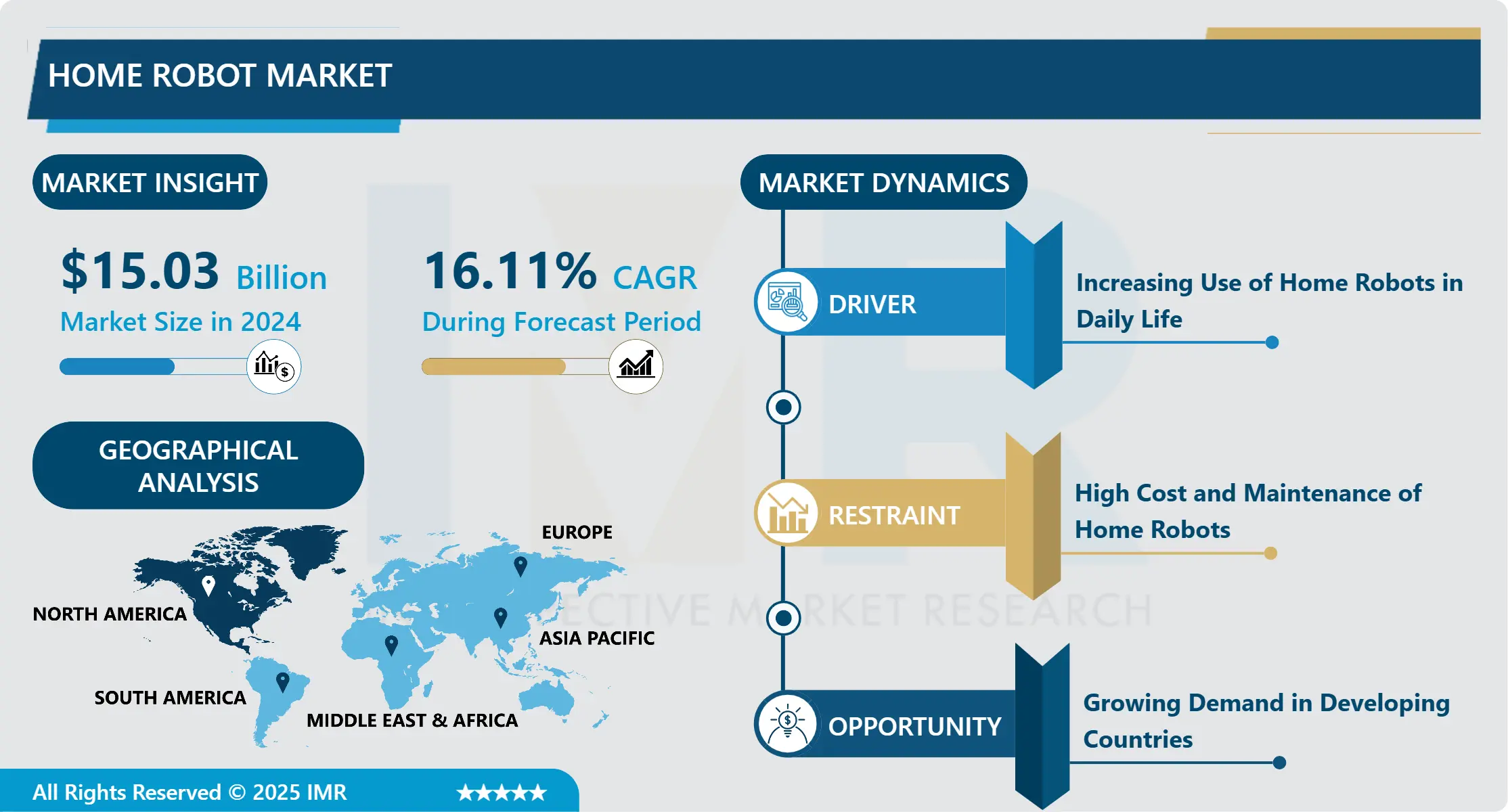
Home Robot Market Size Was Valued at USD 15.03 Billion in 2024 and is Projected to Reach USD 49.65 Billion by 2032, Growing at a CAGR of 16.11% from 2025-2032.
Home robots, also known as domestic robots, are devices designed to automate household tasks and simplify life for their users. These robots can perform a variety of chores, including cleaning, lawn care, and security monitoring, often utilizing advanced technology like artificial intelligence (AI) and high-tech sensors. They are typically connected to Wi-Fi or Bluetooth networks and can be controlled remotely, making them a convenient and efficient addition to the modern home.
Home robot applications refer to the use of robotic devices and systems to perform tasks within a household or domestic environment, aiming to automate chores, provide assistance, and enhance overall living comfort. These applications encompass a wide range of tasks, including cleaning, security, companionship, and even cooking.
The ongoing AI advancement has highly influenced the development of home robots. These advanced machines will perform home tasks by self-learning and interacting with human users. The progress of autonomous robots will create intelligent home assistants that will understand the individual needs of their users.
Home Robot Market Growth and Trend Analysis:
Home Robot Market Growth Driver- Increasing Use of Home Robots in Daily Life
- A big reason the home robot market is growing is that more people want help with daily household tasks. Home robots can vacuum floors, clean windows, cut grass, or even assist elderly people. These robots save time and make life easier. As technology improves, robots are becoming smarter and more affordable. For example, cleaning robots can now map rooms, avoid obstacles, and return to their charging stations.
- Some advanced robots can even understand voice commands and work with smart home systems like Alexa or Google Home. The demand for comfort, time-saving solutions, and smart living is rising, especially in busy households. Families with children or elderly members are also looking for helper robots to improve home care. As a result, more companies are making different types of home robots, which is driving the market forward. So, the need for convenience and better living standards is a key factor pushing the growth of the home robot market.
Home Robot Market Limiting Factor- High Cost and Maintenance of Home Robots
- One thing slowing down the growth of the home robot market is the high cost of buying and maintaining these devices. Many home robots, especially the advanced ones, are still expensive for regular households. For example, robots that offer security, elder care, or smart home integration can cost several hundred to even thousands of dollars.
- Besides the price, some robots need regular updates, repairs, or new parts, which can be costly and time-consuming. If a robot breaks or doesn’t work properly, users may get frustrated and stop using it. Also, in some areas, there are fewer service centres or technicians who can fix home robots. This makes people hesitate to invest in them. So, while home robots are helpful, their price and ongoing maintenance can stop many families from buying them. Until these costs come down, this factor will continue to limit how fast the home robot market can grow.
Home Robot Market Expansion Opportunity- Growing Demand in Developing Countries
- There is a big chance for home robots to grow in developing countries where middle-class families are increasing and more people are using smart home devices. More people are moving into cities, getting better jobs, and looking for ways to improve their lifestyle. As their incomes rise, these families want to buy smart tools that save time like cleaning robots, robotic lawnmowers, or home assistants.
- Also, with internet and smartphone use growing fast, people are learning more about these robots and how useful they can be. Technology is also getting cheaper, which helps companies sell home robots at lower prices in these new markets. This makes home robots more affordable for a larger group of people. So, as more families in developing countries look for smart solutions to help with household work, it creates a strong opportunity for the home robot market to expand.
Home Robot Market Challenge Barrier - Technical Problems and Limited Awareness
- A big challenge in the home robot market is that many people still don’t fully trust or understand how these robots work. Some users worry that robots may not be safe or could break easily. Others are unsure how to set them up or connect them with other devices.
- If the robot is too difficult to use or doesn’t work well, people may stop using it. Also, in many areas, people still don’t know much about the benefits of home robots. They may think robots are only for rich people or just for fun. This lack of awareness and trust can stop people from buying home robots. Another issue is that some robots need strong internet connections or smart home systems to work properly, which not every household has. So, technical issues, fear of failure, and limited knowledge about the advantages of home robots remain big barriers to market growth.
Home Robot Market Segment Analysis:
Home Robot Market is segmented based on Type, Application End-Users, and Region
By Type, Cleaning Robot Segment is Expected to Dominate the Market During the Forecast Period
- Cleaning robots are projected to dominate the home robot market throughout the forecast period due to their practicality and widespread consumer acceptance. These robots, primarily vacuum and mopping models, are increasingly seen as essential appliances in modern households. As urbanization rises and more households have dual-income earners, the need for automated cleaning solutions grows. Consumers are drawn to cleaning robots because they save time and effort while maintaining cleanliness.
- Technological advancements such as AI-powered navigation, laser mapping, and obstacle detection have enhanced the efficiency and user experience of these devices. Integrating cleaning robots with voice assistants like Amazon Alexa and Google Assistant has further increased their appeal. Leading brands including iRobot, Roborock, and Ecovacs continue to invest in innovation, expanding functionality and improving performance. The trend toward smart homes also supports the growth of this segment, as these robots easily integrate with existing home automation systems. With decreasing prices and improved accessibility through e-commerce platforms, cleaning robots are expected to maintain their lead. Overall, the cleaning robot segment addresses a clear consumer need, and its combination of convenience, technology, and affordability positions it to remain the dominant category in the home robot market over the coming years.
By Application, Domestic Segment Held the Largest Share
- The domestic segment held the largest share of the home robot market in 2024, driven by increasing consumer preference for automation in everyday household tasks. Home robots are primarily used for domestic purposes, including cleaning, pet care, child monitoring, entertainment, and security. As people’s lives become busier, the demand for home robots that can perform routine chores has surged. The convenience of having autonomous devices manage tasks like vacuuming, mopping, and even monitoring the home remotely is a significant factor behind this growth.
- Consumers are also increasingly integrating robots with smart home systems, making their homes more connected and intelligent. Moreover, the COVID-19 pandemic heightened awareness of hygiene and cleanliness, which led to a spike in demand for cleaning and sanitizing robots in domestic settings. The domestic application segment continues to benefit from advancements in AI, which allow robots to learn user preferences and navigate spaces more efficiently. With affordability improving and product variety expanding, home robots are no longer seen as luxury items but as practical tools. As technology evolves and user comfort with automation grows, the domestic segment will remain the core application area for home robots, commanding the largest market share in the future.
Home Robot Market Regional Insights:
North America is Expected to Dominate the Market Over the Forecast Period
- North America is poised to dominate the home robot market throughout the forecast period due to several key factors. The region benefits from a high level of technological adoption and a strong culture of innovation, with consumers eager to incorporate smart devices and automation into their daily lives.
- The United States and Canada have well-established smart home ecosystems, which facilitate seamless integration of home robots with other connected devices such as voice assistants, security systems, and IoT platforms. Additionally, North American consumers tend to have high disposable incomes, making them more willing to invest in premium and advanced home robotic solutions. The presence of major home robot manufacturers like iRobot, Amazon, and Google in the region further drives innovation and availability, ensuring continuous product development and market penetration.
- Moreover, busy lifestyles, especially in dual-income households, increase demand for convenience-enhancing devices like cleaning robots and home security bots. The region’s advanced retail infrastructure, including strong e-commerce penetration, provides easy access to the latest robotic technologies. Furthermore, government support for research and development in robotics and artificial intelligence bolsters market growth. Lastly, growing awareness of elder care needs fuels the demand for companion and assistive robots. Together, these factors position North America as the leading home robot market globally over the coming years.
Home Robot Market Active Players:
- ABB Robotics (Switzerland)
- Boston Dynamics (US)
- Ecovacs Robotics (China)
- FANUC (Japan)
- iRobot (US)
- Kawasaki (Japan)
- KUKA Robotics (Germany)
- Maytronics (Israel)
- Neato Robotics (US)
- Robotics (India)
- Samsung Electronics (South Korea)
- Standard Bots (US)
- Symbotic (US)
- Tech Mahindra (India)
- Xiaomi (China)
- Yaskawa (Japan)
- Other Active Players
Key Industry Developments in the Home Robot Market:
- In 2025, Amazon Expands Home Robot Lineup with Astro Companion Robot
Amazon officially launched Astro, a home companion robot designed for security, communication, and assistance. The robot integrates Alexa voice capabilities with advanced sensors to provide home monitoring and interactive functions, marking Amazon’s deeper entry into the home robotics market. - In 2024, iRobot Launches Next-Gen Roomba with Advanced AI Navigation
iRobot introduced its latest Roomba model featuring enhanced AI-powered mapping and obstacle avoidance, improving cleaning efficiency and user experience. This launch underscores the company’s commitment to innovation and maintaining leadership in the cleaning robot segment.
|
Home Robot Market |
|||
|
Base Year: |
2024 |
Forecast Period: |
2025-2032 |
|
Historical Data: |
2018 to 2023 |
Market Size in 2024: |
USD 15.03 Bn. |
|
Forecast Period 2025-32 CAGR: |
16.11% |
Market Size in 2032: |
USD 49.65 Bn. |
|
Segments Covered: |
By Type |
|
|
|
By Application |
|
||
|
By End-User |
|
||
|
By Region |
|
||
|
Growth Driver: |
|
||
|
Limiting Factor |
|
||
|
Expansion Opportunity |
|
||
|
Challenge Barrier |
|
||
|
Companies Covered in the Report: |
|
||
Chapter 1: Introduction
1.1 Scope and Coverage
Chapter 2:Executive Summary
Chapter 3: Market Landscape
3.1 Market Dynamics and Opportunity Analysis
3.1.1 Growth Drivers
3.1.2 Limiting Factors
3.1.3 Growth Opportunities
3.1.4 Challenges and Risks
3.2 Market Trend Analysis
3.3 Industry Ecosystem
3.4 Industry Value Chain Mapping
3.5 Strategic PESTLE Overview
3.6 Porter's Five Forces Framework
3.7 Regulatory Framework
3.8 Pricing Trend Analysis
3.9 Intellectual Property Review
3.10 Technology Evolution
3.11 Import-Export Analysis
3.12 Consumer Behavior Analysis
3.13 Investment Pocket Analysis
3.14 Go-To Market Strategy
Chapter 4: Home Robot Market by Type (2018-2032)
4.1 Home Robot Market Snapshot and Growth Engine
4.2 Market Overview
4.3 Cleaning Robots
4.3.1 Introduction and Market Overview
4.3.2 Historic and Forecasted Market Size in Value USD and Volume Units
4.3.3 Key Market Trends, Growth Factors, and Opportunities
4.3.4 Geographic Segmentation Analysis
4.4 Lawn Mowing Robots
4.5 Companion Robots
4.6 Entertainment Robots
4.7 Security & Surveillance Robots
4.8 Other Specialized Robots
Chapter 5: Home Robot Market by By Application (2018-2032)
5.1 Home Robot Market Snapshot and Growth Engine
5.2 Market Overview
5.3 Domestic
5.3.1 Introduction and Market Overview
5.3.2 Historic and Forecasted Market Size in Value USD and Volume Units
5.3.3 Key Market Trends, Growth Factors, and Opportunities
5.3.4 Geographic Segmentation Analysis
5.4 Elderly Assistance
5.5 Security
5.6 Childcare and Education
Chapter 6: Home Robot Market by End-User (2018-2032)
6.1 Home Robot Market Snapshot and Growth Engine
6.2 Market Overview
6.3 Residential Households
6.3.1 Introduction and Market Overview
6.3.2 Historic and Forecasted Market Size in Value USD and Volume Units
6.3.3 Key Market Trends, Growth Factors, and Opportunities
6.3.4 Geographic Segmentation Analysis
6.4 Smart Apartments and Condominiums
6.5 Elderly Care Centres
Chapter 7: Company Profiles and Competitive Analysis
7.1 Competitive Landscape
7.1.1 Competitive Benchmarking
7.1.2 Home Robot Market Share by Manufacturer/Service Provider(2024)
7.1.3 Industry BCG Matrix
7.1.4 PArtnerships, Mergers & Acquisitions
7.2 ABB ROBOTICS (SWITZERLAND)
7.2.1 Company Overview
7.2.2 Key Executives
7.2.3 Company Snapshot
7.2.4 Role of the Company in the Market
7.2.5 Sustainability and Social Responsibility
7.2.6 Operating Business Segments
7.2.7 Product Portfolio
7.2.8 Business Performance
7.2.9 Recent News & Developments
7.2.10 SWOT Analysis
7.3 BOSTON DYNAMICS (US)
7.4 ECOVACS ROBOTICS (CHINA)
7.5 FANUC (JAPAN)
7.6 IROBOT (US)
7.7 KAWASAKI (JAPAN)
7.8 KUKA ROBOTICS (GERMANY)
7.9 MAYTRONICS (ISRAEL)
7.10 NEATO ROBOTICS (US)
7.11 ROBOTICS (INDIA)
7.12 SAMSUNG ELECTRONICS (SOUTH KOREA)
7.13 STANDARD BOTS (US)
7.14 SYMBOTICL (US)
7.15 TECH MAHINDRA (INDIA)
7.16 XIAOMI (CHINA)
7.17 YASKAWA (JAPAN)
7.18 OTHER ACTIVE PLAYERS.
Chapter 8: Global Home Robot Market By Region
8.1 Overview
8.2. North America Home Robot Market
8.2.1 Key Market Trends, Growth Factors and Opportunities
8.2.2 Top Key Companies
8.2.3 Historic and Forecasted Market Size by Segments
8.2.4 Historic and Forecast Market Size by Country
8.2.4.1 US
8.2.4.2 Canada
8.2.4.3 Mexico
8.3. Eastern Europe Home Robot Market
8.3.1 Key Market Trends, Growth Factors and Opportunities
8.3.2 Top Key Companies
8.3.3 Historic and Forecasted Market Size by Segments
8.3.4 Historic and Forecast Market Size by Country
8.3.4.1 Russia
8.3.4.2 Bulgaria
8.3.4.3 The Czech Republic
8.3.4.4 Hungary
8.3.4.5 Poland
8.3.4.6 Romania
8.3.4.7 Rest of Eastern Europe
8.4. Western Europe Home Robot Market
8.4.1 Key Market Trends, Growth Factors and Opportunities
8.4.2 Top Key Companies
8.4.3 Historic and Forecasted Market Size by Segments
8.4.4 Historic and Forecast Market Size by Country
8.4.4.1 Germany
8.4.4.2 UK
8.4.4.3 France
8.4.4.4 The Netherlands
8.4.4.5 Italy
8.4.4.6 Spain
8.4.4.7 Rest of Western Europe
8.5. Asia Pacific Home Robot Market
8.5.1 Key Market Trends, Growth Factors and Opportunities
8.5.2 Top Key Companies
8.5.3 Historic and Forecasted Market Size by Segments
8.5.4 Historic and Forecast Market Size by Country
8.5.4.1 China
8.5.4.2 India
8.5.4.3 Japan
8.5.4.4 South Korea
8.5.4.5 Malaysia
8.5.4.6 Thailand
8.5.4.7 Vietnam
8.5.4.8 The Philippines
8.5.4.9 Australia
8.5.4.10 New Zealand
8.5.4.11 Rest of APAC
8.6. Middle East & Africa Home Robot Market
8.6.1 Key Market Trends, Growth Factors and Opportunities
8.6.2 Top Key Companies
8.6.3 Historic and Forecasted Market Size by Segments
8.6.4 Historic and Forecast Market Size by Country
8.6.4.1 Turkiye
8.6.4.2 Bahrain
8.6.4.3 Kuwait
8.6.4.4 Saudi Arabia
8.6.4.5 Qatar
8.6.4.6 UAE
8.6.4.7 Israel
8.6.4.8 South Africa
8.7. South America Home Robot Market
8.7.1 Key Market Trends, Growth Factors and Opportunities
8.7.2 Top Key Companies
8.7.3 Historic and Forecasted Market Size by Segments
8.7.4 Historic and Forecast Market Size by Country
8.7.4.1 Brazil
8.7.4.2 Argentina
8.7.4.3 Rest of SA
Chapter 9 Analyst Viewpoint and Conclusion
Chapter 10 Our Thematic Research Methodology
9.1 Research Process
9.2 Primary Research
9.3 Secondary Research
Chapter 11 Analyst Viewpoint and Conclusion
Chapter 12 Research Methodology
10.1 Research Process
10.2 Primary Research
10.3 Secondary Research
Chapter 13 Case Study
Chapter 14 Appendix
10.1 Sources
10.2 List of Tables and figures
10.3 Short Forms and Citations
10.4 Assumption and Conversion
10.5 Disclaimer
|
Home Robot Market |
|||
|
Base Year: |
2024 |
Forecast Period: |
2025-2032 |
|
Historical Data: |
2018 to 2023 |
Market Size in 2024: |
USD 15.03 Bn. |
|
Forecast Period 2025-32 CAGR: |
16.11% |
Market Size in 2032: |
USD 49.65 Bn. |
|
Segments Covered: |
By Type |
|
|
|
By Application |
|
||
|
By End-User |
|
||
|
By Region |
|
||
|
Growth Driver: |
|
||
|
Limiting Factor |
|
||
|
Expansion Opportunity |
|
||
|
Challenge Barrier |
|
||
|
Companies Covered in the Report: |
|
||


