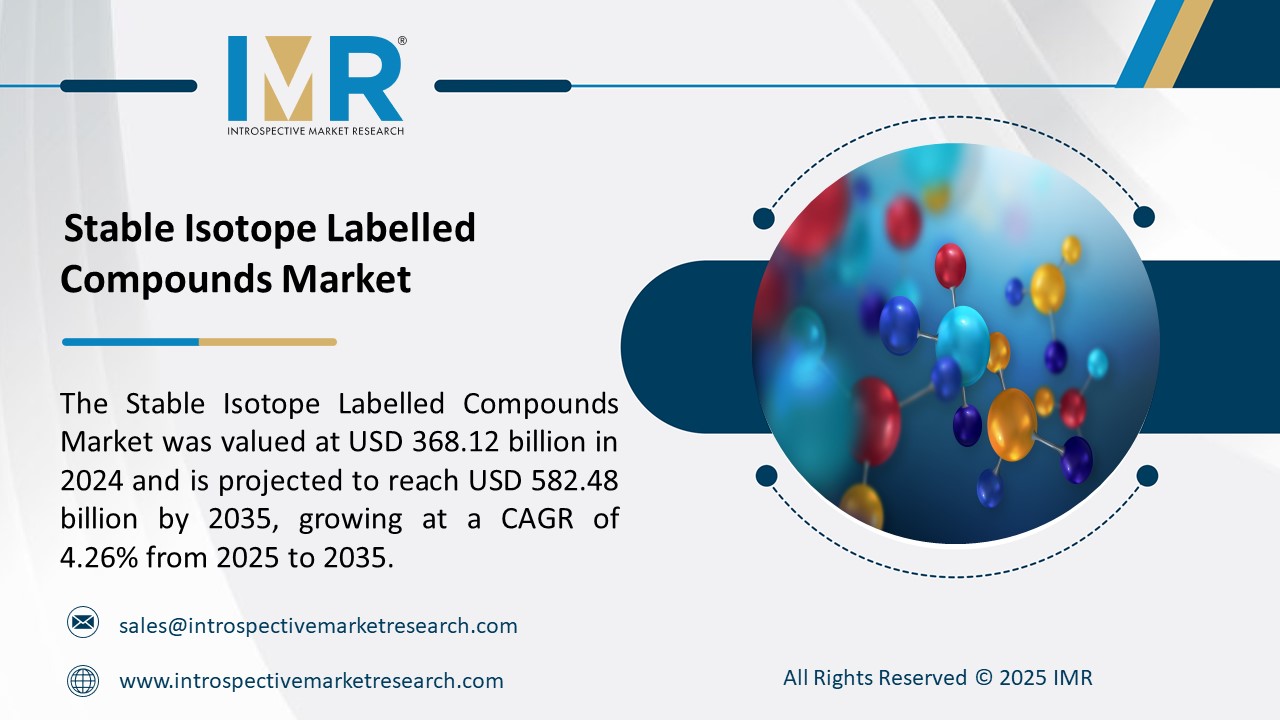
According to a new report published by Introspective Market Research, titled, “Stable Isotope Labelled Compounds Market by Product Type, Application, and End-User,” The Global Stable Isotope Labelled Compounds Market Size Was Valued at USD 368.12 Billion in 2024 and is Projected to Reach USD 582.48 Billion by 2035, Growing at a CAGR of 4.26% From 2025–2035.
The Stable Isotope Labelled Compounds market consists of non-radioactive chemical substances where one or more atoms have been replaced by a stable isotope, such as Carbon-13, Deuterium (Hydrogen-2), or Nitrogen-15. These compounds serve as critical tracers and internal standards in analytical chemistry, offering a powerful advantage over their non-labelled counterparts. Their key benefit is the ability to be tracked and quantified within complex biological, chemical, or environmental systems without altering the molecule's chemical properties or posing radiation hazards. This unique capability makes them indispensable tools for precise measurement and pathway elucidation. Their primary applications are concentrated in advanced research and diagnostic sectors, most notably in pharmaceutical and biotechnology research for drug metabolism and pharmacokinetics (DMPK) studies, clinical diagnostics including metabolic flux analysis, and environmental science for tracing pollutants. The demand for these sophisticated compounds is directly tied to the pursuit of accuracy and depth in scientific discovery and safety testing across major industries.
The primary growth driver for the stable isotope labelled compounds market is the robust and sustained investment in pharmaceutical Research & Development, particularly for complex modalities like biologics, targeted therapies, and antibody-drug conjugates (ADCs). These advanced drug candidates require meticulous DMPK studies to understand their absorption, distribution, metabolism, and excretion within the body. Stable isotope labelling provides an unparalleled, safe method to trace these pathways with high specificity and sensitivity, making it a non-negotiable tool in modern drug development pipelines to ensure efficacy and meet stringent regulatory safety requirements.
A significant market opportunity lies in the expanding application of stable isotope labelled compounds in clinical diagnostics and personalized medicine. There is growing demand for their use in advanced diagnostic assays, such as quantitative proteomics and metabolomics, to identify novel biomarkers for early disease detection. Furthermore, they are crucial for in-vivo metabolic flux analysis, which can guide personalized nutrition and cancer treatment strategies. Companies that develop standardized diagnostic kits and clinically validated assays incorporating these compounds can access the high-value clinical diagnostics market, moving beyond pure research into routine clinical practice.
Stable Isotope Labelled Compounds Market, Segmentation
The Stable Isotope Labelled Compounds Market is segmented on the basis of Product Type, Application, and End-User.
Product Type
The Product Type segment is further classified into Deuterium, Carbon-13, Nitrogen-15, and Oxygen-18. Among these, the Deuterium sub-segment accounted for the highest market share in 2024. Deuterium-labelled compounds dominate due to their relatively lower cost of production, high stability, and exceptional versatility across a vast array of applications. They are extensively used as internal standards in mass spectrometry for quantitative analysis in bioanalytical labs, in NMR spectroscopy for structural elucidation, and in the synthesis of deuterated active pharmaceutical ingredients (APIs) to potentially alter drug metabolism, making them a fundamental and high-volume workhorse in both research and industry.
End-User
The End-User segment is further classified into Pharmaceutical & Biotechnology Companies, Academic & Research Institutes, and CROs & CMOs. Among these, the Pharmaceutical & Biotechnology Companies sub-segment accounted for the highest market share in 2024. This dominance is driven by their substantial, continuous R&D budgets and the regulatory imperative to conduct exhaustive metabolic and toxicology studies for every new drug candidate. These companies are the largest consumers of labelled compounds for DMPK studies, bioanalytical method development, and clinical trials, utilizing them at virtually every stage from discovery through to regulatory submission, creating consistent, high-value demand.
Some of The Leading/Active Market Players Are-
• Merck KGaA (Germany)
• Cambridge Isotope Laboratories, Inc. (US)
• PerkinElmer, Inc. (US)
• Urenco Group (Netherlands/UK)
• Taiyo Nippon Sanso Corporation (Japan)
• Trace Sciences International (Canada)
• Alsachim (France)
• Medical Isotopes, Inc. (US)
• JSC Isotope (Russia)
• Rotem Industries Israel Ltd. (Israel)
• Huayi Isotopes Co., Ltd. (China)
• TCI Chemicals (India) Pvt. Ltd. (India)
• and other active players.
Key Industry Developments
In March 2024, Merck KGaA expanded its stable isotope production capacity with a new facility focused on Carbon-13 and Nitrogen-15 labelled compounds. This investment aims to address supply chain constraints and meet the growing demand from the pharmaceutical and agrochemical industries for these less abundant isotopes used in advanced metabolic research and environmental tracing.
In January 2024, Cambridge Isotope Laboratories announced a strategic collaboration with a leading mass spectrometry company to develop integrated workflow solutions. The partnership will combine CIL's high-purity labelled standards with optimized instrument methods and software, creating streamlined, validated kits for quantitative proteomics and metabolomics to accelerate biomarker discovery and clinical research.
Key Findings of the Study
• Deuterium-labelled compounds and Pharmaceutical & Biotechnology end-users held the dominant market shares.
• North America was the leading regional market, supported by major pharmaceutical R&D hubs.
• Sustained pharmaceutical R&D investment is the primary growth driver.
• Key trends include expansion into clinical diagnostics and strategic collaborations to create integrated analytical workflows