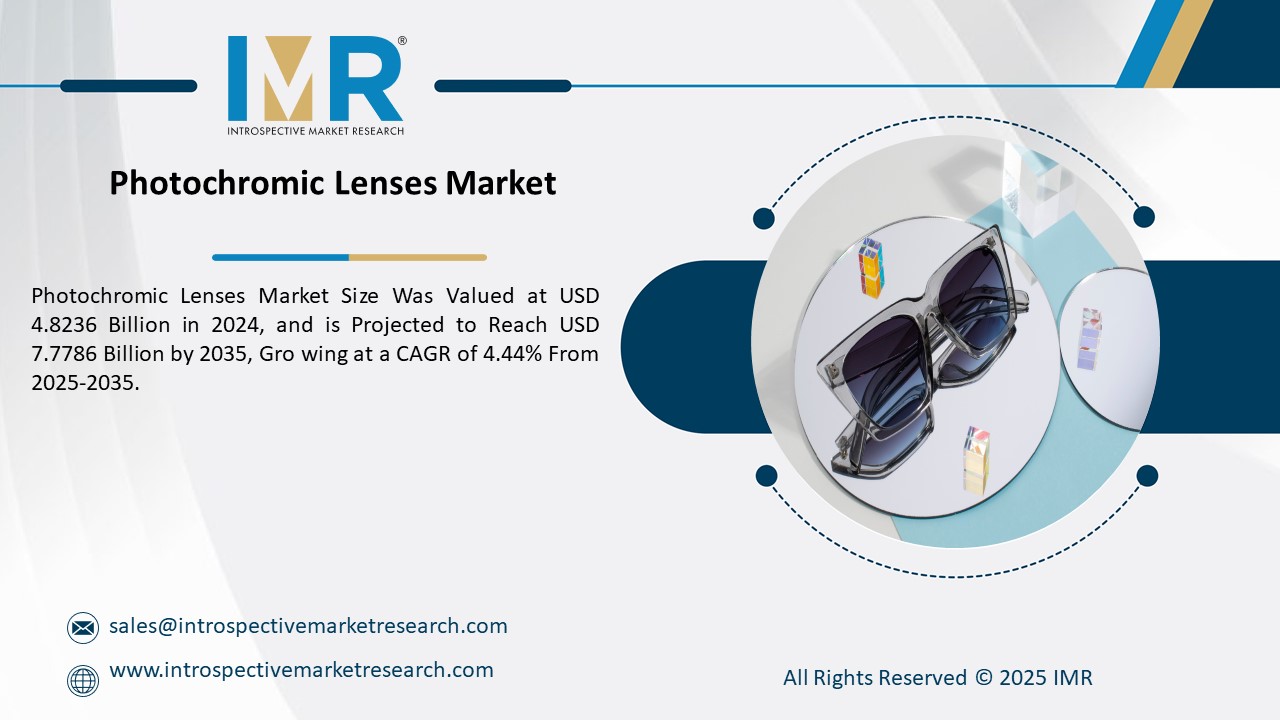
The photochromic lenses market is witnessing consistent growth due to the rising demand for eyewear that combines comfort, protection, and style. Photochromic lenses automatically adjust their tint in response to varying light conditions, offering seamless transition between indoor and outdoor environments. These lenses provide enhanced vision protection by filtering harmful UV rays and reducing glare, making them an ideal choice for individuals with high exposure to sunlight.
Compared to traditional lenses, photochromic lenses deliver significant advantages, including improved eye comfort, reduced strain, and long-term ocular protection. Their integration into prescription eyewear and sunglasses has expanded the market across various consumer segments. Additionally, growing awareness regarding UV-related eye disorders and increasing adoption of smart eyewear technologies have further fueled market expansion globally.
The market’s growth is also supported by advancements in lens coatings, materials, and adaptive technologies. Manufacturers are introducing lightweight and durable lenses with faster transition times and enhanced color uniformity. With the increasing focus on vision health and fashion-conscious consumers, the photochromic lenses market is poised for sustainable long-term growth.
One of the primary growth drivers for the photochromic lenses market is the increasing awareness about eye health and the harmful effects of UV radiation. Prolonged exposure to ultraviolet rays is known to cause cataracts and other vision impairments, prompting consumers to choose adaptive eyewear solutions. Additionally, the growing use of digital screens and smartphones has led to higher incidences of eye strain, driving the adoption of lenses that can automatically adapt to different lighting conditions and reduce glare effectively.
A significant opportunity lies in the integration of photochromic technology into smart eyewear and sports applications. With the rise of augmented reality (AR) and connected glasses, photochromic lenses are increasingly being used to enhance user experience and visibility across varying light environments. Additionally, the surge in e-commerce channels for customized eyewear and the growing popularity of fashion-driven eyewear among younger consumers present new revenue prospects for manufacturers and retailers worldwide.
Photochromic Lenses Market, Segmentation
The Photochromic Lenses Market is segmented on the basis of Type, Material, and Distribution Channel.
Type
- The Type segment is further classified into Glass, Plastic, and Polycarbonate. Among these, the Plastic sub-segment accounted for the highest market share in 2024. Plastic photochromic lenses are lightweight, impact-resistant, and cost-effective, making them the preferred choice for both prescription and non-prescription eyewear. They also offer excellent optical clarity and are compatible with advanced coatings, such as anti-reflective and scratch-resistant layers, which enhance durability and comfort for everyday use.
Material
- The Material segment is further classified into Gray, Brown, Green, and Others. Among these, the Gray sub-segment accounted for the highest market share in 2024. Gray lenses are favored for their ability to maintain true color perception while providing effective glare reduction. They are especially popular among consumers seeking lenses suitable for both outdoor and driving activities. Their neutral tint and balanced light absorption properties make them ideal for varied lighting conditions.
Some of The Leading/Active Market Players Are
• EssilorLuxottica (France)
• Carl Zeiss AG (Germany)
• Hoya Corporation (Japan)
• Transitions Optical (U.S.)
• Corning Incorporated (U.S.)
• Nikon Corporation (Japan)
• Rodenstock GmbH (Germany)
• Vision Ease Lens (U.S.)
• Tokai Optical Co., Ltd. (Japan)
• Indo Optical (Spain)
• Seiko Optical Products (Japan)
• Younger Optics (U.S.)
• Chemiglas Corporation (U.S.)
• Colorlite (Hungary)
• Signet Armorlite (U.S.)
and other active players.
Key Industry Developments
- In April 2024, Transitions Optical introduced its new Transitions Gen 8 lenses, designed to provide faster fade-back time and enhanced darkness outdoors. The updated formulation uses advanced photochromic dyes, offering better durability and consistent performance across temperature variations, addressing consumer demand for improved comfort and adaptability.
- In January 2025, EssilorLuxottica announced a strategic collaboration with Meta to enhance its line of Ray-Ban Meta smart glasses with integrated adaptive photochromic technology. This innovation combines augmented reality with light-adjusting lenses, setting a new benchmark in the premium smart eyewear category and expanding photochromic lens applications beyond vision correction.
Key Findings of the Study
• Plastic lenses dominated the market in 2024 due to their lightweight and durable nature.
• Gray-tinted lenses led among material types for their color-neutral and glare-reducing properties.
• Europe and North America remain the largest markets due to high adoption of premium eyewear.
• Increasing UV awareness and smart eyewear integration are major growth trends.
• Online retail channels are emerging as key distribution avenues globally.