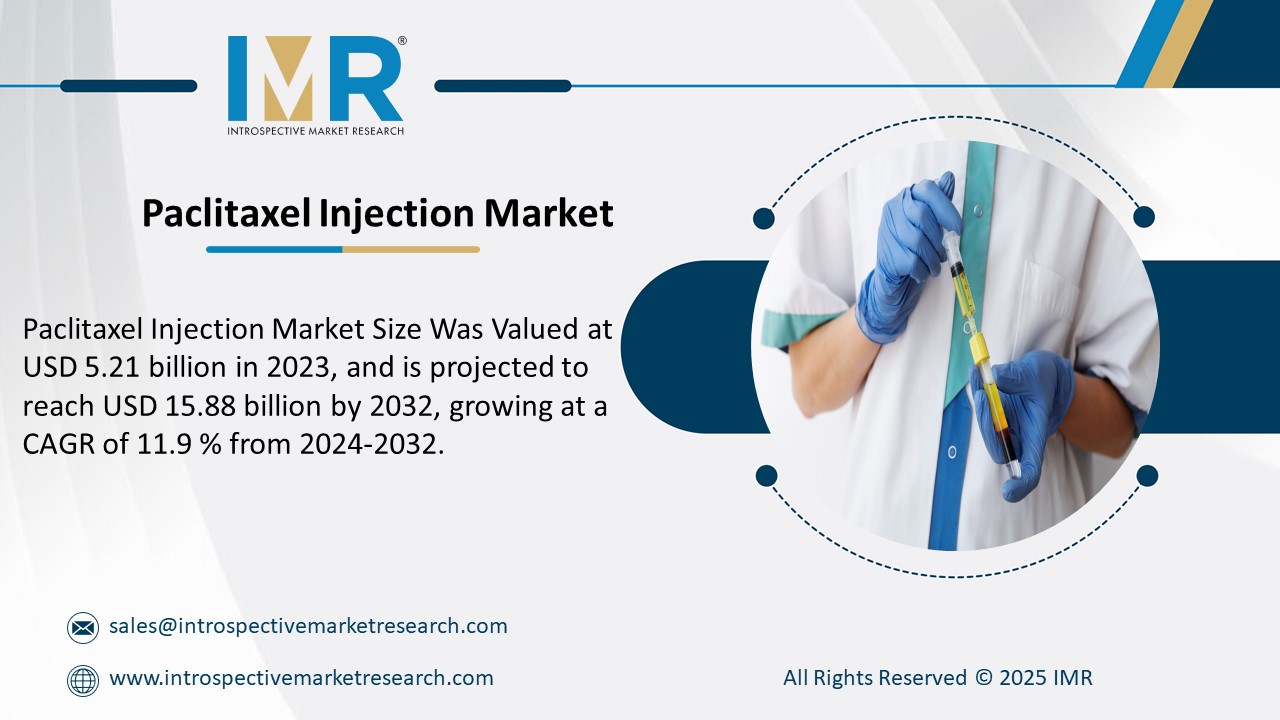
According to a new report published by Introspective Market Research, titled, Paclitaxel Injection Market by Product Type, Application, and End User, The Global Paclitaxel Injection Market Size Was Valued at USD 5.21 Billion in 2023 and is Projected to Reach USD 15.88 Billion by 2032, Growing at a CAGR of 11.9%. The global Paclitaxel Injection Market is witnessing robust growth, driven by the rising incidence of cancer worldwide and the growing demand for effective chemotherapeutic drugs. Paclitaxel, a plant-derived chemotherapy agent, is widely used to treat various cancers including breast, ovarian, and non-small cell lung cancer. Its ability to inhibit cancer cell growth and promote apoptosis makes it a critical drug in oncology.
Compared to traditional cancer treatment approaches, paclitaxel injection offers enhanced therapeutic outcomes and is increasingly being incorporated into combination therapies for better results. Furthermore, the expansion of healthcare infrastructure and growing patient access to advanced cancer therapies across developing nations are fueling market expansion. With strong R&D efforts, biosimilar launches, and increasing approvals, the market is set for significant growth throughout the forecast period.
The Paclitaxel Injection Market is segmented into Product Type, Application, and End User. By Product Type, the market is categorized into Branded Drugs and Generic Drugs. By Application, the market is categorized into Breast Cancer, Ovarian Cancer, Non-Small Cell Lung Cancer, Kaposi’s Sarcoma, and Others. By End User, the market is categorized into Hospitals, Specialty Clinics, and Cancer Treatment Centers.
A key growth driver of the Paclitaxel Injection Market is the increasing global cancer burden. According to WHO, cancer remains a leading cause of death globally, with millions of new cases diagnosed annually. Paclitaxel is widely prescribed in first-line chemotherapy protocols, particularly for breast and ovarian cancer patients. With advancements in oncology research and the rising availability of affordable generics, the drug has become more accessible, further propelling market growth. Governments and health organizations are also increasing investments in cancer treatment programs, which directly supports demand for paclitaxel injections.
A significant market opportunity lies in the growing adoption of biosimilars and emerging markets expansion. As branded paclitaxel injections remain costly, the introduction of affordable biosimilar alternatives is expected to transform access in low- and middle-income countries. Additionally, rapid improvements in healthcare infrastructure in Asia-Pacific, Latin America, and the Middle East create untapped opportunities for pharmaceutical companies. With increasing approvals and strategic collaborations, players can expand their global footprint while catering to the rising demand for cost-effective oncology solutions.
Paclitaxel Injection Market, Segmentation
The Paclitaxel Injection Market is segmented on the basis of Product Type, Application, and End User.
Product Type
The product type segment is further classified into Branded Drugs and Generic Drugs. Among these, the Generic Drugs sub-segment accounted for the highest market share in 2023, driven by cost advantages and wide adoption across emerging economies. With rising patent expirations and regulatory approvals, generic paclitaxel injections are being adopted as affordable alternatives to branded drugs, significantly expanding patient access while boosting overall market volume.
Application
The application segment is further classified into Breast Cancer, Ovarian Cancer, Non-Small Cell Lung Cancer, Kaposi’s Sarcoma, and Others. Among these, the Breast Cancer sub-segment accounted for the highest market share in 2023, as paclitaxel remains a cornerstone in chemotherapy regimens for breast cancer treatment. With the rising prevalence of breast cancer globally, particularly in women under 50, the demand for paclitaxel injections is anticipated to remain strong throughout the forecast period.
Some of The Leading/Active Market Players Are-
- Bristol-Myers Squibb (US)
- Pfizer Inc. (US)
- Sagent Pharmaceuticals (US)
- Fresenius Kabi (Germany)
- Teva Pharmaceutical Industries Ltd. (Israel)
- Cipla Ltd. (India)
- Dr. Reddy’s Laboratories (India)
- Sun Pharmaceutical Industries Ltd. (India)
- Lupin Limited (India)
- Accord Healthcare (UK)
- Intas Pharmaceuticals Ltd. (India)
- Mylan N.V. (US)
- Khandelwal Laboratories Pvt. Ltd. (India)
- Apotex Inc. (Canada)
- Jiangsu Hengrui Medicine Co., Ltd. (China) and other active players.
Key Industry Developments
-
In June 2023, Cipla launched its generic paclitaxel injection in select Asia-Pacific markets, expanding its oncology portfolio.
This development is expected to improve the affordability and accessibility of cancer treatment in developing nations, supporting the company’s global expansion strategy. - In March 2024, Bristol-Myers Squibb announced new clinical trial results highlighting improved survival rates for breast cancer patients treated with paclitaxel in combination therapies.
The positive results are likely to strengthen the adoption of paclitaxel injections in oncology treatment protocols, further boosting market growth.
Key Findings of the Study
- Generic paclitaxel injections dominate the market due to cost-effectiveness.
- Breast cancer remains the leading application segment.
- Asia-Pacific is emerging as a high-growth region due to healthcare expansion.
- Rising cancer incidence and growing biosimilar adoption are key drivers.
- Strategic collaborations and product launches are shaping market trends.