




Spectacle Lens Market Synopsis:
Spectacle Lens Market Size Was Valued at USD 58.98 Billion in 2023, and is Projected to Reach USD 76.82 Billion by 2032, Growing at a CAGR of 2.98% From 2024-2032.
The spectacle lens market is the market of lenses intended to be fitted to spectacles for the correction of eye sight defects like myopia or near sightedness, hyperopia or far sightedness, astigmatism and presbyopia. These are normally manufactured with plastic or glass materials and are normally treated to strengthen them and include features such as UV protection, scratch coating or anti reflection layering. Single vision lenses and bifocal, trifocal and progressive are some of the available types of lenses in the market ranging from prescription to design. Growth factors are technological innovation in this sector, growth in cases of eye difficulties, and improved concern for vision health.
The market for spectacle lenses has been growing at an accelerating rate owing to the growth in the numbers of people with corrective vision problems like myopia, hyperopia, and astigmatism. Some of the major drives for this demand are the global increase in population, people living longer, estimated at 100 million having poor eyesight since their use of digital screens exposure resulted to eye strain and many more related complications. The presence of enhanced technology in the region of spectacles, such as high-index lenses, anti-reflective lenses, and blue light filtering lenses is also helping in enriching growth to the market. Also, the awareness of people for a routine eye examination and the availability and stylish fashionable eye wear also boost the market growth.
Spectacle lens segmentation a single vision lens controls a large share of the market for spectacle lenses, primarily because they are more cost effective and commonly fitted to correct regular sight disorders. Stigmatism. Factors such as the growing global population, the aging demographic, and an increase in digital screen usage, which has led to a surge in eye strain and vision-related issues, are fuelling this demand. Technological advancements in spectacle lens design, including the development of high-index lenses, anti-reflective coatings, and blue light filtering lenses, are contributing to the expansion of the market.
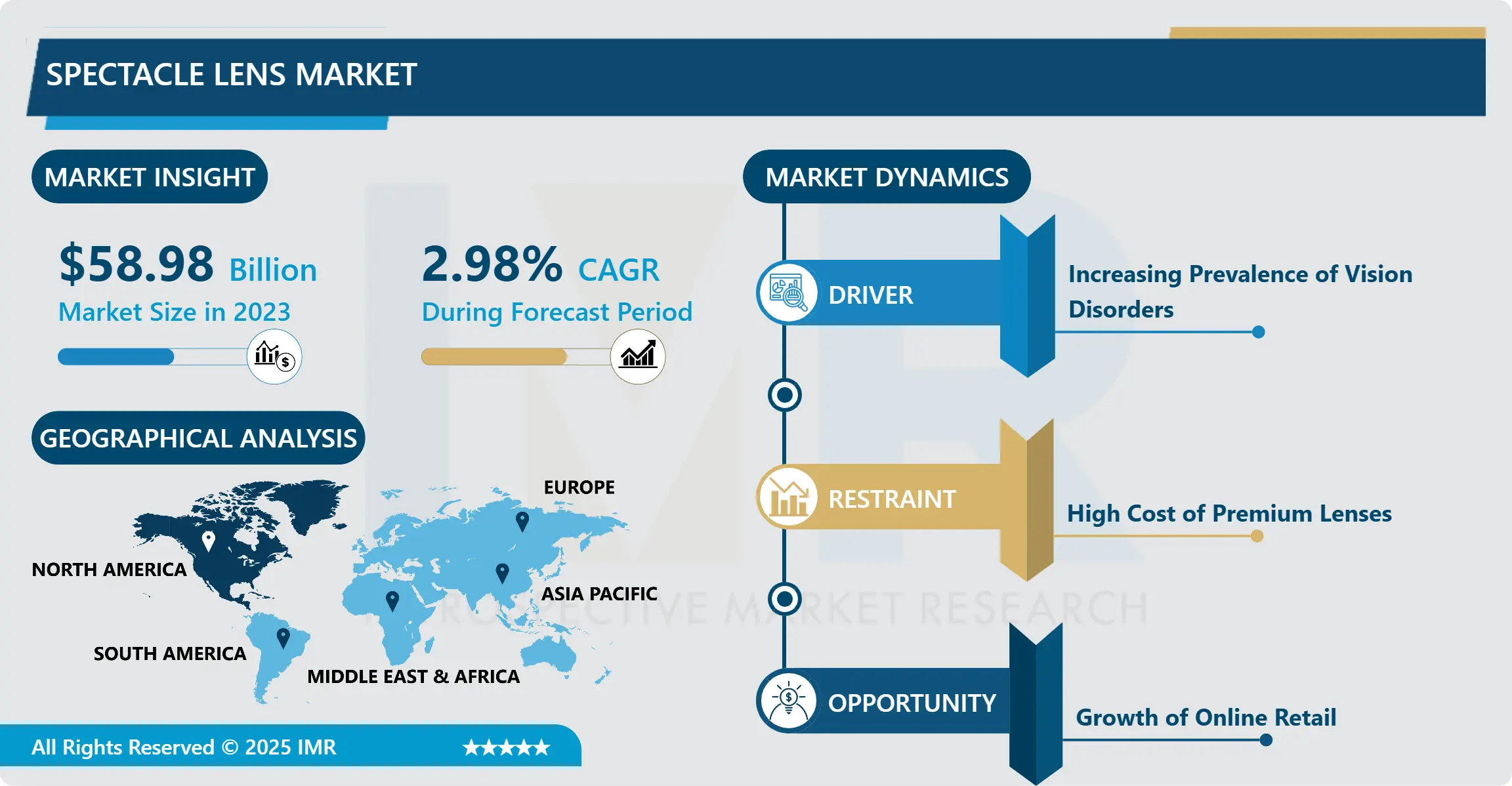
Spectacle Lens Market Trend Analysis:
Growing Demand for Customized Lenses and Solutions for Digital Eye Strain
-
Another noticeable trend being observed in spectacle lens market is the rising tendency of people using progressive and digital lens which provide correction of vision for different points. Multifocal lenses for viewing objects at near, intermediate, and far range, are becoming more popular particularly for users of presbyopia. Some of these lenses offer a more natural vision in comparison to the bifocal glasses, making the lens very attractive. Digital lenses are made by designing Special software to cut them according to individual prescription with great detail than producing a perfect comfort yet clear vision. Currently, consumers are demanding truly different eyewear products and services and therefore firms are developing special lenses that best fit consumers’ needs in terms of frame size and vision requirements appropriately boosting this segment.
- The rise of digital eye strain due to prolonged screen exposure has fueled the demand for specialized lenses designed to reduce eye fatigue. One such trend has to do with blue light filtering and anti-glare coatings which have been seen to grow in popularity. Blue light filtering lenses reduce the amount of the detrimental spectra produced by computers, tablets and smartphones that can cause eye fatigue, poor sleep and possible long-term negative impact to vision. Matthews Anti-glare coatings enhance visibility besides minimizing on reflection making it suitable for both screen use and outdoor activities.
Driving Demand and Technological Advancements
-
There is growing awareness of vision correction around the world due to increased rates of prescription errors like near sightedness, far sightedness and astigmatism. Myopia, especially, is on the rise; studies estimate that 42.7% of the global population may be myopic by 2050, primarily because of the modern propensity for spending hours in front of screens and exercising outdoors less. It is most evident among the urban dwellers because they are most likely to use devices that cause vision problems, and therefore they will require eyeglasses. Since there are young people who need glasses, there is a strong and developing demand for single vision that meets this category’s needs. Also, the need to customized ones is growing thanks to ongoing request for improving lenses’ quality, comfort and individual approach at the same time. With increasing people’s awareness of vision care demand, this will further enhance the demand for spectacle lenses.
- The use of spectacle lenses in a society with growing youthful population is also an important factor that contributes to the growth of demand for spectacle lenses, and astigmatism. Myopia, in particular, is becoming a significant concern, with research predicting that nearly half of the world’s population could be myopic by 2050, largely due to lifestyle factors such as prolonged screen exposure and reduced outdoor activities. This trend is especially pronounced in urban populations, where digital device usage is high, creating a growing need for prescription lenses to correct vision impairment. As more young individuals require corrective eyewear, there is a robust and expanding market for single-vision lenses tailored to their needs.
Spectacle Lens Market Segment Analysis:
Spectacle Lens Market is Segmented on the basis of By Type, Coating Type, Usage and Region.
By Type, Progressive segment is expected to dominate the market during the forecast period
-
The rising demand if progressive lenses include development of lens technology and style of lens design with presbyopia a common age-related condition that affects the ability to focus on close objects. Unlike traditional bifocal or trifocal lenses, which have distinct lines separating different optical zones, progressive lenses offer a smooth gradient of vision correction from the top to the bottom of the lens. This design not only enhances aesthetics by eliminating visible lines but also allows wearers to experience clear vision at various distances, including near, intermediate, and far. The ability to shift focus naturally without needing to switch glasses makes progressive lenses an attractive option for those who lead active lifestyles or engage in activities requiring varied visual acuity, such as reading, working on a computer, or driving.
By Usage, Prescription Glass segment expected to held the largest share
-
The prescription glasses industry has been liberalized through the development of advanced lens type of material and designs to afford more comfort, thinner and lighter lenses that are long lasting a diverse array of lens types, such as single vision, bifocal, trifocal, and progressive lenses, catering to a wide variety of vision impairments. With an aging population increasingly affected by conditions such as presbyopia, myopia, and hyperopia, the demand for prescription glasses continues to grow. Additionally, the rise in screen time associated with digital devices has led to an increase in vision problems like digital eye strain, further propelling the need for tailored eyewear solutions.
- Technological advancements in lens materials and designs have revolutionized the prescription glasses market, allowing for the development of lighter, thinner, and more durable lenses that enhance comfort and visual clarity. Others like the anti-reflective, blue filtering and photochromic lenses fit today’s consumer demand and lifestyle. In addition, the fashion-conscious development of spectacles has turned the prescription ones into the embellished accessories where many consumers look for chic frames according their attitude. The combination of function and fashion, the consistent development with the optical technology and the further diversification tendencies increase prescription glasses’ role to become a fundamental segment in the eyeglasses market for almost all kinds of consumers.
Spectacle Lens Market Regional Insights:
North America is Expected to Dominate the Market Over the Forecast period
-
North American spectacle lens market has the most developed healthcare industry which makes consumers to avail better vision care and eyewear products. The consumers here tend to spend a lot on health and accessories such as eyeglasses where this product can be perceived just as a fashion requirement than a need. Prominent eyewear brands, traditional and new age organizations have nurtured a competitive environment for eyewear brands, which in turn offer highly differentiated products and premium quality. The US dominates this market most of all, mainly owing to a great number of aging citizens who might need effective vision correction services. This demographic change increases the requirement of spectacle lenses that correct all sorts of vision problems, thereby increasing the market’s demand.
- Further, the growth of e-commerce business has a major impact on changing the scenario of the spectacle lens market in North America access to high-quality vision care and eyewear solutions. This region experiences high consumer spending on healthcare and personal accessories, with eyewear being viewed not just as a functional necessity but also as a fashion statement. The presence of leading eyewear brands, including both established companies and innovative startups, has fostered a competitive landscape that encourages product differentiation and premium offerings. The United States, in particular, dominates this market, driven by a substantial aging population that increasingly seeks effective vision correction options. This demographic shift highlights the growing need for spectacle lenses that cater to various visual impairments, further propelling market demand.
Active Key Players in the Spectacle Lens Market:
- Carl Zeiss AG (Carl Zeiss Meditec AG)
- EssilorLuxottica (Essilor)
- Fielmann AG
- GKB Ophthalmics Ltd
- Hoya Corporation (Seiko Optical Products Co. Ltd)
- Inspecs Group PLC (Norville (20/20) Ltd)
- Nikon Corporation
- Rodenstock GmbH
- Tokai Optical Co. Ltd
- Wanxin Optics
- Other Active Players
Key Industry Developments in the Spectacle Lens Market:
-
In May 2024, Essilor Luxottica expanded its Stellest spectacle lenses for myopia management, offering them with sun tints in Canada. This addition allows children and teenagers to wear Essilor Stellest lenses even during outdoor activities, ensuring they are shielded from harmful sunlight. With this, the company has broadened the global availability of its Essilor Stellest clear spectacle lens, catering to a wider prescription range and, thus, addressing the needs of a broader demographic of myopic youth.
|
Spectacle Lens Market |
|||
|
Base Year: |
2023 |
Forecast Period: |
2024-2032 |
|
Historical Data: |
2017 to 2023 |
Market Size in 2023: |
USD 58.98 Billion |
|
Forecast Period 2024-32 CAGR: |
2.98% |
Market Size in 2032: |
USD 76.82 Billion |
|
Segments Covered: |
By Type |
|
|
|
By Coating Type |
|
||
|
By Usage |
|
||
|
By Region |
|
||
|
Key Market Drivers: |
|
||
|
Key Market Restraints: |
|
||
|
Key Opportunities: |
|
||
|
Companies Covered in the report: |
|
||
Chapter 1: Introduction
1.1 Scope and Coverage
Chapter 2:Executive Summary
Chapter 3: Market Landscape
3.1 Market Dynamics
3.1.1 Drivers
3.1.2 Restraints
3.1.3 Opportunities
3.1.4 Challenges
3.2 Market Trend Analysis
3.3 PESTLE Analysis
3.4 Porter's Five Forces Analysis
3.5 Industry Value Chain Analysis
3.6 Ecosystem
3.7 Regulatory Landscape
3.8 Price Trend Analysis
3.9 Patent Analysis
3.10 Technology Evolution
3.11 Investment Pockets
3.12 Import-Export Analysis
Chapter 4: Spectacle Lens Market by Type
4.1 Spectacle Lens Market Snapshot and Growth Engine
4.2 Spectacle Lens Market Overview
4.3 Vision
4.3.1 Introduction and Market Overview
4.3.2 Historic and Forecasted Market Size in Value USD and Volume Units (2017-2032F)
4.3.3 Key Market Trends, Growth Factors and Opportunities
4.3.4 Vision: Geographic Segmentation Analysis
4.4 Bifocal
4.4.1 Introduction and Market Overview
4.4.2 Historic and Forecasted Market Size in Value USD and Volume Units (2017-2032F)
4.4.3 Key Market Trends, Growth Factors and Opportunities
4.4.4 Bifocal: Geographic Segmentation Analysis
4.5 Trifocal and Progressive
4.5.1 Introduction and Market Overview
4.5.2 Historic and Forecasted Market Size in Value USD and Volume Units (2017-2032F)
4.5.3 Key Market Trends, Growth Factors and Opportunities
4.5.4 Trifocal and Progressive: Geographic Segmentation Analysis
Chapter 5: Spectacle Lens Market by Coating Type
5.1 Spectacle Lens Market Snapshot and Growth Engine
5.2 Spectacle Lens Market Overview
5.3 Anti-reflective Coating
5.3.1 Introduction and Market Overview
5.3.2 Historic and Forecasted Market Size in Value USD and Volume Units (2017-2032F)
5.3.3 Key Market Trends, Growth Factors and Opportunities
5.3.4 Anti-reflective Coating: Geographic Segmentation Analysis
5.4 Scratch-Resistant Coating
5.4.1 Introduction and Market Overview
5.4.2 Historic and Forecasted Market Size in Value USD and Volume Units (2017-2032F)
5.4.3 Key Market Trends, Growth Factors and Opportunities
5.4.4 Scratch-Resistant Coating: Geographic Segmentation Analysis
5.5 Anti-fog Coating
5.5.1 Introduction and Market Overview
5.5.2 Historic and Forecasted Market Size in Value USD and Volume Units (2017-2032F)
5.5.3 Key Market Trends, Growth Factors and Opportunities
5.5.4 Anti-fog Coating: Geographic Segmentation Analysis
5.6 UV Protection and Other Coating Types) Usage (Prescription Glass and OTC Reading Glass)
5.6.1 Introduction and Market Overview
5.6.2 Historic and Forecasted Market Size in Value USD and Volume Units (2017-2032F)
5.6.3 Key Market Trends, Growth Factors and Opportunities
5.6.4 UV Protection and Other Coating Types) Usage (Prescription Glass and OTC Reading Glass): Geographic Segmentation Analysis
Chapter 6: Company Profiles and Competitive Analysis
6.1 Competitive Landscape
6.1.1 Competitive Benchmarking
6.1.2 Spectacle Lens Market Share by Manufacturer (2023)
6.1.3 Industry BCG Matrix
6.1.4 Heat Map Analysis
6.1.5 Mergers and Acquisitions
6.2 CARL ZEISS AG (CARL ZEISS MEDITEC AG)
6.2.1 Company Overview
6.2.2 Key Executives
6.2.3 Company Snapshot
6.2.4 Role of the Company in the Market
6.2.5 Sustainability and Social Responsibility
6.2.6 Operating Business Segments
6.2.7 Product Portfolio
6.2.8 Business Performance
6.2.9 Key Strategic Moves and Recent Developments
6.2.10 SWOT Analysis
6.3 ESSILORLUXOTTICA (ESSILOR)
6.4 GKB OPHTHALMICS LTD
6.5 HOYA CORPORATION (SEIKO OPTICAL PRODUCTS CO. LTD)
6.6 RODENSTOCK GMBH
6.7 TOKAI OPTICAL CO. LTD
6.8 NIKON CORPORATION
6.9 FIELMANN AG
6.10 WANXIN OPTICS
6.11 INSPECS GROUP PLC (NORVILLE (20/20) LTD)
6.12 OTHER ACTIVE PLAYERS
Chapter 7: Global Spectacle Lens Market By Region
7.1 Overview
7.2. North America Spectacle Lens Market
7.2.1 Key Market Trends, Growth Factors and Opportunities
7.2.2 Top Key Companies
7.2.3 Historic and Forecasted Market Size by Segments
7.2.4 Historic and Forecasted Market Size By Type
7.2.4.1 Vision
7.2.4.2 Bifocal
7.2.4.3 Trifocal and Progressive
7.2.5 Historic and Forecasted Market Size By Coating Type
7.2.5.1 Anti-reflective Coating
7.2.5.2 Scratch-Resistant Coating
7.2.5.3 Anti-fog Coating
7.2.5.4 UV Protection and Other Coating Types) Usage (Prescription Glass and OTC Reading Glass)
7.2.6 Historic and Forecast Market Size by Country
7.2.6.1 US
7.2.6.2 Canada
7.2.6.3 Mexico
7.3. Eastern Europe Spectacle Lens Market
7.3.1 Key Market Trends, Growth Factors and Opportunities
7.3.2 Top Key Companies
7.3.3 Historic and Forecasted Market Size by Segments
7.3.4 Historic and Forecasted Market Size By Type
7.3.4.1 Vision
7.3.4.2 Bifocal
7.3.4.3 Trifocal and Progressive
7.3.5 Historic and Forecasted Market Size By Coating Type
7.3.5.1 Anti-reflective Coating
7.3.5.2 Scratch-Resistant Coating
7.3.5.3 Anti-fog Coating
7.3.5.4 UV Protection and Other Coating Types) Usage (Prescription Glass and OTC Reading Glass)
7.3.6 Historic and Forecast Market Size by Country
7.3.6.1 Russia
7.3.6.2 Bulgaria
7.3.6.3 The Czech Republic
7.3.6.4 Hungary
7.3.6.5 Poland
7.3.6.6 Romania
7.3.6.7 Rest of Eastern Europe
7.4. Western Europe Spectacle Lens Market
7.4.1 Key Market Trends, Growth Factors and Opportunities
7.4.2 Top Key Companies
7.4.3 Historic and Forecasted Market Size by Segments
7.4.4 Historic and Forecasted Market Size By Type
7.4.4.1 Vision
7.4.4.2 Bifocal
7.4.4.3 Trifocal and Progressive
7.4.5 Historic and Forecasted Market Size By Coating Type
7.4.5.1 Anti-reflective Coating
7.4.5.2 Scratch-Resistant Coating
7.4.5.3 Anti-fog Coating
7.4.5.4 UV Protection and Other Coating Types) Usage (Prescription Glass and OTC Reading Glass)
7.4.6 Historic and Forecast Market Size by Country
7.4.6.1 Germany
7.4.6.2 UK
7.4.6.3 France
7.4.6.4 The Netherlands
7.4.6.5 Italy
7.4.6.6 Spain
7.4.6.7 Rest of Western Europe
7.5. Asia Pacific Spectacle Lens Market
7.5.1 Key Market Trends, Growth Factors and Opportunities
7.5.2 Top Key Companies
7.5.3 Historic and Forecasted Market Size by Segments
7.5.4 Historic and Forecasted Market Size By Type
7.5.4.1 Vision
7.5.4.2 Bifocal
7.5.4.3 Trifocal and Progressive
7.5.5 Historic and Forecasted Market Size By Coating Type
7.5.5.1 Anti-reflective Coating
7.5.5.2 Scratch-Resistant Coating
7.5.5.3 Anti-fog Coating
7.5.5.4 UV Protection and Other Coating Types) Usage (Prescription Glass and OTC Reading Glass)
7.5.6 Historic and Forecast Market Size by Country
7.5.6.1 China
7.5.6.2 India
7.5.6.3 Japan
7.5.6.4 South Korea
7.5.6.5 Malaysia
7.5.6.6 Thailand
7.5.6.7 Vietnam
7.5.6.8 The Philippines
7.5.6.9 Australia
7.5.6.10 New Zealand
7.5.6.11 Rest of APAC
7.6. Middle East & Africa Spectacle Lens Market
7.6.1 Key Market Trends, Growth Factors and Opportunities
7.6.2 Top Key Companies
7.6.3 Historic and Forecasted Market Size by Segments
7.6.4 Historic and Forecasted Market Size By Type
7.6.4.1 Vision
7.6.4.2 Bifocal
7.6.4.3 Trifocal and Progressive
7.6.5 Historic and Forecasted Market Size By Coating Type
7.6.5.1 Anti-reflective Coating
7.6.5.2 Scratch-Resistant Coating
7.6.5.3 Anti-fog Coating
7.6.5.4 UV Protection and Other Coating Types) Usage (Prescription Glass and OTC Reading Glass)
7.6.6 Historic and Forecast Market Size by Country
7.6.6.1 Turkiye
7.6.6.2 Bahrain
7.6.6.3 Kuwait
7.6.6.4 Saudi Arabia
7.6.6.5 Qatar
7.6.6.6 UAE
7.6.6.7 Israel
7.6.6.8 South Africa
7.7. South America Spectacle Lens Market
7.7.1 Key Market Trends, Growth Factors and Opportunities
7.7.2 Top Key Companies
7.7.3 Historic and Forecasted Market Size by Segments
7.7.4 Historic and Forecasted Market Size By Type
7.7.4.1 Vision
7.7.4.2 Bifocal
7.7.4.3 Trifocal and Progressive
7.7.5 Historic and Forecasted Market Size By Coating Type
7.7.5.1 Anti-reflective Coating
7.7.5.2 Scratch-Resistant Coating
7.7.5.3 Anti-fog Coating
7.7.5.4 UV Protection and Other Coating Types) Usage (Prescription Glass and OTC Reading Glass)
7.7.6 Historic and Forecast Market Size by Country
7.7.6.1 Brazil
7.7.6.2 Argentina
7.7.6.3 Rest of SA
Chapter 8 Analyst Viewpoint and Conclusion
8.1 Recommendations and Concluding Analysis
8.2 Potential Market Strategies
Chapter 9 Research Methodology
9.1 Research Process
9.2 Primary Research
9.3 Secondary Research
|
Spectacle Lens Market |
|||
|
Base Year: |
2023 |
Forecast Period: |
2024-2032 |
|
Historical Data: |
2017 to 2023 |
Market Size in 2023: |
USD 58.98 Billion |
|
Forecast Period 2024-32 CAGR: |
2.98% |
Market Size in 2032: |
USD 76.82 Billion |
|
Segments Covered: |
By Type |
|
|
|
By Coating Type |
|
||
|
By Usage |
|
||
|
By Region |
|
||
|
Key Market Drivers: |
|
||
|
Key Market Restraints: |
|
||
|
Key Opportunities: |
|
||
|
Companies Covered in the report: |
|
||


