




Restaurant POS Software Market Synopsis
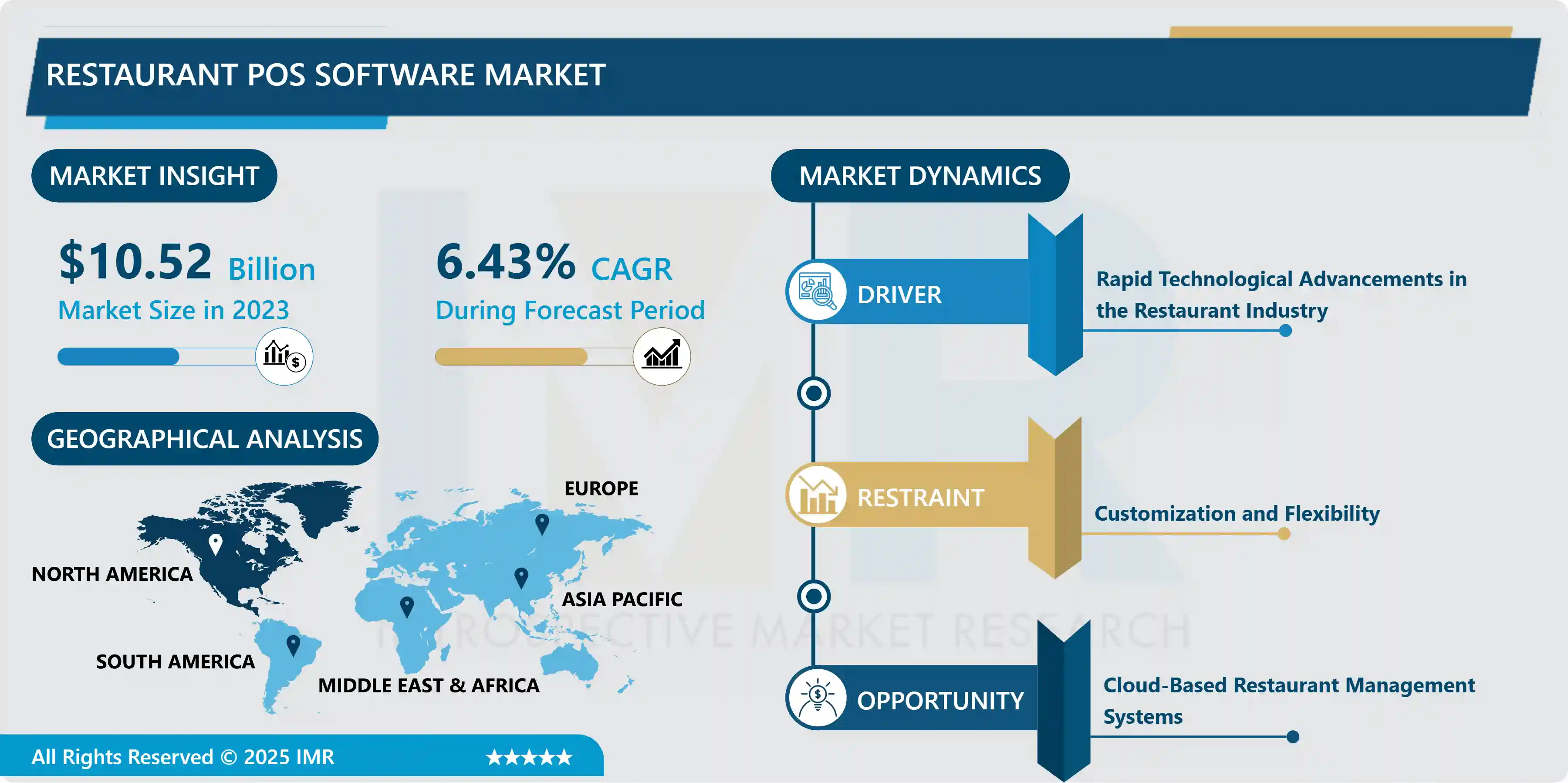
The Restaurant POS Software Market was valued at USD 10.52 billion in 2023 and is projected to reach USD 18.43 billion by 2032, registering a CAGR of 6.43 % from 2024 to 2032.
The Restaurant POS (Point of Sale) Software market has been driven by the increasing adoption of digital solutions by restaurants worldwide. This market offers software systems designed specifically for managing various operations within a restaurant, including order processing, payment processing, inventory management, and customer relationship management.
One of the key drivers of growth in this market is the rising demand for efficient and streamlined operations in the restaurant industry. With the increasing competition and evolving consumer preferences, restaurant owners are increasingly turning to POS software to enhance their operational efficiency, reduce errors, and improve customer satisfaction.
Moreover, the COVID-19 pandemic has further accelerated the adoption of POS software, as restaurants seek contactless and online ordering solutions to comply with social distancing measures and cater to changing consumer behaviors. This has led to a surge in demand for features such as online ordering, delivery management, and curbside pickup integration within POS systems.
The emergence of cloud-based POS solutions has revolutionized the market, offering scalability, flexibility, and accessibility to restaurant owners. Cloud-based POS systems allow restaurants to manage their operations from anywhere with an internet connection, making them particularly attractive for small and medium-sized businesses.
Advancements in technology, such as the integration of artificial intelligence and data analytics capabilities, are driving innovation in the Restaurant POS Software market. These technologies enable restaurants to gain valuable insights into customer behavior, optimize menu offerings, and personalize the dining experience.

Restaurant POS Software Market Trend Analysis
Rapid Technological Advancements in the Restaurant Industry
- Technology in the restaurant industry continues to develop rapidly and there is increasing demand for software designed specifically for restaurants-inventory control, table management systems, invoicing software or POS (point of sale) devices. All this bodes well for development of the market itself.
- One recent development in order processing procedures has been that restaurant owners can simplify the taking of orders. The accompaniments Of course, this system also checks meal delivery dates and records the inventory.
- Whenever there is less than two weeks’ worth of stock for a product, it automatically alerts users that are interested in placing an order to let them know how quickly needs may arise. This correlation is directly related to the restaurant's point-of-sale system. And it ensures that communication is done effectively and the kitchen can be operated in a sustainable manner.
Cloud-Based Restaurant Management Systems Creates an Opportunity for the Global Restaurant POS Software Market
- The increasing awareness of the cloud-based restaurant management systems, particularly in developing economies is stimulating the growth market. Also, onslaught of restaurant point-of sale software in the market is paving way for growth.
- Also important market drivers are factors such as rising urbanization, industrialization and number of restaurants and eateries worldwide. Also, collaboratively the enormous presence of most technologically advanced vendors in this market who cater cutting edge technology for their customers and growing personal disposable income are expected to raise CAGRs across developed economies.
Restaurant POS Software Market Segment Analysis:
Restaurant POS Software Market Segmented because of Component, Type, Operating System, Application, Enterprise Size, Deployment Mode and Restaurant Type.
By Deployment Type, the On-premises segment is expected to dominate the market during the forecast period.
- On-premises deployments offer a high level of control and customization, allowing businesses to tailor the software to their specific operational needs and integrate it seamlessly with existing infrastructure. This level of customization fosters efficiency and streamlines processes, enhancing overall productivity.
- Concerns surrounding data security and compliance are effectively addressed through on-premises solutions, as sensitive customer and transaction data remain within the physical confines of the restaurant's premises. This provides a sense of assurance to both businesses and their patrons, especially in an era marked by increasing cybersecurity threats and regulatory scrutiny.
- For some restaurants, particularly those with limited or unreliable internet connectivity, on-premises solutions represent a more reliable option, ensuring uninterrupted service and transactions even in offline scenarios.
By Application, the Inventory Management segment held the largest share of 34.03% in 2022.
- Inventory management is critical for restaurants to control costs, minimize waste, and ensure consistent supply of ingredients. POS software equipped with robust inventory management features enables restaurant owners to track stock levels, monitor ingredient usage in real-time, and automate reordering processes.
- By efficiently managing inventory, restaurants can optimize stock levels, reduce overstocking or stockouts, and prevent food spoilage, leading to significant cost savings. Moreover, integrated inventory management streamlines operations by synchronizing inventory data with sales transactions, simplifying accounting processes and enhancing accuracy.
- Furthermore, advanced inventory management functionalities offered by POS software allow for comprehensive analytics and reporting, enabling restaurant owners to make data-driven decisions to optimize their supply chain and menu offerings. This segment's dominance underscores the importance of streamlined inventory operations in maximizing profitability and maintaining competitiveness in the restaurant industry.
Restaurant POS Software Market Regional Insights:
North America is Expected to Dominate the Market Over the Forecast Period
- North America is poised to dominate the restaurant POS (Point of Sale) software market for several compelling reasons. Firstly, the region boasts a robust and mature restaurant industry, comprising a diverse array of establishments ranging from quick-service eateries to fine dining restaurants. This diversity creates a substantial demand for POS solutions tailored to varying operational needs.
- North America has a high adoption rate of technology in the restaurant sector, driven by a combination of factors such as efficiency demands, customer preferences, and regulatory compliance. This inclination towards technological solutions extends to POS software, which enables restaurants to streamline operations, enhance customer experiences, and gather valuable data for business insights.
- Additionally, the region's advanced infrastructure, including widespread internet connectivity and digital payment systems, further facilitates the adoption and utilization of POS software solutions.
Restaurant POS Software Market Top Key Players:
- Oracle (U.S.)
- Infor. (U.S.)
- Toshiba Tec Corporation (Japan)
- SpotOn Transact, LLC (U.S.)
- Clover Network, Inc. (U.S.)
- Epos Now (U.K.)
- eZee BurrP! (India)
- Future POS. (U.S.)
- Global Retail Technology Limited. (U.K.)
- Guest Innovations, Inc. (U.S.)
- Kitchen CUT Limited (U.K.)
- LimeTray. (India)
- Loyverse (U.S.)
- Mad Mobile. (U.S.)
- PAR Tech (U.S.)
- POSitouch (U.S.)
- Other Active players
Key Industry Developments in the Restaurant POS Software Market :
- In August 2023, Toast the all-in-one technology platform built for restaurants, announced the launch of Toast Catering & Events, a new product fully integrated with the Toast point-of-sale (POS) to help restaurants seamlessly manage large catering orders and event planning. Toast Catering & Events supports customizable banquet event orders (BEO), fulfillment tools, and lead management functionality.
- In June 2023, Oracle announced the MICROS Workstation 8 Series, a new restaurant POS workstation that offers modern, powerful hardware that can be configured to meet each restaurant's unique vibe and space requirements. The slim profile with a 14-inch touchscreen display and platinum finish provides quality and durability in a sleek, ergonomic package, ensuring that restaurants can create a unique dining experience for their customers.
|
Restaurant POS Software Market |
|||
|
Base Year: |
2023 |
Forecast Period: |
2024-2032 |
|
Historical Data: |
2017 to 2023 |
Market Size in 2023: |
USD 10.52 Bn. |
|
Forecast Period 2024-32 CAGR: |
6.43% |
Market Size in 2032: |
USD 18.43 Bn. |
|
Segments Covered: |
By Component |
|
|
|
By Type |
|
||
|
By Operating System |
|
||
|
By Application |
|
||
|
By Enterprise Size |
|
||
|
By Deployment Mode |
|
||
|
By Restaurant Type |
|
||
|
By Region |
|
||
|
Key Market Drivers: |
|
||
|
Key Market Restraints: |
|
||
|
Key Opportunities: |
|
||
|
Companies Covered in the report: |
|
||
Chapter 1: Introduction
1.1 Scope and Coverage
Chapter 2:Executive Summary
Chapter 3: Market Landscape
3.1 Market Dynamics
3.1.1 Drivers
3.1.2 Restraints
3.1.3 Opportunities
3.1.4 Challenges
3.2 Market Trend Analysis
3.3 PESTLE Analysis
3.4 Porter's Five Forces Analysis
3.5 Industry Value Chain Analysis
3.6 Ecosystem
3.7 Regulatory Landscape
3.8 Price Trend Analysis
3.9 Patent Analysis
3.10 Technology Evolution
3.11 Investment Pockets
3.12 Import-Export Analysis
Chapter 4: Restaurant POS Software Market by Component (2018-2032)
4.1 Restaurant POS Software Market Snapshot and Growth Engine
4.2 Market Overview
4.3 Software
4.3.1 Introduction and Market Overview
4.3.2 Historic and Forecasted Market Size in Value USD and Volume Units
4.3.3 Key Market Trends, Growth Factors, and Opportunities
4.3.4 Geographic Segmentation Analysis
4.4 Hardware
4.5 Services
Chapter 5: Restaurant POS Software Market by Type (2018-2032)
5.1 Restaurant POS Software Market Snapshot and Growth Engine
5.2 Market Overview
5.3 Terminal POS System
5.3.1 Introduction and Market Overview
5.3.2 Historic and Forecasted Market Size in Value USD and Volume Units
5.3.3 Key Market Trends, Growth Factors, and Opportunities
5.3.4 Geographic Segmentation Analysis
5.4 Tablet POS System
5.5 Mobile POS System
5.6 Online POS System
5.7 Self-Service Kiosk POS System
Chapter 6: Restaurant POS Software Market by Operating System (2018-2032)
6.1 Restaurant POS Software Market Snapshot and Growth Engine
6.2 Market Overview
6.3 Android
6.3.1 Introduction and Market Overview
6.3.2 Historic and Forecasted Market Size in Value USD and Volume Units
6.3.3 Key Market Trends, Growth Factors, and Opportunities
6.3.4 Geographic Segmentation Analysis
6.4 MAC
6.5 Dos System
6.6 Windows System
6.7 Linux System
Chapter 7: Restaurant POS Software Market by Application (2018-2032)
7.1 Restaurant POS Software Market Snapshot and Growth Engine
7.2 Market Overview
7.3 Inventory Management
7.3.1 Introduction and Market Overview
7.3.2 Historic and Forecasted Market Size in Value USD and Volume Units
7.3.3 Key Market Trends, Growth Factors, and Opportunities
7.3.4 Geographic Segmentation Analysis
7.4 Employee Clocking
7.5 Tablet Compatibility
7.6 Receipt Printing
7.7 Menu Building
7.8 Accounting Integration
7.9 Credit/Debit Card Processing
Chapter 8: Restaurant POS Software Market by Enterprise Size (2018-2032)
8.1 Restaurant POS Software Market Snapshot and Growth Engine
8.2 Market Overview
8.3 Large Enterprises
8.3.1 Introduction and Market Overview
8.3.2 Historic and Forecasted Market Size in Value USD and Volume Units
8.3.3 Key Market Trends, Growth Factors, and Opportunities
8.3.4 Geographic Segmentation Analysis
8.4 SME’s
Chapter 9: Restaurant POS Software Market by Deployment Mode (2018-2032)
9.1 Restaurant POS Software Market Snapshot and Growth Engine
9.2 Market Overview
9.3 Cloud
9.3.1 Introduction and Market Overview
9.3.2 Historic and Forecasted Market Size in Value USD and Volume Units
9.3.3 Key Market Trends, Growth Factors, and Opportunities
9.3.4 Geographic Segmentation Analysis
9.4 On-Premise
Chapter 10: Company Profiles and Competitive Analysis
10.1 Competitive Landscape
10.1.1 Competitive Benchmarking
10.1.2 Restaurant POS Software Market Share by Manufacturer (2024)
10.1.3 Industry BCG Matrix
10.1.4 Heat Map Analysis
10.1.5 Mergers and Acquisitions
10.2 ORACLE (U.S.)
10.2.1 Company Overview
10.2.2 Key Executives
10.2.3 Company Snapshot
10.2.4 Role of the Company in the Market
10.2.5 Sustainability and Social Responsibility
10.2.6 Operating Business Segments
10.2.7 Product Portfolio
10.2.8 Business Performance
10.2.9 Key Strategic Moves and Recent Developments
10.2.10 SWOT Analysis
10.3 INFOR. (U.S.)
10.4 TOSHIBA TEC CORPORATION (JAPAN)
10.5 SPOTON TRANSACT
10.6 LLC (U.S.)
10.7 CLOVER NETWORK INC. (U.S.)
10.8 EPOS NOW (U.K.)
10.9 EZEE BURRP! (INDIA)
10.10 FUTURE POS. (U.S.)
10.11 GLOBAL RETAIL TECHNOLOGY LIMITED. (U.K.)
10.12 GUEST INNOVATIONS INC. (U.S.)
10.13 KITCHEN CUT LIMITED (U.K.)
10.14 LIMETRAY. (INDIA)
10.15 LOYVERSE (U.S.)
10.16 MAD MOBILE. (U.S.)
10.17 PAR TECH (U.S.)
10.18 POSITOUCH (U.S.)
10.19
Chapter 11: Global Restaurant POS Software Market By Region
11.1 Overview
11.2. North America Restaurant POS Software Market
11.2.1 Key Market Trends, Growth Factors and Opportunities
11.2.2 Top Key Companies
11.2.3 Historic and Forecasted Market Size by Segments
11.2.4 Historic and Forecasted Market Size by Component
11.2.4.1 Software
11.2.4.2 Hardware
11.2.4.3 Services
11.2.5 Historic and Forecasted Market Size by Type
11.2.5.1 Terminal POS System
11.2.5.2 Tablet POS System
11.2.5.3 Mobile POS System
11.2.5.4 Online POS System
11.2.5.5 Self-Service Kiosk POS System
11.2.6 Historic and Forecasted Market Size by Operating System
11.2.6.1 Android
11.2.6.2 MAC
11.2.6.3 Dos System
11.2.6.4 Windows System
11.2.6.5 Linux System
11.2.7 Historic and Forecasted Market Size by Application
11.2.7.1 Inventory Management
11.2.7.2 Employee Clocking
11.2.7.3 Tablet Compatibility
11.2.7.4 Receipt Printing
11.2.7.5 Menu Building
11.2.7.6 Accounting Integration
11.2.7.7 Credit/Debit Card Processing
11.2.8 Historic and Forecasted Market Size by Enterprise Size
11.2.8.1 Large Enterprises
11.2.8.2 SME’s
11.2.9 Historic and Forecasted Market Size by Deployment Mode
11.2.9.1 Cloud
11.2.9.2 On-Premise
11.2.10 Historic and Forecast Market Size by Country
11.2.10.1 US
11.2.10.2 Canada
11.2.10.3 Mexico
11.3. Eastern Europe Restaurant POS Software Market
11.3.1 Key Market Trends, Growth Factors and Opportunities
11.3.2 Top Key Companies
11.3.3 Historic and Forecasted Market Size by Segments
11.3.4 Historic and Forecasted Market Size by Component
11.3.4.1 Software
11.3.4.2 Hardware
11.3.4.3 Services
11.3.5 Historic and Forecasted Market Size by Type
11.3.5.1 Terminal POS System
11.3.5.2 Tablet POS System
11.3.5.3 Mobile POS System
11.3.5.4 Online POS System
11.3.5.5 Self-Service Kiosk POS System
11.3.6 Historic and Forecasted Market Size by Operating System
11.3.6.1 Android
11.3.6.2 MAC
11.3.6.3 Dos System
11.3.6.4 Windows System
11.3.6.5 Linux System
11.3.7 Historic and Forecasted Market Size by Application
11.3.7.1 Inventory Management
11.3.7.2 Employee Clocking
11.3.7.3 Tablet Compatibility
11.3.7.4 Receipt Printing
11.3.7.5 Menu Building
11.3.7.6 Accounting Integration
11.3.7.7 Credit/Debit Card Processing
11.3.8 Historic and Forecasted Market Size by Enterprise Size
11.3.8.1 Large Enterprises
11.3.8.2 SME’s
11.3.9 Historic and Forecasted Market Size by Deployment Mode
11.3.9.1 Cloud
11.3.9.2 On-Premise
11.3.10 Historic and Forecast Market Size by Country
11.3.10.1 Russia
11.3.10.2 Bulgaria
11.3.10.3 The Czech Republic
11.3.10.4 Hungary
11.3.10.5 Poland
11.3.10.6 Romania
11.3.10.7 Rest of Eastern Europe
11.4. Western Europe Restaurant POS Software Market
11.4.1 Key Market Trends, Growth Factors and Opportunities
11.4.2 Top Key Companies
11.4.3 Historic and Forecasted Market Size by Segments
11.4.4 Historic and Forecasted Market Size by Component
11.4.4.1 Software
11.4.4.2 Hardware
11.4.4.3 Services
11.4.5 Historic and Forecasted Market Size by Type
11.4.5.1 Terminal POS System
11.4.5.2 Tablet POS System
11.4.5.3 Mobile POS System
11.4.5.4 Online POS System
11.4.5.5 Self-Service Kiosk POS System
11.4.6 Historic and Forecasted Market Size by Operating System
11.4.6.1 Android
11.4.6.2 MAC
11.4.6.3 Dos System
11.4.6.4 Windows System
11.4.6.5 Linux System
11.4.7 Historic and Forecasted Market Size by Application
11.4.7.1 Inventory Management
11.4.7.2 Employee Clocking
11.4.7.3 Tablet Compatibility
11.4.7.4 Receipt Printing
11.4.7.5 Menu Building
11.4.7.6 Accounting Integration
11.4.7.7 Credit/Debit Card Processing
11.4.8 Historic and Forecasted Market Size by Enterprise Size
11.4.8.1 Large Enterprises
11.4.8.2 SME’s
11.4.9 Historic and Forecasted Market Size by Deployment Mode
11.4.9.1 Cloud
11.4.9.2 On-Premise
11.4.10 Historic and Forecast Market Size by Country
11.4.10.1 Germany
11.4.10.2 UK
11.4.10.3 France
11.4.10.4 The Netherlands
11.4.10.5 Italy
11.4.10.6 Spain
11.4.10.7 Rest of Western Europe
11.5. Asia Pacific Restaurant POS Software Market
11.5.1 Key Market Trends, Growth Factors and Opportunities
11.5.2 Top Key Companies
11.5.3 Historic and Forecasted Market Size by Segments
11.5.4 Historic and Forecasted Market Size by Component
11.5.4.1 Software
11.5.4.2 Hardware
11.5.4.3 Services
11.5.5 Historic and Forecasted Market Size by Type
11.5.5.1 Terminal POS System
11.5.5.2 Tablet POS System
11.5.5.3 Mobile POS System
11.5.5.4 Online POS System
11.5.5.5 Self-Service Kiosk POS System
11.5.6 Historic and Forecasted Market Size by Operating System
11.5.6.1 Android
11.5.6.2 MAC
11.5.6.3 Dos System
11.5.6.4 Windows System
11.5.6.5 Linux System
11.5.7 Historic and Forecasted Market Size by Application
11.5.7.1 Inventory Management
11.5.7.2 Employee Clocking
11.5.7.3 Tablet Compatibility
11.5.7.4 Receipt Printing
11.5.7.5 Menu Building
11.5.7.6 Accounting Integration
11.5.7.7 Credit/Debit Card Processing
11.5.8 Historic and Forecasted Market Size by Enterprise Size
11.5.8.1 Large Enterprises
11.5.8.2 SME’s
11.5.9 Historic and Forecasted Market Size by Deployment Mode
11.5.9.1 Cloud
11.5.9.2 On-Premise
11.5.10 Historic and Forecast Market Size by Country
11.5.10.1 China
11.5.10.2 India
11.5.10.3 Japan
11.5.10.4 South Korea
11.5.10.5 Malaysia
11.5.10.6 Thailand
11.5.10.7 Vietnam
11.5.10.8 The Philippines
11.5.10.9 Australia
11.5.10.10 New Zealand
11.5.10.11 Rest of APAC
11.6. Middle East & Africa Restaurant POS Software Market
11.6.1 Key Market Trends, Growth Factors and Opportunities
11.6.2 Top Key Companies
11.6.3 Historic and Forecasted Market Size by Segments
11.6.4 Historic and Forecasted Market Size by Component
11.6.4.1 Software
11.6.4.2 Hardware
11.6.4.3 Services
11.6.5 Historic and Forecasted Market Size by Type
11.6.5.1 Terminal POS System
11.6.5.2 Tablet POS System
11.6.5.3 Mobile POS System
11.6.5.4 Online POS System
11.6.5.5 Self-Service Kiosk POS System
11.6.6 Historic and Forecasted Market Size by Operating System
11.6.6.1 Android
11.6.6.2 MAC
11.6.6.3 Dos System
11.6.6.4 Windows System
11.6.6.5 Linux System
11.6.7 Historic and Forecasted Market Size by Application
11.6.7.1 Inventory Management
11.6.7.2 Employee Clocking
11.6.7.3 Tablet Compatibility
11.6.7.4 Receipt Printing
11.6.7.5 Menu Building
11.6.7.6 Accounting Integration
11.6.7.7 Credit/Debit Card Processing
11.6.8 Historic and Forecasted Market Size by Enterprise Size
11.6.8.1 Large Enterprises
11.6.8.2 SME’s
11.6.9 Historic and Forecasted Market Size by Deployment Mode
11.6.9.1 Cloud
11.6.9.2 On-Premise
11.6.10 Historic and Forecast Market Size by Country
11.6.10.1 Turkiye
11.6.10.2 Bahrain
11.6.10.3 Kuwait
11.6.10.4 Saudi Arabia
11.6.10.5 Qatar
11.6.10.6 UAE
11.6.10.7 Israel
11.6.10.8 South Africa
11.7. South America Restaurant POS Software Market
11.7.1 Key Market Trends, Growth Factors and Opportunities
11.7.2 Top Key Companies
11.7.3 Historic and Forecasted Market Size by Segments
11.7.4 Historic and Forecasted Market Size by Component
11.7.4.1 Software
11.7.4.2 Hardware
11.7.4.3 Services
11.7.5 Historic and Forecasted Market Size by Type
11.7.5.1 Terminal POS System
11.7.5.2 Tablet POS System
11.7.5.3 Mobile POS System
11.7.5.4 Online POS System
11.7.5.5 Self-Service Kiosk POS System
11.7.6 Historic and Forecasted Market Size by Operating System
11.7.6.1 Android
11.7.6.2 MAC
11.7.6.3 Dos System
11.7.6.4 Windows System
11.7.6.5 Linux System
11.7.7 Historic and Forecasted Market Size by Application
11.7.7.1 Inventory Management
11.7.7.2 Employee Clocking
11.7.7.3 Tablet Compatibility
11.7.7.4 Receipt Printing
11.7.7.5 Menu Building
11.7.7.6 Accounting Integration
11.7.7.7 Credit/Debit Card Processing
11.7.8 Historic and Forecasted Market Size by Enterprise Size
11.7.8.1 Large Enterprises
11.7.8.2 SME’s
11.7.9 Historic and Forecasted Market Size by Deployment Mode
11.7.9.1 Cloud
11.7.9.2 On-Premise
11.7.10 Historic and Forecast Market Size by Country
11.7.10.1 Brazil
11.7.10.2 Argentina
11.7.10.3 Rest of SA
Chapter 12 Analyst Viewpoint and Conclusion
12.1 Recommendations and Concluding Analysis
12.2 Potential Market Strategies
Chapter 13 Research Methodology
13.1 Research Process
13.2 Primary Research
13.3 Secondary Research
|
Restaurant POS Software Market |
|||
|
Base Year: |
2023 |
Forecast Period: |
2024-2032 |
|
Historical Data: |
2017 to 2023 |
Market Size in 2023: |
USD 10.52 Bn. |
|
Forecast Period 2024-32 CAGR: |
6.43% |
Market Size in 2032: |
USD 18.43 Bn. |
|
Segments Covered: |
By Component |
|
|
|
By Type |
|
||
|
By Operating System |
|
||
|
By Application |
|
||
|
By Enterprise Size |
|
||
|
By Deployment Mode |
|
||
|
By Restaurant Type |
|
||
|
By Region |
|
||
|
Key Market Drivers: |
|
||
|
Key Market Restraints: |
|
||
|
Key Opportunities: |
|
||
|
Companies Covered in the report: |
|
||


