




Plastic Packaging Market Synopsis
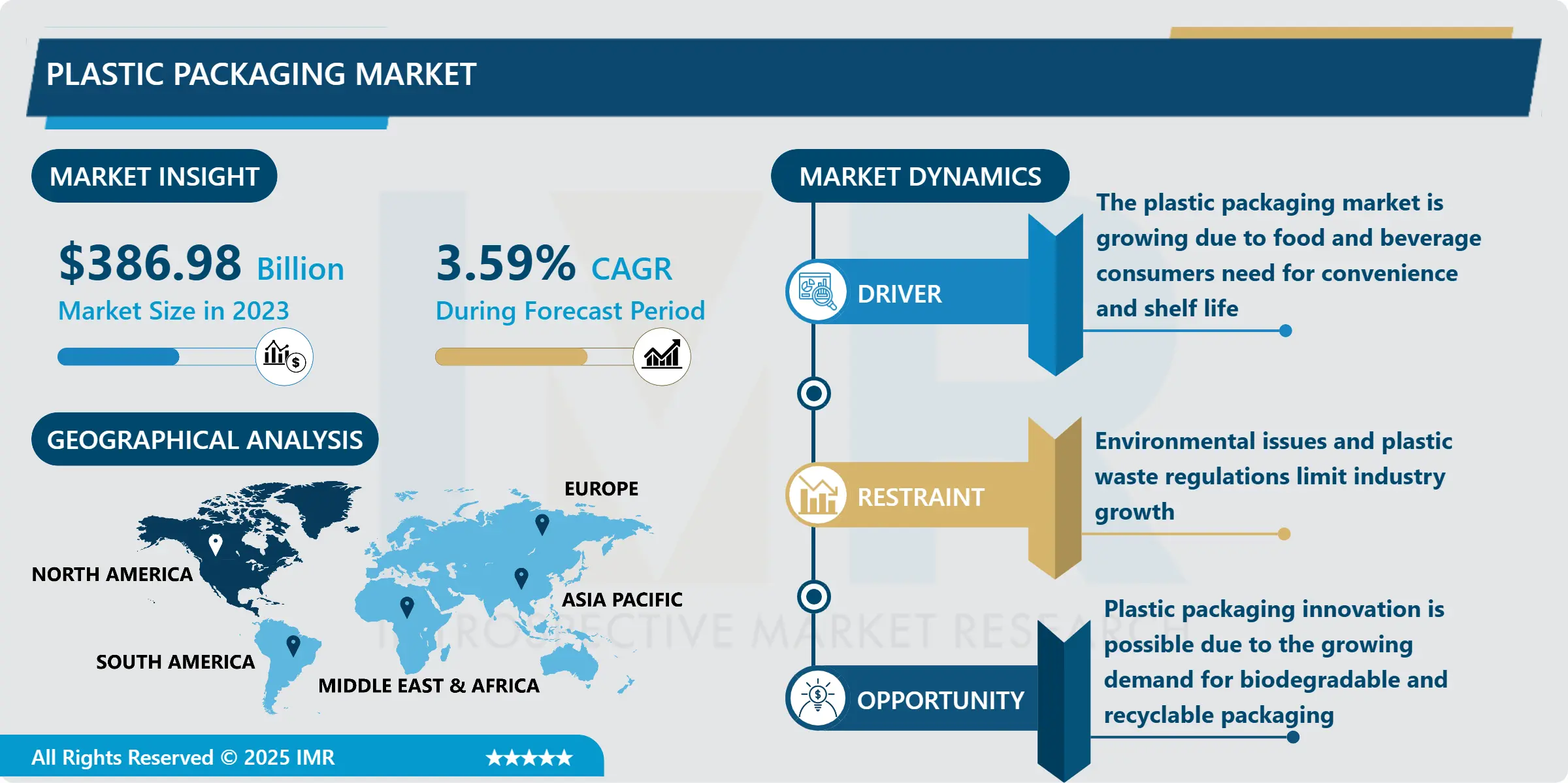
Plastic Packaging Market Size Was Valued at USD 386.98 Billion in 2023, and is Projected to Reach USD 531.56 Billion by 2032, Growing at a CAGR of 3.59% From 2024-2032
The Plastic Packaging Market has demonstrated tremendous growth over the last few decades into the increasing need of the packaging of goods in industries. Plastics are popular due to their lightweight, high durability and relatively low material cost, which adapts the material to an extensive set of uses, including in the food and beverages, pharmaceuticals, personal goods and home products categories. The expansion of the market to the e-commerce segment also put pressure on packaging, as companies turn to plastic for protection and optimisation of delivery. Besides, versatility of the plastic material; which trends in packaging design, including reseal ability and easy handling have contributed to the expansion of the plastic packaging market globally.
Over the last few years, the sustainability trend has emerged in the global market of plastic packaging at a faster pace than before. People around the world are growing more conscious about the effects of plastic waste on the environment hence the call for eco-friendly production. This has lead to advent of biodegradable plastics, recycled products, and packaging solutions that require the least amount of material to hold their contents. National and local governments and some regulatory centers are also putting in place other measures against excessive use of plastics and recycling, which put pressure on the companies to take environmentally friendly measures. This has led to increased market focus on eco-friendly packaging materials fulfilling the demand of the customers as well as the legal compliance.
The nature of competition in the plastic packaging market also differs with the North America, Europe and Asia-Pacific being the most important regions. Thus, North America and Europe are strengthening their positions in recycling and developing innovative technologies in this sphere, regions, such as the Asia-Pacific region, are experiencing rapid industrialization and urbanization and, therefore, the need for packaging made of plastics rises. This is because smaller players such as China and India are emerging as potential market drivers driven by an increasing population base coupled with growing per capita consumption. With a future projection of the global packaging industry changing and developing, the market is likely to grow as the plastic packaging market continues to expand over the following years as a result of changing customer needs, the emergence of new technologies, and consideration of the impact of the surrounding environment.
Plastic Packaging Market Trend Analysis:
Shift Towards Sustainable Packaging Solutions
- An emerging trend recognized in the Plastic Packaging Market is the rising demand for environmentally friendly packaging material. Through increased awareness consumers always look for packaging that is environmental friendly. This trend has given birth to biodegradable and compostable plastics besides increasing reuse of recyclable materials in packaging. Businesses are gradually giving attention to research and development across product portfolios in order to come up with solutions that are environmentally friendly and optimize on recyclability of materials used in production. Thirdly, the brands are involving clear information about their sustainability activities, which is useful for consumers who want to make the right purchase. It is important because it focuses the companies’ attention on the environmental impacts, but also places them in a suitable market context, as sustainability becomes a dominant trend.
Advancements in Smart Packaging Technologies
-
Smart packaging technologies are the other major emerging them that has the ability to impact the Plastic Packaging Market. These innovations apply high tech materials and processes into packaging designs to provide added functionalities for improved user interface. Technological possibilities like codes, indicators and sensors help monitor such aspects of perishable goods as freshness, temperature, and stock. While smart packaging increases the effectiveness of the supply chain and also impacts the consumer engagement by providing the necessary details about the product. With the increasing global adoption of e-commerce the requirement for packaging technologies that can deliver safe and intact products to consumers is also likely to improve. Smart technologies in plastics to aid in the growth of the food packaging sector, as firms try to offer improved value for the plastic packaging to consumers.
Plastic Packaging Market Segment Analysis:
The Plastic Packaging Market is Segmented on the basis of Type, Application, and Region
By Type, Rigid packaging segment is expected to dominate the market during the forecast period
- The Plastic Packaging Market can be broadly categorized into two main types like an inflexible packaging and a flexible packaging. Cognitive packaging is rigid packaging that does not deform or collapse during distribution and is best suited for applications and products that ideally would need the product completely protected, for example, food, beverages, pharmaceuticals, cosmetics, among others. This segment is preferred it offers a great opportunity for offering protection against outside factors, which keeps the product intact. In contrast, flexible packaging includes the bags, Pouches, films, and wraps that can easily be shaped or formed to the look at the product. This type is increasing in demand across all industries because it is lightweight, inexpensive, and occupies little space; however, it can be utilized widely in the food processing industry. The increasingly established trends toward convenience and sustainability have remained highly influential within the segments as producers search for adding more value and reflecting increased ecological consciousness.
By Application, Food and Beverages segment expected to held the largest share
- The Plastic Packaging Market is analyzed using several key applications which are food & beverages, industrial, Healthcare, and personal care. In the food and beverages segment particularly, it is used because it helps in keeping the products fresh for a long time besides enhancing the convenience of carry through pouch, bottles and containers among others. The industrial segment also depends on the plastic packaging for sustainable and protective single use products including shrink wrappings and stretchings in protecting the products during transportation and storage. In the case of healthcare, the plastic packaging is used to protect medical appliances, drugs, and laboratory equipment where it has to employ materials that meet set legal requirements on sterilization. In the final category, it is essential to note that personal care applies plastic packaging to preserve cosmetics toiletries primarily because the appearance and functionality of the product matter. In conclusion, it can be concluded that the versatility of the plastic packaging in sectors, industries and in functions has been well depicted that plays an important role for the prolonged growth of the market.
Plastic Packaging Market Regional Insights:
North America plastic packaging market accounts for the largest market share.
- It also controls the largest market share through the North America Plastic Packaging Market, due to a flourishing manufacturing sector and extensive application in different sectors like food & beverages, pharmaceuticals, personal care & others. The increased focus on convenience and functionality in packaging within the region has meant that there is high requirement of plastic materials that will offer increased shelf life and product functionality. Furthermore, raising awareness about sustainability and eco-friendly initiatives is changing the market trends: Companies decide to invest in recycled and biodegradable plastic products. The market has major players involved along with a large consumer concern for packing productivity and waste management that makes North America is the global leader in the plastic packaging. With regards to the flexible packaging market, the region is expected to sustain its dominance amidst evolving markets and changing customer needs as well as advancing administrative requirements.
Active Key Players in the Plastic Packaging Market:
- Amcor Ltd (Australia)
- Wipak Group (Finland)
- Ampac Holdings LLC (US)
- BASF SE (Germany)
- Saint-Gobain (France)
- Sealed Air Corporation (US)
- Crown Holdings Inc (US)
- Mondi Group (UK)
- Constantia Flexibles International GmbH (Austria)
- Sonoco Products Company (US)
- Bemis Company Inc (US)
- Huhtamaki Oyj (Finland)
- Other Active Players.
|
Plastic Packaging Market |
|||
|
Base Year: |
2023 |
Forecast Period: |
2024-2032 |
|
Historical Data: |
2017 to 2023 |
Market Size in 2023: |
USD 386.98 Billion |
|
Forecast Period 2024-32 CAGR: |
3.59% |
Market Size in 2032: |
USD 531.56 Billion |
|
Segments Covered: |
By Type |
|
|
|
By Application |
|
||
|
By Region |
|
||
|
Key Market Drivers: |
|
||
|
Key Market Restraints: |
|
||
|
Key Opportunities: |
|
||
|
Companies Covered in the report: |
|
||
Chapter 1: Introduction
1.1 Scope and Coverage
Chapter 2:Executive Summary
Chapter 3: Market Landscape
3.1 Market Dynamics
3.1.1 Drivers
3.1.2 Restraints
3.1.3 Opportunities
3.1.4 Challenges
3.2 Market Trend Analysis
3.3 PESTLE Analysis
3.4 Porter's Five Forces Analysis
3.5 Industry Value Chain Analysis
3.6 Ecosystem
3.7 Regulatory Landscape
3.8 Price Trend Analysis
3.9 Patent Analysis
3.10 Technology Evolution
3.11 Investment Pockets
3.12 Import-Export Analysis
Chapter 4: Plastic Packaging Market by Type
4.1 Plastic Packaging Market Snapshot and Growth Engine
4.2 Plastic Packaging Market Overview
4.3 Rigid packaging and Flexible packaging
4.3.1 Introduction and Market Overview
4.3.2 Historic and Forecasted Market Size in Value USD and Volume Units (2017-2032F)
4.3.3 Key Market Trends, Growth Factors and Opportunities
4.3.4 Rigid packaging and Flexible packaging: Geographic Segmentation Analysis
Chapter 5: Plastic Packaging Market by Application
5.1 Plastic Packaging Market Snapshot and Growth Engine
5.2 Plastic Packaging Market Overview
5.3 Food & beverages
5.3.1 Introduction and Market Overview
5.3.2 Historic and Forecasted Market Size in Value USD and Volume Units (2017-2032F)
5.3.3 Key Market Trends, Growth Factors and Opportunities
5.3.4 Food & beverages: Geographic Segmentation Analysis
5.4 Industrial
5.4.1 Introduction and Market Overview
5.4.2 Historic and Forecasted Market Size in Value USD and Volume Units (2017-2032F)
5.4.3 Key Market Trends, Growth Factors and Opportunities
5.4.4 Industrial: Geographic Segmentation Analysis
5.5 Healthcare
5.5.1 Introduction and Market Overview
5.5.2 Historic and Forecasted Market Size in Value USD and Volume Units (2017-2032F)
5.5.3 Key Market Trends, Growth Factors and Opportunities
5.5.4 Healthcare: Geographic Segmentation Analysis
5.6 and Personal care
5.6.1 Introduction and Market Overview
5.6.2 Historic and Forecasted Market Size in Value USD and Volume Units (2017-2032F)
5.6.3 Key Market Trends, Growth Factors and Opportunities
5.6.4 and Personal care: Geographic Segmentation Analysis
Chapter 6: Company Profiles and Competitive Analysis
6.1 Competitive Landscape
6.1.1 Competitive Benchmarking
6.1.2 Plastic Packaging Market Share by Manufacturer (2023)
6.1.3 Industry BCG Matrix
6.1.4 Heat Map Analysis
6.1.5 Mergers and Acquisitions
6.2 AMCOR LTD (AUSTRALIA)
6.2.1 Company Overview
6.2.2 Key Executives
6.2.3 Company Snapshot
6.2.4 Role of the Company in the Market
6.2.5 Sustainability and Social Responsibility
6.2.6 Operating Business Segments
6.2.7 Product Portfolio
6.2.8 Business Performance
6.2.9 Key Strategic Moves and Recent Developments
6.2.10 SWOT Analysis
6.3 WIPAK GROUP (FINLAND)
6.4 AMPAC HOLDINGS LLC (US)
6.5 BASF SE (GERMANY)
6.6 SAINT-GOBAIN (FRANCE)
6.7 SEALED AIR CORPORATION (US)
6.8 CROWN HOLDINGS INC (US)
6.9 MONDI GROUP (UK)
6.10 CONSTANTIA FLEXIBLES INTERNATIONAL GMBH (AUSTRIA)
6.11 SONOCO PRODUCTS COMPANY (US)
6.12 BEMIS COMPANY INC (US)
6.13 HUHTAMAKI OYJ (FINLAND)
6.14 OTHER ACTIVE PLAYERS
Chapter 7: Global Plastic Packaging Market By Region
7.1 Overview
7.2. North America Plastic Packaging Market
7.2.1 Key Market Trends, Growth Factors and Opportunities
7.2.2 Top Key Companies
7.2.3 Historic and Forecasted Market Size by Segments
7.2.4 Historic and Forecasted Market Size By Type
7.2.4.1 Rigid packaging and Flexible packaging
7.2.5 Historic and Forecasted Market Size By Application
7.2.5.1 Food & beverages
7.2.5.2 Industrial
7.2.5.3 Healthcare
7.2.5.4 and Personal care
7.2.6 Historic and Forecast Market Size by Country
7.2.6.1 US
7.2.6.2 Canada
7.2.6.3 Mexico
7.3. Eastern Europe Plastic Packaging Market
7.3.1 Key Market Trends, Growth Factors and Opportunities
7.3.2 Top Key Companies
7.3.3 Historic and Forecasted Market Size by Segments
7.3.4 Historic and Forecasted Market Size By Type
7.3.4.1 Rigid packaging and Flexible packaging
7.3.5 Historic and Forecasted Market Size By Application
7.3.5.1 Food & beverages
7.3.5.2 Industrial
7.3.5.3 Healthcare
7.3.5.4 and Personal care
7.3.6 Historic and Forecast Market Size by Country
7.3.6.1 Russia
7.3.6.2 Bulgaria
7.3.6.3 The Czech Republic
7.3.6.4 Hungary
7.3.6.5 Poland
7.3.6.6 Romania
7.3.6.7 Rest of Eastern Europe
7.4. Western Europe Plastic Packaging Market
7.4.1 Key Market Trends, Growth Factors and Opportunities
7.4.2 Top Key Companies
7.4.3 Historic and Forecasted Market Size by Segments
7.4.4 Historic and Forecasted Market Size By Type
7.4.4.1 Rigid packaging and Flexible packaging
7.4.5 Historic and Forecasted Market Size By Application
7.4.5.1 Food & beverages
7.4.5.2 Industrial
7.4.5.3 Healthcare
7.4.5.4 and Personal care
7.4.6 Historic and Forecast Market Size by Country
7.4.6.1 Germany
7.4.6.2 UK
7.4.6.3 France
7.4.6.4 The Netherlands
7.4.6.5 Italy
7.4.6.6 Spain
7.4.6.7 Rest of Western Europe
7.5. Asia Pacific Plastic Packaging Market
7.5.1 Key Market Trends, Growth Factors and Opportunities
7.5.2 Top Key Companies
7.5.3 Historic and Forecasted Market Size by Segments
7.5.4 Historic and Forecasted Market Size By Type
7.5.4.1 Rigid packaging and Flexible packaging
7.5.5 Historic and Forecasted Market Size By Application
7.5.5.1 Food & beverages
7.5.5.2 Industrial
7.5.5.3 Healthcare
7.5.5.4 and Personal care
7.5.6 Historic and Forecast Market Size by Country
7.5.6.1 China
7.5.6.2 India
7.5.6.3 Japan
7.5.6.4 South Korea
7.5.6.5 Malaysia
7.5.6.6 Thailand
7.5.6.7 Vietnam
7.5.6.8 The Philippines
7.5.6.9 Australia
7.5.6.10 New Zealand
7.5.6.11 Rest of APAC
7.6. Middle East & Africa Plastic Packaging Market
7.6.1 Key Market Trends, Growth Factors and Opportunities
7.6.2 Top Key Companies
7.6.3 Historic and Forecasted Market Size by Segments
7.6.4 Historic and Forecasted Market Size By Type
7.6.4.1 Rigid packaging and Flexible packaging
7.6.5 Historic and Forecasted Market Size By Application
7.6.5.1 Food & beverages
7.6.5.2 Industrial
7.6.5.3 Healthcare
7.6.5.4 and Personal care
7.6.6 Historic and Forecast Market Size by Country
7.6.6.1 Turkiye
7.6.6.2 Bahrain
7.6.6.3 Kuwait
7.6.6.4 Saudi Arabia
7.6.6.5 Qatar
7.6.6.6 UAE
7.6.6.7 Israel
7.6.6.8 South Africa
7.7. South America Plastic Packaging Market
7.7.1 Key Market Trends, Growth Factors and Opportunities
7.7.2 Top Key Companies
7.7.3 Historic and Forecasted Market Size by Segments
7.7.4 Historic and Forecasted Market Size By Type
7.7.4.1 Rigid packaging and Flexible packaging
7.7.5 Historic and Forecasted Market Size By Application
7.7.5.1 Food & beverages
7.7.5.2 Industrial
7.7.5.3 Healthcare
7.7.5.4 and Personal care
7.7.6 Historic and Forecast Market Size by Country
7.7.6.1 Brazil
7.7.6.2 Argentina
7.7.6.3 Rest of SA
Chapter 8 Analyst Viewpoint and Conclusion
8.1 Recommendations and Concluding Analysis
8.2 Potential Market Strategies
Chapter 9 Research Methodology
9.1 Research Process
9.2 Primary Research
9.3 Secondary Research
|
Plastic Packaging Market |
|||
|
Base Year: |
2023 |
Forecast Period: |
2024-2032 |
|
Historical Data: |
2017 to 2023 |
Market Size in 2023: |
USD 386.98 Billion |
|
Forecast Period 2024-32 CAGR: |
3.59% |
Market Size in 2032: |
USD 531.56 Billion |
|
Segments Covered: |
By Type |
|
|
|
By Application |
|
||
|
By Region |
|
||
|
Key Market Drivers: |
|
||
|
Key Market Restraints: |
|
||
|
Key Opportunities: |
|
||
|
Companies Covered in the report: |
|
||


