




Plastic Bag and Sack Market Synopsis:
Plastic Bag and Sack Market Size Was Valued at USD 35.1 Billion in 2023, and is Projected to Reach USD 51.7 Billion by 2032, Growing at a CAGR of 5% From 2024-2032.
The plastic bag and sack market include a broad classification of products used for containing, moving, and preserving products. These products are mostly manufactured from different types of plastics such as polyethylene, polypropylene and biodegradable plastics. Plastic bags and sacks exist in a variety of settings in the retailing, food preparation, farming and even in the sectors like catering and health facilities because they are light weight, long lasting and inexpensive. The supply chain challenges and the spare usage for consumer requires the easy and convenient packaging product requested since its usage has been enhance through the e-commercial platform.
The global plastic bag and sack market has come under pressure within recent years, mainly because of environmental issues associated with the use of plastics. Single use plastics are getting banned and restricted in many governments and organizations across the world which in turn forcing manufacturers to bring in more environmental friendly products like biodegradable and compostable bags. This move towards sustainable packaging material options is helping to generate more new business potential inside the market since consumers are becoming more environmentally conscious when purchasing products. As the marketplace continues to transform, the businesses, which are able to expend capital on research and development to introduce more environmentally friendly products, are possible to achieve greater competitive advantage.
The market for plastic bag and sack is expected to retain the same trend as it is expected that the demand of versatile packaging material and sustainable approach will remain constant. The Asia-Pacific and Latin American markets will drive the mantle of expansion as the markets in Africa follow suit via urbanization, rising disposable incomes, and new consumer behavior. In this context, plastic bag and sack manufacturers will need to come up with new environmental-friendly products that align with the industry standards but will also fit the consumer market effectively meeting the economic and environmental objectives of the future market.
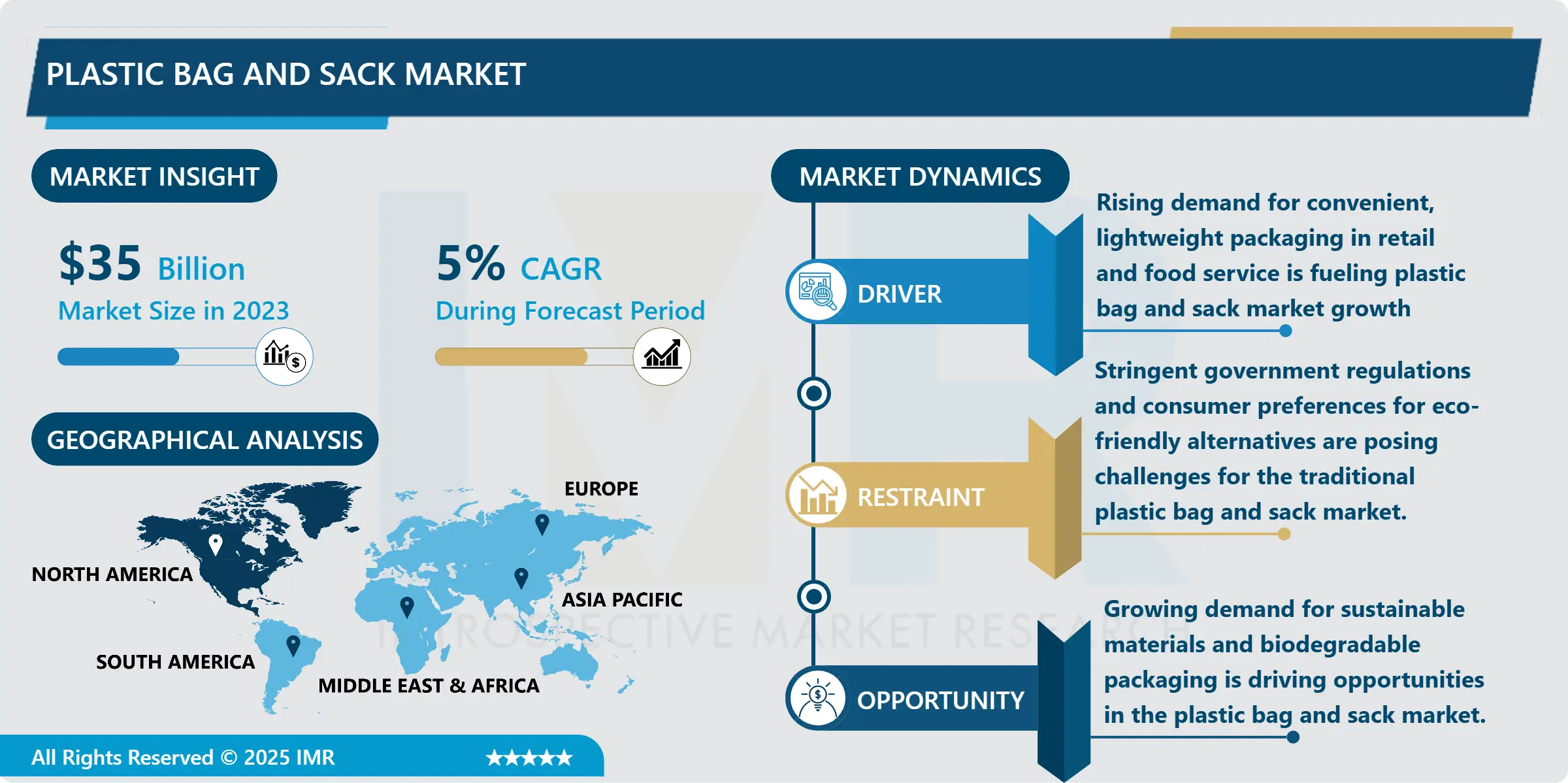
Plastic Bag and Sack Market Trend Analysis:
Shift Towards Sustainable Materials
-
The environmental factor is the most prominent trend affecting the plastic bag and sack market for it is fully focused on the sustainable and environmentally friendly materials. Increasingly, consumers and governments are realizing the need to reduce or eliminate waste through use of eco friendly products including biodegradable and compostable bags that are made from plant based plastic and/or recycled content. Business manufacturers also remain in tune with this trend by using their resources in trying to develop eco-friendly packaging materials which can replace the use of plastics and thus reduce the environmental effects caused by plastics. This shift not only assists the organization meet tough regulatory standards but also assists in improving the corporate image of firms to the green buying public thus boosting market share in the green segment.
Adoption of Advanced Manufacturing Technologies
-
Another key trend in the plastic bag and sack market is the adoption of advanced manufacturing technologies, such as automation and digital printing. These innovations improve production efficiency, reduce costs, and enable manufacturers to create customized products that meet specific consumer needs. For example, digital printing technology allows for high-quality graphics and branding on bags, enhancing their appeal in the retail sector. Additionally, advancements in extrusion and sealing techniques contribute to the production of stronger, more durable bags, further enhancing their functionality. As technology continues to evolve, manufacturers that embrace these advancements will likely gain a competitive edge in the dynamic plastic bag and sack market.
Plastic Bag and Sack Market Segment Analysis:
Plastic Bag and Sack Market is Segmented on the basis of Material Type, Bio-Degradable, Product Type, Application, Institutional, and Region.
By Material Type, Low-density polyethylene (LDPE) segment is expected to dominate the market during the forecast period
-
The market is categorized by material type of plastic bags and sack like HDPE, LDPE, LLDPE, PP, PS, and many others which are non-biodegradable. HDPE bags are stronger and denser and therefore preferred for tough uses while LDPE bags are more flexible and clearer and therefore used in shops. LDPE has improved puncture resistance and finds its use in applications like agricultural films. Polypproplen bags are known to have the most versatility and they are widely used in food packaging and in the bulk packaging systems. Poly styrene though used less frequently is used where there is a need for more strength or hardness than that which is offered by expandable polystyrene. Different types of materials indicate that manufacturers have wide ranges of products that look at fulfilling different needs for various industries, thus contributing to the growth of the plastic bag and sack market even if facing changing consumer trends and strict measures.
By Application, Clothing & Apparel segment expected to held the largest share
-
The market of plastic bag and sack is profoundly impacted by the generalized utility pervading largely through the different sectors from retail and consumer. Here, grocery product and food & beverage packaging take the biggest slice as plastic bags provide convenience and protection, and most importantly moisture what is paramount in food products. The same applies to the kind of packaging material such as plastic bags, which are highly popular for use in the clothing and apparels industry since they are lighter, cheaper than other packaging materials, and also can have brand designs to make them highly visible to the customers. Besides, other uses include the use in industries, health sector, and in the production of personal products making the market wider. With the changing demographics shifting towards convenience and environmental concerns the need for increasingly sophisticated and sustainability conscious plastic bags and sacks in these applications defines the possibilities for growth in the market.
Plastic Bag and Sack Market Regional Insights:
Asia-Pacific is expected to witness high growth during the forecast period of 2024 to 2034.
-
The Asia Pacific region is expected to have high growth of plastic bag and sack market in the projected timeframe of 2024 to 2034. The one that grow up because many factors like: Urbanization in Asia, increase in disposable income, and a trend for the use of convenient packaging in retail and food service and others industries, including e-commerce. According to the report, it is clearly seen that as the consumer in the emerging economies gets wealthier there is increasing inclination towards the packaged goods which, in turn, mandates the need for packaging solutions that are flexible and cost effective. In addition, the shift towards sustainability in the region is already applying pressure on manufacturers to offer equally sustainable solutions which are in line with the trends globally to cut down on the use of plastics. Under these dynamics, Asia-Pacific market is poised for strong growth, which as makes it area of interest to players in the plastic bag and sack business.
Active Key Players in the Plastic Bag and Sack Market:
-
Berry Global Inc. (USA)
- Mondi (Austria)
- Amcor plc (Switzerland)
- Inteplast Group (USA)
- Smurfit Kappa (Ireland)
- Novolex (USA)
- Bischof+Klein SE & Co. KG (Germany)
- Alfa Poly Plast (India)
- Goglio SpA (Italy)
- ARIHANT PACKAGING (India)
- ProAmpac (USA)
- Schur (Netherlands)
- Starlinger & Co Gesellschaft m.b.H. (Austria)
- Packman Packaging Private Limited (India)
- Knack Packaging Pvt. Ltd. (India)
- The Buckeye Bag Company (USA)
- Kanpur Plastipack Limited (India)
- Fujian Yangqiang Plastic Products Co., Ltd. (China)
- VAVA PACK CO., LTD. (Vietnam)
- Leadpacks (Xiamen) Environmental Protection Packing Co., Ltd. (China), and other Active Players
|
Global Plastic Bag and Sack Market |
|||
|
Base Year: |
2023 |
Forecast Period: |
2024-2032 |
|
Historical Data: |
2017 to 2023 |
Market Size in 2023: |
USD 35.1 Billion |
|
Forecast Period 2024-32 CAGR: |
5% |
Market Size in 2032: |
USD 51.7 Billion |
|
Segments Covered: |
By Material Type |
|
|
|
Bio-Degradable |
|
||
|
By Product Type |
|
||
|
By Application |
|
||
|
Institutional |
|
||
|
By Region |
|
||
|
Key Market Drivers: |
|
||
|
Key Market Restraints: |
|
||
|
Key Opportunities: |
|
||
|
Companies Covered in the report: |
|
||
Chapter 1: Introduction
1.1 Scope and Coverage
Chapter 2:Executive Summary
Chapter 3: Market Landscape
3.1 Market Dynamics
3.1.1 Drivers
3.1.2 Restraints
3.1.3 Opportunities
3.1.4 Challenges
3.2 Market Trend Analysis
3.3 PESTLE Analysis
3.4 Porter's Five Forces Analysis
3.5 Industry Value Chain Analysis
3.6 Ecosystem
3.7 Regulatory Landscape
3.8 Price Trend Analysis
3.9 Patent Analysis
3.10 Technology Evolution
3.11 Investment Pockets
3.12 Import-Export Analysis
Chapter 4: Plastic Bag and Sack Market by Material Type
4.1 Plastic Bag and Sack Market Snapshot and Growth Engine
4.2 Plastic Bag and Sack Market Overview
4.3 Non-Bio-Degradable High-density polyethylene (HDPE)
4.3.1 Introduction and Market Overview
4.3.2 Historic and Forecasted Market Size in Value USD and Volume Units (2017-2032F)
4.3.3 Key Market Trends, Growth Factors and Opportunities
4.3.4 Non-Bio-Degradable High-density polyethylene (HDPE): Geographic Segmentation Analysis
4.4 Low-density polyethylene (LDPE)
4.4.1 Introduction and Market Overview
4.4.2 Historic and Forecasted Market Size in Value USD and Volume Units (2017-2032F)
4.4.3 Key Market Trends, Growth Factors and Opportunities
4.4.4 Low-density polyethylene (LDPE): Geographic Segmentation Analysis
4.5 Linear low-density polyethylene (LLDPE)
4.5.1 Introduction and Market Overview
4.5.2 Historic and Forecasted Market Size in Value USD and Volume Units (2017-2032F)
4.5.3 Key Market Trends, Growth Factors and Opportunities
4.5.4 Linear low-density polyethylene (LLDPE): Geographic Segmentation Analysis
4.6 Polypropylene (PP)
4.6.1 Introduction and Market Overview
4.6.2 Historic and Forecasted Market Size in Value USD and Volume Units (2017-2032F)
4.6.3 Key Market Trends, Growth Factors and Opportunities
4.6.4 Polypropylene (PP): Geographic Segmentation Analysis
4.7 Polystyrene (PS)
4.7.1 Introduction and Market Overview
4.7.2 Historic and Forecasted Market Size in Value USD and Volume Units (2017-2032F)
4.7.3 Key Market Trends, Growth Factors and Opportunities
4.7.4 Polystyrene (PS): Geographic Segmentation Analysis
4.8 Others) Bio-Degradable (Polylactic acid (PLA)
4.8.1 Introduction and Market Overview
4.8.2 Historic and Forecasted Market Size in Value USD and Volume Units (2017-2032F)
4.8.3 Key Market Trends, Growth Factors and Opportunities
4.8.4 Others) Bio-Degradable (Polylactic acid (PLA): Geographic Segmentation Analysis
4.9 Polyhydroxyalkanoates (PHA)
4.9.1 Introduction and Market Overview
4.9.2 Historic and Forecasted Market Size in Value USD and Volume Units (2017-2032F)
4.9.3 Key Market Trends, Growth Factors and Opportunities
4.9.4 Polyhydroxyalkanoates (PHA): Geographic Segmentation Analysis
4.10 Starch Blends
4.10.1 Introduction and Market Overview
4.10.2 Historic and Forecasted Market Size in Value USD and Volume Units (2017-2032F)
4.10.3 Key Market Trends, Growth Factors and Opportunities
4.10.4 Starch Blends: Geographic Segmentation Analysis
4.11 Others)
4.11.1 Introduction and Market Overview
4.11.2 Historic and Forecasted Market Size in Value USD and Volume Units (2017-2032F)
4.11.3 Key Market Trends, Growth Factors and Opportunities
4.11.4 Others): Geographic Segmentation Analysis
Chapter 5: Plastic Bag and Sack Market by Product Type
5.1 Plastic Bag and Sack Market Snapshot and Growth Engine
5.2 Plastic Bag and Sack Market Overview
5.3 T-Shirt Bag
5.3.1 Introduction and Market Overview
5.3.2 Historic and Forecasted Market Size in Value USD and Volume Units (2017-2032F)
5.3.3 Key Market Trends, Growth Factors and Opportunities
5.3.4 T-Shirt Bag: Geographic Segmentation Analysis
5.4 Gusseted Bag
5.4.1 Introduction and Market Overview
5.4.2 Historic and Forecasted Market Size in Value USD and Volume Units (2017-2032F)
5.4.3 Key Market Trends, Growth Factors and Opportunities
5.4.4 Gusseted Bag: Geographic Segmentation Analysis
5.5 Lay Flat Bag
5.5.1 Introduction and Market Overview
5.5.2 Historic and Forecasted Market Size in Value USD and Volume Units (2017-2032F)
5.5.3 Key Market Trends, Growth Factors and Opportunities
5.5.4 Lay Flat Bag: Geographic Segmentation Analysis
5.6 Trash Bag
5.6.1 Introduction and Market Overview
5.6.2 Historic and Forecasted Market Size in Value USD and Volume Units (2017-2032F)
5.6.3 Key Market Trends, Growth Factors and Opportunities
5.6.4 Trash Bag: Geographic Segmentation Analysis
5.7 Rubble Sack
5.7.1 Introduction and Market Overview
5.7.2 Historic and Forecasted Market Size in Value USD and Volume Units (2017-2032F)
5.7.3 Key Market Trends, Growth Factors and Opportunities
5.7.4 Rubble Sack: Geographic Segmentation Analysis
5.8 Woven Sack
5.8.1 Introduction and Market Overview
5.8.2 Historic and Forecasted Market Size in Value USD and Volume Units (2017-2032F)
5.8.3 Key Market Trends, Growth Factors and Opportunities
5.8.4 Woven Sack: Geographic Segmentation Analysis
5.9 Others
5.9.1 Introduction and Market Overview
5.9.2 Historic and Forecasted Market Size in Value USD and Volume Units (2017-2032F)
5.9.3 Key Market Trends, Growth Factors and Opportunities
5.9.4 Others: Geographic Segmentation Analysis
Chapter 6: Plastic Bag and Sack Market by Application
6.1 Plastic Bag and Sack Market Snapshot and Growth Engine
6.2 Plastic Bag and Sack Market Overview
6.3 Retail & Consumer (Grocery Products
6.3.1 Introduction and Market Overview
6.3.2 Historic and Forecasted Market Size in Value USD and Volume Units (2017-2032F)
6.3.3 Key Market Trends, Growth Factors and Opportunities
6.3.4 Retail & Consumer (Grocery Products: Geographic Segmentation Analysis
6.4 Food & Beverage
6.4.1 Introduction and Market Overview
6.4.2 Historic and Forecasted Market Size in Value USD and Volume Units (2017-2032F)
6.4.3 Key Market Trends, Growth Factors and Opportunities
6.4.4 Food & Beverage: Geographic Segmentation Analysis
6.5 Clothing & Apparel
6.5.1 Introduction and Market Overview
6.5.2 Historic and Forecasted Market Size in Value USD and Volume Units (2017-2032F)
6.5.3 Key Market Trends, Growth Factors and Opportunities
6.5.4 Clothing & Apparel: Geographic Segmentation Analysis
6.6 Others)
6.6.1 Introduction and Market Overview
6.6.2 Historic and Forecasted Market Size in Value USD and Volume Units (2017-2032F)
6.6.3 Key Market Trends, Growth Factors and Opportunities
6.6.4 Others): Geographic Segmentation Analysis
6.7 Institutional (Hospitality
6.7.1 Introduction and Market Overview
6.7.2 Historic and Forecasted Market Size in Value USD and Volume Units (2017-2032F)
6.7.3 Key Market Trends, Growth Factors and Opportunities
6.7.4 Institutional (Hospitality: Geographic Segmentation Analysis
6.8 Hospital & Healthcare Facility
6.8.1 Introduction and Market Overview
6.8.2 Historic and Forecasted Market Size in Value USD and Volume Units (2017-2032F)
6.8.3 Key Market Trends, Growth Factors and Opportunities
6.8.4 Hospital & Healthcare Facility: Geographic Segmentation Analysis
6.9 Others)
6.9.1 Introduction and Market Overview
6.9.2 Historic and Forecasted Market Size in Value USD and Volume Units (2017-2032F)
6.9.3 Key Market Trends, Growth Factors and Opportunities
6.9.4 Others): Geographic Segmentation Analysis
6.10 Industrial
6.10.1 Introduction and Market Overview
6.10.2 Historic and Forecasted Market Size in Value USD and Volume Units (2017-2032F)
6.10.3 Key Market Trends, Growth Factors and Opportunities
6.10.4 Industrial: Geographic Segmentation Analysis
Chapter 7: Company Profiles and Competitive Analysis
7.1 Competitive Landscape
7.1.1 Competitive Benchmarking
7.1.2 Plastic Bag and Sack Market Share by Manufacturer (2023)
7.1.3 Industry BCG Matrix
7.1.4 Heat Map Analysis
7.1.5 Mergers and Acquisitions
7.2 BERRY GLOBAL INC. (USA)
7.2.1 Company Overview
7.2.2 Key Executives
7.2.3 Company Snapshot
7.2.4 Role of the Company in the Market
7.2.5 Sustainability and Social Responsibility
7.2.6 Operating Business Segments
7.2.7 Product Portfolio
7.2.8 Business Performance
7.2.9 Key Strategic Moves and Recent Developments
7.2.10 SWOT Analysis
7.3 MONDI (AUSTRIA)
7.4 AMCOR PLC (SWITZERLAND)
7.5 INTEPLAST GROUP (USA)
7.6 SMURFIT KAPPA (IRELAND)
7.7 NOVOLEX (USA)
7.8 BISCHOF+KLEIN SE & CO. KG (GERMANY)
7.9 ALFA POLY PLAST (INDIA)
7.10 GOGLIO SPA (ITALY)
7.11 ARIHANT PACKAGING (INDIA)
7.12 PROAMPAC (USA)
7.13 SCHUR (NETHERLANDS)
7.14 STARLINGER & CO GESELLSCHAFT M.B.H. (AUSTRIA)
7.15 PACKMAN PACKAGING PRIVATE LIMITED (INDIA)
7.16 KNACK PACKAGING PVT. LTD. (INDIA)
7.17 THE BUCKEYE BAG COMPANY (USA)
7.18 KANPUR PLASTIPACK LIMITED (INDIA)
7.19 FUJIAN YANGQIANG PLASTIC PRODUCTS CO. LTD. (CHINA)
7.20 VAVA PACK CO. LTD. (VIETNAM)
7.21 LEADPACKS (XIAMEN) ENVIRONMENTAL PROTECTION PACKING CO. LTD. (CHINA)
7.22 OTHER ACTIVE PLAYERS
Chapter 8: Global Plastic Bag and Sack Market By Region
8.1 Overview
8.2. North America Plastic Bag and Sack Market
8.2.1 Key Market Trends, Growth Factors and Opportunities
8.2.2 Top Key Companies
8.2.3 Historic and Forecasted Market Size by Segments
8.2.4 Historic and Forecasted Market Size By Material Type
8.2.4.1 Non-Bio-Degradable High-density polyethylene (HDPE)
8.2.4.2 Low-density polyethylene (LDPE)
8.2.4.3 Linear low-density polyethylene (LLDPE)
8.2.4.4 Polypropylene (PP)
8.2.4.5 Polystyrene (PS)
8.2.4.6 Others) Bio-Degradable (Polylactic acid (PLA)
8.2.4.7 Polyhydroxyalkanoates (PHA)
8.2.4.8 Starch Blends
8.2.4.9 Others)
8.2.5 Historic and Forecasted Market Size By Product Type
8.2.5.1 T-Shirt Bag
8.2.5.2 Gusseted Bag
8.2.5.3 Lay Flat Bag
8.2.5.4 Trash Bag
8.2.5.5 Rubble Sack
8.2.5.6 Woven Sack
8.2.5.7 Others
8.2.6 Historic and Forecasted Market Size By Application
8.2.6.1 Retail & Consumer (Grocery Products
8.2.6.2 Food & Beverage
8.2.6.3 Clothing & Apparel
8.2.6.4 Others)
8.2.6.5 Institutional (Hospitality
8.2.6.6 Hospital & Healthcare Facility
8.2.6.7 Others)
8.2.6.8 Industrial
8.2.7 Historic and Forecast Market Size by Country
8.2.7.1 US
8.2.7.2 Canada
8.2.7.3 Mexico
8.3. Eastern Europe Plastic Bag and Sack Market
8.3.1 Key Market Trends, Growth Factors and Opportunities
8.3.2 Top Key Companies
8.3.3 Historic and Forecasted Market Size by Segments
8.3.4 Historic and Forecasted Market Size By Material Type
8.3.4.1 Non-Bio-Degradable High-density polyethylene (HDPE)
8.3.4.2 Low-density polyethylene (LDPE)
8.3.4.3 Linear low-density polyethylene (LLDPE)
8.3.4.4 Polypropylene (PP)
8.3.4.5 Polystyrene (PS)
8.3.4.6 Others) Bio-Degradable (Polylactic acid (PLA)
8.3.4.7 Polyhydroxyalkanoates (PHA)
8.3.4.8 Starch Blends
8.3.4.9 Others)
8.3.5 Historic and Forecasted Market Size By Product Type
8.3.5.1 T-Shirt Bag
8.3.5.2 Gusseted Bag
8.3.5.3 Lay Flat Bag
8.3.5.4 Trash Bag
8.3.5.5 Rubble Sack
8.3.5.6 Woven Sack
8.3.5.7 Others
8.3.6 Historic and Forecasted Market Size By Application
8.3.6.1 Retail & Consumer (Grocery Products
8.3.6.2 Food & Beverage
8.3.6.3 Clothing & Apparel
8.3.6.4 Others)
8.3.6.5 Institutional (Hospitality
8.3.6.6 Hospital & Healthcare Facility
8.3.6.7 Others)
8.3.6.8 Industrial
8.3.7 Historic and Forecast Market Size by Country
8.3.7.1 Russia
8.3.7.2 Bulgaria
8.3.7.3 The Czech Republic
8.3.7.4 Hungary
8.3.7.5 Poland
8.3.7.6 Romania
8.3.7.7 Rest of Eastern Europe
8.4. Western Europe Plastic Bag and Sack Market
8.4.1 Key Market Trends, Growth Factors and Opportunities
8.4.2 Top Key Companies
8.4.3 Historic and Forecasted Market Size by Segments
8.4.4 Historic and Forecasted Market Size By Material Type
8.4.4.1 Non-Bio-Degradable High-density polyethylene (HDPE)
8.4.4.2 Low-density polyethylene (LDPE)
8.4.4.3 Linear low-density polyethylene (LLDPE)
8.4.4.4 Polypropylene (PP)
8.4.4.5 Polystyrene (PS)
8.4.4.6 Others) Bio-Degradable (Polylactic acid (PLA)
8.4.4.7 Polyhydroxyalkanoates (PHA)
8.4.4.8 Starch Blends
8.4.4.9 Others)
8.4.5 Historic and Forecasted Market Size By Product Type
8.4.5.1 T-Shirt Bag
8.4.5.2 Gusseted Bag
8.4.5.3 Lay Flat Bag
8.4.5.4 Trash Bag
8.4.5.5 Rubble Sack
8.4.5.6 Woven Sack
8.4.5.7 Others
8.4.6 Historic and Forecasted Market Size By Application
8.4.6.1 Retail & Consumer (Grocery Products
8.4.6.2 Food & Beverage
8.4.6.3 Clothing & Apparel
8.4.6.4 Others)
8.4.6.5 Institutional (Hospitality
8.4.6.6 Hospital & Healthcare Facility
8.4.6.7 Others)
8.4.6.8 Industrial
8.4.7 Historic and Forecast Market Size by Country
8.4.7.1 Germany
8.4.7.2 UK
8.4.7.3 France
8.4.7.4 The Netherlands
8.4.7.5 Italy
8.4.7.6 Spain
8.4.7.7 Rest of Western Europe
8.5. Asia Pacific Plastic Bag and Sack Market
8.5.1 Key Market Trends, Growth Factors and Opportunities
8.5.2 Top Key Companies
8.5.3 Historic and Forecasted Market Size by Segments
8.5.4 Historic and Forecasted Market Size By Material Type
8.5.4.1 Non-Bio-Degradable High-density polyethylene (HDPE)
8.5.4.2 Low-density polyethylene (LDPE)
8.5.4.3 Linear low-density polyethylene (LLDPE)
8.5.4.4 Polypropylene (PP)
8.5.4.5 Polystyrene (PS)
8.5.4.6 Others) Bio-Degradable (Polylactic acid (PLA)
8.5.4.7 Polyhydroxyalkanoates (PHA)
8.5.4.8 Starch Blends
8.5.4.9 Others)
8.5.5 Historic and Forecasted Market Size By Product Type
8.5.5.1 T-Shirt Bag
8.5.5.2 Gusseted Bag
8.5.5.3 Lay Flat Bag
8.5.5.4 Trash Bag
8.5.5.5 Rubble Sack
8.5.5.6 Woven Sack
8.5.5.7 Others
8.5.6 Historic and Forecasted Market Size By Application
8.5.6.1 Retail & Consumer (Grocery Products
8.5.6.2 Food & Beverage
8.5.6.3 Clothing & Apparel
8.5.6.4 Others)
8.5.6.5 Institutional (Hospitality
8.5.6.6 Hospital & Healthcare Facility
8.5.6.7 Others)
8.5.6.8 Industrial
8.5.7 Historic and Forecast Market Size by Country
8.5.7.1 China
8.5.7.2 India
8.5.7.3 Japan
8.5.7.4 South Korea
8.5.7.5 Malaysia
8.5.7.6 Thailand
8.5.7.7 Vietnam
8.5.7.8 The Philippines
8.5.7.9 Australia
8.5.7.10 New Zealand
8.5.7.11 Rest of APAC
8.6. Middle East & Africa Plastic Bag and Sack Market
8.6.1 Key Market Trends, Growth Factors and Opportunities
8.6.2 Top Key Companies
8.6.3 Historic and Forecasted Market Size by Segments
8.6.4 Historic and Forecasted Market Size By Material Type
8.6.4.1 Non-Bio-Degradable High-density polyethylene (HDPE)
8.6.4.2 Low-density polyethylene (LDPE)
8.6.4.3 Linear low-density polyethylene (LLDPE)
8.6.4.4 Polypropylene (PP)
8.6.4.5 Polystyrene (PS)
8.6.4.6 Others) Bio-Degradable (Polylactic acid (PLA)
8.6.4.7 Polyhydroxyalkanoates (PHA)
8.6.4.8 Starch Blends
8.6.4.9 Others)
8.6.5 Historic and Forecasted Market Size By Product Type
8.6.5.1 T-Shirt Bag
8.6.5.2 Gusseted Bag
8.6.5.3 Lay Flat Bag
8.6.5.4 Trash Bag
8.6.5.5 Rubble Sack
8.6.5.6 Woven Sack
8.6.5.7 Others
8.6.6 Historic and Forecasted Market Size By Application
8.6.6.1 Retail & Consumer (Grocery Products
8.6.6.2 Food & Beverage
8.6.6.3 Clothing & Apparel
8.6.6.4 Others)
8.6.6.5 Institutional (Hospitality
8.6.6.6 Hospital & Healthcare Facility
8.6.6.7 Others)
8.6.6.8 Industrial
8.6.7 Historic and Forecast Market Size by Country
8.6.7.1 Turkiye
8.6.7.2 Bahrain
8.6.7.3 Kuwait
8.6.7.4 Saudi Arabia
8.6.7.5 Qatar
8.6.7.6 UAE
8.6.7.7 Israel
8.6.7.8 South Africa
8.7. South America Plastic Bag and Sack Market
8.7.1 Key Market Trends, Growth Factors and Opportunities
8.7.2 Top Key Companies
8.7.3 Historic and Forecasted Market Size by Segments
8.7.4 Historic and Forecasted Market Size By Material Type
8.7.4.1 Non-Bio-Degradable High-density polyethylene (HDPE)
8.7.4.2 Low-density polyethylene (LDPE)
8.7.4.3 Linear low-density polyethylene (LLDPE)
8.7.4.4 Polypropylene (PP)
8.7.4.5 Polystyrene (PS)
8.7.4.6 Others) Bio-Degradable (Polylactic acid (PLA)
8.7.4.7 Polyhydroxyalkanoates (PHA)
8.7.4.8 Starch Blends
8.7.4.9 Others)
8.7.5 Historic and Forecasted Market Size By Product Type
8.7.5.1 T-Shirt Bag
8.7.5.2 Gusseted Bag
8.7.5.3 Lay Flat Bag
8.7.5.4 Trash Bag
8.7.5.5 Rubble Sack
8.7.5.6 Woven Sack
8.7.5.7 Others
8.7.6 Historic and Forecasted Market Size By Application
8.7.6.1 Retail & Consumer (Grocery Products
8.7.6.2 Food & Beverage
8.7.6.3 Clothing & Apparel
8.7.6.4 Others)
8.7.6.5 Institutional (Hospitality
8.7.6.6 Hospital & Healthcare Facility
8.7.6.7 Others)
8.7.6.8 Industrial
8.7.7 Historic and Forecast Market Size by Country
8.7.7.1 Brazil
8.7.7.2 Argentina
8.7.7.3 Rest of SA
Chapter 9 Analyst Viewpoint and Conclusion
9.1 Recommendations and Concluding Analysis
9.2 Potential Market Strategies
Chapter 10 Research Methodology
10.1 Research Process
10.2 Primary Research
10.3 Secondary Research
|
Global Plastic Bag and Sack Market |
|||
|
Base Year: |
2023 |
Forecast Period: |
2024-2032 |
|
Historical Data: |
2017 to 2023 |
Market Size in 2023: |
USD 35.1 Billion |
|
Forecast Period 2024-32 CAGR: |
5% |
Market Size in 2032: |
USD 51.7 Billion |
|
Segments Covered: |
By Material Type |
|
|
|
Bio-Degradable |
|
||
|
By Product Type |
|
||
|
By Application |
|
||
|
Institutional |
|
||
|
By Region |
|
||
|
Key Market Drivers: |
|
||
|
Key Market Restraints: |
|
||
|
Key Opportunities: |
|
||
|
Companies Covered in the report: |
|
||


