




Paint Stripper Market Synopsis:
Paint Stripper Market Size Was Valued at USD 4.13 Billion in 2024, and is Projected to Reach USD 7.91 Billion by 2035, Growing at a CAGR of 6.09 % from 2025-2035.
The paint stripper market is growing as more people and companies need products to remove old paint from surfaces like wood, metal, and concrete. These products are used in many areas, including home renovations, car repairs, and industrial cleaning.
More homeowners are fixing up their houses, and businesses are updating buildings and machines, which increases the demand for paint removers. At the same time, there is a shift toward safer and more eco-friendly paint strippers, as many traditional ones can be harmful to health and the environment. As a result, companies are making new types of paint strippers that are less toxic and better for the planet.
Still, the market has some challenges. Some chemical paint strippers are being banned in certain countries because they are dangerous. Also, people sometimes choose other ways to remove paint, like sanding or using heat tools. In general, the market is moving toward safer, greener solutions while continuing to support a wide range of industries that need reliable ways to remove paint.
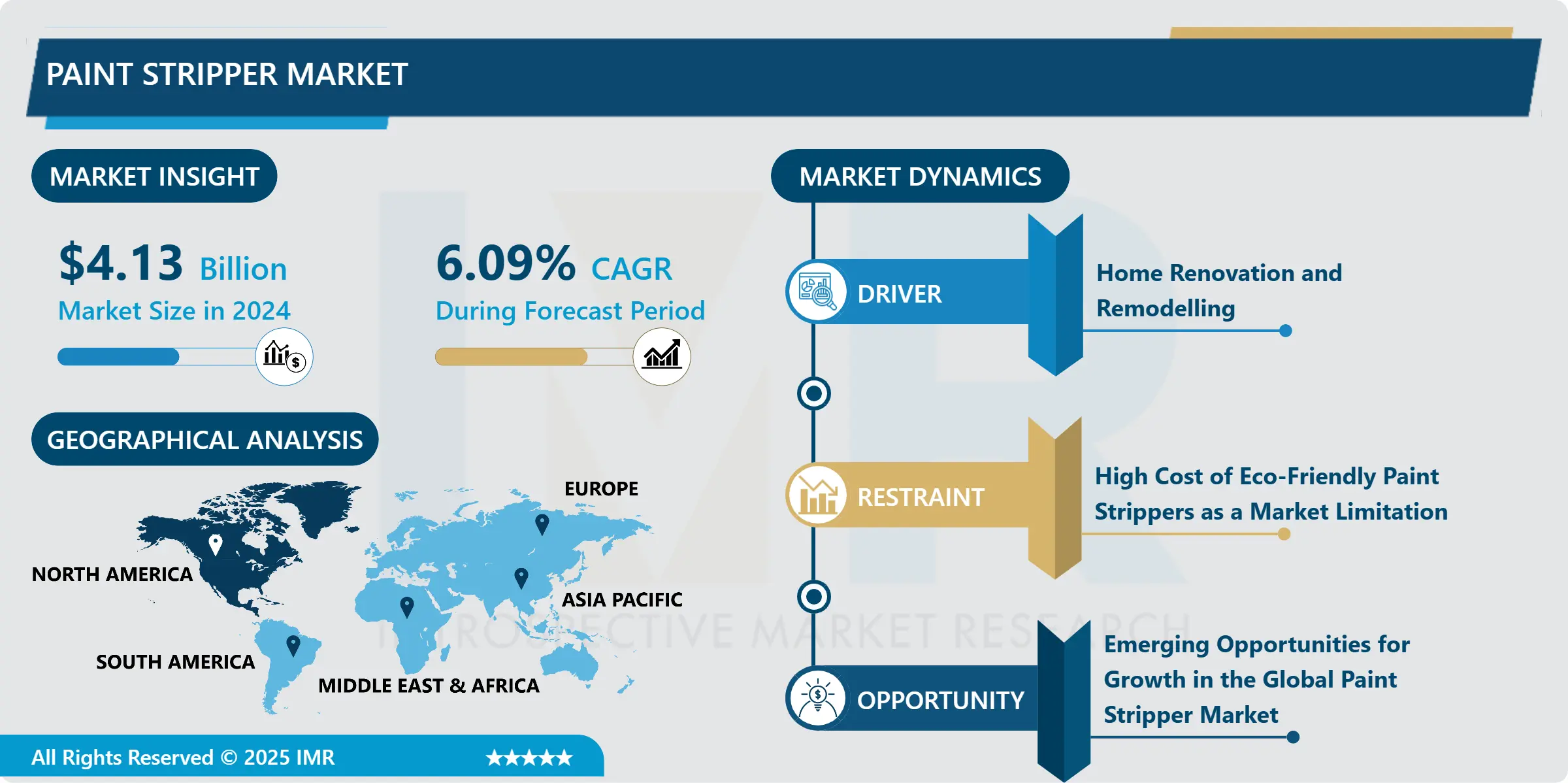
Paint Stripper Market Growth and Trend Analysis:
Paint Stripper Market Growth Driver- Home Renovation and Remodelling
- One of the biggest reasons for the growth of the paint stripper market is the increase in home renovation and remodelling projects. Across the world, more people are choosing to update and improve their homes. This is especially common with older houses, where surfaces like walls, doors, and furniture may have layers of old or damaged paint. Before repainting, it's important to remove this old paint to get a smooth and clean finish. This is where paint strippers become very useful.
- Many homeowners now take on do-it-yourself (DIY) projects, which include repainting rooms, restoring furniture, or fixing up outdoor spaces like fences and decks. Paint strippers help remove old paint easily, saving time and effort. As a result, demand for user-friendly and safe paint remover products is rising.
- In addition, real estate trends also play a role. People buying old homes often want to personalize or modernize them, which usually includes painting work. Before this can be done properly, stripping away the existing paint is necessary.
- Because of all these activities, paint strippers are now seen as an important tool for home improvement. With the growing interest in home design, interior decoration, and DIY makeovers, the need for paint removal products continues to rise steadily making the residential sector a major driver of market growth.
Paint Stripper Market Limiting Factor - High Cost of Eco-Friendly Paint Strippers as a Market Limitation
- One of the major challenges in the paint stripper market is the high cost of eco-friendly products. While these safer and greener paint removers are becoming more popular, especially in countries with strict environmental laws, they are often much more expensive than traditional chemical-based paint strippers.
- Eco-friendly paint strippers are made with safer ingredients that are less harmful to people and the environment. They are designed to have low levels of toxic fumes and are often biodegradable. However, the process of developing and producing these safe products costs more. As a result, companies sell them at higher prices to cover these costs.
- In many regions, especially in developing countries or price-sensitive markets, consumers may not be able or willing to pay extra for these eco-friendly options. They may still choose cheaper, traditional products even if they are more harmful. In some cases, people may turn to alternative methods like sanding or scraping to avoid the cost of paint strippers altogether.
- This price barrier can slow down the growth of eco-friendly products in the global market. Until the prices of safer paint strippers become more competitive, their use may remain limited, especially among average homeowners, small businesses, or in countries where environmental awareness is still growing.
Paint Stripper Market Expansion Opportunity – Emerging Opportunities for Growth in the Global Paint Stripper Market
- The paint stripper market has many chances to grow in the coming years. One big opportunity is the rising demand for eco-friendly and safe products. Many people and governments are now more aware of health and environmental risks. Because of this, they prefer paint strippers that do not contain harmful chemicals. Companies that create non-toxic, biodegradable, and low-odour products can attract more customers and expand their business.
- Another strong growth area is in developing countries, where industries like construction, automotive repair, and home improvement are growing fast. As more buildings, homes, and vehicles are built or repaired, the need for paint removal also increases. People in these regions are also becoming more interested in DIY projects, creating more demand for easy-to-use paint strippers.
- There is also a rising trend of restoring old furniture and vintage items. Many consumers now enjoy repainting and fixing up old chairs, tables, or wooden items. This trend supports the use of paint removers.
- Lastly, online shopping is making it easier for companies to reach new buyers. By selling products on e-commerce platforms, businesses can expand into new markets without opening stores. In short, focusing on safe, easy-to-use products and reaching new customers in growing regions gives the paint stripper market many opportunities for future successBottom of Form
Paint Stripper Market Challenge and Risk - Challenges and Risks Hindering the Growth of the Paint Stripper Market
- The paint stripper market is growing, but it also faces several important challenges and risks that can affect its progress. One of the biggest challenges is the use of harmful chemicals in traditional paint strippers. Some products contain substances like methylene chloride, which can be dangerous to human health. These chemicals may cause breathing problems, skin irritation, or even serious illness with long-term exposure. Because of these health risks, many people are hesitant to use chemical-based paint strippers, especially at home.
- Another key issue is government regulation. Many countries have placed strict rules on the use of toxic ingredients in paint removers. Some have even banned certain chemicals altogether. These rules make it harder for companies to sell older products and force them to develop new, safer formulas, which can be expensive and slow.
- There is also low awareness in some markets, especially in developing countries. People may not know about the dangers of traditional products or the benefits of safer alternatives. This slows down the growth of eco-friendly solutions.
- Lastly, competition from other paint removal methods like sanding or using heat guns reduces the need for chemical paint strippers. These methods are often seen as safer and easier to control. To keep growing, the market must overcome these challenges through innovation and education.Bottom of Form
Paint Stripper Market Segment Analysis:
Paint Stripper Market is segmented based on Type, Application, End-Users, and Region
By Type, Paint Stripper Segment is Expected to Dominate the Market During the Forecast Period
- Solvent-based paint strippers are among the most widely used products for removing paint and coatings from surfaces. They are popular because they work very quickly and are highly effective. These strippers are capable of removing several layers of old or thick paint in just one application, saving time and effort. They are commonly used on a variety of surfaces, including wood, metal, masonry, and concrete.
- These products work by breaking down the chemical structure of the paint, which makes it soft and easy to scrape or wipe away. This strong performance makes solvent-based paint strippers a top choice for professionals in construction, automotive repair, furniture refinishing, and industrial maintenance.
- However, despite their effectiveness, solvent-based strippers often contain harsh chemicals such as methylene chloride, toluene, or acetone. These chemicals can pose serious health risks if they are inhaled or come into contact with the skin. Short-term exposure may lead to dizziness, nausea, headaches, and skin irritation. Long-term exposure has been linked to more serious conditions, including respiratory issues and even organ damage.
- There are also environmental concerns. Many solvent-based products release harmful vapours into the air, which contribute to air pollution and may harm indoor air quality. Because of these risks, many countries have introduced strict safety rules, and some have even banned the use of certain ingredients. As a result, while solvent-based paint strippers remain popular, there's a growing shift toward safer, eco-friendly alternatives that offer similar results without the health and environmental drawbacks.
By Application, Paint Stripper Segment Held the Largest Share in 2024
- In the automotive industry, paint strippers are essential for vehicle repair, restoration, and repainting. When repairing dents or rusted panels, the old paint must be completely removed before applying new coatings. Chemical paint strippers are preferred in many body shops and restoration centres because they save time and ensure clean, smooth surfaces. With the increasing demand for vehicle customization and the restoration of classic or vintage cars, the use of paint strippers in this sector continues to grow.
- Similarly, the furniture refinishing segment is experiencing a rise in popularity, especially due to growing consumer interest in vintage and DIY home décor trends. Many people are now refurbishing old furniture instead of buying new items. Paint strippers are commonly used to remove old paint, varnish, or finishes from wooden chairs, tables, and cabinets. These products are especially useful for preserving fine details on carved or antique furniture, where sanding might damage the design.
- Both sectors rely on the speed and effectiveness of chemical paint strippers, making them top contributors to market demand. As interest in sustainability and restoration grows, these industries are expected to keep driving high usage, especially for user-friendly and eco-safe formulations.
Paint Stripper Market Regional Insights:
North America is Expected to Dominate the Market Over the Forecast Period
- North America holds a major share in the global paint stripper market, with the United States leading the region. The strong presence of key industries such as automotive, aerospace, construction, and furniture refinishing contributes to the high demand for paint stripping products. In the automotive and aerospace sectors, paint strippers are widely used for maintenance, repair, and surface preparation before repainting. These industries require efficient and fast paint removal solutions, making chemical strippers a preferred choice.
- In the construction sector, paint strippers are essential for restoring surfaces during renovation projects. As older buildings are upgraded, paint removal becomes necessary before applying new coatings. The popularity of DIY home improvement and furniture restoration projects has also increased demand in the residential market.
- One of the key factors that sets North America apart is its strict environmental and safety regulations. Regulatory bodies such as the Environmental Protection Agency (EPA) in the U.S. have placed limits on the use of hazardous chemicals like methylene chloride. As a result, there is a growing shift toward eco-friendly and low-toxicity paint strippers.
- This push for safer products has led to increased innovation and product development across the region. Manufacturers are investing in new, biodegradable formulations that meet both performance and safety standards. This trend not only supports market growth but also aligns with consumer demand for healthier, more sustainable products. As a result, North America continues to be a key market for both traditional and green paint stripper solutions.
Paint Stripper Market Active Players:
- 3M Company (North America)
- Absolute Coatings, Inc. (North America)
- AkzoNobel N.V. (Europe)
- Asian Paints Ltd. (Asia-Pacific)
- Axalta Coating Systems (North America)
- Berger Paints India Ltd. (Asia-Pacific)
- Biochem Systems, Inc. (North America)
- Certis Europe B.V. (Europe)
- Cloverdale Paint Inc. (North America)
- Dumond Chemicals, Inc. (North America)
- Eco Solutions Limited (Europe)
- Franmar Chemical, Inc. (North America)
- Henkel AG & Co. KGaA (Europe)
- HG International B.V. (Europe)
- Jotun Group (Europe)
- Kansai Paint Co., Ltd. (Asia-Pacific)
- Krud Kutter, Inc. (North America)
- Motsenbocker’s Lift Off, Inc. (North America)
- Nippon Paint Holdings Co., Ltd. (Asia-Pacific)
- Paint Bull Inc. (North America)
- PPG Industries, Inc. (North America)
- PSM Industries (Asia-Pacific)
- RPM International Inc. (North America)
- Rust-Oleum Corporation (North America)
- Savogran Company (North America)
- Sherwin-Williams Company (North America)
- Sunnyside Corporation (North America)
- Tikkurila Oyj (Europe)
- W.M. Barr & Company, Inc. (North America)
- Wolman Wood Care Products (North America)
- Other Active Players
Key Industry Developments in the Paint Stripper Market:
- In 2024, 3M launched eco-friendly paint strippers that do not contain methylene chloride, aiming to meet growing demand from both industries and consumers, especially in areas with strict environmental regulations.
- In 2022, PPG Industries launched a low-VOC, biodegradable paint stripper designed for the marine and protective coatings sectors, offering strong performance while meeting environmental regulations.
|
Paint Stripper Market |
|||
|
Base Year: |
2024 |
Forecast Period: |
2025-2035 |
|
Historical Data: |
2018 to 2023 |
Market Size in 2024: |
USD 4.13 Billion |
|
Forecast Period 2025-35 CAGR: |
6.09 % |
Market Size in 2035: |
USD 7.91 Billion |
|
Segments Covered: |
By Type |
|
|
|
By Application
|
|
||
|
Distribution Channel |
|
||
|
End-User |
|
||
|
By Region |
|
||
|
Growth Driver: |
|
||
|
Limiting Factor |
|
||
|
Expansion Opportunity |
|
||
|
Challenge and Risk |
|
||
|
Companies Covered in the Report: |
|
||
Chapter 1: Introduction
1.1 Scope and Coverage
Chapter 2:Executive Summary
Chapter 3: Market Landscape
3.1 Market Dynamics and Opportunity Analysis
3.1.1 Growth Drivers
3.1.2 Limiting Factors
3.1.3 Growth Opportunities
3.1.4 Challenges and Risks
3.2 Market Trend Analysis
3.3 Industry Ecosystem
3.4 Industry Value Chain Mapping
3.5 Strategic PESTLE Overview
3.6 Porter's Five Forces Framework
3.7 Regulatory Framework
3.8 Pricing Trend Analysis
3.9 Intellectual Property Review
3.10 Technology Evolution
3.11 Import-Export Analysis
3.12 Consumer Behavior Analysis
3.13 Investment Pocket Analysis
3.14 Go-To Market Strategy
Chapter 4: Paint Stripper Market by Product Type (2018-2035)
4.1 Paint Stripper Market Snapshot and Growth Engine
4.2 Market Overview
4.3 Solvent-Based
4.3.1 Introduction and Market Overview
4.3.2 Historic and Forecasted Market Size in Value USD and Volume Units
4.3.3 Key Market Trends, Growth Factors, and Opportunities
4.3.4 Geographic Segmentation Analysis
4.4 Caustic-Based
4.5 Biochemical
4.6 Others
Chapter 5: Paint Stripper Market by Application (2018-2035)
5.1 Paint Stripper Market Snapshot and Growth Engine
5.2 Market Overview
5.3 Automotive
5.3.1 Introduction and Market Overview
5.3.2 Historic and Forecasted Market Size in Value USD and Volume Units
5.3.3 Key Market Trends, Growth Factors, and Opportunities
5.3.4 Geographic Segmentation Analysis
5.4 Aerospace
5.5 Furniture Refinishing
5.6 Building and Construction
5.7 Others
Chapter 6: Paint Stripper Market by Distribution Channel (2018-2035)
6.1 Paint Stripper Market Snapshot and Growth Engine
6.2 Market Overview
6.3 Online Stores
6.3.1 Introduction and Market Overview
6.3.2 Historic and Forecasted Market Size in Value USD and Volume Units
6.3.3 Key Market Trends, Growth Factors, and Opportunities
6.3.4 Geographic Segmentation Analysis
6.4 Specialty Stores
6.5 Supermarkets/Hypermarkets
6.6 Others
Chapter 7: Paint Stripper Market by End-User (2018-2035)
7.1 Paint Stripper Market Snapshot and Growth Engine
7.2 Market Overview
7.3 Industrial
7.3.1 Introduction and Market Overview
7.3.2 Historic and Forecasted Market Size in Value USD and Volume Units
7.3.3 Key Market Trends, Growth Factors, and Opportunities
7.3.4 Geographic Segmentation Analysis
7.4 Commercial
7.5 Residential
7.6 Others
Chapter 8: Company Profiles and Competitive Analysis
8.1 Competitive Landscape
8.1.1 Competitive Benchmarking
8.1.2 Paint Stripper Market Share by Manufacturer/Service Provider(2024)
8.1.3 Industry BCG Matrix
8.1.4 PArtnerships, Mergers & Acquisitions
8.2 3M COMPANY (NORTH AMERICA)
8.2.1 Company Overview
8.2.2 Key Executives
8.2.3 Company Snapshot
8.2.4 Role of the Company in the Market
8.2.5 Sustainability and Social Responsibility
8.2.6 Operating Business Segments
8.2.7 Product Portfolio
8.2.8 Business Performance
8.2.9 Recent News & Developments
8.2.10 SWOT Analysis
8.3 ABSOLUTE COATINGS
8.4 INC. (NORTH AMERICA)
8.5 AKZONOBEL N.V. (EUROPE)
8.6 ASIAN PAINTS LTD. (ASIA-PACIFIC)
8.7 AXALTA COATING SYSTEMS (NORTH AMERICA)
8.8 BERGER PAINTS INDIA LTD. (ASIA-PACIFIC)
8.9 BIOCHEM SYSTEMS
8.10 INC. (NORTH AMERICA)
8.11 CERTIS EUROPE B.V. (EUROPE)
8.12 CLOVERDALE PAINT INC. (NORTH AMERICA)
8.13 DUMOND CHEMICALS
8.14 INC. (NORTH AMERICA)
8.15 ECO SOLUTIONS LIMITED (EUROPE)
8.16 FRANMAR CHEMICAL
8.17 INC. (NORTH AMERICA)
8.18 HENKEL AG & CO. KGAA (EUROPE)
8.19 HG INTERNATIONAL B.V. (EUROPE)
8.20 JOTUN GROUP (EUROPE)
8.21 KANSAI PAINT CO.
8.22 LTD. (ASIA-PACIFIC)
8.23 KRUD KUTTER
8.24 INC. (NORTH AMERICA)
8.25 MOTSENBOCKER’S LIFT OFF
8.26 INC. (NORTH AMERICA)
8.27 NIPPON PAINT HOLDINGS CO.
8.28 LTD. (ASIA-PACIFIC)
8.29 PAINT BULL INC. (NORTH AMERICA)
8.30 PPG INDUSTRIES
8.31 INC. (NORTH AMERICA)
8.32 PSM INDUSTRIES (ASIA-PACIFIC)
8.33 RPM INTERNATIONAL INC. (NORTH AMERICA)
8.34 RUST-OLEUM CORPORATION (NORTH AMERICA)
8.35 SAVOGRAN COMPANY (NORTH AMERICA)
8.36 SHERWIN-WILLIAMS COMPANY (NORTH AMERICA)
8.37 SUNNYSIDE CORPORATION (NORTH AMERICA)
8.38 TIKKURILA OYJ (EUROPE)
8.39 W.M. BARR & COMPANY
8.40 INC. (NORTH AMERICA)
8.41 WOLMAN WOOD CARE PRODUCTS (NORTH AMERICA)
8.42 AND OTHER ACTIVE PLAYERS
Chapter 9: Global Paint Stripper Market By Region
9.1 Overview
9.2. North America Paint Stripper Market
9.2.1 Key Market Trends, Growth Factors and Opportunities
9.2.2 Top Key Companies
9.2.3 Historic and Forecasted Market Size by Segments
9.2.4 Historic and Forecast Market Size by Country
9.2.4.1 US
9.2.4.2 Canada
9.2.4.3 Mexico
9.3. Eastern Europe Paint Stripper Market
9.3.1 Key Market Trends, Growth Factors and Opportunities
9.3.2 Top Key Companies
9.3.3 Historic and Forecasted Market Size by Segments
9.3.4 Historic and Forecast Market Size by Country
9.3.4.1 Russia
9.3.4.2 Bulgaria
9.3.4.3 The Czech Republic
9.3.4.4 Hungary
9.3.4.5 Poland
9.3.4.6 Romania
9.3.4.7 Rest of Eastern Europe
9.4. Western Europe Paint Stripper Market
9.4.1 Key Market Trends, Growth Factors and Opportunities
9.4.2 Top Key Companies
9.4.3 Historic and Forecasted Market Size by Segments
9.4.4 Historic and Forecast Market Size by Country
9.4.4.1 Germany
9.4.4.2 UK
9.4.4.3 France
9.4.4.4 The Netherlands
9.4.4.5 Italy
9.4.4.6 Spain
9.4.4.7 Rest of Western Europe
9.5. Asia Pacific Paint Stripper Market
9.5.1 Key Market Trends, Growth Factors and Opportunities
9.5.2 Top Key Companies
9.5.3 Historic and Forecasted Market Size by Segments
9.5.4 Historic and Forecast Market Size by Country
9.5.4.1 China
9.5.4.2 India
9.5.4.3 Japan
9.5.4.4 South Korea
9.5.4.5 Malaysia
9.5.4.6 Thailand
9.5.4.7 Vietnam
9.5.4.8 The Philippines
9.5.4.9 Australia
9.5.4.10 New Zealand
9.5.4.11 Rest of APAC
9.6. Middle East & Africa Paint Stripper Market
9.6.1 Key Market Trends, Growth Factors and Opportunities
9.6.2 Top Key Companies
9.6.3 Historic and Forecasted Market Size by Segments
9.6.4 Historic and Forecast Market Size by Country
9.6.4.1 Turkiye
9.6.4.2 Bahrain
9.6.4.3 Kuwait
9.6.4.4 Saudi Arabia
9.6.4.5 Qatar
9.6.4.6 UAE
9.6.4.7 Israel
9.6.4.8 South Africa
9.7. South America Paint Stripper Market
9.7.1 Key Market Trends, Growth Factors and Opportunities
9.7.2 Top Key Companies
9.7.3 Historic and Forecasted Market Size by Segments
9.7.4 Historic and Forecast Market Size by Country
9.7.4.1 Brazil
9.7.4.2 Argentina
9.7.4.3 Rest of SA
Chapter 10 Analyst Viewpoint and Conclusion
Chapter 11 Our Thematic Research Methodology
11.1 Research Process
11.2 Primary Research
11.3 Secondary Research
Chapter 12 Case Study
Chapter 13 Appendix
13.1 Sources
13.2 List of Tables and figures
13.3 Short Forms and Citations
13.4 Assumption and Conversion
13.5 Disclaimer
|
Paint Stripper Market |
|||
|
Base Year: |
2024 |
Forecast Period: |
2025-2035 |
|
Historical Data: |
2018 to 2023 |
Market Size in 2024: |
USD 4.13 Billion |
|
Forecast Period 2025-35 CAGR: |
6.09 % |
Market Size in 2035: |
USD 7.91 Billion |
|
Segments Covered: |
By Type |
|
|
|
By Application
|
|
||
|
Distribution Channel |
|
||
|
End-User |
|
||
|
By Region |
|
||
|
Growth Driver: |
|
||
|
Limiting Factor |
|
||
|
Expansion Opportunity |
|
||
|
Challenge and Risk |
|
||
|
Companies Covered in the Report: |
|
||


