




Food Packaging Equipment Market Synopsis:
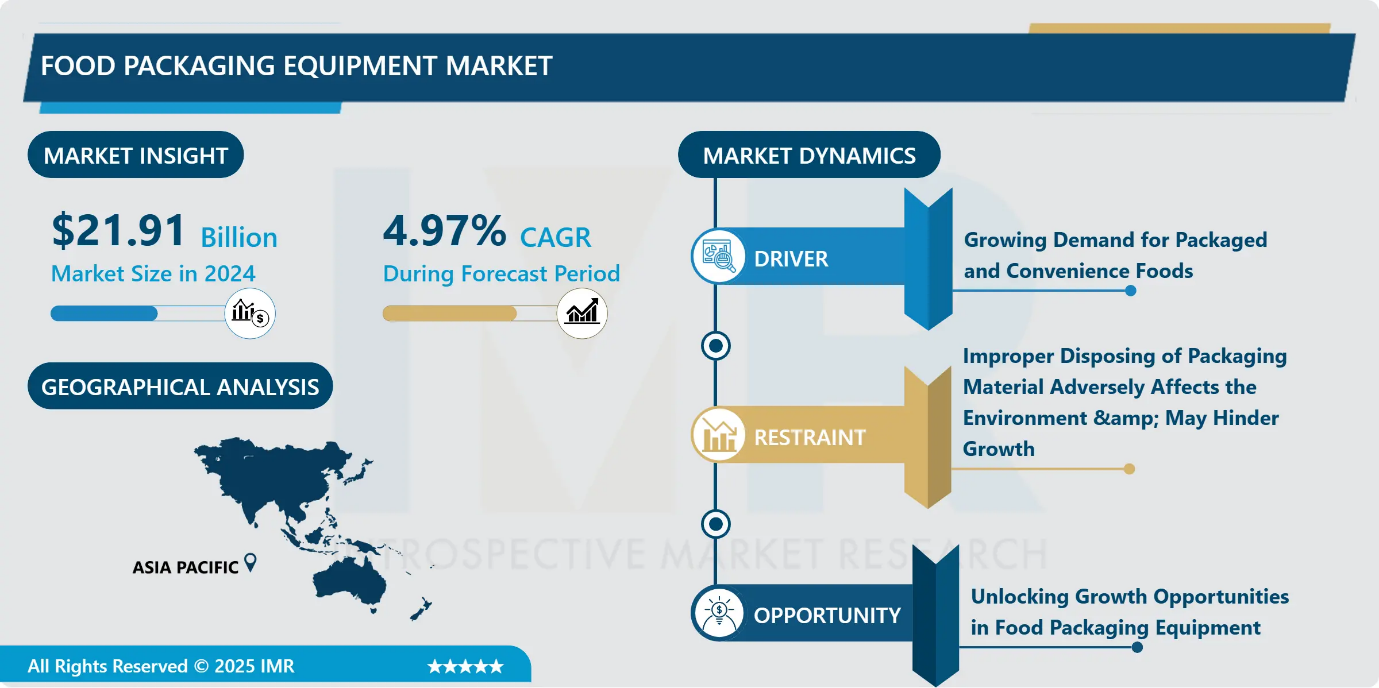
Food Packaging Equipment Market Size Was Valued at USD 21.91 Billion in 2024, and is Projected to Reach USD 37.36 Billion by 2035, Growing at a CAGR of 4.97% From 2025–2035.
The Food Packaging Equipment Market is growing quickly because more people around the world want packaged food. Packaged food is easy to store, carry, and use, which fits well with busy lifestyles and changing habits. People today often look for ready-to-eat or easy-to-cook food that saves time and effort. This makes food companies invest in better machines to pack food quickly, safely, and attractively.
These packaging machines do many jobs, such as filling containers, sealing packs, wrapping products, and labelling. New technologies like automation, robotics, and the Internet of Things (IoT) are helping companies make packaging faster and more efficient. IoT, for example, allows companies to track food from the factory to the store, making sure it stays fresh and safe.
Smart packaging is also becoming popular. It uses sensors to monitor food quality, temperature, and humidity during transport. This helps keep food fresh and reduces waste. Interactive packaging that provides extra information or fun features is also growing, improving customer experience.
Sustainability is another important factor. People want packaging that is eco-friendly and easy to recycle. Food companies are looking for machines that can handle new materials like biodegradable plastics and paper. This helps reduce environmental problems caused by packaging waste.
In short, the Food Packaging Equipment Market is expanding because of growing consumer demand for convenience, safety, technology, and sustainability. This growth is expected to continue in the coming years as food companies adopt newer and smarter packaging solutions.
Food Packaging Equipment Market Growth and Trend Analysis:
Food Packaging Equipment Market Growth Driver - Growing Demand for Packaged and Convenience Foods
-
One of the biggest reasons the food packaging equipment market is growing is because more people want packaged and convenience foods. As more people move to cities and lead busy lives, they don’t have as much time to cook meals at home. This has increased the demand for ready-to-eat, frozen, canned, and microwaveable foods that are quick and easy to prepare.
- These types of foods need to be properly packed to stay fresh, safe, and easy to use. That’s why food companies are now investing more in modern and efficient packaging machines. These machines can quickly pack large amounts of food while keeping it safe and hygienic. They also help companies save time and reduce waste.
- Packaging also plays a big role in attracting customers. When food is packed neatly in boxes, pouches, or trays, and labelled clearly, it becomes easier to store, carry, and use. People are now looking for foods that come in resealable pouches, single-serving packs, or microwave-safe containers. This trend has made food companies look for packaging equipment that can handle these new types of packaging.
- Moreover, packaged foods also need to meet strict safety rules and last longer on store shelves. Advanced packaging equipment helps in sealing food properly and protecting it from air, moisture, and germs. This improves the shelf life of the product and builds trust with consumers.
- In short, the growing demand for convenient, easy-to-use food is encouraging food companies to upgrade their packaging methods, which is helping the food packaging equipment market grow fast.
Food Packaging Equipment Market Limiting Factor - Improper Disposing of Packaging Material Adversely Affects the Environment & May Hinder Growth
-
Improper disposal of packaging materials is a serious problem that harms the environment and may slow down the growth of the food packaging equipment market. Many packaging materials, like plastic wrappers, metal, and cardboard, are made from complex compounds that do not break down easily. When these materials are thrown away carelessly, they can pollute the soil, block water drainage, and cause long-term damage to nature.
- One major concern is that plastic waste, in particular, takes hundreds of years to decompose. As a result, large amounts of waste build up in landfills, rivers, and oceans, affecting wildlife and the environment. These environmental problems have made people more aware of the need for better waste management practices and sustainable packaging options.
- Governments around the world are stepping in to address this issue. For example, the European Union introduced the Packaging and Packaging Waste Directive 94/62/EC. This law focuses on reducing the impact of packaging waste on the environment and encourages recycling and reuse of packaging materials. However, there are also rules that limit the use of recycled materials for packaging food. This is because some recycled materials may release harmful chemicals into the food, which can be dangerous for health.
- These rules and environmental concerns are making companies rethink how they design and dispose of packaging. They need to find solutions that are both eco-friendly and safe for food. If the industry fails to adapt to these changes, it could face stricter regulations, higher costs, and slower growth in the future.
Food Packaging Equipment Market Expansion Opportunity - Unlocking Growth Opportunities in Food Packaging Equipment
-
One major opportunity is in smart packaging technology. This includes using sensors and tracking devices that monitor the condition of food during transportation and storage. These technologies help make sure the food stays fresh longer and reaches customers safely. Companies that invest in these innovations can stand out and grow faster.
- Another opportunity is in the growing demand for eco-friendly and sustainable packaging. More consumers want packaging that is good for the environment and easy to recycle or compost. Businesses that design machines capable of using new, sustainable materials have a chance to lead in this green packaging trend.
- The rise of e-commerce and online grocery shopping also creates opportunities. Packaged foods need special types of packaging that protect products during delivery and appeal to customers when they receive their orders at home. Equipment that can produce customized, durable, and attractive packaging will be in high demand.
- Additionally, emerging markets like Asia, Latin America, and Africa offer huge potential. With growing populations, rising incomes, and changing lifestyles, these regions need more food packaging solutions. Companies expanding into these markets can reach millions of new customers.
- In summary, innovations in smart technology, sustainability, e-commerce, and expanding global markets create strong growth opportunities in the food packaging equipment industry.
Food Packaging Equipment Market Challenge and Risk - High Costs in Advanced Food Packaging Technology
-
One of the biggest challenges in the food packaging equipment market is the high cost of advanced technology. Today, many companies are using modern machines that come with smart features such as automation and the Internet of Things (IoT). These technologies help make the packaging process faster, safer, and more efficient. However, these machines are often very expensive to buy and maintain.
- For small and medium-sized companies, the cost of these advanced packaging machines can be a major problem. Many smaller businesses do not have enough money to invest in the latest equipment. This means they might have to continue using older machines, which are slower and less efficient. As a result, they can fall behind their competitors who use modern technology.
- Even for bigger companies, the high cost means they have to carefully plan their investments. They need to make sure the new machines will bring enough benefits to cover the costs. Sometimes, the cost of buying, installing, and training staff to use new equipment can be very high.
- Another issue is the maintenance and repair costs of these advanced machines. Because they use complex technology, fixing them when they break down can be expensive and take time. This downtime can affect production and cause financial losses.
- In summary, while advanced packaging technology offers many advantages, its high cost creates a barrier for many companies. Finding ways to reduce these costs or offer affordable solutions can help more businesses adopt modern packaging equipment and grow in the market.
Food Packaging Equipment Market Segment Analysis:
Food Packaging Equipment Market is segmented based on Type, Application, End-Users, and Region
By Type, Food Packaging Equipment segment is expected to dominate the market during the forecast period
-
Filling equipment is one of the most important machines used in the food packaging industry. Its main job is to put food, liquids, powders, or other products into containers like bottles, jars, cans, or pouches. This process is called “filling.” Without filling machines, packaging food products safely and quickly would be very hard.
- There are many types of filling equipment designed for different products. For example, liquid fillers are used for drinks like juice, milk, or sauces. Powder fillers handle products like flour, spices, or sugar. Solid fillers can fill things like nuts or candies into packages. Each type of filler is built to make sure the right amount of product goes into each container, avoiding waste or shortages.
- Filling machines are designed to be fast and accurate. They help companies produce large amounts of packaged food quickly. This is very important because the food industry often needs to meet high demand. Filling machines also help keep the food safe by reducing human contact, which lowers the chance of contamination.
- Some modern filling equipment includes smart technology like sensors and automation. These features make the machines more efficient and easier to control. They can detect problems like spills or incorrect filling and stop the process to fix the issue.
- In summary, filling equipment plays a key role in food packaging. It ensures products are packed accurately, safely, and quickly. This helps food companies provide good quality products to customers and meet growing demands in the market.Top of Form
By Application, Food Packaging Equipment segment held the largest share in 2024
-
Food packaging equipment is used differently depending on the type of food product. The main applications include bakery and confectionery products, meat and poultry, dairy products, beverages, and other food items. Each type of food requires special machines to package it safely and effectively.
- For bakery and confectionery products like bread, cakes, cookies, and chocolates, packaging machines often use wrapping, bagging, or tray sealing methods. These machines help keep the products fresh by protecting them from air and moisture. They also make it easy to transport and display these delicate items without damage.
- In the case of meat and poultry products, packaging equipment must keep the food fresh and prevent contamination. Vacuum packaging and modified atmosphere packaging machines are often used. These machines remove air or replace it with special gases to extend shelf life and keep the meat safe.
- Dairy products such as milk, cheese, and yogurt require equipment that can handle liquids and semi-solids. Bottling machines are used for milk, while cup filling and sealing machines pack yogurt and other dairy items. These machines ensure hygiene and prevent spoilage.
- For beverages, bottling machines fill and seal bottles of water, juice, soda, and other drinks. These machines work quickly and accurately to keep drinks fresh and prevent leaks. Other food products, like snacks, frozen foods, and ready meals, also need specific packaging machines to keep them safe and fresh during transport and storage.
Food Packaging Equipment Market Regional Insights:
Asia Pacific is Expected to Dominate the Market Over the Forecast period.
-
The Asia Pacific region is expected to lead the global food packaging equipment market during the forecast period. This growth is mainly due to the rising demand for packaged and processed food in countries like China, India, Japan, and other Southeast Asian nations. As people in these countries get busier and their incomes increase, they prefer convenient and ready-to-eat food options. This trend has created a higher need for efficient and modern packaging equipment.
- Additionally, the food and beverage industry in the Asia Pacific region is growing quickly, with many local and international companies expanding their production. To meet safety and hygiene standards, these companies are investing in advanced packaging technologies. Governments are also supporting the industry by improving infrastructure and encouraging better food safety practices.
- Another reason for the region’s growth is the availability of low-cost labor and raw materials, which helps manufacturers lower their production costs. Many global packaging equipment companies are setting up their factories in Asia to take advantage of these benefits.
- Overall, the combination of strong consumer demand, industrial growth, government support, and lower costs is helping Asia Pacific become the top region in the food packaging equipment market. As these trends continue, the region is likely to remain the global leader in this sector over the coming years.
Food Packaging Equipment Market Active Players:
- ARPAC LLC (U.S.)
- Barry-Wehmiller Companies, Inc. (U.S.)
- Bradman Lake Group Ltd. (United Kingdom)
- Cama Group (Italy)
- Coesia S.p.A. (Italy)
- Delkor Systems, Inc. (U.S.)
- Econocorp Inc. (U.S.)
- FUJI Machinery Co., Ltd. (Japan)
- GEA Group Aktiengesellschaft (Germany)
- I.M.A. INDUSTRIA MACCHINE AUTOMATICHE S.P.A. (Italy)
- Illinois Tool Works Inc. (U.S.)
- IMA Dairy & Food USA (U.S.)
- Ishida Co., Ltd. (Japan)
- Kliklok-Woodman (U.S.)
- Krones AG (Germany)
- Marchesini Group S.p.A. (Italy)
- Mespack S.L. (Spain)
- MULTIVAC (Germany)
- Nordson Corporation (U.S.)
- Omori Machinery Co., Ltd. (Japan)
- OPTIMA Packaging Group GmbH (Germany)
- PAC Machinery (U.S.)
- ProMach Inc. (U.S.)
- Robert Bosch Packaging Technology GmbH (Germany)
- Rovema GmbH (Germany)
- Serac Group (France)
- Sidel Group (France)
- Syntegon Technology GmbH (Germany)
- Tetra Pak International S.A. (Switzerland)
- Triangle Package Machinery Company (U.S.)
- Other active players
|
Food Packaging Equipment Market
|
|||
|
Base Year: |
2024 |
Forecast Period: |
2025-2035 |
|
Historical Data: |
2018 to 2024 |
Market Size in 2024: |
USD 21.91 Billion
|
|
Forecast Period 2025-35 CAGR: |
4.97% |
Market Size in 2035: |
USD 37.36 Billion |
|
Segments Covered: |
By Type |
|
|
|
By Application |
|
||
|
By Region |
|
||
|
Growth Driver: |
|
||
|
Limiting Factor |
|
||
|
Expansion Opportunity |
|
||
|
Challenge and Risk |
|
||
|
Companies Covered in the Report: |
|
||
Chapter 1: Introduction
1.1 Scope and Coverage
Chapter 2:Executive Summary
Chapter 3: Market Landscape
3.1 Market Dynamics and Opportunity Analysis
3.1.1 Growth Drivers
3.1.2 Limiting Factors
3.1.3 Growth Opportunities
3.1.4 Challenges and Risks
3.2 Market Trend Analysis
3.3 Industry Ecosystem
3.4 Industry Value Chain Mapping
3.5 Strategic PESTLE Overview
3.6 Porter's Five Forces Framework
3.7 Regulatory Framework
3.8 Pricing Trend Analysis
3.9 Intellectual Property Review
3.10 Technology Evolution
3.11 Import-Export Analysis
3.12 Consumer Behavior Analysis
3.13 Investment Pocket Analysis
3.14 Go-To Market Strategy
Chapter 4: Food Packaging Equipment Market by Equipment Type (2018-2035)
4.1 Food Packaging Equipment Market Snapshot and Growth Engine
4.2 Market Overview
4.3 Filling
4.3.1 Introduction and Market Overview
4.3.2 Historic and Forecasted Market Size in Value USD and Volume Units
4.3.3 Key Market Trends, Growth Factors, and Opportunities
4.3.4 Geographic Segmentation Analysis
4.4 Bottling
4.5 Case Cartooning
4.6 Labelling
4.7 Palletizing
Chapter 5: Food Packaging Equipment Market by Application (2018-2035)
5.1 Food Packaging Equipment Market Snapshot and Growth Engine
5.2 Market Overview
5.3 Bakery and Confectionery Products
5.3.1 Introduction and Market Overview
5.3.2 Historic and Forecasted Market Size in Value USD and Volume Units
5.3.3 Key Market Trends, Growth Factors, and Opportunities
5.3.4 Geographic Segmentation Analysis
5.4 Meat and Poultry Products
5.5 Dairy Products
5.6 Beverages
5.7 Others
Chapter 6: Company Profiles and Competitive Analysis
6.1 Competitive Landscape
6.1.1 Competitive Benchmarking
6.1.2 Food Packaging Equipment Market Share by Manufacturer/Service Provider(2024)
6.1.3 Industry BCG Matrix
6.1.4 PArtnerships, Mergers & Acquisitions
6.2 ARPAC LLC (U.S.)
6.2.1 Company Overview
6.2.2 Key Executives
6.2.3 Company Snapshot
6.2.4 Role of the Company in the Market
6.2.5 Sustainability and Social Responsibility
6.2.6 Operating Business Segments
6.2.7 Product Portfolio
6.2.8 Business Performance
6.2.9 Recent News & Developments
6.2.10 SWOT Analysis
6.3 BARRY-WEHMILLER COMPANIES
6.4 INC. (U.S.)
6.5 BRADMAN LAKE GROUP LTD. (UNITED KINGDOM)
6.6 CAMA GROUP (ITALY)
6.7 COESIA S.P.A. (ITALY)
6.8 DELKOR SYSTEMS
6.9 INC. (U.S.)
6.10 ECONOCORP INC. (U.S.)
6.11 FUJI MACHINERY CO.
6.12 LTD. (JAPAN)
6.13 GEA GROUP AKTIENGESELLSCHAFT (GERMANY)
6.14 I.M.A. INDUSTRIA MACCHINE AUTOMATICHE S.P.A. (ITALY)
6.15 ILLINOIS TOOL WORKS INC. (U.S.)
6.16 IMA DAIRY & FOOD USA (U.S.)
6.17 ISHIDA CO.
6.18 LTD. (JAPAN)
6.19 KLIKLOK-WOODMAN (U.S.)
6.20 KRONES AG (GERMANY)
6.21 MARCHESINI GROUP S.P.A. (ITALY)
6.22 MESPACK S.L. (SPAIN)
6.23 MULTIVAC (GERMANY)
6.24 NORDSON CORPORATION (U.S.)
6.25 OMORI MACHINERY CO.
6.26 LTD. (JAPAN)
6.27 OPTIMA PACKAGING GROUP GMBH (GERMANY)
6.28 PAC MACHINERY (U.S.)
6.29 PROMACH INC. (U.S.)
6.30 ROBERT BOSCH PACKAGING TECHNOLOGY GMBH (GERMANY)
6.31 ROVEMA GMBH (GERMANY)
6.32 SERAC GROUP (FRANCE)
6.33 SIDEL GROUP (FRANCE)
6.34 SYNTEGON TECHNOLOGY GMBH (GERMANY)
6.35 TETRA PAK INTERNATIONAL S.A. (SWITZERLAND)
6.36 TRIANGLE PACKAGE MACHINERY COMPANY (U.S.)
6.37 AND OTHER ACTIVE PLAYERS
Chapter 7: Global Food Packaging Equipment Market By Region
7.1 Overview
7.2. North America Food Packaging Equipment Market
7.2.1 Key Market Trends, Growth Factors and Opportunities
7.2.2 Top Key Companies
7.2.3 Historic and Forecasted Market Size by Segments
7.2.4 Historic and Forecast Market Size by Country
7.2.4.1 US
7.2.4.2 Canada
7.2.4.3 Mexico
7.3. Eastern Europe Food Packaging Equipment Market
7.3.1 Key Market Trends, Growth Factors and Opportunities
7.3.2 Top Key Companies
7.3.3 Historic and Forecasted Market Size by Segments
7.3.4 Historic and Forecast Market Size by Country
7.3.4.1 Russia
7.3.4.2 Bulgaria
7.3.4.3 The Czech Republic
7.3.4.4 Hungary
7.3.4.5 Poland
7.3.4.6 Romania
7.3.4.7 Rest of Eastern Europe
7.4. Western Europe Food Packaging Equipment Market
7.4.1 Key Market Trends, Growth Factors and Opportunities
7.4.2 Top Key Companies
7.4.3 Historic and Forecasted Market Size by Segments
7.4.4 Historic and Forecast Market Size by Country
7.4.4.1 Germany
7.4.4.2 UK
7.4.4.3 France
7.4.4.4 The Netherlands
7.4.4.5 Italy
7.4.4.6 Spain
7.4.4.7 Rest of Western Europe
7.5. Asia Pacific Food Packaging Equipment Market
7.5.1 Key Market Trends, Growth Factors and Opportunities
7.5.2 Top Key Companies
7.5.3 Historic and Forecasted Market Size by Segments
7.5.4 Historic and Forecast Market Size by Country
7.5.4.1 China
7.5.4.2 India
7.5.4.3 Japan
7.5.4.4 South Korea
7.5.4.5 Malaysia
7.5.4.6 Thailand
7.5.4.7 Vietnam
7.5.4.8 The Philippines
7.5.4.9 Australia
7.5.4.10 New Zealand
7.5.4.11 Rest of APAC
7.6. Middle East & Africa Food Packaging Equipment Market
7.6.1 Key Market Trends, Growth Factors and Opportunities
7.6.2 Top Key Companies
7.6.3 Historic and Forecasted Market Size by Segments
7.6.4 Historic and Forecast Market Size by Country
7.6.4.1 Turkiye
7.6.4.2 Bahrain
7.6.4.3 Kuwait
7.6.4.4 Saudi Arabia
7.6.4.5 Qatar
7.6.4.6 UAE
7.6.4.7 Israel
7.6.4.8 South Africa
7.7. South America Food Packaging Equipment Market
7.7.1 Key Market Trends, Growth Factors and Opportunities
7.7.2 Top Key Companies
7.7.3 Historic and Forecasted Market Size by Segments
7.7.4 Historic and Forecast Market Size by Country
7.7.4.1 Brazil
7.7.4.2 Argentina
7.7.4.3 Rest of SA
Chapter 8 Analyst Viewpoint and Conclusion
Chapter 9 Our Thematic Research Methodology
9.1 Research Process
9.2 Primary Research
9.3 Secondary Research
Chapter 10 Case Study
Chapter 11 Appendix
11.1 Sources
11.2 List of Tables and figures
11.3 Short Forms and Citations
11.4 Assumption and Conversion
11.5 Disclaimer
|
Food Packaging Equipment Market
|
|||
|
Base Year: |
2024 |
Forecast Period: |
2025-2035 |
|
Historical Data: |
2018 to 2024 |
Market Size in 2024: |
USD 21.91 Billion
|
|
Forecast Period 2025-35 CAGR: |
4.97% |
Market Size in 2035: |
USD 37.36 Billion |
|
Segments Covered: |
By Type |
|
|
|
By Application |
|
||
|
By Region |
|
||
|
Growth Driver: |
|
||
|
Limiting Factor |
|
||
|
Expansion Opportunity |
|
||
|
Challenge and Risk |
|
||
|
Companies Covered in the Report: |
|
||


