




Electronic Dictionary Market Synopsis
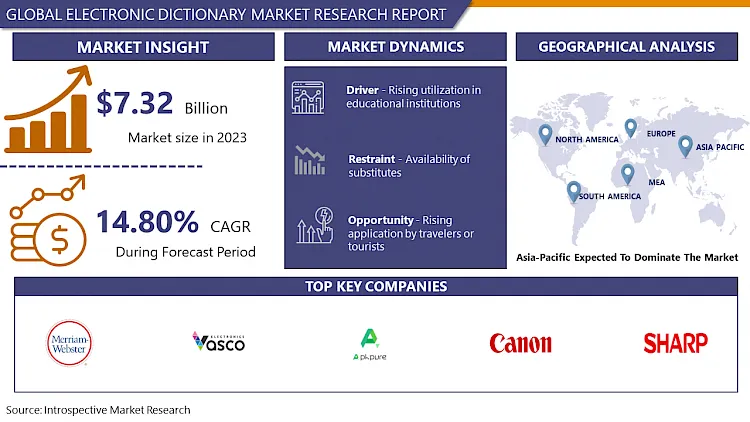
The Global Electronic Dictionary market was valued at USD 7.32 billion in 2023 and is expected to reach USD 25.35 billion by the year 2032, at a CAGR of 14.80%.
Theelectronic dictionary market encompasses the development, production, and distribution of portable devices or software applications designed to provide language translation, definitions, and related reference material electronically. These devices often include features such as text-to-speech capabilities, bilingual dictionaries, language learning tools, and sometimes internet connectivity for accessing updated content. Electronic dictionaries are widely used by students, language enthusiasts, travelers, and professionals in need of quick access to accurate definitions, translations, and other linguistic resources. Over time, these products have evolved from simple handheld devices to sophisticated apps running on smartphones and tablets, offering users convenient and comprehensive language support on the go.
The electronic dictionary market has experienced substantial growth and innovation over the past few years. This growth is largely attributed to advancements in technology, which have transformed the way people access and interact with language tools. Electronic dictionaries have become increasingly sophisticated, offering features that cater to diverse language needs, from translation and pronunciation assistance to vocabulary building and contextual usage.
One key driver of market expansion is the rising demand for portable and multifunctional language tools. Modern electronic dictionaries are compact, and lightweight, and often include additional functionalities such as voice recognition, language translation, and integration with mobile devices. This versatility appeals to a broad spectrum of users, including students, travelers, professionals, and language enthusiasts.
Another significant trend is the integration of artificial intelligence (AI) and machine learning technologies into electronic dictionaries. AI-powered dictionaries can provide more accurate translations, adaptive learning experiences, and personalized recommendations based on user interactions. These capabilities enhance the overall user experience and contribute to the increasing popularity of electronic dictionaries in both consumer and educational markets.
The electronic dictionary market is also witnessing growing adoption in educational institutions. These devices are being integrated into language learning curricula, offering students immediate access to definitions, synonyms, and contextual usage examples. The real-time feedback and interactive features of electronic dictionaries contribute to more engaging and effective language learning experiences.
In summary, the electronic dictionary market continues to evolve with technological advancements, offering consumers innovative language solutions that are portable, multifunctional, and increasingly intelligent. The future outlook for this market remains positive as demand grows for tools that facilitate language learning, communication, and cross-cultural understanding in an increasingly globalized world.
.webp)
Electronic Dictionary Market Trend Analysis
Security Concerns in Educational Settings
- Security concerns related to device usage in educational settings, particularly regarding electronic dictionaries, stem from several key factors. Firstly, the widespread adoption of smartphones and tablets as educational tools has raised concerns about data privacy and device security. These devices, often used for accessing electronic dictionaries, may contain sensitive information or be vulnerable to unauthorized access or malware. In classroom environments where multiple students use personal devices, maintaining data integrity and ensuring secure usage becomes challenging.
- Another aspect of security concerns in educational settings is the potential for distractions caused by mobile devices. Students using electronic dictionaries on smartphones or tablets may be tempted to engage in non-educational activities, such as social media or gaming, which can detract from learning objectives. This distraction not only affects individual learning outcomes but also impacts classroom management and overall student engagement.
- In response to these challenges, educational institutions may implement policies or technologies aimed at mitigating security risks associated with mobile device usage. This could involve deploying mobile device management (MDM) solutions to enforce security protocols, such as device encryption and remote data wiping. Additionally, educators and administrators may emphasize responsible device usage and digital citizenship to promote a safe and focused learning environment. However, balancing the educational benefits of electronic dictionaries with security considerations remains an ongoing challenge in modern classrooms.
Challenges of Limited Language Support in Electronic Dictionaries
- Limited language support poses a significant restraint for electronic dictionaries, especially in catering to niche or less commonly spoken languages. One key challenge is the development and maintenance of comprehensive language databases that cover a wide range of linguistic variations. Many electronic dictionaries prioritize widely spoken languages, such as English, Spanish, Mandarin, and French, due to their large user bases and commercial viability. As a result, users seeking language support for less mainstream languages may find limited or incomplete resources available in electronic dictionary platforms.
- For language learners or individuals residing in regions where niche languages are spoken, the absence of adequate language support can hinder the effectiveness and practicality of electronic dictionaries. Without access to accurate translations, definitions, or pronunciation guides in their native or target languages, users may resort to traditional paper dictionaries or alternative digital resources. This limitation not only affects language acquisition but also impacts the overall usability and market penetration of electronic dictionaries in diverse linguistic contexts.
- To address the issue of limited language support, electronic dictionary developers and providers can adopt strategies to expand language databases and improve linguistic coverage. This may involve collaborations with language experts, localization specialists, and native speakers to ensure accurate and culturally appropriate content for less commonly spoken languages. Additionally, leveraging advances in machine learning and natural language processing technologies can facilitate the rapid development of language databases and enable real-time updates to accommodate evolving linguistic needs. By prioritizing language diversity and inclusivity, electronic dictionary providers can enhance their market appeal and better serve the global language learning community.
Electronic Dictionary Market Segment Analysis:
Electronic Dictionary Market Segmented based on By Display Type, By End User, and By Sales Channel.
By Product Type, Mobile applications segment is expected to dominate the market during the forecast period
- Mobile applications have indeed risen to dominance within the realm of electronic dictionaries, largely propelled by the exponential growth in smartphone adoption worldwide. The ubiquitous nature of smartphones has transformed them into powerful tools for accessing information on the go, including language dictionaries. Mobile dictionary apps offer unparalleled versatility by providing instant access to comprehensive dictionaries directly from users' pockets. Whether it's translating a word in real-time, looking up definitions, or learning new vocabulary, these apps have become indispensable companions for language learners, students, travelers, and professionals alike.
- One key advantage of mobile dictionary applications is their accessibility. They are available for download on major app stores, catering to a global audience across different mobile platforms (iOS and Android). This accessibility has democratized language learning and reference, making dictionaries accessible to users regardless of their location or time zone. Furthermore, mobile apps can easily integrate multimedia content such as audio pronunciations, example sentences, and interactive quizzes, enhancing the learning experience and engagement for users. The ability to customize features, save favorite words, and receive updates further enhances the user experience, fostering continuous engagement with the app.
- Another significant factor driving the popularity of mobile dictionary apps is their dynamic nature. Unlike traditional printed dictionaries, mobile apps can be updated in real time, ensuring that users have access to the latest definitions, translations, and language resources. This agility allows developers to respond quickly to changes in language usage and incorporate new words or phrases, keeping the content relevant and up-to-date. Additionally, many mobile dictionary apps offer offline functionality, allowing users to access essential language resources even in areas with limited or no internet connectivity. This combination of accessibility, real-time updates, and offline capabilities has solidified mobile applications as the preferred choice for language reference and learning in today's digital age.
By Display Type, Stylus Touch Display, segment held the largest share in 2023
- Stylus touch displays have gained significant popularity due to several factors. Firstly, they offer a more interactive and engaging user experience compared to traditional LCDs or keyboard entry devices. Users can directly interact with the screen using a stylus, allowing for precise input and control, which is particularly beneficial for tasks like writing, drawing, or annotating text.
- Furthermore, Stylus Touch Displays are commonly found on tablets and higher-end electronic dictionary devices, which are increasingly favored for their versatility and functionality. These devices often incorporate advanced features such as handwriting recognition, multi-touch gestures, and the ability to display multimedia content alongside text, enriching the overall user experience.
- Although LCDs and keyboard entry devices still have their niche markets, the Stylus Touch Display segment has witnessed greater growth and adoption, especially in the context of language learning and professional use where precise input and interactive features are valued. The popularity of tablets and hybrid devices with stylus support further contributes to the dominance of this display type within the electronic dictionary market.
Electronic Dictionary Market Regional Insights:
Asia-Pacific is Expected to Dominate the Market Over the Forecast period
- The Asia-Pacific (APAC) region is a key driver of the global electronic dictionary market, propelled by several significant factors. One of the primary drivers is the rapid growth of the e-learning industry across various APAC countries. The adoption of digital education systems in this region has been extensive, particularly in countries like China, India, and South Korea. As educational institutions shift towards digital platforms, there is a heightened demand for electronic dictionaries to support language learning and comprehension among students. This shift has been further accelerated by the COVID-19 pandemic, which emphasized the importance of remote learning and digital tools.
- China stands out as a major player in the APAC electronic dictionary market. Companies like IFLYTEK and Canon Hanvon have established themselves as leaders in this space, leveraging advanced technologies to offer innovative electronic dictionary solutions. IFLYTEK, known for its expertise in voice recognition technology, has integrated AI capabilities into its electronic dictionaries, enhancing user experience and accuracy in language translation. Canon Hanvon, on the other hand, has introduced electronic dictionaries with large touchscreen displays and multilingual support, catering to the diverse language requirements prevalent in the APAC region. The widespread adoption of electronic dictionaries in China reflects the country's tech-savvy population and the growing importance of language proficiency in both education and professional settings. As APAC continues to embrace digital learning solutions, the electronic dictionary market is poised for sustained growth, with China playing a pivotal role in shaping its trajectory.
Active Key Players in the Electronic Dictionary Market
- CASIO COMPUTER CO. LTD.
- Vasco Electronics
- SHARP CORPORATION
- iFLYTEK Corporation
- Hanvon Technology Co. Ltd.
- Canon Electronic Business Machines (H.K.) Co. Ltd.
- ECTACO Inc.
- ELLTON ENTERPRISE PTE LTD
- APKPure
- Merriam-Webster Incorporated, and Other Key Players
Key Industry Developments in the Electronic Dictionary Market:
- In February 2024, UNDP Bangladesh launched Sign Language E-Dictionary on the occasion of International Mother Language Day 2024. The launch promotes the availability of a dictionary for people with hearing and speech deficiencies.
|
Electronic Dictionary Market |
|||
|
Base Year: |
2023 |
Forecast Period: |
2024-2032 |
|
Historical Data: |
2017 to 2023 |
Market Size in 2023: |
USD 7.32 Bn. |
|
Forecast Period 2024-32 CAGR: |
14.80% |
Market Size in 2032: |
USD 25.35 Bn. |
|
|
By Product Type |
|
|
|
Segments Covered: |
By Display Type |
|
|
|
By Sales Channel |
|
||
|
By End User |
|
||
|
By Region |
|
||
|
Key Market Drivers: |
|
||
|
Key Market Restraints: |
|
||
|
Key Opportunities: |
|
||
|
Companies Covered in the report: |
|
||
Chapter 1: Introduction
1.1 Scope and Coverage
Chapter 2:Executive Summary
Chapter 3: Market Landscape
3.1 Market Dynamics
3.1.1 Drivers
3.1.2 Restraints
3.1.3 Opportunities
3.1.4 Challenges
3.2 Market Trend Analysis
3.3 PESTLE Analysis
3.4 Porter's Five Forces Analysis
3.5 Industry Value Chain Analysis
3.6 Ecosystem
3.7 Regulatory Landscape
3.8 Price Trend Analysis
3.9 Patent Analysis
3.10 Technology Evolution
3.11 Investment Pockets
3.12 Import-Export Analysis
Chapter 4: Electronic Dictionary Market by Display Type (2018-2032)
4.1 Electronic Dictionary Market Snapshot and Growth Engine
4.2 Market Overview
4.3 LCD
4.3.1 Introduction and Market Overview
4.3.2 Historic and Forecasted Market Size in Value USD and Volume Units
4.3.3 Key Market Trends, Growth Factors, and Opportunities
4.3.4 Geographic Segmentation Analysis
4.4 Keyboard E
4.5 Stylus Touch Display
4.6 Others
Chapter 5: Electronic Dictionary Market by Sales Channel (2018-2032)
5.1 Electronic Dictionary Market Snapshot and Growth Engine
5.2 Market Overview
5.3 Direct Sales
5.3.1 Introduction and Market Overview
5.3.2 Historic and Forecasted Market Size in Value USD and Volume Units
5.3.3 Key Market Trends, Growth Factors, and Opportunities
5.3.4 Geographic Segmentation Analysis
5.4 Distributor Sales
5.5 Others
Chapter 6: Electronic Dictionary Market by End User (2018-2032)
6.1 Electronic Dictionary Market Snapshot and Growth Engine
6.2 Market Overview
6.3 School Level
6.3.1 Introduction and Market Overview
6.3.2 Historic and Forecasted Market Size in Value USD and Volume Units
6.3.3 Key Market Trends, Growth Factors, and Opportunities
6.3.4 Geographic Segmentation Analysis
6.4 College Level
6.5 Post Graduate Level
6.6 Professional
6.7 Other End Users
Chapter 7: Company Profiles and Competitive Analysis
7.1 Competitive Landscape
7.1.1 Competitive Benchmarking
7.1.2 Electronic Dictionary Market Share by Manufacturer (2024)
7.1.3 Industry BCG Matrix
7.1.4 Heat Map Analysis
7.1.5 Mergers and Acquisitions
7.2 GUANGZHOU OED TECHNOLOGIES COLTD. (CHINA)
7.2.1 Company Overview
7.2.2 Key Executives
7.2.3 Company Snapshot
7.2.4 Role of the Company in the Market
7.2.5 Sustainability and Social Responsibility
7.2.6 Operating Business Segments
7.2.7 Product Portfolio
7.2.8 Business Performance
7.2.9 Key Strategic Moves and Recent Developments
7.2.10 SWOT Analysis
7.3 INKCASE ENTERPRISE PTE LTD (SINGAPORE)
7.4 LG ELECTRONICS (SOUTH KOREA)
7.5 PERVASIVE DISPLAYS INC. (TAIWAN)
7.6 PLASTIC LOGIC HK LTD (HONG KONG)
7.7 SAMSUNG (SOUTH KOREA)
7.8 DISPLAYDATA LIMITED (UNITED KINGDOM)
7.9 DKE CO. LTD. (SOUTH KOREA)
7.10 EPSON AMERICA INC. (UNITED STATES)
7.11 GDS HOLDING S.R.L. (ITALY)
7.12 MOTION DISPLAY (SWEDEN)
7.13 MPICOSYS LOW POWER INNOVATORS (GERMANY)
7.14 OMNI-ID (UNITED STATES)
7.15 SOLOMON SYSTECH (HONG KONG)
7.16 UBIIK (TAIWAN)
7.17 VISIONECT (SLOVENIA)
7.18 CAMBRIOS TECHNOLOGIES CORP. (UNITED STATES)
7.19 CLEARINK DISPLAYS INC. (UNITED STATES)
7.20 E INK HOLDINGS INC. (TAIWAN)
7.21
Chapter 8: Global Electronic Dictionary Market By Region
8.1 Overview
8.2. North America Electronic Dictionary Market
8.2.1 Key Market Trends, Growth Factors and Opportunities
8.2.2 Top Key Companies
8.2.3 Historic and Forecasted Market Size by Segments
8.2.4 Historic and Forecasted Market Size by Display Type
8.2.4.1 LCD
8.2.4.2 Keyboard E
8.2.4.3 Stylus Touch Display
8.2.4.4 Others
8.2.5 Historic and Forecasted Market Size by Sales Channel
8.2.5.1 Direct Sales
8.2.5.2 Distributor Sales
8.2.5.3 Others
8.2.6 Historic and Forecasted Market Size by End User
8.2.6.1 School Level
8.2.6.2 College Level
8.2.6.3 Post Graduate Level
8.2.6.4 Professional
8.2.6.5 Other End Users
8.2.7 Historic and Forecast Market Size by Country
8.2.7.1 US
8.2.7.2 Canada
8.2.7.3 Mexico
8.3. Eastern Europe Electronic Dictionary Market
8.3.1 Key Market Trends, Growth Factors and Opportunities
8.3.2 Top Key Companies
8.3.3 Historic and Forecasted Market Size by Segments
8.3.4 Historic and Forecasted Market Size by Display Type
8.3.4.1 LCD
8.3.4.2 Keyboard E
8.3.4.3 Stylus Touch Display
8.3.4.4 Others
8.3.5 Historic and Forecasted Market Size by Sales Channel
8.3.5.1 Direct Sales
8.3.5.2 Distributor Sales
8.3.5.3 Others
8.3.6 Historic and Forecasted Market Size by End User
8.3.6.1 School Level
8.3.6.2 College Level
8.3.6.3 Post Graduate Level
8.3.6.4 Professional
8.3.6.5 Other End Users
8.3.7 Historic and Forecast Market Size by Country
8.3.7.1 Russia
8.3.7.2 Bulgaria
8.3.7.3 The Czech Republic
8.3.7.4 Hungary
8.3.7.5 Poland
8.3.7.6 Romania
8.3.7.7 Rest of Eastern Europe
8.4. Western Europe Electronic Dictionary Market
8.4.1 Key Market Trends, Growth Factors and Opportunities
8.4.2 Top Key Companies
8.4.3 Historic and Forecasted Market Size by Segments
8.4.4 Historic and Forecasted Market Size by Display Type
8.4.4.1 LCD
8.4.4.2 Keyboard E
8.4.4.3 Stylus Touch Display
8.4.4.4 Others
8.4.5 Historic and Forecasted Market Size by Sales Channel
8.4.5.1 Direct Sales
8.4.5.2 Distributor Sales
8.4.5.3 Others
8.4.6 Historic and Forecasted Market Size by End User
8.4.6.1 School Level
8.4.6.2 College Level
8.4.6.3 Post Graduate Level
8.4.6.4 Professional
8.4.6.5 Other End Users
8.4.7 Historic and Forecast Market Size by Country
8.4.7.1 Germany
8.4.7.2 UK
8.4.7.3 France
8.4.7.4 The Netherlands
8.4.7.5 Italy
8.4.7.6 Spain
8.4.7.7 Rest of Western Europe
8.5. Asia Pacific Electronic Dictionary Market
8.5.1 Key Market Trends, Growth Factors and Opportunities
8.5.2 Top Key Companies
8.5.3 Historic and Forecasted Market Size by Segments
8.5.4 Historic and Forecasted Market Size by Display Type
8.5.4.1 LCD
8.5.4.2 Keyboard E
8.5.4.3 Stylus Touch Display
8.5.4.4 Others
8.5.5 Historic and Forecasted Market Size by Sales Channel
8.5.5.1 Direct Sales
8.5.5.2 Distributor Sales
8.5.5.3 Others
8.5.6 Historic and Forecasted Market Size by End User
8.5.6.1 School Level
8.5.6.2 College Level
8.5.6.3 Post Graduate Level
8.5.6.4 Professional
8.5.6.5 Other End Users
8.5.7 Historic and Forecast Market Size by Country
8.5.7.1 China
8.5.7.2 India
8.5.7.3 Japan
8.5.7.4 South Korea
8.5.7.5 Malaysia
8.5.7.6 Thailand
8.5.7.7 Vietnam
8.5.7.8 The Philippines
8.5.7.9 Australia
8.5.7.10 New Zealand
8.5.7.11 Rest of APAC
8.6. Middle East & Africa Electronic Dictionary Market
8.6.1 Key Market Trends, Growth Factors and Opportunities
8.6.2 Top Key Companies
8.6.3 Historic and Forecasted Market Size by Segments
8.6.4 Historic and Forecasted Market Size by Display Type
8.6.4.1 LCD
8.6.4.2 Keyboard E
8.6.4.3 Stylus Touch Display
8.6.4.4 Others
8.6.5 Historic and Forecasted Market Size by Sales Channel
8.6.5.1 Direct Sales
8.6.5.2 Distributor Sales
8.6.5.3 Others
8.6.6 Historic and Forecasted Market Size by End User
8.6.6.1 School Level
8.6.6.2 College Level
8.6.6.3 Post Graduate Level
8.6.6.4 Professional
8.6.6.5 Other End Users
8.6.7 Historic and Forecast Market Size by Country
8.6.7.1 Turkiye
8.6.7.2 Bahrain
8.6.7.3 Kuwait
8.6.7.4 Saudi Arabia
8.6.7.5 Qatar
8.6.7.6 UAE
8.6.7.7 Israel
8.6.7.8 South Africa
8.7. South America Electronic Dictionary Market
8.7.1 Key Market Trends, Growth Factors and Opportunities
8.7.2 Top Key Companies
8.7.3 Historic and Forecasted Market Size by Segments
8.7.4 Historic and Forecasted Market Size by Display Type
8.7.4.1 LCD
8.7.4.2 Keyboard E
8.7.4.3 Stylus Touch Display
8.7.4.4 Others
8.7.5 Historic and Forecasted Market Size by Sales Channel
8.7.5.1 Direct Sales
8.7.5.2 Distributor Sales
8.7.5.3 Others
8.7.6 Historic and Forecasted Market Size by End User
8.7.6.1 School Level
8.7.6.2 College Level
8.7.6.3 Post Graduate Level
8.7.6.4 Professional
8.7.6.5 Other End Users
8.7.7 Historic and Forecast Market Size by Country
8.7.7.1 Brazil
8.7.7.2 Argentina
8.7.7.3 Rest of SA
Chapter 9 Analyst Viewpoint and Conclusion
9.1 Recommendations and Concluding Analysis
9.2 Potential Market Strategies
Chapter 10 Research Methodology
10.1 Research Process
10.2 Primary Research
10.3 Secondary Research
|
Electronic Dictionary Market |
|||
|
Base Year: |
2023 |
Forecast Period: |
2024-2032 |
|
Historical Data: |
2017 to 2023 |
Market Size in 2023: |
USD 7.32 Bn. |
|
Forecast Period 2024-32 CAGR: |
14.80% |
Market Size in 2032: |
USD 25.35 Bn. |
|
|
By Product Type |
|
|
|
Segments Covered: |
By Display Type |
|
|
|
By Sales Channel |
|
||
|
By End User |
|
||
|
By Region |
|
||
|
Key Market Drivers: |
|
||
|
Key Market Restraints: |
|
||
|
Key Opportunities: |
|
||
|
Companies Covered in the report: |
|
||


