




CAD Software Market Overview
The CAD Software Market was estimated at USD 13.23 Billion in 2024 and is projected to reach USD 23.07 Billion by 2032, growing at a CAGR of 7.2 %.
Design with Computers (CAD) has revolutionized the field of mechanical design and documentation, transforming traditional manual drafting into a highly interactive, precise, and efficient process. CAD software applications allow designers and engineers to create detailed digital models of products, incorporating vital information on materials, tolerances, and dimensions that adhere to industry standards. This technology not only facilitates the design process but also plays a critical role in manufacturing and production, ensuring that each component is accurately defined and ready for fabrication. CAD software serves a multitude of purposes across various industries. In product development, it is instrumental in crafting layouts and conceptual designs, allowing designers to visualize and refine ideas before moving to physical production. This ability to create detailed 3D models and simulations speeds up the design cycle, reduces the need for physical prototypes, and lowers costs. CAD also plays a role in analyzing manufacturing and assembly processes, enabling engineers to identify potential issues in advance and optimize designs for efficiency and ease of production.
Another significant application of CAD lies in environmental impact studies. CAD software can simulate and generate visual representations of new constructions, allowing architects, engineers, and planners to assess how a project will affect the environment and surrounding areas. This capability is essential in the planning and approval stages, where stakeholders need a realistic view of the final appearance and potential environmental impact of a project. Users interact with CAD software through various input devices such as a mouse, digital graphic tablet, or digital pen, enabling precision in drawing and manipulating complex designs. Some advanced CAD systems also support virtual reality (VR) and augmented reality (AR) technologies, providing an immersive design experience. VR and AR make it possible to "walk through" a design, analyze it from multiple perspectives, and identify potential improvements or adjustments, further enhancing the design process. The global CAD market is expanding rapidly due to the increasing reliance on CAD platforms across industries such as automotive, aerospace, electronics, and architecture. The transition from traditional design methods to digital platforms enables companies to improve product quality, streamline production processes, and respond quickly to market demands. Additionally, as virtual platforms become more prominent in the product development landscape, CAD software is becoming an integral part of the digital transformation strategies for many industrial sectors.
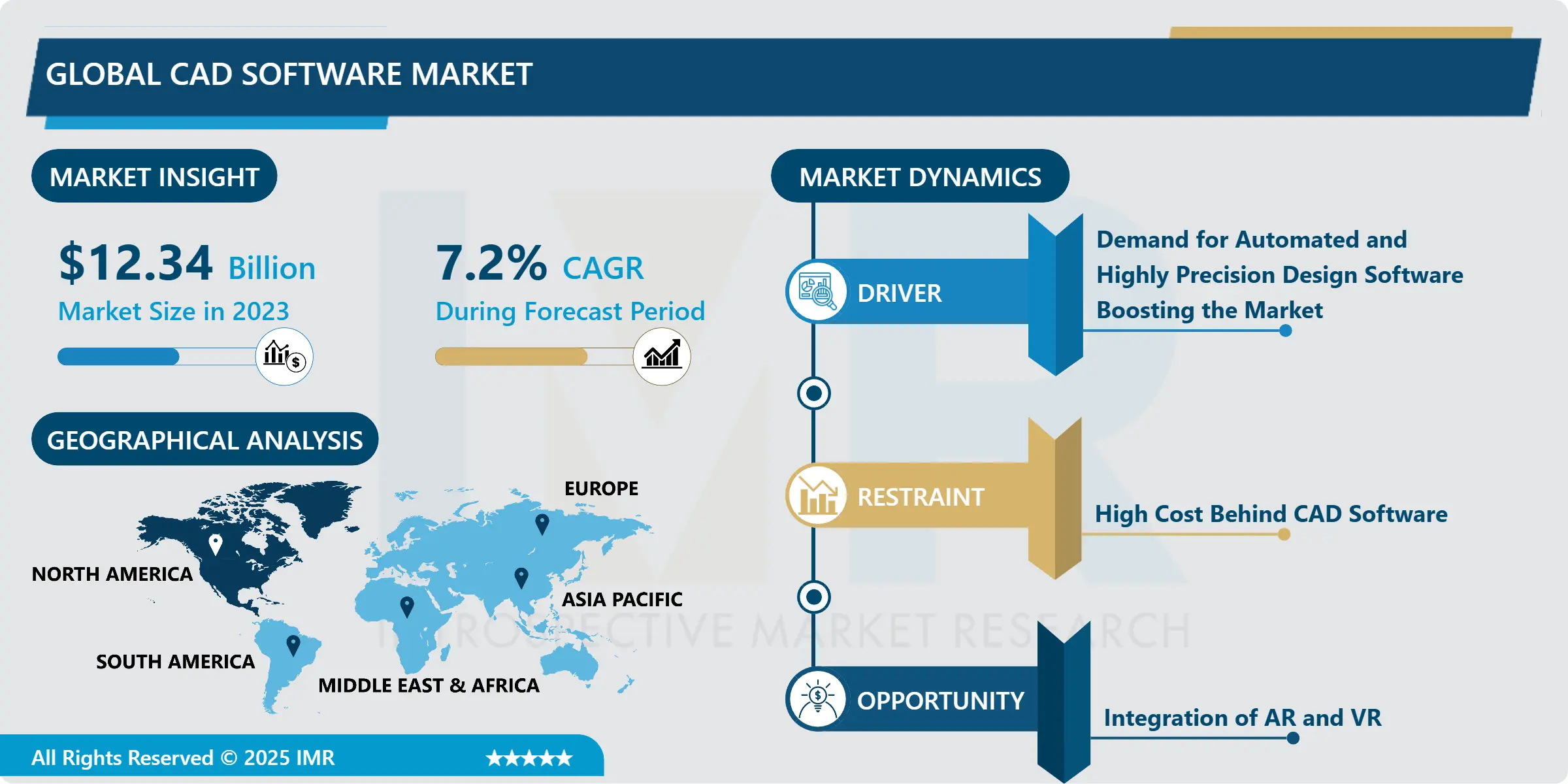

Market Dynamics And Factors For CAD Software Market
Drivers:
Demand for Automated and Highly Precision Design Software
- CAD is extremely precise since it is a computer application. In comparison to conventional drafting, its tolerance limits are far lower. By using CAD software, the proportion of mistakes that hand sketching brings may be significantly reduced. Low tolerance and high accuracy ensure that diverse CAD-created models have a small margin of error. When several sub-assemblies must be put together, this small margin of error is very important. CAD also includes tools for evaluating the quality and correctness of designs. The model's physical and material characteristics can be considered using CAD software. Using CAD, a user may assemble all the subassemblies and see how the final product will appear and whether all the measurements and tolerances are accurate. It enables engineers and customers to picture the finished product. When various materials are used in certain sub-assemblies, CAD can provide a clearer picture of how those sub-assemblies will fit together. Different materials can interact with one another using CAD software to simulate this interaction. It would take significantly longer to perform such analysis and simulation in a conventional drawing environment.
Restraints:
High Cost Behind CAD Software
- Software solutions for CAD are expensive. Several CAD software solutions are open source and free. Software-related expenditures are ongoing, recurring expenses. They are ongoing expenses since software programs must be renewed annually or sometimes. It is a recurring cost for the company. In addition to the software, a substantial sum of money must be spent on the gear that will support a CAD-enabled work environment. Additionally, if the design is needed to print out huge models, there is a significant necessity for strong computers with cutting-edge graphic cards and massive printers with plotters.
Opportunities:
Integration of AR and VR
- As it allows users to visualize how their ideas will function in reality, virtual reality (VR) has developed as a helpful auxiliary tool for 3D CAD. Users may identify flaws in the designs through an immersive visual experience provided by the VR technology, which provides a virtual duplicate of the model. The technique is advantageous in lowering prices and mistakes, and it is anticipated to be advantageous to many industrial undertakings, particularly in the aerospace and automotive industry. Major businesses are investing in the R&D of their solution offerings to fend off competition from rival businesses and to provide the market with cutting-edge items. To provide cutting-edge solutions to their clients and achieve a competitive advantage, major firms have started to implement and utilize 3D printing technology. For example, Autodesk Inc. integrated Netfabb's 3D printing software into Fusion 360, the business's first 3D CAD, CAM, CAE, and PCB tool, in January 2021. Users of Netfabb now have full access to Fusion 360 and HSMWorks thanks to the inclusion. The rivalry among firms is fueled by increased investment in cutting-edge technologies, enabling them to create goods with cutting-edge technology and improved capabilities, such as augmented reality (AR) and the internet of things (IoT). Through the incorporation of digital designs for real objects, these cutting-edge technologies assist users in expediting the production and designing process.
Challenges:
Training OF CAD Software for Existing Employees
- As technology advances, CAD software becomes more adaptable and versatile. But doing so makes the software more difficult. The program's complexity makes it more difficult for new users to learn it. Another negative of CAD/CAM is that it is more complicated than it needs to be, which increases the cost of training people in the technology. Therefore, finding skilled employees in CAD software and training the existing staff is a tedious task for companies to face.
Segmentation Analysis of the CAD Software Market
- By Type, the 3D Segment dominates the CAD Software Market. It is feasible to create mechanical models that are intricate and precise when 3D modeling and CAD are combined. Software for 3-D animation has become crucial in engineering design, especially in the discipline of mechanical engineering. Over 700,000 common templates for mechanical components are available in the 3D CAD program, which is rich in a variety of libraries. This capability allows designers and modelers to choose designs in a useful way based on the requirements of the modeling job. By doing this, the design correctness is guaranteed and time is saved. With 3D CAD, all deformities and design imperfections are removed. Even in the early phases of the design process, 3D CAD modeling may greatly improve the designer's ability to visualize all the mechanical parts of a design. This aids in making quick modifications by assisting the mechanical CAD designer in comprehending the final depiction of the same and making any necessary changes right away. The reduced number of revisions goes hand in hand with the designer's productivity. The laborious and manual aspects of the design are also diminished by 3D CAD modeling which expects to further the growth of the CAD Software market.
- By Deployment, On Premises dominates the deployment segment in CAD Software Market. This can be ascribed to the technology's high level of information or data security. Deploying the on-premise solution is easy for software users since all information and design data can be simply kept on their systems. End-users primarily employ on-premise solutions in industries with strict regulations, such as the medical, healthcare, and government sectors. The strong adoption of on-premise systems across sectors is a result of their ability to speed innovation by promoting collaboration, considerable data and design reuse, error reduction or removal owing to version control difficulties, and quality assurance.
- By Application, the Manufacturing segment dominates the CAD Software Market. This can be ascribed to the industrial industry's significant usage of 3D CAD software for prototype creation. Original Equipment Manufacturers (OEMs) can replicate the movement of parts during production thanks to this software, which is what is causing the market to develop. The development of CAD-CAM technology took many individuals decades of work in the name of industrial automation. It is the goal of those who are using technology to create the future and increase output, including innovators, inventors, mathematicians, and machinists. A lot of people refer to the software that is used to create items using a CNC machine by the acronym "CAD-CAM." Both CAD and CAM, which are used to produce things, stand for computer-aided design and manufacturing, respectively. Prototypes, final goods, and production runs of products are designed and produced using CAD/CAM software.
Regional Analysis for the CAD Software Market
- North America is likely to dominate the CAD Software market. This may be ascribed to the assistance provided by the American government for the adoption of digitization tools that will accelerate the growth of the region's industrial sector and so promote the use of 3D CAD software tools. The market is growing as a result of the presence of major companies in the area, including Autodesk Inc., PTC, Dassault Systèmes, and Dassault Systèmes SolidWorks Corp. This is partly because the aerospace and defense industries in the region employ CAD software extensively for product development, which makes the process of visualizing, creating, and perfecting aircraft designs much simpler. Additionally, many of the biggest CAD technology businesses in the world have facilities in North America. A good example is Dassault Systèmes SE, which has 188 locations worldwide, with around 25% of those in North America. Therefore, North America is likely to dominate the CAD Software Market during the forecasted period.
- The Asia-Pacific region is growing at a fast pace in CAD Software. The region's growth in the CAD software market is mainly the growing engineering projects in India, China, Japan, South Korea, and Southeast Asian countries. Also, CAD services have been a major sector where Indian outsourcing companies have drawn a prominent track of success. Using computer technology to design and draught components, products, or structures is known as computer-aided design (CAD). It may be used for a wide range of tasks, including the design of equipment and machines as well as various sorts of buildings, including residential, commercial, and industrial zones. In the Indian outsourcing market, CAD outsourcing has become a key sector. Due to the abundance of skilled engineers, English language competence, and comparably inexpensive cost of labor compared to wealthy nations, CAD outsourcing has flourished in India. Numerous CAD services have been delegated to Indian businesses. These include architectural drafting, 3D modeling, paper drawings to CAD conversion, GIS mapping services, and CAD conversion and drafting. In the fields of design and building construction, CAD outsourcing has been particularly significant. This is due to the significant benefits that CAD provides to customers, architects, interior designers, and real estate developers. Therefore, Asia pacific shows a robust growth rate in the CAD Software market during the forecasted period.
COVID-19 Impact on the CAD Software Market
- The market growth has been negatively impacted by the lockdowns implemented by various governments in 2020 and 2021 to stop the spread of the COVID-19 illness. The market expansion was hampered by the need for several companies, particularly those in manufacturing, automation, and media and entertainment, to cease their present projects and, in some cases, cancel their future assignments. Businesses are reportedly developing plans to deal with the crisis and make up for the loss following the outbreak. Additionally, the expanding outsourcing and mergers & acquisitions of big engineering organizations have forced small- and medium-sized enterprises to invest in digital simulation technologies, driving the market expansion.
Top Key Players Covered In CAD Software Market:
- Autodesk
- TurboCAD
- SketchUp
- CADopia
- Prosoft
- FormZ
- SolidWorks
- SkyCiv
- SmartDraw
- Bentley Systems
- Corel
- Dassault Systemes SE
- Hexagon AB
- RubySketch
- ANSYS
- Other Active Players
Key Industry Developments In The CAD Software Market
- In September 2024, IMSI Design, a leading software developer of Home Design and CAD titles for over 30 years, announced the release of new Windows versions for all of its award-winning FloorPlan Home & Landscape Design software titles.
|
Global CAD Software Market |
|||
|
Base Year: |
2024 |
Forecast Period: |
2025-2032 |
|
Historical Data: |
2018 to 2023 |
Market Size in 2024: |
USD 13.23 Bn. |
|
Forecast Period 2024-32 CAGR: |
7.2% |
Market Size in 2032: |
USD 23.07 Bn. |
|
Segments Covered: |
By Type |
|
|
|
By Application |
|
||
|
By End Users |
|
||
|
By Region |
|
||
|
Key Market Drivers: |
|
||
|
Key Market Restraints: |
|
||
|
Key Opportunities: |
|
||
|
Companies Covered in the report: |
|
||
Chapter 1: Introduction
1.1 Scope and Coverage
Chapter 2:Executive Summary
Chapter 3: Market Landscape
3.1 Market Dynamics
3.1.1 Drivers
3.1.2 Restraints
3.1.3 Opportunities
3.1.4 Challenges
3.2 Market Trend Analysis
3.3 PESTLE Analysis
3.4 Porter's Five Forces Analysis
3.5 Industry Value Chain Analysis
3.6 Ecosystem
3.7 Regulatory Landscape
3.8 Price Trend Analysis
3.9 Patent Analysis
3.10 Technology Evolution
3.11 Investment Pockets
3.12 Import-Export Analysis
Chapter 4: CAD Software Market by Type (2018-2032)
4.1 CAD Software Market Snapshot and Growth Engine
4.2 Market Overview
4.3 2D
4.3.1 Introduction and Market Overview
4.3.2 Historic and Forecasted Market Size in Value USD and Volume Units
4.3.3 Key Market Trends, Growth Factors, and Opportunities
4.3.4 Geographic Segmentation Analysis
4.4 3D
4.5 Other
Chapter 5: CAD Software Market by Application (2018-2032)
5.1 CAD Software Market Snapshot and Growth Engine
5.2 Market Overview
5.3 Cloud
5.3.1 Introduction and Market Overview
5.3.2 Historic and Forecasted Market Size in Value USD and Volume Units
5.3.3 Key Market Trends, Growth Factors, and Opportunities
5.3.4 Geographic Segmentation Analysis
5.4 On-Premises
Chapter 6: CAD Software Market by End Users (2018-2032)
6.1 CAD Software Market Snapshot and Growth Engine
6.2 Market Overview
6.3 Aerospace & Defense
6.3.1 Introduction and Market Overview
6.3.2 Historic and Forecasted Market Size in Value USD and Volume Units
6.3.3 Key Market Trends, Growth Factors, and Opportunities
6.3.4 Geographic Segmentation Analysis
6.4 Arts
6.5 Automotive
6.6 Healthcare
6.7 Manufacturing
6.8 Media & Entertainment
Chapter 7: Company Profiles and Competitive Analysis
7.1 Competitive Landscape
7.1.1 Competitive Benchmarking
7.1.2 CAD Software Market Share by Manufacturer (2024)
7.1.3 Industry BCG Matrix
7.1.4 Heat Map Analysis
7.1.5 Mergers and Acquisitions
7.2 AKAMAI TECHNOLOGIES (US)
7.2.1 Company Overview
7.2.2 Key Executives
7.2.3 Company Snapshot
7.2.4 Role of the Company in the Market
7.2.5 Sustainability and Social Responsibility
7.2.6 Operating Business Segments
7.2.7 Product Portfolio
7.2.8 Business Performance
7.2.9 Key Strategic Moves and Recent Developments
7.2.10 SWOT Analysis
7.3 CLOUDFLARE (US)
7.4 FASTLY (US)
7.5 LIMELIGHT NETWORKS (US)
7.6 AMAZON WEB SERVICES (US)
7.7 MICROSOFT AZURE (US)
7.8 GOOGLE CLOUD PLATFORM (US)
7.9 VERIZON DIGITAL MEDIA SERVICES (US)
7.10 STACKPATH (US)
7.11 CENTURYLINK (US)
7.12 ARYAKA NETWORKS (US)
7.13 COMCAST TECHNOLOGY SOLUTIONS (US)
7.14 LUMEN TECHNOLOGIES (US)
7.15 CLOUDFRONT (US)
7.16 IMPERVA (US)
7.17 LEVEL 3 COMMUNICATIONS (US)
7.18 RACKSPACE TECHNOLOGY (US)
7.19 EDGECAST (US)
7.20 INTERNAP (US)
7.21 IBM CLOUD (US)
7.22 BITGRAVITY (US)
7.23 ALIBABA CLOUD (CHINA)
7.24 TENCENT CLOUD (CHINA)
7.25 CDNETWORKS (SOUTH KOREA)
7.26 NTT COMMUNICATIONS (JAPAN)
7.27
Chapter 8: Global CAD Software Market By Region
8.1 Overview
8.2. North America CAD Software Market
8.2.1 Key Market Trends, Growth Factors and Opportunities
8.2.2 Top Key Companies
8.2.3 Historic and Forecasted Market Size by Segments
8.2.4 Historic and Forecasted Market Size by Type
8.2.4.1 2D
8.2.4.2 3D
8.2.4.3 Other
8.2.5 Historic and Forecasted Market Size by Application
8.2.5.1 Cloud
8.2.5.2 On-Premises
8.2.6 Historic and Forecasted Market Size by End Users
8.2.6.1 Aerospace & Defense
8.2.6.2 Arts
8.2.6.3 Automotive
8.2.6.4 Healthcare
8.2.6.5 Manufacturing
8.2.6.6 Media & Entertainment
8.2.7 Historic and Forecast Market Size by Country
8.2.7.1 US
8.2.7.2 Canada
8.2.7.3 Mexico
8.3. Eastern Europe CAD Software Market
8.3.1 Key Market Trends, Growth Factors and Opportunities
8.3.2 Top Key Companies
8.3.3 Historic and Forecasted Market Size by Segments
8.3.4 Historic and Forecasted Market Size by Type
8.3.4.1 2D
8.3.4.2 3D
8.3.4.3 Other
8.3.5 Historic and Forecasted Market Size by Application
8.3.5.1 Cloud
8.3.5.2 On-Premises
8.3.6 Historic and Forecasted Market Size by End Users
8.3.6.1 Aerospace & Defense
8.3.6.2 Arts
8.3.6.3 Automotive
8.3.6.4 Healthcare
8.3.6.5 Manufacturing
8.3.6.6 Media & Entertainment
8.3.7 Historic and Forecast Market Size by Country
8.3.7.1 Russia
8.3.7.2 Bulgaria
8.3.7.3 The Czech Republic
8.3.7.4 Hungary
8.3.7.5 Poland
8.3.7.6 Romania
8.3.7.7 Rest of Eastern Europe
8.4. Western Europe CAD Software Market
8.4.1 Key Market Trends, Growth Factors and Opportunities
8.4.2 Top Key Companies
8.4.3 Historic and Forecasted Market Size by Segments
8.4.4 Historic and Forecasted Market Size by Type
8.4.4.1 2D
8.4.4.2 3D
8.4.4.3 Other
8.4.5 Historic and Forecasted Market Size by Application
8.4.5.1 Cloud
8.4.5.2 On-Premises
8.4.6 Historic and Forecasted Market Size by End Users
8.4.6.1 Aerospace & Defense
8.4.6.2 Arts
8.4.6.3 Automotive
8.4.6.4 Healthcare
8.4.6.5 Manufacturing
8.4.6.6 Media & Entertainment
8.4.7 Historic and Forecast Market Size by Country
8.4.7.1 Germany
8.4.7.2 UK
8.4.7.3 France
8.4.7.4 The Netherlands
8.4.7.5 Italy
8.4.7.6 Spain
8.4.7.7 Rest of Western Europe
8.5. Asia Pacific CAD Software Market
8.5.1 Key Market Trends, Growth Factors and Opportunities
8.5.2 Top Key Companies
8.5.3 Historic and Forecasted Market Size by Segments
8.5.4 Historic and Forecasted Market Size by Type
8.5.4.1 2D
8.5.4.2 3D
8.5.4.3 Other
8.5.5 Historic and Forecasted Market Size by Application
8.5.5.1 Cloud
8.5.5.2 On-Premises
8.5.6 Historic and Forecasted Market Size by End Users
8.5.6.1 Aerospace & Defense
8.5.6.2 Arts
8.5.6.3 Automotive
8.5.6.4 Healthcare
8.5.6.5 Manufacturing
8.5.6.6 Media & Entertainment
8.5.7 Historic and Forecast Market Size by Country
8.5.7.1 China
8.5.7.2 India
8.5.7.3 Japan
8.5.7.4 South Korea
8.5.7.5 Malaysia
8.5.7.6 Thailand
8.5.7.7 Vietnam
8.5.7.8 The Philippines
8.5.7.9 Australia
8.5.7.10 New Zealand
8.5.7.11 Rest of APAC
8.6. Middle East & Africa CAD Software Market
8.6.1 Key Market Trends, Growth Factors and Opportunities
8.6.2 Top Key Companies
8.6.3 Historic and Forecasted Market Size by Segments
8.6.4 Historic and Forecasted Market Size by Type
8.6.4.1 2D
8.6.4.2 3D
8.6.4.3 Other
8.6.5 Historic and Forecasted Market Size by Application
8.6.5.1 Cloud
8.6.5.2 On-Premises
8.6.6 Historic and Forecasted Market Size by End Users
8.6.6.1 Aerospace & Defense
8.6.6.2 Arts
8.6.6.3 Automotive
8.6.6.4 Healthcare
8.6.6.5 Manufacturing
8.6.6.6 Media & Entertainment
8.6.7 Historic and Forecast Market Size by Country
8.6.7.1 Turkiye
8.6.7.2 Bahrain
8.6.7.3 Kuwait
8.6.7.4 Saudi Arabia
8.6.7.5 Qatar
8.6.7.6 UAE
8.6.7.7 Israel
8.6.7.8 South Africa
8.7. South America CAD Software Market
8.7.1 Key Market Trends, Growth Factors and Opportunities
8.7.2 Top Key Companies
8.7.3 Historic and Forecasted Market Size by Segments
8.7.4 Historic and Forecasted Market Size by Type
8.7.4.1 2D
8.7.4.2 3D
8.7.4.3 Other
8.7.5 Historic and Forecasted Market Size by Application
8.7.5.1 Cloud
8.7.5.2 On-Premises
8.7.6 Historic and Forecasted Market Size by End Users
8.7.6.1 Aerospace & Defense
8.7.6.2 Arts
8.7.6.3 Automotive
8.7.6.4 Healthcare
8.7.6.5 Manufacturing
8.7.6.6 Media & Entertainment
8.7.7 Historic and Forecast Market Size by Country
8.7.7.1 Brazil
8.7.7.2 Argentina
8.7.7.3 Rest of SA
Chapter 9 Analyst Viewpoint and Conclusion
9.1 Recommendations and Concluding Analysis
9.2 Potential Market Strategies
Chapter 10 Research Methodology
10.1 Research Process
10.2 Primary Research
10.3 Secondary Research
|
Global CAD Software Market |
|||
|
Base Year: |
2024 |
Forecast Period: |
2025-2032 |
|
Historical Data: |
2018 to 2023 |
Market Size in 2024: |
USD 13.23 Bn. |
|
Forecast Period 2024-32 CAGR: |
7.2% |
Market Size in 2032: |
USD 23.07 Bn. |
|
Segments Covered: |
By Type |
|
|
|
By Application |
|
||
|
By End Users |
|
||
|
By Region |
|
||
|
Key Market Drivers: |
|
||
|
Key Market Restraints: |
|
||
|
Key Opportunities: |
|
||
|
Companies Covered in the report: |
|
||


