




Key Market Highlights
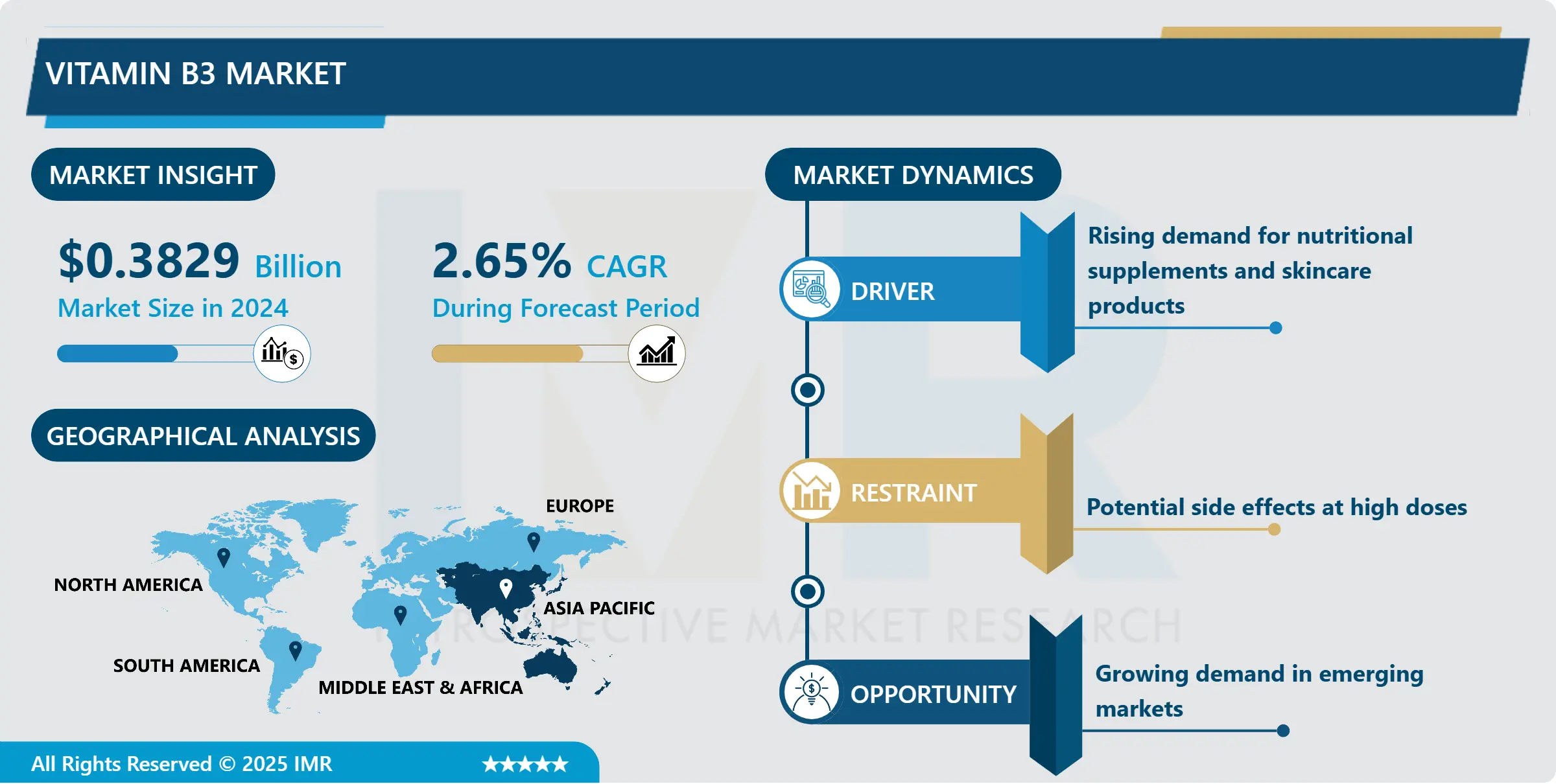
Vitamin B3 Market Size Was Valued at 0.3829 billion in 2024, and is Projected to Reach 0.5120 billion by 2035, Growing at a CAGR of 2.65% from 2025-2035.
- Market Size in 2024: 0.3829 billion
- Projected Market Size by 2035: 0.5120 billion
- CAGR (2025–2035): 2.65%
- Leading Market in 2024: Asia Pacific
- Fastest-Growing Market: Asia Pacific
- By Type : The Natural Vitamin segment is anticipated to lead the market by accounting for 30% of the market share throughout the forecast period.
- By Application : The Pharmaceutical Vitamin segment is expected to capture 32% of the market share, thereby maintaining its dominance over the forecast period.
- By Region: Asia Pacific region is projected to hold 40% of the market share during the forecast period.
- Active Players: Abbott Laboratories (USA), Anhui Tiger Biotech Co., Ltd. (China), BASF SE (Germany), Bayer AG (Germany), Brother Enterprises Holding Co., Ltd. (China), Other Active Players
Vitamin B3 Market Synopsis:
The Vitamin B3 market includes niacin and niacinamide, used in supplements, animal feed, medicine, and skincare. Valued at USD 382.9 million in 2024, it’s growing steadily, led by Asia-Pacific. Rising health and beauty awareness is increasing global demand, especially in countries like China and India.
Vitamin B3 Market Dynamics and Trend Analysis:
Vitamin B3 Market Growth Driver - Rising demand for nutritional supplements and skincare products
-
The Vitamin B3 market is growing because more people are using nutritional supplements and skincare products. One of the main forms of Vitamin B3 is niacinamide, which is becoming very popular for its health and beauty benefits. People are learning more about how it can help improve skin, reduce acne, and support energy and brain function. This growing awareness is pushing more companies to add Vitamin B3 to multivitamins, fortified foods, and cosmetics.
- As more people focus on staying healthy and looking good, the demand for Vitamin B3 keeps increasing. This is especially true in developing countries like India and China, where people are spending more on health and personal care. This trend is one of the biggest drivers of market growth.
- Also, the beauty industry is using niacinamide in creams, serums, and lotions because it helps with skin brightness and aging. Many skincare brands promote niacinamide as a safe and effective ingredient, which makes it more attractive to customers.
- People today want products that are both natural and effective, and Vitamin B3 fits well with this need. Whether taken as a supplement or applied to the skin, Vitamin B3 offers many benefits. That’s why it continues to be a key ingredient in the health and beauty market, driving the growth of the global Vitamin B3 industry.
Vitamin B3 Market Limiting Factor - Potential side effects at high doses
-
While the Vitamin B3 market is growing, there are some factors that can limit its growth. One major concern is the side effects that can happen when people take high doses of Vitamin B3, especially niacin. These side effects may include skin flushing, stomach upset, or in rare cases, liver problems. Because of these risks, some people may be cautious about using Vitamin B3 supplements regularly.
- Another limiting factor is the lack of awareness in certain regions. In many developing countries, people may not fully understand the benefits of Vitamin B3, or may not be aware of the right dosage. This lack of knowledge can lead to low demand, even though the product is available in the market.
- There are also regulatory restrictions in many countries. Governments have strict rules about how much of a vitamin can be added to food or medicine. Companies must follow these rules carefully, which can make it harder to launch new products quickly.
- Additionally, some Vitamin B3 products are made in low-cost factories that may not meet international quality standards. This raises concerns about product safety and effectiveness, especially in the pharmaceutical and food industries. Poor quality control can damage consumer trust and make healthcare providers avoid recommending certain brands. All these factors can slow down the overall growth of the Vitamin B3 market.
Vitamin B3 Market Expansion Opportunity - Growing demand in emerging markets
-
The Vitamin B3 market has many opportunities to grow, especially in emerging markets like Southeast Asia, Africa, and Latin America. In these regions, more people are becoming aware of the importance of good nutrition, skincare, and preventive health. As incomes rise and lifestyles improve, people are spending more on vitamins, supplements, and personal care products. This creates a big opportunity for companies to introduce Vitamin B3 products to new customers who are just starting to explore health and wellness options.
- Another exciting opportunity is in the rise of vegan and clean-label products. More people today are looking for products that are plant-based, natural, and free from harmful chemicals. Vitamin B3 fits well into this trend, especially when it is made from sustainable or non-animal sources. Companies that offer clean-label niacin or niacinamide can stand out in a busy market.
- Also, the fast growth of the cosmeceutical industry (cosmetics with added health benefits) is opening doors for new Vitamin B3-based skincare products. Niacinamide is already known for improving skin tone, reducing wrinkles, and treating acne, so it is in high demand for serums, creams, and facial masks.
- These trends offer strong opportunities for innovation, premium product development, and global expansion, especially for brands that meet the growing demand for quality, safety, and natural ingredients.
Vitamin B3 Market Challenge and Risk - Raw material price volatility and supply chain disruptions
-
The Vitamin B3 market faces several challenges and risks that can slow down its growth. One major issue is the changing price of raw materials. The cost of the ingredients needed to make Vitamin B3 can go up and down quickly. This makes it hard for companies especially those making animal feed and pharmaceutical products to keep prices stable and stay profitable.
- Another big challenge is Supply chain disruption. Problems like global shipping delays, political conflicts, or health crises (like COVID-19) can make it difficult for companies to get the raw materials they need on time. This causes delays in production and delivery, leading to product shortages and unhappy customers.
- There is also strong competition from synthetic substitutes and other types of vitamins. Some companies may use cheaper or artificial ingredients that offer similar benefits, which can reduce the demand for Vitamin B3 especially if those substitutes are more affordable.
- In addition, strict government rules around safety, quality, and labelling can make it difficult for small producers to enter the market. Getting approval to sell Vitamin B3 products in food or medicine often takes time and money. Companies must meet high standards, which not all can afford. Together, these risks create obstacles that the Vitamin B3 industry must carefully manage to ensure long-term growth and success.
Vitamin B3 Market Segment Analysis:
Vitamin B3 Market is segmented based on Type, Application, End-Users, and Region
By Type, Vitamin B3 Segment is Expected to Dominate the Market During the Forecast Period
-
Natural Vitamin B3 is made from plant-based or microbial sources, meaning it comes from nature instead of being made in a factory using chemicals. This type of Vitamin B3 is becoming more popular as people are choosing products that are vegan, organic, and clean-label. Clean-label means products that have simple, natural ingredients without artificial chemicals or additives.
- Many consumers today care about their health and what they put into their bodies. They are reading labels and looking for vitamins that are safe, natural, and eco-friendly. This is why natural Vitamin B3 is in high demand. It is mostly used in dietary supplements and cosmetic products, especially those targeting people who want healthier and more natural options.
- In cosmetics, natural niacinamide (a form of Vitamin B3) is used in face creams, serums, and lotions because it helps improve skin tone, reduce dark spots, and fight acne. People feel more confident using natural skincare products, especially those with no harmful chemicals.
- In supplements, natural Vitamin B3 is taken to support energy, brain function, and heart health. It fits well with current health trends like plant-based nutrition, making it a great choice for health-conscious users. As the demand for natural and sustainable products keeps growing, the use of natural Vitamin B3 is expected to rise in many countries around the world.
By Application, Vitamin B3 Segment Held the Largest Share in 2024
-
In the pharmaceutical industry, Vitamin B3 is an important ingredient used in both medicines and health supplements. It plays a key role in helping the body stay healthy and strong. One of its main uses is to treat high cholesterol levels. It works by lowering the levels of "bad" cholesterol (LDL) and increasing "good" cholesterol (HDL). This helps reduce the risk of heart disease, which is a major health problem in many parts of the world.
- Vitamin B3 also helps with brain function. It supports better memory, focus, and overall mental health. In addition, it helps in the body’s energy production by converting food into energy. That’s why it is often included in multivitamin tablets and energy supplements.
- Another important use of Vitamin B3 is in treating skin problems. It is used in both creams and oral supplements to reduce acne, redness, and inflammation. Many skincare products now include niacinamide, a form of Vitamin B3, to improve skin tone and texture.
- Doctors also recommend Vitamin B3 for people who have a deficiency, which can cause tiredness, skin rashes, and digestive problems. Regular use of Vitamin B3, under medical guidance, can improve overall health and help manage several medical conditions. Because of all these benefits, the use of Vitamin B3 in medicine continues to grow globally.
Vitamin B3 Market Regional Insights:
Asia Pacific is Expected to Dominate the Market Over the Forecast Period
-
The Asia-Pacific region holds the largest share of the global Vitamin B3 market, making up about 38–40% of total revenue in 2023–2024. This region is also expected to grow steadily with a CAGR of around 6%, showing strong demand and market potential.
- One of the main reasons for this growth is the rising awareness among consumers about health, wellness, and skincare. More people in countries like China, India, Japan, and South Korea are using health supplements and skincare products that include Vitamin B3 (also known as niacin or niacinamide). This is helping drive demand across both the nutritional supplement and cosmetic industries.
- Another key factor is the growing middle class in many Asian countries. As incomes rise, more people are spending on personal care, healthcare, and high-quality food and supplements. This change in lifestyle is pushing companies to develop more Vitamin B3-based products.
- Additionally, the pharmaceutical industry in Asia-Pacific is expanding rapidly, with more local production and healthcare spending. The animal feed industry is also using Vitamin B3 widely to improve animal health and productivity, especially in poultry and livestock farming.
- Overall, Asia-Pacific is not only leading in size but is also the fastest-growing market for Vitamin B3, offering many opportunities for manufacturers and investors in the coming years.
Vitamin B3 Market Active Players:
- Abbott Laboratories (USA)
- Anhui Tiger Biotech Co., Ltd. (China)
- BASF SE (Germany)
- Bayer AG (Germany)
- Brother Enterprises Holding Co., Ltd. (China)
- Evonik Industries AG (Germany)
- Foodchem International Corporation (China)
- Hebei Yanuo Bioscience Co., Ltd. (China)
- Hubei Grand Life Science and Technology Co., Ltd. (China)
- Jiangsu Brother Vitamin Co., Ltd. (China)
- Jiangxi Tianxin Pharmaceutical Co., Ltd. (China)
- Jubilant Life Sciences / Jubilant Ingrevia (India)
- Koninklijke DSM N.V. (Netherlands/Switzerland)
- Lasons India Pvt. Ltd. (India)
- Lonza Group AG (Switzerland)
- Lonza Guangzhou Nansha Ltd. (China)
- Merck KGaA (Germany)
- Nantong Acetic Acid Chemical Co., Ltd. (China)
- Resonance Specialties Limited (India)
- Shandong Hongda Biotechnology Co., Ltd. (China)
- Shandong Hongda Group Co., Ltd. (China)
- Shandong Xinfa Pharmaceutical Co., Ltd. (China)
- Shanghai Acebright Pharmaceutical Group Co., Ltd. (China)
- Shanghai Freemen Lifescience Co., Ltd. (China)
- Tianjin Zhongrui Pharmaceutical Co., Ltd. (China)
- Vanetta Ltd. (China)
- Vertellus Holdings LLC (USA)
- Yuki Gosei Kogyo Co., Ltd. (Japan)
- Zhejiang Medicine Co., Ltd. (China)
- Zhejiang NHU Co., Ltd. (China)
- Other Active Players
|
Vitamin B3 Market |
|||
|
Base Year: |
2024 |
Forecast Period: |
2025-2035 |
|
Historical Data: |
2018 to 2024 |
Market Size in 2024: |
0.3829 billion |
|
Forecast Period 2025-35 CAGR: |
2.65 % |
Market Size in 2035: |
0.5120 billion |
|
Segments Covered: |
By Type |
|
|
|
By Application |
|
||
|
By Form |
|
||
|
By Region |
|
||
|
Growth Driver: |
|
||
|
Limiting Factor |
|
||
|
Expansion Opportunity |
|
||
|
Challenge and Risk |
|
||
|
Companies Covered in the Report: |
|
||
Chapter 1: Introduction
1.1 Scope and Coverage
Chapter 2:Executive Summary
Chapter 3: Market Landscape
3.1 Market Dynamics and Opportunity Analysis
3.1.1 Growth Drivers
3.1.2 Limiting Factors
3.1.3 Growth Opportunities
3.1.4 Challenges and Risks
3.2 Market Trend Analysis
3.3 Industry Ecosystem
3.4 Industry Value Chain Mapping
3.5 Strategic PESTLE Overview
3.6 Porter's Five Forces Framework
3.7 Regulatory Framework
3.8 Pricing Trend Analysis
3.9 Intellectual Property Review
3.10 Technology Evolution
3.11 Import-Export Analysis
3.12 Consumer Behavior Analysis
3.13 Investment Pocket Analysis
3.14 Go-To Market Strategy
Chapter 4: Vitamin B3 Market by Source (2018-2035)
4.1 Vitamin B3 Market Snapshot and Growth Engine
4.2 Market Overview
4.3 Natural
4.3.1 Introduction and Market Overview
4.3.2 Historic and Forecasted Market Size in Value USD and Volume Units
4.3.3 Key Market Trends, Growth Factors, and Opportunities
4.3.4 Geographic Segmentation Analysis
4.4 Synthetic
Chapter 5: Vitamin B3 Market by Form (2018-2035)
5.1 Vitamin B3 Market Snapshot and Growth Engine
5.2 Market Overview
5.3 Dry
5.3.1 Introduction and Market Overview
5.3.2 Historic and Forecasted Market Size in Value USD and Volume Units
5.3.3 Key Market Trends, Growth Factors, and Opportunities
5.3.4 Geographic Segmentation Analysis
5.4 Liquid
Chapter 6: Vitamin B3 Market by Application (2018-2035)
6.1 Vitamin B3 Market Snapshot and Growth Engine
6.2 Market Overview
6.3 Animal Feed
6.3.1 Introduction and Market Overview
6.3.2 Historic and Forecasted Market Size in Value USD and Volume Units
6.3.3 Key Market Trends, Growth Factors, and Opportunities
6.3.4 Geographic Segmentation Analysis
6.4 Pharmaceutical
Chapter 7: Company Profiles and Competitive Analysis
7.1 Competitive Landscape
7.1.1 Competitive Benchmarking
7.1.2 Vitamin B3 Market Share by Manufacturer/Service Provider(2024)
7.1.3 Industry BCG Matrix
7.1.4 PArtnerships, Mergers & Acquisitions
7.2 ABBOTT LABORATORIES (USA)
7.2.1 Company Overview
7.2.2 Key Executives
7.2.3 Company Snapshot
7.2.4 Role of the Company in the Market
7.2.5 Sustainability and Social Responsibility
7.2.6 Operating Business Segments
7.2.7 Product Portfolio
7.2.8 Business Performance
7.2.9 Recent News & Developments
7.2.10 SWOT Analysis
7.3 ANHUI TIGER BIOTECH CO.
7.4 LTD. (CHINA)
7.5 BASF SE (GERMANY)
7.6 BAYER AG (GERMANY)
7.7 BROTHER ENTERPRISES HOLDING CO.
7.8 LTD. (CHINA)
7.9 EVONIK INDUSTRIES AG (GERMANY)
7.10 FOODCHEM INTERNATIONAL CORPORATION (CHINA)
7.11 HEBEI YANUO BIOSCIENCE CO.
7.12 LTD. (CHINA)
7.13 HUBEI GRAND LIFE SCIENCE AND TECHNOLOGY CO.
7.14 LTD. (CHINA)
7.15 JIANGSU BROTHER VITAMIN CO.
7.16 LTD. (CHINA)
7.17 JIANGXI TIANXIN PHARMACEUTICAL CO.
7.18 LTD. (CHINA)
7.19 JUBILANT LIFE SCIENCES / JUBILANT INGREVIA (INDIA)
7.20 KONINKLIJKE DSM N.V. (NETHERLANDS/SWITZERLAND)
7.21 LASONS INDIA PVT. LTD. (INDIA)
7.22 LONZA GROUP AG (SWITZERLAND)
7.23 LONZA GUANGZHOU NANSHA LTD. (CHINA)
7.24 MERCK KGAA (GERMANY)
7.25 NANTONG ACETIC ACID CHEMICAL CO.
7.26 LTD. (CHINA)
7.27 RESONANCE SPECIALTIES LIMITED (INDIA)
7.28 SHANDONG HONGDA BIOTECHNOLOGY CO.
7.29 LTD. (CHINA)
7.30 SHANDONG HONGDA GROUP CO.
7.31 LTD. (CHINA)
7.32 SHANDONG XINFA PHARMACEUTICAL CO.
7.33 LTD. (CHINA)
7.34 SHANGHAI ACEBRIGHT PHARMACEUTICAL GROUP CO.
7.35 LTD. (CHINA)
7.36 SHANGHAI FREEMEN LIFESCIENCE CO.
7.37 LTD. (CHINA)
7.38 TIANJIN ZHONGRUI PHARMACEUTICAL CO.
7.39 LTD. (CHINA)
7.40 VANETTA LTD. (CHINA)
7.41 VERTELLUS HOLDINGS LLC (USA)
7.42 YUKI GOSEI KOGYO CO.
7.43 LTD. (JAPAN)
7.44 ZHEJIANG MEDICINE CO.
7.45 LTD. (CHINA)
7.46 ZHEJIANG NHU CO.
7.47 LTD. (CHINA)
7.48 AND OTHER ACTIVE PLAYERS.
Chapter 8: Global Vitamin B3 Market By Region
8.1 Overview
8.2. North America Vitamin B3 Market
8.2.1 Key Market Trends, Growth Factors and Opportunities
8.2.2 Top Key Companies
8.2.3 Historic and Forecasted Market Size by Segments
8.2.4 Historic and Forecast Market Size by Country
8.2.4.1 US
8.2.4.2 Canada
8.2.4.3 Mexico
8.3. Eastern Europe Vitamin B3 Market
8.3.1 Key Market Trends, Growth Factors and Opportunities
8.3.2 Top Key Companies
8.3.3 Historic and Forecasted Market Size by Segments
8.3.4 Historic and Forecast Market Size by Country
8.3.4.1 Russia
8.3.4.2 Bulgaria
8.3.4.3 The Czech Republic
8.3.4.4 Hungary
8.3.4.5 Poland
8.3.4.6 Romania
8.3.4.7 Rest of Eastern Europe
8.4. Western Europe Vitamin B3 Market
8.4.1 Key Market Trends, Growth Factors and Opportunities
8.4.2 Top Key Companies
8.4.3 Historic and Forecasted Market Size by Segments
8.4.4 Historic and Forecast Market Size by Country
8.4.4.1 Germany
8.4.4.2 UK
8.4.4.3 France
8.4.4.4 The Netherlands
8.4.4.5 Italy
8.4.4.6 Spain
8.4.4.7 Rest of Western Europe
8.5. Asia Pacific Vitamin B3 Market
8.5.1 Key Market Trends, Growth Factors and Opportunities
8.5.2 Top Key Companies
8.5.3 Historic and Forecasted Market Size by Segments
8.5.4 Historic and Forecast Market Size by Country
8.5.4.1 China
8.5.4.2 India
8.5.4.3 Japan
8.5.4.4 South Korea
8.5.4.5 Malaysia
8.5.4.6 Thailand
8.5.4.7 Vietnam
8.5.4.8 The Philippines
8.5.4.9 Australia
8.5.4.10 New Zealand
8.5.4.11 Rest of APAC
8.6. Middle East & Africa Vitamin B3 Market
8.6.1 Key Market Trends, Growth Factors and Opportunities
8.6.2 Top Key Companies
8.6.3 Historic and Forecasted Market Size by Segments
8.6.4 Historic and Forecast Market Size by Country
8.6.4.1 Turkiye
8.6.4.2 Bahrain
8.6.4.3 Kuwait
8.6.4.4 Saudi Arabia
8.6.4.5 Qatar
8.6.4.6 UAE
8.6.4.7 Israel
8.6.4.8 South Africa
8.7. South America Vitamin B3 Market
8.7.1 Key Market Trends, Growth Factors and Opportunities
8.7.2 Top Key Companies
8.7.3 Historic and Forecasted Market Size by Segments
8.7.4 Historic and Forecast Market Size by Country
8.7.4.1 Brazil
8.7.4.2 Argentina
8.7.4.3 Rest of SA
Chapter 9 Analyst Viewpoint and Conclusion
Chapter 10 Our Thematic Research Methodology
10.1 Research Process
10.2 Primary Research
10.3 Secondary Research
Chapter 11 Case Study
Chapter 12 Appendix
12.1 Sources
12.2 List of Tables and figures
12.3 Short Forms and Citations
12.4 Assumption and Conversion
12.5 Disclaimer
|
Vitamin B3 Market |
|||
|
Base Year: |
2024 |
Forecast Period: |
2025-2035 |
|
Historical Data: |
2018 to 2024 |
Market Size in 2024: |
0.3829 billion |
|
Forecast Period 2025-35 CAGR: |
2.65 % |
Market Size in 2035: |
0.5120 billion |
|
Segments Covered: |
By Type |
|
|
|
By Application |
|
||
|
By Form |
|
||
|
By Region |
|
||
|
Growth Driver: |
|
||
|
Limiting Factor |
|
||
|
Expansion Opportunity |
|
||
|
Challenge and Risk |
|
||
|
Companies Covered in the Report: |
|
||


