
Antibiotics Market - Global Size & Upcoming Industry Trends 2025-2035
Pharmaceutical and HealthcarePublished On : Mar 2026

Targeting DNA Repair Drugs Market by Drug Type (Small Molecule Inhibitors, Monoclonal Antibodies, Gene Therapy Products, RNA-based Therapeutics, Proteins and Enzymes), Mechanism of Action (Nucleotide Excision Repair (NER) Inhibitors, Base Excision Repair (BER) Modulators, Double-Strand Break Repair Agents, Alternative Pathway Activators, DNA Damage Response (DDR) Pathways), Disease Indications (Cancer, Neurodegenerative Disorders, Autoimmune Diseases, Cardiovascular Diseases, Age-related Disorders), Distribution Channel (Hospital Pharmacies, Retail Pharmacies, Online Pharmacies, Institutional Pharmacies, Specialized Drug Stores), End-User (Hospitals, Research Institutes, Pharmaceutical Companies, Diagnostic Laboratories, Academic Institutions), and Region



Targeting DNA Repair Drugs Market Synopsis:
Targeting DNA Repair Drugs Market Size Was Valued at USD 5.4 Billion in 2024, and is Projected to Reach USD 12.0 Billion by 2032, Growing at a CAGR of 10.5% from 2025-2032.
The targeting DNA repair drugs market encompasses a specialized segment of oncology and genetic disorder therapeutics focused on modulating DNA repair mechanisms. These drugs are designed to either inhibit or enhance the cell's natural ability to repair DNA damage, depending on the therapeutic goal. Most commonly used in cancer treatment, they exploit the defective DNA repair pathways in cancer cells to increase their vulnerability to treatments like chemotherapy, radiation, and immunotherapy. By selectively targeting repair pathways such as homologous recombination (HR) or base excision repair (BER), these drugs offer a precision medicine approach to cancer therapy.
The market has gained significant traction with the rise of PARP inhibitors and other targeted therapies that capitalize on synthetic lethality a strategy where the simultaneous disruption of two genes leads to cell death, while disruption of either alone does not. DNA repair inhibitors are especially beneficial in treating cancers with BRCA1/2 mutations and other homologous recombination deficiencies (HRDs). Ongoing research is expanding the pipeline to include drugs targeting additional repair pathways like mismatch repair (MMR) and nucleotide excision repair (NER), further broadening the market’s scope and therapeutic potential.
Globally, the market is driven by increasing cancer incidence, advancements in genomics, and growing interest in personalized medicine. Strategic collaborations between biotech firms and pharmaceutical giants are fostering innovation and accelerating clinical development. Despite promising opportunities, challenges remain, including resistance development and the complexity of DNA repair networks. Nonetheless, with continued research and supportive regulatory frameworks, the targeting DNA repair drugs market is poised for sustained growth in the coming years.
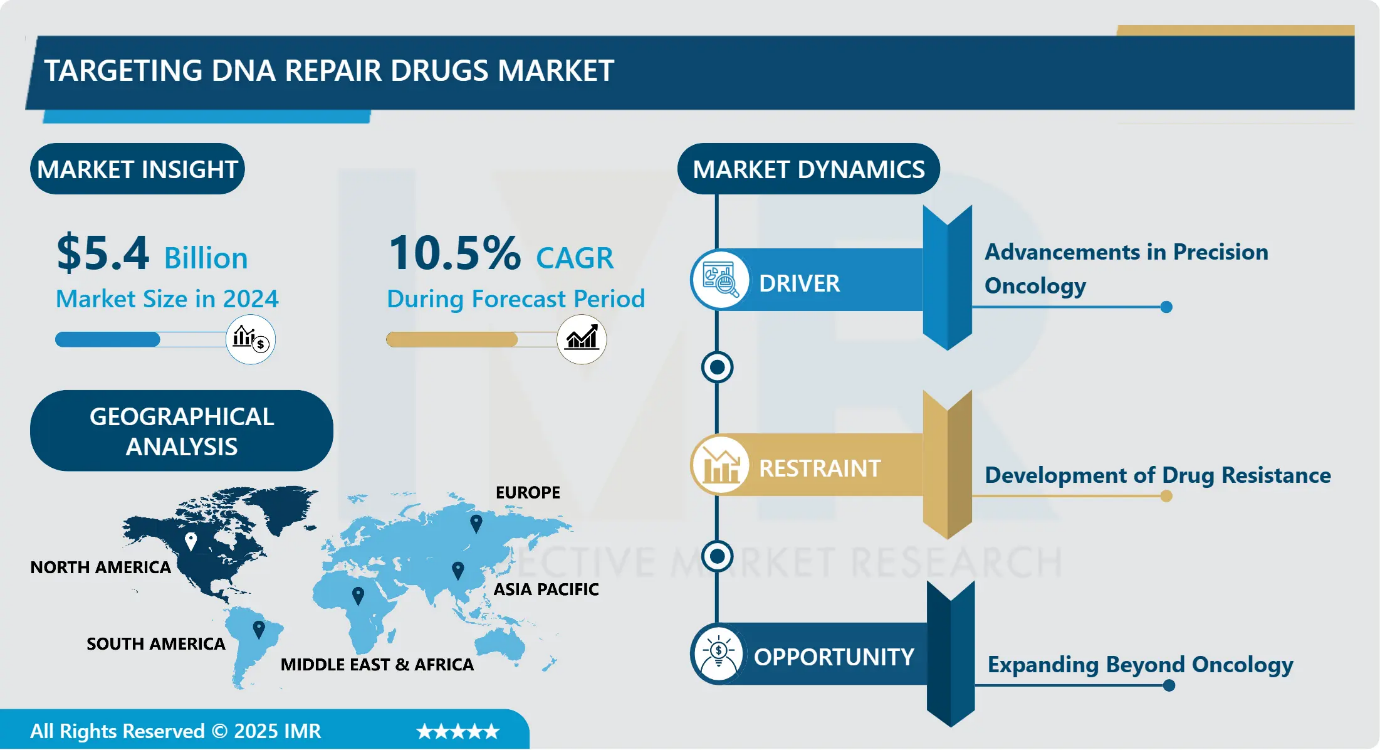
Targeting DNA Repair Drugs Market is segmented based on Drug Type, Mechanism of Action, Disease Indications, Distribution Channel, End-Users, and Region
|
Targeting DNA Repair Drugs Market |
|||
|
Base Year: |
2024 |
Forecast Period: |
2025-2032 |
|
Historical Data: |
2018 to 2024 |
Market Size in 2024: |
USD 5.4 Bn. |
|
Forecast Period 2025-32 CAGR: |
10.5 % |
Market Size in 2032: |
USD 12.0 Bn. |
|
Segments Covered: |
By Drug Type |
|
|
|
By Mechanism of Action |
|
||
|
By Disease Indications |
|
||
|
By Distribution Channel |
|
||
|
By End-User |
|
||
|
By Region |
|
||
|
Growth Driver: |
|
||
|
Limiting Factor |
|
||
|
Expansion Opportunity |
|
||
|
Challenge Barrier |
|
||
|
Companies Covered in the Report: |
|
||
Chapter 1: Introduction
1.1 Scope and Coverage
Chapter 2:Executive Summary
Chapter 3: Market Landscape
3.1 Market Dynamics and Opportunity Analysis
3.1.1 Growth Drivers
3.1.2 Limiting Factors
3.1.3 Growth Opportunities
3.1.4 Challenges and Risks
3.2 Market Trend Analysis
3.3 Industry Ecosystem
3.4 Industry Value Chain Mapping
3.5 Strategic PESTLE Overview
3.6 Porter's Five Forces Framework
3.7 Regulatory Framework
3.8 Pricing Trend Analysis
3.9 Intellectual Property Review
3.10 Technology Evolution
3.11 Import-Export Analysis
3.12 Consumer Behavior Analysis
3.13 Investment Pocket Analysis
3.14 Go-To Market Strategy
Chapter 4: Targeting DNA Repair Drugs Market by Drug Type (2018-2032)
4.1 Targeting DNA Repair Drugs Market Snapshot and Growth Engine
4.2 Market Overview
4.3 Small Molecule Inhibitors
4.3.1 Introduction and Market Overview
4.3.2 Historic and Forecasted Market Size in Value USD and Volume Units
4.3.3 Key Market Trends, Growth Factors, and Opportunities
4.3.4 Geographic Segmentation Analysis
4.4 Monoclonal Antibodies
4.5 Gene Therapy Products
4.6 RNA-based Therapeutics
4.7 Proteins and Enzymes
Chapter 5: Targeting DNA Repair Drugs Market by Mechanism of Action (2018-2032)
5.1 Targeting DNA Repair Drugs Market Snapshot and Growth Engine
5.2 Market Overview
5.3 Nucleotide Excision Repair (NER) Inhibitors
5.3.1 Introduction and Market Overview
5.3.2 Historic and Forecasted Market Size in Value USD and Volume Units
5.3.3 Key Market Trends, Growth Factors, and Opportunities
5.3.4 Geographic Segmentation Analysis
5.4 Base Excision Repair (BER) Modulators
5.5 Double-Strand Break Repair Agents
5.6 Alternative Pathway Activators
5.7 DNA Damage Response (DDR) Pathways
Chapter 6: Targeting DNA Repair Drugs Market by Disease Indications (2018-2032)
6.1 Targeting DNA Repair Drugs Market Snapshot and Growth Engine
6.2 Market Overview
6.3 Cancer
6.3.1 Introduction and Market Overview
6.3.2 Historic and Forecasted Market Size in Value USD and Volume Units
6.3.3 Key Market Trends, Growth Factors, and Opportunities
6.3.4 Geographic Segmentation Analysis
6.4 Neurodegenerative Disorders
6.5 Autoimmune Diseases
6.6 Cardiovascular Diseases
6.7 Age-related Disorders
Chapter 7: Targeting DNA Repair Drugs Market by Distribution Channel (2018-2032)
7.1 Targeting DNA Repair Drugs Market Snapshot and Growth Engine
7.2 Market Overview
7.3 Hospital Pharmacies
7.3.1 Introduction and Market Overview
7.3.2 Historic and Forecasted Market Size in Value USD and Volume Units
7.3.3 Key Market Trends, Growth Factors, and Opportunities
7.3.4 Geographic Segmentation Analysis
7.4 Retail Pharmacies
7.5 Online Pharmacies
7.6 Institutional Pharmacies
7.7 Specialized Drug Stores
Chapter 8: Targeting DNA Repair Drugs Market by End-User (2018-2032)
8.1 Targeting DNA Repair Drugs Market Snapshot and Growth Engine
8.2 Market Overview
8.3 Hospitals
8.3.1 Introduction and Market Overview
8.3.2 Historic and Forecasted Market Size in Value USD and Volume Units
8.3.3 Key Market Trends, Growth Factors, and Opportunities
8.3.4 Geographic Segmentation Analysis
8.4 Research Institutes
8.5 Pharmaceutical Companies
8.6 Diagnostic Laboratories
8.7 Academic Institutions
Chapter 9: Company Profiles and Competitive Analysis
9.1 Competitive Landscape
9.1.1 Competitive Benchmarking
9.1.2 Targeting DNA Repair Drugs Market Share by Manufacturer/Service Provider(2024)
9.1.3 Industry BCG Matrix
9.1.4 PArtnerships, Mergers & Acquisitions
9.2 ABBOTT (USA)
9.2.1 Company Overview
9.2.2 Key Executives
9.2.3 Company Snapshot
9.2.4 Role of the Company in the Market
9.2.5 Sustainability and Social Responsibility
9.2.6 Operating Business Segments
9.2.7 Product Portfolio
9.2.8 Business Performance
9.2.9 Recent News & Developments
9.2.10 SWOT Analysis
9.3 AMGEN INC. (USA)
9.4 ASTRAZENECA (UK)
9.5 BAYER AG (GERMANY)
9.6 ELI LILLY AND CO. (USA)
9.7 F. HOFFMANN-LA ROCHE LTD. (SWITZERLAND)
9.8 FORX THERAPEUTICS (SWITZERLAND)
9.9 GILEAD SCIENCES INC. (USA)
9.10 GLAXOSMITHKLINE (UK)
9.11 LONZA (SWITZERLAND)
9.12 MERCK & CO. INC. (USA)
9.13 NOVARTIS AG (SWITZERLAND)
9.14 PFIZER (USA)
9.15 SANOFI (FRANCE)
9.16 OTHER ACTIVE PLAYERS
Chapter 10: Global Targeting DNA Repair Drugs Market By Region
10.1 Overview
10.2. North America Targeting DNA Repair Drugs Market
10.2.1 Key Market Trends, Growth Factors and Opportunities
10.2.2 Top Key Companies
10.2.3 Historic and Forecasted Market Size by Segments
10.2.4 Historic and Forecast Market Size by Country
10.2.4.1 US
10.2.4.2 Canada
10.2.4.3 Mexico
10.3. Eastern Europe Targeting DNA Repair Drugs Market
10.3.1 Key Market Trends, Growth Factors and Opportunities
10.3.2 Top Key Companies
10.3.3 Historic and Forecasted Market Size by Segments
10.3.4 Historic and Forecast Market Size by Country
10.3.4.1 Russia
10.3.4.2 Bulgaria
10.3.4.3 The Czech Republic
10.3.4.4 Hungary
10.3.4.5 Poland
10.3.4.6 Romania
10.3.4.7 Rest of Eastern Europe
10.4. Western Europe Targeting DNA Repair Drugs Market
10.4.1 Key Market Trends, Growth Factors and Opportunities
10.4.2 Top Key Companies
10.4.3 Historic and Forecasted Market Size by Segments
10.4.4 Historic and Forecast Market Size by Country
10.4.4.1 Germany
10.4.4.2 UK
10.4.4.3 France
10.4.4.4 The Netherlands
10.4.4.5 Italy
10.4.4.6 Spain
10.4.4.7 Rest of Western Europe
10.5. Asia Pacific Targeting DNA Repair Drugs Market
10.5.1 Key Market Trends, Growth Factors and Opportunities
10.5.2 Top Key Companies
10.5.3 Historic and Forecasted Market Size by Segments
10.5.4 Historic and Forecast Market Size by Country
10.5.4.1 China
10.5.4.2 India
10.5.4.3 Japan
10.5.4.4 South Korea
10.5.4.5 Malaysia
10.5.4.6 Thailand
10.5.4.7 Vietnam
10.5.4.8 The Philippines
10.5.4.9 Australia
10.5.4.10 New Zealand
10.5.4.11 Rest of APAC
10.6. Middle East & Africa Targeting DNA Repair Drugs Market
10.6.1 Key Market Trends, Growth Factors and Opportunities
10.6.2 Top Key Companies
10.6.3 Historic and Forecasted Market Size by Segments
10.6.4 Historic and Forecast Market Size by Country
10.6.4.1 Turkiye
10.6.4.2 Bahrain
10.6.4.3 Kuwait
10.6.4.4 Saudi Arabia
10.6.4.5 Qatar
10.6.4.6 UAE
10.6.4.7 Israel
10.6.4.8 South Africa
10.7. South America Targeting DNA Repair Drugs Market
10.7.1 Key Market Trends, Growth Factors and Opportunities
10.7.2 Top Key Companies
10.7.3 Historic and Forecasted Market Size by Segments
10.7.4 Historic and Forecast Market Size by Country
10.7.4.1 Brazil
10.7.4.2 Argentina
10.7.4.3 Rest of SA
Chapter 11 Analyst Viewpoint and Conclusion
Chapter 12 Our Thematic Research Methodology
11.1 Research Process
11.2 Primary Research
11.3 Secondary Research
Chapter 13 Analyst Viewpoint and Conclusion
Chapter 14 Research Methodology
12.1 Research Process
12.2 Primary Research
12.3 Secondary Research
Chapter 15 Case Study
Chapter 16 Appendix
12.1 Sources
12.2 List of Tables and figures
12.3 Short Forms and Citations
12.4 Assumption and Conversion
12.5 Disclaimer
|
Targeting DNA Repair Drugs Market |
|||
|
Base Year: |
2024 |
Forecast Period: |
2025-2032 |
|
Historical Data: |
2018 to 2024 |
Market Size in 2024: |
USD 5.4 Bn. |
|
Forecast Period 2025-32 CAGR: |
10.5 % |
Market Size in 2032: |
USD 12.0 Bn. |
|
Segments Covered: |
By Drug Type |
|
|
|
By Mechanism of Action |
|
||
|
By Disease Indications |
|
||
|
By Distribution Channel |
|
||
|
By End-User |
|
||
|
By Region |
|
||
|
Growth Driver: |
|
||
|
Limiting Factor |
|
||
|
Expansion Opportunity |
|
||
|
Challenge Barrier |
|
||
|
Companies Covered in the Report: |
|
||
Related Reports
Understand your customers' needs so can deliver better services and experiences.
Stay in touch with us to get latest news and discount coupons.