




Key Market Highlights
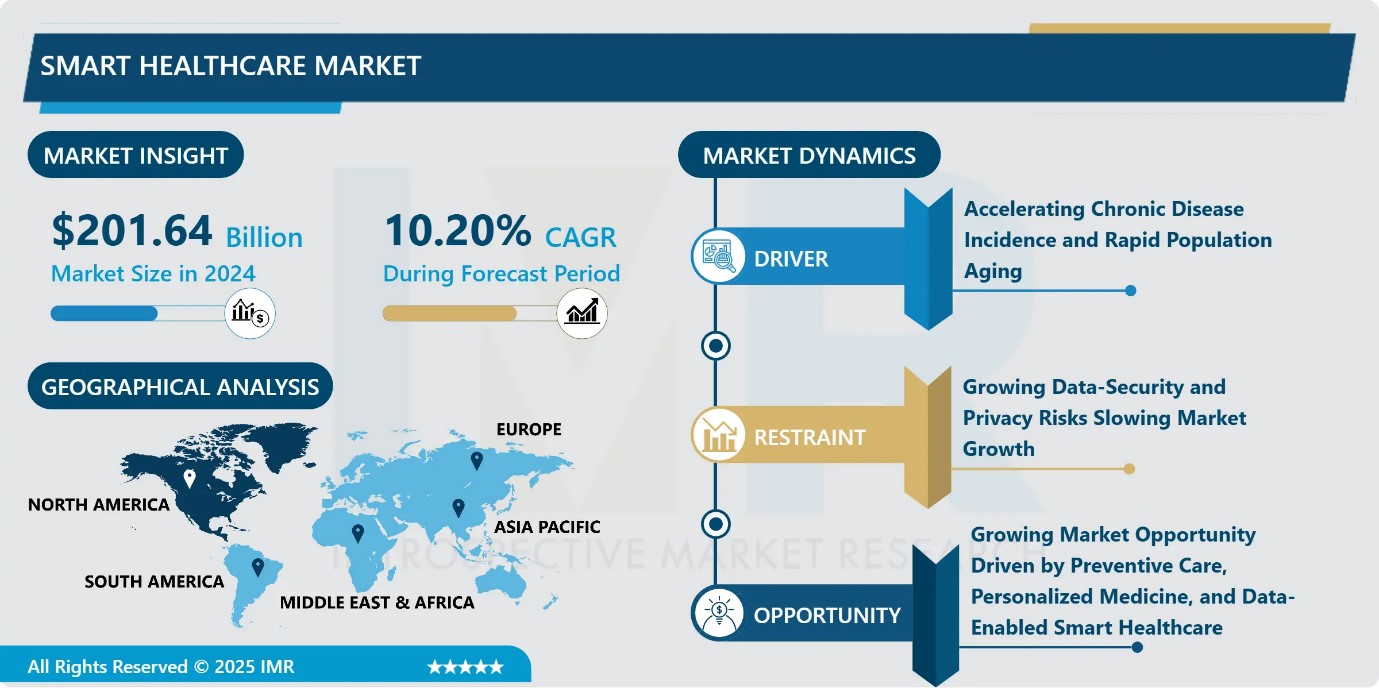
Smart Healthcare Market Size Was Valued at USD 201.64 Billion in 2024, and is Projected to Reach USD 586.91 Billion by 2035, Growing at a CAGR of 10.20% from 2025-2035.
- Market Size in 2024: USD 201.64 Billion
- Projected Market Size by 2035: USD 586.91 Billion
- CAGR (2025–2035): 10.20%
- Leading Market in 2024: North America
- Fastest-Growing Market: Asia-Pacific
- By Product: The Telemedicine Platforms segment is anticipated to lead the market by accounting for 25.90% of the market share throughout the forecast period.
- By End-User: The Hospitals segment is expected to capture 39.70% of the market share, thereby maintaining its dominance over the forecast period.
- By Region: North America region is projected to hold 26.22% of the market share during the forecast period.
- Active Players: Abbott Laboratories (U.S.), AirStrip Technologies Inc. (U.S.), Apple Inc. (U.S.), BD (U.S.), Cerner Corporation / Oracle (U.S.), and Other Active Players.
Smart Healthcare Market Synopsis:
The smart healthcare market refers to a technology-driven healthcare ecosystem that integrates IoT devices, mHealth platforms, remote monitoring systems, electronic health records, and connected medical products to enhance patient care, diagnosis, and hospital efficiency. It enables real-time health data collection, continuous monitoring, telemedicine consultations, and automated clinical workflows. Increasing chronic disease prevalence, rising elderly population, and growing need for personalized and cost-effective treatment are key market drivers. Strong government support, digital health policies, and rapid adoption of wearable medical devices further accelerate growth. The market aims to transform conventional healthcare into proactive, accessible, and data-centered care delivery.
Smart Healthcare Market Dynamics and Trend Analysis:
Smart Healthcare Market Growth Driver
Accelerating Chronic Disease Incidence and Rapid Population Aging
- The growing number of people living with chronic diseases, together with the rapid rise in the elderly population, is becoming one of the biggest drivers of smart healthcare adoption worldwide. Chronic illnesses now account for about 74% of global deaths (2024), and lifestyle factors such as inactivity, obesity, and poor diets are pushing these numbers higher each year. In the U.S., 6 in 10 adults have at least 1 chronic disease, while 4 in 10 manage 2 or more, which creates a clear need for ongoing support rather than occasional hospital visits. Smart monitoring tools and connected devices help by enabling care at home and can cut hospital readmissions by up to 85%, while improving patient satisfaction to around 97%. As more people live longer with multiple health issues, demand for home-based technologies, safety devices, and AI-supported diagnostics is expected to increase significantly.
Smart Healthcare Market Limiting Factor
Growing Data-Security and Privacy Risks Slowing Market Growth
- Concerns around data security are becoming a major obstacle for smart healthcare products. Connected devices and cloud platforms collect large volumes of personal medical information, which makes them appealing targets for hackers. A well-known example happened in 2018, when a fitness-tracking app’s public activity map accidentally exposed the locations of military bases, raising alarms about how personal data could be misused. In the US, around 725 healthcare breaches in 2023 affected nearly 133 million patient records, while over 180 million people were impacted by healthcare-related data breaches during 2024. These numbers reflect how patient information is increasingly exposed to cyber threats. Many smart medical devices still lack strong protection, leading hospitals and device makers to invest more in security and regulatory compliance.
Smart Healthcare Market Expansion Opportunity
Growing Market Opportunity Driven by Preventive Care, Personalized Medicine, and Data-Enabled Smart Healthcare
- There is a clear movement in healthcare from treating illness after it occurs toward helping people stay healthy in the first place. This shift is pushing demand for smart devices such as wearables and mobile health apps that allow individuals to keep an eye on their physical activity, heart rate, sleep and other daily indicators. At the same time, digital tools are getting better at using personal health information to suggest early interventions and preventive steps.
- Another major opportunity lies in the rapid expansion of technologies capable of analyzing medical data. The global market for healthcare-related artificial intelligence is estimated to reach around USD 36 billion by 2025, showing how quickly hospitals and health systems are adopting these tools. As remote monitoring, connected devices and more tailored treatment approaches continue to grow, companies that provide smart, data-driven and patient-focused solutions are well-positioned for long-term expansion.
Smart Healthcare Market Challenge and Risk
High Costs, Workforce Gaps and Regulatory Hurdles Slowing Adoption
- The cost of setting up smart healthcare systems remains a major challenge for hospitals and clinics. Upfront spending covers advanced devices, secure networks, cloud platforms and cyber-protection, which can be difficult for smaller facilities or those in developing regions to afford. In the US, changes proposed to patient-data rules are estimated to require around 9.3 billion in the first year, mainly for security upgrades and staff training, showing how expensive compliance alone can be. At the same time, many providers lack trained people who can run data systems, protect digital equipment or support remote-care platforms, which slows day-to-day use. A further obstacle is that rules differ from country to country for connected medical tools, making approvals slow and costly. These combined pressures are holding back wider adoption of smart healthcare solutions, despite their long-term benefits.
Smart Healthcare Market Trend
Rapid Digital Health Integration and Wearable Expansion Fueling Smart Healthcare Transformation
- One of the most noticeable trends in smart healthcare today is how quickly digital tools are being built into everyday care. Hospitals and clinics are making wider use of IoT, AI, machine learning and connected sensors to monitor patients continuously and simplify clinical tasks. Electronic Health Records and mobile health platforms are now standard across many healthcare systems, giving clinicians faster access to information and improving treatment decisions.
- Policy support is also pushing this shift. In the U.S., Medicare currently includes more than 250 reimbursable telehealth codes and has extended these flexibilities through March 2025, while the American Medical Association has added 17 billing codes for virtual care. Wearables show how strong this trend has become, with global shipments and smartwatches and fitness trackers surpassing 250 million units in 2023. As devices become more accurate and easier to use, adoption is likely to grow even faster.
Smart Healthcare Market Segment Analysis:
Smart Healthcare Market is segmented based on Type Product, Application, End-User and Region.
By Product, Telemedicine Platforms segment is expected to dominate the market with around 25.90% share during the forecast period.
- In 2024, Telemedicine accounted for roughly 25.90% of global smart healthcare revenue, making it the largest product category. The segment leads mainly because patients now look for medical support without traveling, especially after COVID-19 changed care-seeking behavior. Remote consultations, virtual monitoring, and follow-ups have become routine for chronic cases and elderly patients. A practical example is the Mar 2025 partnership between Airtel Business and Fortis, which introduced 5G-based Smart Clinics to provide real-time care for both urban and rural users. Telemedicine also benefits from growing government programs and insurance coverage that accept online consultations. Meanwhile, RFID Kanban Systems are set for the fastest growth, driven by the need to track supplies accurately and avoid shortages, such as the Aug 2023 BlueBin–Avatek RFID rollout for hospital inventory.
By End-User, Hospitals is expected to dominate with close to 39.70% market share during the forecast period.
- Hospitals hold around 39.70% of global spending on smart healthcare products, making them the largest end-user group in this market. This happens mainly because hospitals manage higher patient volumes and face pressure to cut waiting times, modernize systems, and comply with government mandates for electronic medical records. In addition, hospital environments usually require advanced tools such as connected monitoring devices and digital diagnostic systems, which naturally pushes their technology budgets upward.
- Home-care settings represent a smaller share today, but they are expanding quickly because aging populations and chronic diseases are shifting demand toward continuous monitoring and treatment outside hospitals, making home-based digital solutions more valuable.
Smart Healthcare Market Regional Insights:
North America region is estimated to lead the market with around 26.22% share during the forecast period.
- North America led the global smart healthcare market in 2024, accounting for more than 26.22% of total revenue. The region benefits from strong digital infrastructure, supportive government programs, and a population that is generally comfortable using technology in healthcare. This momentum is also helped by initiatives such as the Alliance for Smart Healthcare Excellence, launched in November 2024 to encourage the use of advanced hospital systems. The U.S. remains the key contributor thanks to its early uptake of electronic health records, telehealth, and mobile health toolsaround 76% of hospitals were already using telehealth by 2020. North America, continues to grow as agencies like the FDA and HITECH support digital transformation, while Asia-Pacific is projected to expand steadily from 2025 to 2035 as investment in healthcare technology rises.
Smart Healthcare Market Active Players:
- Abbott Laboratories (U.S.)
- AirStrip Technologies Inc. (U.S.)
- Apple Inc. (U.S.)
- BD (U.S.)
- Oracle (U.S.)
- Cisco Systems Inc. (U.S.)
- GE Healthcare (U.S.)
- IBM Corporation (U.S.)
- McKesson Corporation (U.S.)
- Medtronic Plc (Ireland)
- Olympus Corporation (Japan)
- Pepperl+Fuchs (Germany)
- Samsung Electronics Co. Ltd. (South Korea)
- Siemens Healthcare Private Limited (Germany)
- STANLEY Healthcare (Canada)
- Other Active Players
Key Industry Developments in the Smart Healthcare Market:
- In May 2025, Oracle Health partnered with Cleveland Clinic and G42 to develop a comprehensive healthcare delivery platform aimed at improving patient care and public health outcomes. This platform uses intelligent clinical tools and large-scale data analytics to build secure, accessible, and scalable care models that support better health and longevity.
- In July 2025, Medtronic entered a strategic partnership with Philips to embed next-generation Nellcor pulse oximetry and Microstream capnography into Philips’ patient-monitoring platforms. The collaboration aims to expand worldwide access to advanced respiratory monitoring capabilities.
Technical Architecture and Digital Infrastructure Advancements Shaping the Global Smart Healthcare Market
- Smart healthcare products rely on a mix of connected medical devices, wireless communication, and digital data systems that allow patient information to move quickly between equipment, clinicians, and hospital platforms. Tools such as wearable heart sensors, remote monitoring devices, smart infusion pumps, and app-linked diagnostic equipment collect clinical readings and share them through common communication channels, including Bluetooth, Wi-Fi, and 5G networks. Many systems now process information at the device level, which helps reduce delays in emergency or intensive-care situations.
- From a data standpoint, modern platforms follow healthcare information standards such as HL7 and FHIR, which make it easier for hospitals to integrate different devices into electronic medical records and daily workflows. Predictive algorithms are increasingly used to support early risk detection and treatment planning. Because these systems handle sensitive information, secure authentication, encryption, and protected network design remain essential to meet global healthcare privacy rules.
|
Smart Healthcare Market |
|||
|
Base Year: |
2024 |
Forecast Period: |
2025-2035 |
|
Historical Data: |
2018 to 2023 |
Market Size in 2024: |
USD 201.64 Bn. |
|
Forecast Period 2025-32 CAGR: |
10.20% |
Market Size in 2035: |
USD 586.91 Bn. |
|
Segments Covered: |
By Product Type |
|
|
|
By Application
|
|
||
|
By End-User |
|
||
|
By Region |
|
||
|
Growth Driver: |
|
||
|
Limiting Factor |
|
||
|
Expansion Opportunity |
|
||
|
Challenge and Risk |
|
||
|
Companies Covered in the Report: |
|
||
Chapter 1: Introduction
1.1 Scope and Coverage
Chapter 2:Executive Summary
Chapter 3: Market Landscape
3.1 Market Dynamics and Opportunity Analysis
3.1.1 Growth Drivers
3.1.2 Limiting Factors
3.1.3 Growth Opportunities
3.1.4 Challenges and Risks
3.2 Market Trend Analysis
3.3 Industry Ecosystem
3.4 Industry Value Chain Mapping
3.5 Strategic PESTLE Overview
3.6 Porter's Five Forces Framework
3.7 Regulatory Framework
3.8 Pricing Trend Analysis
3.9 Intellectual Property Review
3.10 Technology Evolution
3.11 Import-Export Analysis
3.12 Consumer Behavior Analysis
3.13 Investment Pocket Analysis
3.14 Go-To Market Strategy
Chapter 4: Smart Healthcare Market by Type Product (2018-2035)
4.1 Smart Healthcare Market Snapshot and Growth Engine
4.2 Market Overview
4.3 Wearable Devices
4.3.1 Introduction and Market Overview
4.3.2 Historic and Forecasted Market Size in Value USD and Volume Units
4.3.3 Key Market Trends, Growth Factors, and Opportunities
4.3.4 Geographic Segmentation Analysis
4.4 Mobile Health Apps
4.5 Telemedicine Platforms
4.6 Electronic Health Record Systems
4.7 Medical Imaging
Chapter 5: Smart Healthcare Market by Application (2018-2035)
5.1 Smart Healthcare Market Snapshot and Growth Engine
5.2 Market Overview
5.3 Remote Patient Monitoring
5.3.1 Introduction and Market Overview
5.3.2 Historic and Forecasted Market Size in Value USD and Volume Units
5.3.3 Key Market Trends, Growth Factors, and Opportunities
5.3.4 Geographic Segmentation Analysis
5.4 Chronic Disease Management
5.5 Wellness & Fitness
5.6 Storage & Inventory Management
5.7 Treatment
5.8 Monitoring
5.9 Others
Chapter 6: Smart Healthcare Market by End-User (2018-2035)
6.1 Smart Healthcare Market Snapshot and Growth Engine
6.2 Market Overview
6.3 Hospitals
6.3.1 Introduction and Market Overview
6.3.2 Historic and Forecasted Market Size in Value USD and Volume Units
6.3.3 Key Market Trends, Growth Factors, and Opportunities
6.3.4 Geographic Segmentation Analysis
6.4 Clinics
6.5 Home Care Settings
6.6 Others
Chapter 7: Company Profiles and Competitive Analysis
7.1 Competitive Landscape
7.1.1 Competitive Benchmarking
7.1.2 Smart Healthcare Market Share by Manufacturer/Service Provider(2024)
7.1.3 Industry BCG Matrix
7.1.4 PArtnerships, Mergers & Acquisitions
7.2 ABBOTT LABORATORIES (USA)
7.2.1 Company Overview
7.2.2 Key Executives
7.2.3 Company Snapshot
7.2.4 Role of the Company in the Market
7.2.5 Sustainability and Social Responsibility
7.2.6 Operating Business Segments
7.2.7 Product Portfolio
7.2.8 Business Performance
7.2.9 Recent News & Developments
7.2.10 SWOT Analysis
7.3 AIRSTRIP TECHNOLOGIES INC. (USA)
7.4 APPLE INC. (USA)
7.5 BD (USA)
7.6 CERNER CORPORATION / ORACLE (USA)
7.7 CISCO SYSTEMS INC. (USA)
7.8 GE HEALTHCARE (USA)
7.9 IBM CORPORATION (USA)
7.10 MCKESSON CORPORATION (USA)
7.11 MEDTRONIC PLC (IRELAND)
7.12 OLYMPUS CORPORATION (JAPAN)
7.13 PEPPERL+FUCHS (GERMANY)
7.14 SAMSUNG ELECTRONICS CO. LTD. (SOUTH KOREA)
7.15 SIEMENS HEALTHCARE PRIVATE LIMITED (GERMANY)
7.16 STANLEY HEALTHCARE (CANADA) AND OTHER ACTIVE PLAYERS
Chapter 8: Global Smart Healthcare Market By Region
8.1 Overview
8.2. North America Smart Healthcare Market
8.2.1 Key Market Trends, Growth Factors and Opportunities
8.2.2 Top Key Companies
8.2.3 Historic and Forecasted Market Size by Segments
8.2.4 Historic and Forecast Market Size by Country
8.2.4.1 US
8.2.4.2 Canada
8.2.4.3 Mexico
8.3. Eastern Europe Smart Healthcare Market
8.3.1 Key Market Trends, Growth Factors and Opportunities
8.3.2 Top Key Companies
8.3.3 Historic and Forecasted Market Size by Segments
8.3.4 Historic and Forecast Market Size by Country
8.3.4.1 Russia
8.3.4.2 Bulgaria
8.3.4.3 The Czech Republic
8.3.4.4 Hungary
8.3.4.5 Poland
8.3.4.6 Romania
8.3.4.7 Rest of Eastern Europe
8.4. Western Europe Smart Healthcare Market
8.4.1 Key Market Trends, Growth Factors and Opportunities
8.4.2 Top Key Companies
8.4.3 Historic and Forecasted Market Size by Segments
8.4.4 Historic and Forecast Market Size by Country
8.4.4.1 Germany
8.4.4.2 UK
8.4.4.3 France
8.4.4.4 The Netherlands
8.4.4.5 Italy
8.4.4.6 Spain
8.4.4.7 Rest of Western Europe
8.5. Asia Pacific Smart Healthcare Market
8.5.1 Key Market Trends, Growth Factors and Opportunities
8.5.2 Top Key Companies
8.5.3 Historic and Forecasted Market Size by Segments
8.5.4 Historic and Forecast Market Size by Country
8.5.4.1 China
8.5.4.2 India
8.5.4.3 Japan
8.5.4.4 South Korea
8.5.4.5 Malaysia
8.5.4.6 Thailand
8.5.4.7 Vietnam
8.5.4.8 The Philippines
8.5.4.9 Australia
8.5.4.10 New Zealand
8.5.4.11 Rest of APAC
8.6. Middle East & Africa Smart Healthcare Market
8.6.1 Key Market Trends, Growth Factors and Opportunities
8.6.2 Top Key Companies
8.6.3 Historic and Forecasted Market Size by Segments
8.6.4 Historic and Forecast Market Size by Country
8.6.4.1 Turkiye
8.6.4.2 Bahrain
8.6.4.3 Kuwait
8.6.4.4 Saudi Arabia
8.6.4.5 Qatar
8.6.4.6 UAE
8.6.4.7 Israel
8.6.4.8 South Africa
8.7. South America Smart Healthcare Market
8.7.1 Key Market Trends, Growth Factors and Opportunities
8.7.2 Top Key Companies
8.7.3 Historic and Forecasted Market Size by Segments
8.7.4 Historic and Forecast Market Size by Country
8.7.4.1 Brazil
8.7.4.2 Argentina
8.7.4.3 Rest of SA
Chapter 9 Analyst Viewpoint and Conclusion
Chapter 10 Our Thematic Research Methodology
10.1 Research Process
10.2 Primary Research
10.3 Secondary Research
Chapter 11 Case Study
Chapter 12 Appendix
10.1 Sources
10.2 List of Tables and figures
10.3 Short Forms and Citations
10.4 Assumption and Conversion
10.5 Disclaimer
|
Smart Healthcare Market |
|||
|
Base Year: |
2024 |
Forecast Period: |
2025-2035 |
|
Historical Data: |
2018 to 2023 |
Market Size in 2024: |
USD 201.64 Bn. |
|
Forecast Period 2025-32 CAGR: |
10.20% |
Market Size in 2035: |
USD 586.91 Bn. |
|
Segments Covered: |
By Product Type |
|
|
|
By Application
|
|
||
|
By End-User |
|
||
|
By Region |
|
||
|
Growth Driver: |
|
||
|
Limiting Factor |
|
||
|
Expansion Opportunity |
|
||
|
Challenge and Risk |
|
||
|
Companies Covered in the Report: |
|
||


