




Key Market Highlights
Small Molecule API Market Size Was Valued at USD 140.45 Billion in 2024, and is Projected to Reach USD 280.78 Billion by 2035, Growing at a CAGR of 6.5% from 2025-2035.
- Market Size in 2024: USD 140.45 Billion
- Projected Market Size by 2035: USD 280.78 Billion
- CAGR (2025–2035): 6.5%
- Leading Market in 2024: North America
- Fastest-Growing Market: Asia-Pacific
- By Therapeutic Area: The Oncology segment is anticipated to lead the market by accounting for 27.67% of the market share throughout the forecast period.
- By End-User: The Pharmaceutical Companies segment is expected to capture 39.70% of the market share, thereby maintaining its dominance over the forecast period.
- By Region: North America region is projected to hold 32.88% of the market share during the forecast period.
- Active Players: AbbVie Inc. (U.S.), AstraZeneca plc (U.K.), Boehringer Ingelheim International GmbH (DE), Bristol-Myers Squibb Company (U.S.), Cipla Inc. (IN), and Other Active Players.
Small Molecule API Market Synopsis:
The small molecule active pharmaceutical ingredient (API) market comprises chemically synthesized, low–molecular-weight compounds that provide the therapeutic effect in most conventional medicines. These APIs are widely used in oral and injectable drug formulations due to their ability to penetrate cell membranes and act on intracellular targets. The market is experiencing stable growth driven by the rising global burden of chronic diseases such as cancer, cardiovascular disorders, and diabetes, along with increasing demand for affordable generic medicines. Ongoing regulatory approvals, expanding pharmaceutical R&D pipelines, and strengthened API manufacturing capacities worldwide continue to sustain the critical need for small molecule APIs across global healthcare systems.
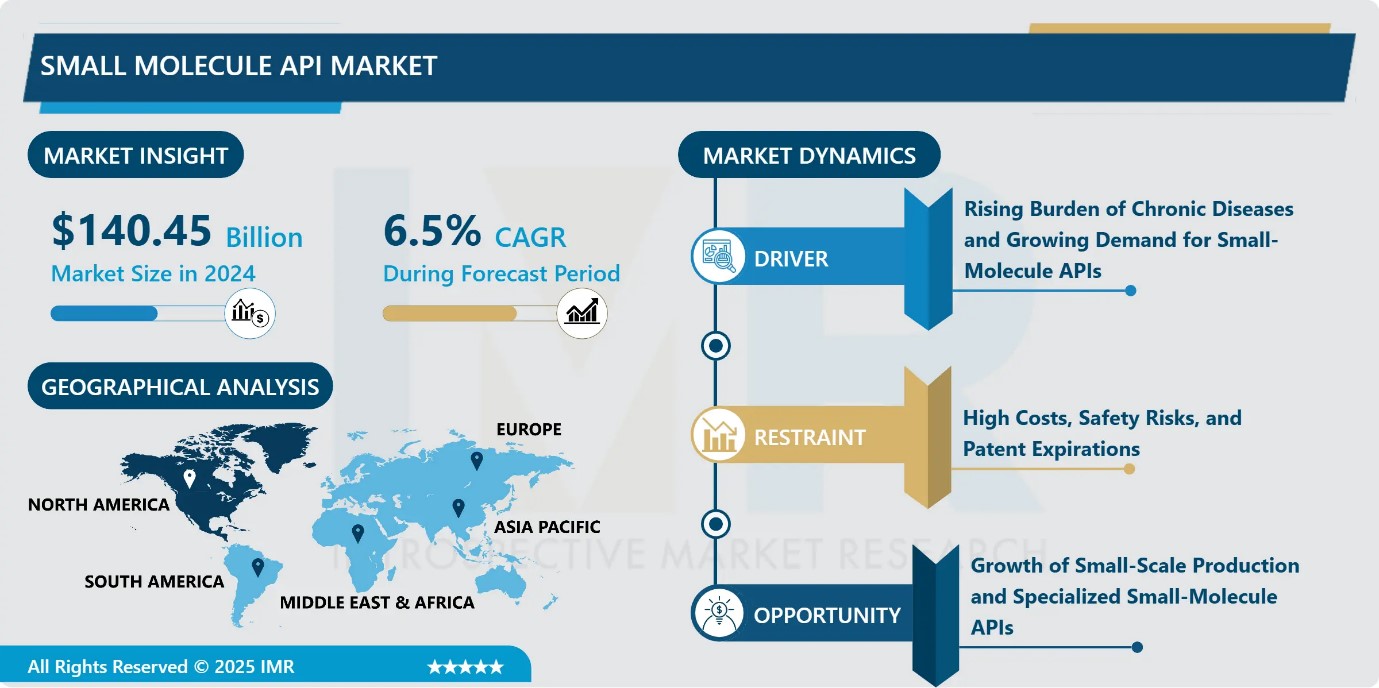
Small Molecule API Market Dynamics and Trend Analysis:
Small Molecule API Market Growth Driver-Rising Burden of Chronic Diseases and Growing Demand for Small-Molecule APIs
- The increasing prevalence of chronic and non-communicable diseases such as cancer, cardiovascular disorders, diabetes, respiratory, neurological, and autoimmune conditions is a key driver of the small-molecule API market. An aging global population and longer life expectancy have expanded the patient pool requiring long-term and cost-effective therapies. Small-molecule APIs, including highly potent active pharmaceutical ingredients (HPAPIs), play a critical role in oncology and other chronic indications due to their high bioavailability, stability, and suitability for oral formulations. Continued investment in R&D, expanded HPAPI manufacturing capacity, and growing generic drug development are further accelerating market growth.
Small Molecule API Market Limiting Factor-High Costs, Safety Risks, and Patent Expirations
- The small molecule API market is constrained by high development and manufacturing costs, stringent safety requirements, and patent expirations. API development demands significant investment in advanced synthesis technologies, specialized containment facilities, skilled personnel, and rigorous quality control, increasing overall production expenses. Demonstrating safety and efficacy across diverse patient populations further prolongs timelines and raises clinical trial costs.
- Additionally, handling potent or toxic compounds introduces environmental and occupational safety challenges, requiring costly compliance with evolving regulations. Patent expirations of key small-molecule drugs intensify pricing pressure by enabling generic competition, sharply reducing margins for originator APIs. Collectively, these factors limit profitability, slow innovation, and restrain market expansion, particularly in cost-sensitive and highly regulated regions.
Small Molecule API Market Expansion Opportunity-Growth of Small-Scale Production and Specialized Small-Molecule APIs
- The expansion of small-scale production presents a significant opportunity for the small-molecule API market, driven by rising demand for personalized medicine, clinical trial materials, and niche therapies. Advancements in pharmaceutical technologies enable flexible, cost-efficient manufacturing of high-value, low-volume APIs, particularly for oncology, neurology, and rare diseases. Small-scale industries benefit from increased R&D activity, generic drug development, and reduced production costs. Strategic collaborations with CDMOs further support scalable and efficient manufacturing while accelerating time-to-market. Additionally, adoption of sustainable and green chemistry practices enhances competitiveness, regulatory compliance, and long-term growth potential in the evolving pharmaceutical landscape.
Small Molecule API Market Challenge and Risk-Stringent Regulatory Requirements and Rising Competition from Biologics
- The small molecule API market faces significant challenges due to increasingly stringent regulatory requirements and the growing shift toward biologics and biosimilars. Regulatory authorities such as the U.S. FDA and the EMA enforce rigorous quality, safety, and compliance standards, including GMP adherence, extensive documentation, and repeated inspections, which increase development timelines and operational costs. Navigating diverse regional regulatory frameworks further complicates global market entry, particularly for smaller manufacturers. In parallel, rising R&D investments in biologics, mRNA therapies, and biosimilars offer alternative treatment options for complex diseases, limiting small molecule API demand. Frequent approvals of biologics and biosimilars intensify competition, potentially restraining innovation, delaying product launches, and constraining overall market growth.
Small Molecule API Market Trend-Technological Advancements in Small Molecule API Manufacturing
- Technological innovation in the manufacturing sector is a key trend shaping the small molecule API market. Manufacturers are increasingly adopting advanced technologies such as continuous manufacturing, automation, and advanced purification techniques to improve process efficiency, yield, and product quality. Continuous flow chemistry is replacing traditional batch processing, enabling better reaction control, reduced waste, and enhanced scalability. These advancements are particularly important for producing complex and highly potent APIs required for oncology, CNS, and cardiovascular therapies. Integration of green chemistry principles further supports sustainable and regulatory-compliant production. Leading companies are leveraging these technologies to accelerate time-to-market, reduce costs, and support a strong pipeline of innovative and generic small-molecule drugs, driving long-term market expansion
Small Molecule API Market Segment Analysis:
Small Molecule API Market is segmented based on Therapeutic Area, Manufacturing type, Application, End-User and Region
By Therapeutic Area, Oncology segment is expected to dominate the market with around 27.67% share during the forecast period.
- Oncology represents the dominant and fastest-growing segment in the global small molecule API market, accounting for approximately 27.67% of revenue in 2024. This dominance is driven by the rising global cancer burden, continuous innovation in targeted therapies, and increasing regulatory approvals for small molecule–based anticancer drugs. Small molecules are highly effective in oncology due to their ability to penetrate cells, target intracellular pathways, and inhibit tumor-specific mechanisms with improved selectivity and tolerability. Strong pharmaceutical R&D investments, expanding pipelines of kinase inhibitors and targeted agents, and sustained demand for cost-effective cancer treatments further reinforce oncology’s leadership position in the market.
By End-User, Pharmaceutical Companies is expected to dominate with close to 39.70% market share during the forecast period.
- The pharmaceutical industry represents the largest end-use segment in the global small molecule API market, accounting for over 39.70% of market share in 2024. Its dominance is driven by large-scale manufacturing capabilities, strong branded and generic drug pipelines, and extensive global distribution networks. Leading pharmaceutical companies rely heavily on small molecule APIs for the treatment of chronic and acute diseases, supported by sustained investments in R&D and capacity expansion.
- Established regulatory expertise and consistent demand for cost-effective therapies further reinforce this leadership. Meanwhile, research institutions and CDMOs are experiencing rapid growth due to increased drug discovery activities and outsourcing trends. However, the pharmaceutical industry remains dominant due to its end-to-end control over drug development, commercialization, and large-volume API consumption.
Small Molecule API Market Regional Insights:
North America region is estimated to lead the market with around 32.88% share during the forecast period.
- North America accounted for over 32.88% of the global small molecule API market in 2024, with the U.S. holding the largest share. The region’s growth is driven by a well-established pharmaceutical sector, strong R&D infrastructure, and high demand for therapies in oncology, cardiovascular diseases, and metabolic disorders. Rising prescription drug consumption and the need for affordable, effective treatments for chronic illnesses and an aging population further support market expansion. Major companies like Pfizer, Merck & Co., and Teva Pharmaceuticals are investing in domestic API manufacturing, high-potency APIs, and personalized medicine to ensure supply chain resilience and regulatory compliance. Additionally, innovations in process optimization and technological advancements enhance production efficiency, positioning the U.S. as a key global hub for small molecule API development and consumption.
Small Molecule API Market Active Players:
- AbbVie Inc. (U.S.)
- AstraZeneca plc (U.K.)
- Boehringer Ingelheim International GmbH (DE)
- Bristol-Myers Squibb Company (U.S.)
- Cipla Inc. (IN)
- Dr. Reddy’s Laboratories Ltd. (IN)
- Gilead Sciences, Inc. (U.S.)
- GSK plc (GlaxoSmithKline) (U.K.)
- Johnson Matthey plc (U.K.)
- Lonza Group AG (CH)
- Merck & Co., Inc. (U.S.)
- Novartis AG (CH)
- Pfizer Inc. (U.S.)
- Sanofi S.A. (FR)
- Teva Pharmaceutical Industries Ltd. (IL)
- Other Active Players
Key Industry Developments in the Small Molecule API Market:
- In September 2025, Lonza Group (Switzerland) inaugurated a new manufacturing facility in the U.S. to increase small molecule API production, improving service to North American clients and strengthening its regional competitiveness.
- In August 2025, Teva Pharmaceutical Industries (Israel) formed a strategic partnership with a biotechnology firm to co-develop a new class of small molecule therapeutics, enhancing its R&D capabilities and product pipeline.
Technical Architecture, Manufacturing Processes, and Quality Control Systems Governing the Global Small Molecule API Market
- The technical framework of the Small Molecule API Market is based on advanced chemical synthesis, process optimization, and stringent quality control systems. APIs are produced using complex multi-step organic synthesis, including catalysis, chiral chemistry, and high-potency compound handling. Manufacturing processes incorporate batch and continuous flow chemistry, supported by automation, real-time process monitoring, and advanced purification techniques such as chromatography and crystallization.
- Compliance with global regulatory standards, including GMP, ICH, and pharmacopeial requirements, governs production and validation. Analytical technologies such as HPLC, LC-MS, and NMR ensure purity, potency, and consistency. Increasing adoption of green chemistry, solvent recovery, and waste-minimization techniques improves sustainability. Additionally, scalable manufacturing platforms, containment systems for HPAPIs, and digital process controls enhance efficiency, safety, and reliability, supporting both large-scale commercial production and small-batch clinical supply.
|
Small Molecule API Market |
|||
|
Base Year: |
2024 |
Forecast Period: |
2025-2035 |
|
Historical Data: |
2018 to 2023 |
Market Size in 2024: |
USD 140.45 Bn. |
|
Forecast Period 2025-35 CAGR: |
6.5 % |
Market Size in 2035: |
USD 280.78 Bn. |
|
Segments Covered: |
|
|
|
|
|
||
|
|
||
|
|
||
|
|
||
|
Growth Driver: |
|
||
|
Limiting Factor |
|
||
|
Expansion Opportunity |
|
||
|
Challenge and Risk |
|
||
|
Companies Covered in the Report: |
|
||
Chapter 1: Introduction
1.1 Scope and Coverage
Chapter 2:Executive Summary
Chapter 3: Market Landscape
3.1 Market Dynamics and Opportunity Analysis
3.1.1 Growth Drivers
3.1.2 Limiting Factors
3.1.3 Growth Opportunities
3.1.4 Challenges and Risks
3.2 Market Trend Analysis
3.3 Industry Ecosystem
3.4 Industry Value Chain Mapping
3.5 Strategic PESTLE Overview
3.6 Porter's Five Forces Framework
3.7 Regulatory Framework
3.8 Pricing Trend Analysis
3.9 Intellectual Property Review
3.10 Technology Evolution
3.11 Import-Export Analysis
3.12 Consumer Behavior Analysis
3.13 Investment Pocket Analysis
3.14 Go-To Market Strategy
Chapter 4: Small Molecule API Market by Type (2018-2035)
4.1 Small Molecule API Market Snapshot and Growth Engine
4.2 Market Overview
4.3 Branded APIs
4.3.1 Introduction and Market Overview
4.3.2 Historic and Forecasted Market Size in Value USD and Volume Units
4.3.3 Key Market Trends, Growth Factors, and Opportunities
4.3.4 Geographic Segmentation Analysis
4.4 Generic APIs
4.5 Synthetic/Chemical APIs
4.6 Biological APIs
Chapter 5: Small Molecule API Market by Therapeutic Area (2018-2035)
5.1 Small Molecule API Market Snapshot and Growth Engine
5.2 Market Overview
5.3 Oncology
5.3.1 Introduction and Market Overview
5.3.2 Historic and Forecasted Market Size in Value USD and Volume Units
5.3.3 Key Market Trends, Growth Factors, and Opportunities
5.3.4 Geographic Segmentation Analysis
5.4 Diabetes
5.5 Cardiovascular Diseases
5.6 CNS & Neurology
5.7 Orthopedic
5.8 Endocrinology
5.9 Gastroenterology
5.10 Nephrology
5.11 Ophthalmology
5.12 Others
Chapter 6: Small Molecule API Market by Application (2018-2035)
6.1 Small Molecule API Market Snapshot and Growth Engine
6.2 Market Overview
6.3 Commercial
6.3.1 Introduction and Market Overview
6.3.2 Historic and Forecasted Market Size in Value USD and Volume Units
6.3.3 Key Market Trends, Growth Factors, and Opportunities
6.3.4 Geographic Segmentation Analysis
6.4 Clinical
Chapter 7: Small Molecule API Market by Manufacturing Type (2018-2035)
7.1 Small Molecule API Market Snapshot and Growth Engine
7.2 Market Overview
7.3 Captive/In-house
7.3.1 Introduction and Market Overview
7.3.2 Historic and Forecasted Market Size in Value USD and Volume Units
7.3.3 Key Market Trends, Growth Factors, and Opportunities
7.3.4 Geographic Segmentation Analysis
7.4 Merchant/Outsourced
Chapter 8: Small Molecule API Market by End-User (2018-2035)
8.1 Small Molecule API Market Snapshot and Growth Engine
8.2 Market Overview
8.3 Pharmaceutical Companies
8.3.1 Introduction and Market Overview
8.3.2 Historic and Forecasted Market Size in Value USD and Volume Units
8.3.3 Key Market Trends, Growth Factors, and Opportunities
8.3.4 Geographic Segmentation Analysis
8.4 Biotechnology Companies
8.5 CDMOs
Chapter 9: Company Profiles and Competitive Analysis
9.1 Competitive Landscape
9.1.1 Competitive Benchmarking
9.1.2 Small Molecule API Market Share by Manufacturer/Service Provider(2024)
9.1.3 Industry BCG Matrix
9.1.4 PArtnerships, Mergers & Acquisitions
9.2 ABBVIE INC. (USA)
9.2.1 Company Overview
9.2.2 Key Executives
9.2.3 Company Snapshot
9.2.4 Role of the Company in the Market
9.2.5 Sustainability and Social Responsibility
9.2.6 Operating Business Segments
9.2.7 Product Portfolio
9.2.8 Business Performance
9.2.9 Recent News & Developments
9.2.10 SWOT Analysis
9.3 ASTRAZENECA PLC (UK)
9.4 BOEHRINGER INGELHEIM INTERNATIONAL GMBH (GERMANY)
9.5 BRISTOL-MYERS SQUIBB COMPANY (USA)
9.6 CIPLA INC. (INDIA)
9.7 DR. REDDY’S LABORATORIES LTD. (INDIA)
9.8 GILEAD SCIENCES
9.9 INC. (USA)
9.10 GSK PLC (UK)
9.11 JOHNSON MATTHEY PLC (UK)
9.12 LONZA GROUP AG (SWITZERLAND)
9.13 MERCK & CO.
9.14 INC. (USA)
9.15 NOVARTIS AG (SWITZERLAND)
9.16 PFIZER INC. (USA)
9.17 SANOFI S.A. (FRANCE)
9.18 TEVA PHARMACEUTICAL INDUSTRIES LTD. (ISRAEL)
9.19 OTHER ACTIVE PLAYERS.
Chapter 10: Global Small Molecule API Market By Region
10.1 Overview
10.2. North America Small Molecule API Market
10.2.1 Key Market Trends, Growth Factors and Opportunities
10.2.2 Top Key Companies
10.2.3 Historic and Forecasted Market Size by Segments
10.2.4 Historic and Forecast Market Size by Country
10.2.4.1 US
10.2.4.2 Canada
10.2.4.3 Mexico
10.3. Eastern Europe Small Molecule API Market
10.3.1 Key Market Trends, Growth Factors and Opportunities
10.3.2 Top Key Companies
10.3.3 Historic and Forecasted Market Size by Segments
10.3.4 Historic and Forecast Market Size by Country
10.3.4.1 Russia
10.3.4.2 Bulgaria
10.3.4.3 The Czech Republic
10.3.4.4 Hungary
10.3.4.5 Poland
10.3.4.6 Romania
10.3.4.7 Rest of Eastern Europe
10.4. Western Europe Small Molecule API Market
10.4.1 Key Market Trends, Growth Factors and Opportunities
10.4.2 Top Key Companies
10.4.3 Historic and Forecasted Market Size by Segments
10.4.4 Historic and Forecast Market Size by Country
10.4.4.1 Germany
10.4.4.2 UK
10.4.4.3 France
10.4.4.4 The Netherlands
10.4.4.5 Italy
10.4.4.6 Spain
10.4.4.7 Rest of Western Europe
10.5. Asia Pacific Small Molecule API Market
10.5.1 Key Market Trends, Growth Factors and Opportunities
10.5.2 Top Key Companies
10.5.3 Historic and Forecasted Market Size by Segments
10.5.4 Historic and Forecast Market Size by Country
10.5.4.1 China
10.5.4.2 India
10.5.4.3 Japan
10.5.4.4 South Korea
10.5.4.5 Malaysia
10.5.4.6 Thailand
10.5.4.7 Vietnam
10.5.4.8 The Philippines
10.5.4.9 Australia
10.5.4.10 New Zealand
10.5.4.11 Rest of APAC
10.6. Middle East & Africa Small Molecule API Market
10.6.1 Key Market Trends, Growth Factors and Opportunities
10.6.2 Top Key Companies
10.6.3 Historic and Forecasted Market Size by Segments
10.6.4 Historic and Forecast Market Size by Country
10.6.4.1 Turkiye
10.6.4.2 Bahrain
10.6.4.3 Kuwait
10.6.4.4 Saudi Arabia
10.6.4.5 Qatar
10.6.4.6 UAE
10.6.4.7 Israel
10.6.4.8 South Africa
10.7. South America Small Molecule API Market
10.7.1 Key Market Trends, Growth Factors and Opportunities
10.7.2 Top Key Companies
10.7.3 Historic and Forecasted Market Size by Segments
10.7.4 Historic and Forecast Market Size by Country
10.7.4.1 Brazil
10.7.4.2 Argentina
10.7.4.3 Rest of SA
Chapter 11 Analyst Viewpoint and Conclusion
Chapter 12 Our Thematic Research Methodology
12.1 Research Process
12.2 Primary Research
12.3 Secondary Research
Chapter 13 Case Study
Chapter 14 Appendix
14.1 Sources
14.2 List of Tables and figures
14.3 Short Forms and Citations
14.4 Assumption and Conversion
14.5 Disclaimer
|
Small Molecule API Market |
|||
|
Base Year: |
2024 |
Forecast Period: |
2025-2035 |
|
Historical Data: |
2018 to 2023 |
Market Size in 2024: |
USD 140.45 Bn. |
|
Forecast Period 2025-35 CAGR: |
6.5 % |
Market Size in 2035: |
USD 280.78 Bn. |
|
Segments Covered: |
|
|
|
|
|
||
|
|
||
|
|
||
|
|
||
|
Growth Driver: |
|
||
|
Limiting Factor |
|
||
|
Expansion Opportunity |
|
||
|
Challenge and Risk |
|
||
|
Companies Covered in the Report: |
|
||


