




Skin Care Supplements Market Synopsis:
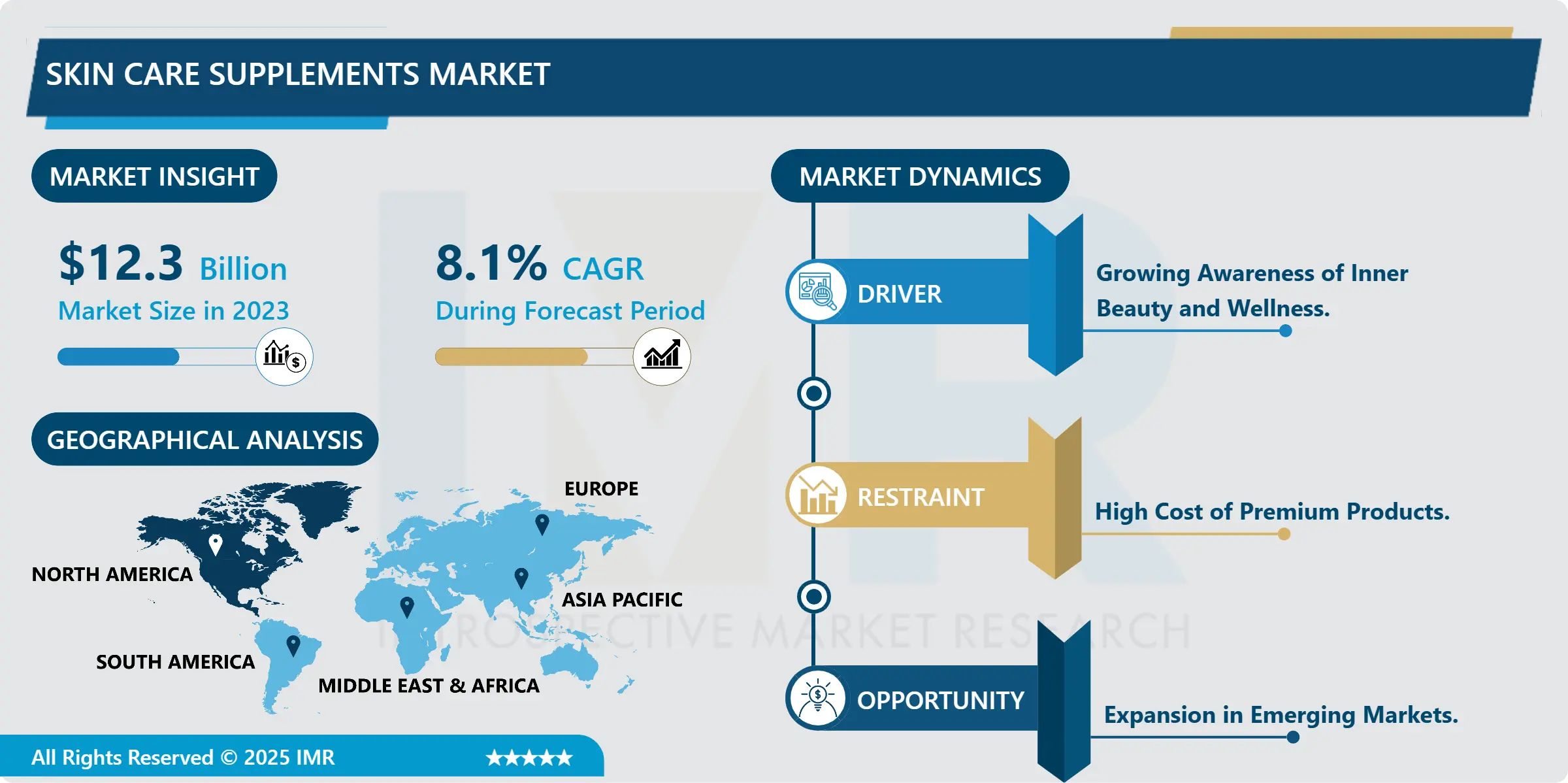
Skin Care Supplements Market Size Was Valued at USD 12.30 Billion in 2023, and is Projected to Reach USD 24.79 Billion by 2032, Growing at a CAGR of 8.1% From 2024-2032.
The skin care supplements market concerns itself with specific nutrients and compounds that can be taken as dietary supplements for improving skin condition from within. These supplements are available for wide skin problems such as skin aging, acne, skin dryness and dullness among others. The market is segmented according to various demographics as well as being motivated by the increasing appreciation regarding effects of skin care supplements for obtaining enhanced skin health, regarding the environmental influences, including the negative effects of pollution and facial lines and wrinkles caused by aging.
It has been growing steadily over the recent past due to increasing demand for skin care supplements to pamper and sustain youthful beauty. Market expansion is even more driven by a shift in the consumers’ approach toward the prevention of skin ailments where skincare solutions that act as adjuncts to topicals are considered, together with internal health boosters. New technological breakthroughs in dermatology and Nutraceutical sciences; atypical have also brought new formulations for healthy and chemical-free skin and body.
Also, the endorsement by beautiful social icons and celebrities has boosted the use of the skin care supplements. One of the reasons why this is a growing trend is because more consumers are in their youth, and supplements have become part of their beauty regimes. Furthermore, attention on the part of the elderly for anti-aging products contributes to market expansion since supplements are widely promoted as effective ways providing skin firmness, diminishing wrinkles, and providing shield against negative influences of the environment.
Skin Care Supplements Market Trend Analysis:
The Rise of Collagen and Hyaluronic Acid-Based Supplements
- A few of the growing skin care supplement ingredients include collagen and hyaluronic acid. Lately, consumers have learned about structural proteins for skin elasticity and moisture which has spurred greater demand for collagen products supplements. Proteins such as collagen, which contributes to skin firming and hydration and hyaluronic acid, which is famous for its moisture retention property are now being mentioned prominently in the formulations addressing the aging and moisture less skin issues. The skin health boost provided by collagen is being capitalised on with new products that form a new category of drinkable powders and pills. The trend is especially apparent in North America and Europe, where consumers who are interested in their appearance choose simple, effective products.
- Also, the plant-based trend has shifted to skin care supplements as plant-based collagen and hyaluronic acid boosters have been established. This corresponds to the modern trend for vegan and environmentally friendly products since customers prefer cosmetics that have not been tested on animals and are based on plant ingredients. Therefore, business organizations are experimenting with botanical extracts, and this diversification is boosting the market’s appeal to consumers with a conscience.
Rising Demand in the Asia-Pacific Region
- Asia Pacific is expected to show healthy growth for the skin care supplements market because of the rising concerns of health and wellness and preventive medicines. It is not surprising, for example, when the Japanese, Chinese or Koreans have used popular herbal and nutrient based food supplements to maintain healthy skin. It has also contributed to improving the integration of cosmetic procedures with health by promoting supplements. Growing disposable per capita income and urbanization in these countries further increases the opportunity for growth where consumers switch towards supplements for anti-aging, hydration, and brightening.
Skin Care Supplements Market Segment Analysis:
Skin Care Supplements Market is Segmented on the basis of product, content, formulation, application, gender, and Region.
By Product, Oral segment is expected to dominate the market during the forecast period
- The skin care supplements market is expected to be powered by the oral segment during the timeframe since capsules and tablets are easy to consume and effective. They are categorized as capsules, tablets, powders, and others, which are highly chosen because the products can be conveniently taken as a supplement and are assumed to contain all skin related nutrients that need to be ingested. These supplements tend to pack potent doses of vitamins, minerals, antioxidants, and other bioactive substances needed for our skin to maintain its elasticity, hydration, and ability to heal from skin damage, which is why they are favoured by consumers more reliant on a full-body and internal approach to skincare.
- In addition, an innovation in the formulation technology has made it possible to have vast improvements in nutrient bioavailability hence making the oral supplements more appealing. This segment’s expected growth can be primarily explained by the higher concern of customers with their skin’s overall health leaving behind mere topical treatment of the skin.
By Content, Organic segment expected to held the largest share
- The organic segment is projected to dominate the skin care supplements market due to a rising focus on clean label and green products. Given that people are becoming sensitive to effects of synthetic additives that may be ingested in the supplements, the market now offers more natural supplements that are gentle to the skin. Botanically derived skin care and body supplements that are Miticides, chemicals and artificial preservatives also fits well within the healthy skin and anti-aging craze. This change is fuelled by the increase in consciousness of the beauty industry in terms of the need to label products more effectively and provide its customers with proof that it is from organic sources. Therefore, brands are shifting to organic certifications and sustainable sourcing to fill this gap and entrench the organic segment in the market.
Skin Care Supplements Market Regional Insights:
North America is Expected to Dominate the Market Over the Forecast period
- North America focuses on skin care supplement in 2023 by having a large market share. The dominance of beauty and wellness market and the consumer sensitivity towards the preventive skincare solutions are considered key factors for this dominance. Current trend analysis suggests that North America accounts for about one-third of the total dollar volume of business globally. It sets North America in place with signature players, a concentrated move to product development and the region’s increasing demand for health-conscious products. The regional market leadership is also pulling through more trends in anti-aging products and availability of premium supplements of skin concern.
Active Key Players in the Skin Care Supplements Market:
- Amway (USA)
- Bayer AG (Germany)
- Beiersdorf AG (Germany)
- Blackmores Limited (Australia)
- GNC Holdings (USA)
- Herbalife Nutrition (USA)
- HUM Nutrition Inc. (USA)
- IM HealthScience (USA)
- Modere (USA)
- Nutrafol (USA)
- Olly Public Benefit Corporation (USA)
- Pfizer Inc. (USA)
- Shiseido Company Limited (Japan)
- The Nature’s Bounty Co. (USA)
- Vita Life Sciences (Australia)
- Other Active Players
|
Skin Care Supplements Market |
|||
|
Base Year: |
2023 |
Forecast Period: |
2024-2032 |
|
Historical Data: |
2017 to 2023 |
Market Size in 2023: |
USD 12.3 Billion |
|
Forecast Period 2024-32 CAGR: |
8.1 % |
Market Size in 2032: |
USD 24.79 Billion |
|
Segments Covered: |
By Product |
|
|
|
By Content Type |
|
||
|
By Formulation |
|
||
|
By Application |
|
||
|
By Gender |
|
||
|
By Region |
|
||
|
Key Market Drivers: |
|
||
|
Key Market Restraints: |
|
||
|
Key Opportunities: |
|
||
|
Companies Covered in the report: |
|
||
Chapter 1: Introduction
1.1 Scope and Coverage
Chapter 2:Executive Summary
Chapter 3: Market Landscape
3.1 Market Dynamics
3.1.1 Drivers
3.1.2 Restraints
3.1.3 Opportunities
3.1.4 Challenges
3.2 Market Trend Analysis
3.3 PESTLE Analysis
3.4 Porter's Five Forces Analysis
3.5 Industry Value Chain Analysis
3.6 Ecosystem
3.7 Regulatory Landscape
3.8 Price Trend Analysis
3.9 Patent Analysis
3.10 Technology Evolution
3.11 Investment Pockets
3.12 Import-Export Analysis
Chapter 4: Skin Care Supplements Market by Product Type
4.1 Skin Care Supplements Market Snapshot and Growth Engine
4.2 Skin Care Supplements Market Overview
4.3 Oral
4.3.1 Introduction and Market Overview
4.3.2 Historic and Forecasted Market Size in Value USD and Volume Units (2017-2032F)
4.3.3 Key Market Trends, Growth Factors and Opportunities
4.3.4 Oral: Geographic Segmentation Analysis
4.4 Supplements)
4.4.1 Introduction and Market Overview
4.4.2 Historic and Forecasted Market Size in Value USD and Volume Units (2017-2032F)
4.4.3 Key Market Trends, Growth Factors and Opportunities
4.4.4 Supplements): Geographic Segmentation Analysis
4.5 Content Type
4.5.1 Introduction and Market Overview
4.5.2 Historic and Forecasted Market Size in Value USD and Volume Units (2017-2032F)
4.5.3 Key Market Trends, Growth Factors and Opportunities
4.5.4 Content Type: Geographic Segmentation Analysis
Chapter 5: Skin Care Supplements Market by Application
5.1 Skin Care Supplements Market Snapshot and Growth Engine
5.2 Skin Care Supplements Market Overview
5.3 Skin Aging
5.3.1 Introduction and Market Overview
5.3.2 Historic and Forecasted Market Size in Value USD and Volume Units (2017-2032F)
5.3.3 Key Market Trends, Growth Factors and Opportunities
5.3.4 Skin Aging: Geographic Segmentation Analysis
5.4 Skin Hydration
5.4.1 Introduction and Market Overview
5.4.2 Historic and Forecasted Market Size in Value USD and Volume Units (2017-2032F)
5.4.3 Key Market Trends, Growth Factors and Opportunities
5.4.4 Skin Hydration: Geographic Segmentation Analysis
5.5 Acne & Blemishes
5.5.1 Introduction and Market Overview
5.5.2 Historic and Forecasted Market Size in Value USD and Volume Units (2017-2032F)
5.5.3 Key Market Trends, Growth Factors and Opportunities
5.5.4 Acne & Blemishes: Geographic Segmentation Analysis
5.6 Skin Brightening
5.6.1 Introduction and Market Overview
5.6.2 Historic and Forecasted Market Size in Value USD and Volume Units (2017-2032F)
5.6.3 Key Market Trends, Growth Factors and Opportunities
5.6.4 Skin Brightening: Geographic Segmentation Analysis
5.7 Others)
5.7.1 Introduction and Market Overview
5.7.2 Historic and Forecasted Market Size in Value USD and Volume Units (2017-2032F)
5.7.3 Key Market Trends, Growth Factors and Opportunities
5.7.4 Others): Geographic Segmentation Analysis
5.8 Gender (Female
5.8.1 Introduction and Market Overview
5.8.2 Historic and Forecasted Market Size in Value USD and Volume Units (2017-2032F)
5.8.3 Key Market Trends, Growth Factors and Opportunities
5.8.4 Gender (Female: Geographic Segmentation Analysis
5.9 Male)
5.9.1 Introduction and Market Overview
5.9.2 Historic and Forecasted Market Size in Value USD and Volume Units (2017-2032F)
5.9.3 Key Market Trends, Growth Factors and Opportunities
5.9.4 Male): Geographic Segmentation Analysis
Chapter 6: Company Profiles and Competitive Analysis
6.1 Competitive Landscape
6.1.1 Competitive Benchmarking
6.1.2 Skin Care Supplements Market Share by Manufacturer (2023)
6.1.3 Industry BCG Matrix
6.1.4 Heat Map Analysis
6.1.5 Mergers and Acquisitions
6.2 AMWAY (USA)
6.2.1 Company Overview
6.2.2 Key Executives
6.2.3 Company Snapshot
6.2.4 Role of the Company in the Market
6.2.5 Sustainability and Social Responsibility
6.2.6 Operating Business Segments
6.2.7 Product Portfolio
6.2.8 Business Performance
6.2.9 Key Strategic Moves and Recent Developments
6.2.10 SWOT Analysis
6.3 HERBALIFE NUTRITION (USA)
6.4 GNC HOLDINGS (USA)
6.5 PFIZER INC. (USA)
6.6 BLACKMORES LIMITED (AUSTRALIA)
6.7 OTHER ACTIVE PLAYERS
Chapter 7: Global Skin Care Supplements Market By Region
7.1 Overview
7.2. North America Skin Care Supplements Market
7.2.1 Key Market Trends, Growth Factors and Opportunities
7.2.2 Top Key Companies
7.2.3 Historic and Forecasted Market Size by Segments
7.2.4 Historic and Forecasted Market Size By Product Type
7.2.4.1 Oral
7.2.4.2 Supplements)
7.2.4.3 Content Type
7.2.5 Historic and Forecasted Market Size By Application
7.2.5.1 Skin Aging
7.2.5.2 Skin Hydration
7.2.5.3 Acne & Blemishes
7.2.5.4 Skin Brightening
7.2.5.5 Others)
7.2.5.6 Gender (Female
7.2.5.7 Male)
7.2.6 Historic and Forecast Market Size by Country
7.2.6.1 US
7.2.6.2 Canada
7.2.6.3 Mexico
7.3. Eastern Europe Skin Care Supplements Market
7.3.1 Key Market Trends, Growth Factors and Opportunities
7.3.2 Top Key Companies
7.3.3 Historic and Forecasted Market Size by Segments
7.3.4 Historic and Forecasted Market Size By Product Type
7.3.4.1 Oral
7.3.4.2 Supplements)
7.3.4.3 Content Type
7.3.5 Historic and Forecasted Market Size By Application
7.3.5.1 Skin Aging
7.3.5.2 Skin Hydration
7.3.5.3 Acne & Blemishes
7.3.5.4 Skin Brightening
7.3.5.5 Others)
7.3.5.6 Gender (Female
7.3.5.7 Male)
7.3.6 Historic and Forecast Market Size by Country
7.3.6.1 Russia
7.3.6.2 Bulgaria
7.3.6.3 The Czech Republic
7.3.6.4 Hungary
7.3.6.5 Poland
7.3.6.6 Romania
7.3.6.7 Rest of Eastern Europe
7.4. Western Europe Skin Care Supplements Market
7.4.1 Key Market Trends, Growth Factors and Opportunities
7.4.2 Top Key Companies
7.4.3 Historic and Forecasted Market Size by Segments
7.4.4 Historic and Forecasted Market Size By Product Type
7.4.4.1 Oral
7.4.4.2 Supplements)
7.4.4.3 Content Type
7.4.5 Historic and Forecasted Market Size By Application
7.4.5.1 Skin Aging
7.4.5.2 Skin Hydration
7.4.5.3 Acne & Blemishes
7.4.5.4 Skin Brightening
7.4.5.5 Others)
7.4.5.6 Gender (Female
7.4.5.7 Male)
7.4.6 Historic and Forecast Market Size by Country
7.4.6.1 Germany
7.4.6.2 UK
7.4.6.3 France
7.4.6.4 The Netherlands
7.4.6.5 Italy
7.4.6.6 Spain
7.4.6.7 Rest of Western Europe
7.5. Asia Pacific Skin Care Supplements Market
7.5.1 Key Market Trends, Growth Factors and Opportunities
7.5.2 Top Key Companies
7.5.3 Historic and Forecasted Market Size by Segments
7.5.4 Historic and Forecasted Market Size By Product Type
7.5.4.1 Oral
7.5.4.2 Supplements)
7.5.4.3 Content Type
7.5.5 Historic and Forecasted Market Size By Application
7.5.5.1 Skin Aging
7.5.5.2 Skin Hydration
7.5.5.3 Acne & Blemishes
7.5.5.4 Skin Brightening
7.5.5.5 Others)
7.5.5.6 Gender (Female
7.5.5.7 Male)
7.5.6 Historic and Forecast Market Size by Country
7.5.6.1 China
7.5.6.2 India
7.5.6.3 Japan
7.5.6.4 South Korea
7.5.6.5 Malaysia
7.5.6.6 Thailand
7.5.6.7 Vietnam
7.5.6.8 The Philippines
7.5.6.9 Australia
7.5.6.10 New Zealand
7.5.6.11 Rest of APAC
7.6. Middle East & Africa Skin Care Supplements Market
7.6.1 Key Market Trends, Growth Factors and Opportunities
7.6.2 Top Key Companies
7.6.3 Historic and Forecasted Market Size by Segments
7.6.4 Historic and Forecasted Market Size By Product Type
7.6.4.1 Oral
7.6.4.2 Supplements)
7.6.4.3 Content Type
7.6.5 Historic and Forecasted Market Size By Application
7.6.5.1 Skin Aging
7.6.5.2 Skin Hydration
7.6.5.3 Acne & Blemishes
7.6.5.4 Skin Brightening
7.6.5.5 Others)
7.6.5.6 Gender (Female
7.6.5.7 Male)
7.6.6 Historic and Forecast Market Size by Country
7.6.6.1 Turkiye
7.6.6.2 Bahrain
7.6.6.3 Kuwait
7.6.6.4 Saudi Arabia
7.6.6.5 Qatar
7.6.6.6 UAE
7.6.6.7 Israel
7.6.6.8 South Africa
7.7. South America Skin Care Supplements Market
7.7.1 Key Market Trends, Growth Factors and Opportunities
7.7.2 Top Key Companies
7.7.3 Historic and Forecasted Market Size by Segments
7.7.4 Historic and Forecasted Market Size By Product Type
7.7.4.1 Oral
7.7.4.2 Supplements)
7.7.4.3 Content Type
7.7.5 Historic and Forecasted Market Size By Application
7.7.5.1 Skin Aging
7.7.5.2 Skin Hydration
7.7.5.3 Acne & Blemishes
7.7.5.4 Skin Brightening
7.7.5.5 Others)
7.7.5.6 Gender (Female
7.7.5.7 Male)
7.7.6 Historic and Forecast Market Size by Country
7.7.6.1 Brazil
7.7.6.2 Argentina
7.7.6.3 Rest of SA
Chapter 8 Analyst Viewpoint and Conclusion
8.1 Recommendations and Concluding Analysis
8.2 Potential Market Strategies
Chapter 9 Research Methodology
9.1 Research Process
9.2 Primary Research
9.3 Secondary Research
|
Skin Care Supplements Market |
|||
|
Base Year: |
2023 |
Forecast Period: |
2024-2032 |
|
Historical Data: |
2017 to 2023 |
Market Size in 2023: |
USD 12.3 Billion |
|
Forecast Period 2024-32 CAGR: |
8.1 % |
Market Size in 2032: |
USD 24.79 Billion |
|
Segments Covered: |
By Product |
|
|
|
By Content Type |
|
||
|
By Formulation |
|
||
|
By Application |
|
||
|
By Gender |
|
||
|
By Region |
|
||
|
Key Market Drivers: |
|
||
|
Key Market Restraints: |
|
||
|
Key Opportunities: |
|
||
|
Companies Covered in the report: |
|
||


