




MRI Market Synopsis:
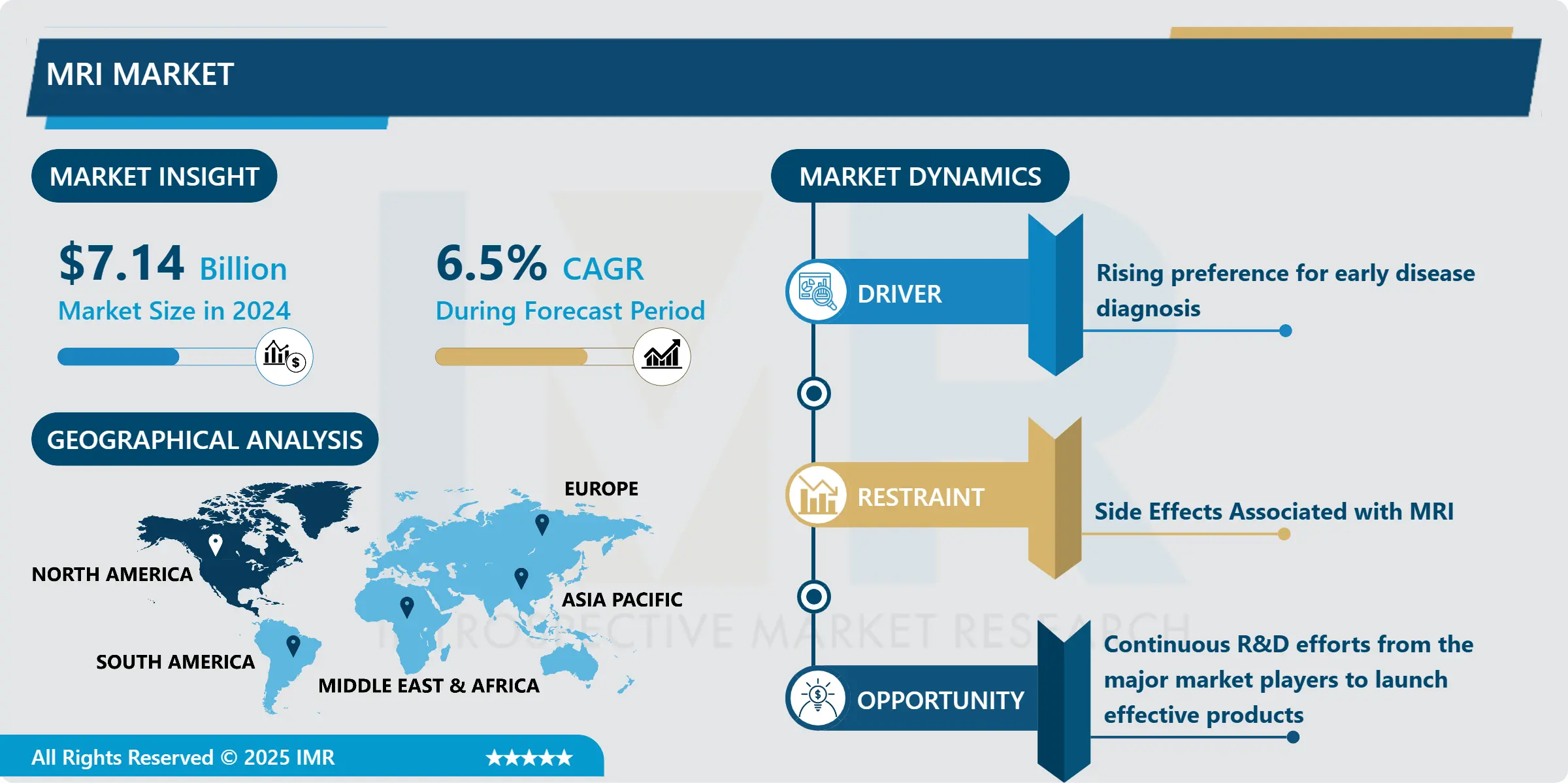
MRI Market Size Was Valued at USD 7.14 Billion in 2024, and is Projected to Reach USD 14.27 Billion by 2035, Growing at a CAGR of 6.5% From 2025-2035.
Magnetic resonance imaging (MRI) is a technique of portraying detailed and three expanded visualization of the body and is applied in identifying the disease-causing path. To diagnose principal forms of the stroke, cancers and other spine disorders that chiefly affect the vessels and the brain. If there is tissue or nervous system dysfunction this technology is applied. The major categories of magnetic resource imaging technologies and facilities refer to closed MRI and open MRI.
Some of the more enhanced MRI equipment include multiple consultancy MRI scanners, silent MRI diagnostic equipment among others that enables the radiologist alter patient’s image difference after scanning unlike traditional imaging technology. For example, Fujifilm Healthcare Americas Corporation aligned a U. S. based medical technology firm introduced its new velocity MRI system, a high-field open MRI system, in 2021. The new product will help to provide improvements to the workflow processes from the end-users point of view which is the patient. Therefore, to sum up, this factor contributes to the overall market development.
Development in MRI machines to improve their effectiveness across the intended applications is another factor that can propel the growth of the market in the forecasting period. Some of key advancements occurred in the last few years include; diffusion and diffusion tensor imaging with tractography, perfusion imaging, neuro imaging through MR spectroscopy, and functional imaging using BOLD technique are expected to put a strong support to the magnetic resonance imaging market in the future. In addition, growth in the usage of intraoperative MRI and its various specialties in various surgeries such as neurosurgeries is likely to boost the market during the forecast period. Furthermore, diffusion-weighted MR imaging is mainly used in the identification of the evolution of the effect of stroke within 30 minutes of its onset.
Hence, the continuous research and development of improvements to MRI that will expand the role of MRI in numerous fields will create further growth prospects for the market in the near future. However, the overall costs that they have incurred to set up the MRI system are still rather high, more so, to purchase these machines, thereby remaining a restraints to this market’s growth, particularly in the developing countries. The cost of a low to mid-strength machine ranges from one hundred thousand to over than one million US dollars. In the same manner, the daily need of helium gas for cooling of MRI machines from depleting deposits is increasing the wait time and in the process impairing productivity. Such factors as delayed product approval, and regular product recall particularly because of the strict regulatory environment are also significantly affecting the growth of the market.

MRI Market Trend Analysis
Increasing Awareness About the Health Concerns
- The ever rising health complications are making the necessity of medical imaging equipment in various health facilities for diagnosis to rise. for example, 150,000 health and wellness centers with the expenditure of US$ 1.8 billion make it possible for healthcare to be more accessible within the system in India.
- In addition, rising awareness of health issues constituting a critical driver of major market development and relevance of health insurance. Therefore, this factor increases market development.
Growing Adoption of Multimodality Imaging
- Integrated PET/CT and combined PET/MRI systems together with the new approaches are mostly significant after the utilization of multimodality imaging is used, and after PET/MRI systems become commercialized. For example, based on the research work existing in BRJ Journal in 2021, where the PET-MRI concomitant scanning and the single image reconstruction method make it possible to diagnose cardiovascular disease and improve the PET image quality. It may markedly enhance the diagnosis of heart diseases. Hence, this factor increases the market growth.
- Further, increased research for cancer radiation therapy also proves to be beneficial for the specified market segment. For instance, ViewRay Inc. started a phase III randomized controlled trial known as LAP Arduino treated with ABLAtivE stereotactic MRI-guided adap tive radiation therapy for patients receiving concurrent chemotherapy and 5-fraction MRIdian SMART in the year 2022. The results of this research indicate increased overall survival rates in patients subjected to post-chemotherapy MRIdian SMART. Therefore, this factor accelerates the growth of the market in increasing measure.
MRI Market Segment Analysis:
MRI Market Segmented based on Architecture, Field Strength, Application, and End-Use.
By Field Strength, closed MRI are expected to capture approximately 57.64% share during the forecast period.
- The closed MRI system segment is expected to have strong market hold during the forecast period. Some types of MRI machines are closed while others are open and while both are powerful, the closed ones use strong magnetic fields accompanied by high frequency radio waves which produce very detailed pictures. The close blending of the design also means that only the required image slices are chosen to avoid mistakes. Nevertheless, patients who undergo closed MRI scans might feel claustrophobic and uncomfortable, specially due to the equipments’ noise during operation. Such issues may cause inaccurate measurements, which can be potentially damaging. In response to these challenges, some market players are striving to create wide-bore and open MRI systems with the needed features for claustrophobic patients. Besides some manufacturers of pediatric MRI machines, they use drawings as well as cartoons on the actual MRI machines as a way of making the position of children undergoing scanning more comfortable.
By End-Use, hospital segment is anticipated to account for around 39.51% market share during the upcoming years.
- The hospital segment accounted for largest share in 2023 owing to the growing advancement and incorporation of MRI units in the hospitals. Increasing adoption of rMRI for diagnosis and treatment for the patients in emergency as well as trauma centres and increasing MRI installations in teaching and acadically affiliated hospitals may allow this segment to grow substantially. The imaging centers segment has been expected to have the highest growth rate among all the segments when estimated in the forecast period. There is the growing need for diagnosis without surgical operations and thus the creation of different independent centers that provide services like MRI.
- In order to meet this demand, several nurses and other medical personnel are setting up facilities where MRI is affordable. This trend is thus undermining the use of MRI in the medical services segment; it, therefore, presents itself as the pathway to the segment’s growth in the coming years. The ambulatory care centers segment is also anticipated to increase at a rather fast pace in the near future. This growth is due to the rise in government activities that seeks to improve as well as increase the number of ambulatory care centres especially in the provision of health services in the rural areas.
MRI Market Regional Insights:
North America market is estimated to maintain leadership with around 33.73% share across the forecast duration.
- North America was the largest market in the year 2023. The cumulating frequency of chronic diseases is also on the rise in this area, including the breast cancer, cardiovascular diseases or neurological diseases, all of which demand intricate analysis of imagery information. This region is anticipated to maintain this supremacy up to and beyond the foreseen horizon of the prognosticated timeframe. Therefore, it is anticipated that the descriptive technological integration process added with escalating occurrence rate of chronic diseases will foster MRI technology growth during the forecast period.
Active Key Players in the MRI Market:
- GE Healthcare
- Siemens Healthineers
- Koninklijke Philips N.V.
- Canon Medical Systems
- Hitachi Healthcare
- Hologic Inc.
- Bruker Corporation
- Esaote SPA
- Fujifilm Holdings Corporation
- Shimadzu Corporation
- Aurora Imaging Technologies, Inc.
- Other Key Players
Key Industry Developments in the MRI Market:
- In September 2023, Polarean Imaging plc cooperated with VIDA Diagnostics to facilitate the Polarean xenon 129 MRI further for clinical and research applications.
- In June 2023 Imagion Biosystems Limited has declared an extension of its collaboration agreement with Siemens Healthineers, with much emphasis to partner in the United States via Siemens Medical Solutions USA. In this further development, MagSense plans to conduct a multicenter phase II investigation for the MagSense HER2 imaging agent.
- In April 2023, Siemens Healthineers initiated the production line for MRI machines in its manufacturing unit located in Bengaluru. Magellan would be manufacturing MAGNETOM Free. Star.
- In February 2023, United Imaging engaged itself as Platinum sponsor for Arab Health 2023, an event held in Dubai, UAE. United Imaging and I-ONE Nuclear Medicine & Oncology Center then enter an MOU to jointly work and perform research on the first PET/MR uPMR 790 in the Gulf countries.
|
MRI Market |
|||
|
Base Year: |
2024 |
Forecast Period: |
2025-2035 |
|
Historical Data: |
2018 to 2023 |
Market Size in 2024: |
USD 7.14 Billion |
|
Forecast Period 2025-35 CAGR: |
6.5% |
Market Size in 2035: |
USD 14.27 Billion |
|
Segments Covered: |
By Architecture |
|
|
|
By Field Strength |
|
||
|
By Application |
|
||
|
By End-use |
|
||
|
By Region |
|
||
|
Key Market Drivers: |
|
||
|
Key Market Restraints: |
|
||
|
Key Opportunities: |
|
||
|
Companies Covered in the report: |
|
||
Chapter 1: Introduction
1.1 Scope and Coverage
Chapter 2:Executive Summary
Chapter 3: Market Landscape
3.1 Market Dynamics
3.1.1 Drivers
3.1.2 Restraints
3.1.3 Opportunities
3.1.4 Challenges
3.2 Market Trend Analysis
3.3 PESTLE Analysis
3.4 Porter's Five Forces Analysis
3.5 Industry Value Chain Analysis
3.6 Ecosystem
3.7 Regulatory Landscape
3.8 Price Trend Analysis
3.9 Patent Analysis
3.10 Technology Evolution
3.11 Investment Pockets
3.12 Import-Export Analysis
Chapter 4: MRI Market by Architecture (2018-2032)
4.1 MRI Market Snapshot and Growth Engine
4.2 Market Overview
4.3 Open system
4.3.1 Introduction and Market Overview
4.3.2 Historic and Forecasted Market Size in Value USD and Volume Units
4.3.3 Key Market Trends, Growth Factors, and Opportunities
4.3.4 Geographic Segmentation Analysis
4.4 Closed system
Chapter 5: MRI Market by Field Strength (2018-2032)
5.1 MRI Market Snapshot and Growth Engine
5.2 Market Overview
5.3 Low Field Strength
5.3.1 Introduction and Market Overview
5.3.2 Historic and Forecasted Market Size in Value USD and Volume Units
5.3.3 Key Market Trends, Growth Factors, and Opportunities
5.3.4 Geographic Segmentation Analysis
5.4 Mid Field Strength
5.5 High Field Strength
Chapter 6: MRI Market by Application (2018-2032)
6.1 MRI Market Snapshot and Growth Engine
6.2 Market Overview
6.3 Obstructive Sleep Apnea (OSA)
6.3.1 Introduction and Market Overview
6.3.2 Historic and Forecasted Market Size in Value USD and Volume Units
6.3.3 Key Market Trends, Growth Factors, and Opportunities
6.3.4 Geographic Segmentation Analysis
6.4 Brain and neurological
6.5 Spine and musculoskeletal
6.6 Vascular
6.7 Abdominal
6.8 Cardiac
6.9 Breast
6.10 Other
Chapter 7: MRI Market by End-use (2018-2032)
7.1 MRI Market Snapshot and Growth Engine
7.2 Market Overview
7.3 Hospitals
7.3.1 Introduction and Market Overview
7.3.2 Historic and Forecasted Market Size in Value USD and Volume Units
7.3.3 Key Market Trends, Growth Factors, and Opportunities
7.3.4 Geographic Segmentation Analysis
7.4 Imaging Centers
7.5 Ambulatory Surgical Centers
7.6 Others
Chapter 8: Company Profiles and Competitive Analysis
8.1 Competitive Landscape
8.1.1 Competitive Benchmarking
8.1.2 MRI Market Share by Manufacturer (2024)
8.1.3 Industry BCG Matrix
8.1.4 Heat Map Analysis
8.1.5 Mergers and Acquisitions
8.2 GE HEALTHCARE
8.2.1 Company Overview
8.2.2 Key Executives
8.2.3 Company Snapshot
8.2.4 Role of the Company in the Market
8.2.5 Sustainability and Social Responsibility
8.2.6 Operating Business Segments
8.2.7 Product Portfolio
8.2.8 Business Performance
8.2.9 Key Strategic Moves and Recent Developments
8.2.10 SWOT Analysis
8.3 SIEMENS HEALTHINEERS
8.4 KONINKLIJKE PHILIPS N.VCANON MEDICAL SYSTEMS
8.5 HITACHI HEALTHCARE
8.6 HOLOGIC INCBRUKER CORPORATION
8.7 ESAOTE SPA
8.8 FUJIFILM HOLDINGS CORPORATION
8.9 SHIMADZU CORPORATION
8.10 AURORA IMAGING TECHNOLOGIES INCOTHER KEY PLAYERS
Chapter 9: Global MRI Market By Region
9.1 Overview
9.2. North America MRI Market
9.2.1 Key Market Trends, Growth Factors and Opportunities
9.2.2 Top Key Companies
9.2.3 Historic and Forecasted Market Size by Segments
9.2.4 Historic and Forecasted Market Size by Architecture
9.2.4.1 Open system
9.2.4.2 Closed system
9.2.5 Historic and Forecasted Market Size by Field Strength
9.2.5.1 Low Field Strength
9.2.5.2 Mid Field Strength
9.2.5.3 High Field Strength
9.2.6 Historic and Forecasted Market Size by Application
9.2.6.1 Obstructive Sleep Apnea (OSA)
9.2.6.2 Brain and neurological
9.2.6.3 Spine and musculoskeletal
9.2.6.4 Vascular
9.2.6.5 Abdominal
9.2.6.6 Cardiac
9.2.6.7 Breast
9.2.6.8 Other
9.2.7 Historic and Forecasted Market Size by End-use
9.2.7.1 Hospitals
9.2.7.2 Imaging Centers
9.2.7.3 Ambulatory Surgical Centers
9.2.7.4 Others
9.2.8 Historic and Forecast Market Size by Country
9.2.8.1 US
9.2.8.2 Canada
9.2.8.3 Mexico
9.3. Eastern Europe MRI Market
9.3.1 Key Market Trends, Growth Factors and Opportunities
9.3.2 Top Key Companies
9.3.3 Historic and Forecasted Market Size by Segments
9.3.4 Historic and Forecasted Market Size by Architecture
9.3.4.1 Open system
9.3.4.2 Closed system
9.3.5 Historic and Forecasted Market Size by Field Strength
9.3.5.1 Low Field Strength
9.3.5.2 Mid Field Strength
9.3.5.3 High Field Strength
9.3.6 Historic and Forecasted Market Size by Application
9.3.6.1 Obstructive Sleep Apnea (OSA)
9.3.6.2 Brain and neurological
9.3.6.3 Spine and musculoskeletal
9.3.6.4 Vascular
9.3.6.5 Abdominal
9.3.6.6 Cardiac
9.3.6.7 Breast
9.3.6.8 Other
9.3.7 Historic and Forecasted Market Size by End-use
9.3.7.1 Hospitals
9.3.7.2 Imaging Centers
9.3.7.3 Ambulatory Surgical Centers
9.3.7.4 Others
9.3.8 Historic and Forecast Market Size by Country
9.3.8.1 Russia
9.3.8.2 Bulgaria
9.3.8.3 The Czech Republic
9.3.8.4 Hungary
9.3.8.5 Poland
9.3.8.6 Romania
9.3.8.7 Rest of Eastern Europe
9.4. Western Europe MRI Market
9.4.1 Key Market Trends, Growth Factors and Opportunities
9.4.2 Top Key Companies
9.4.3 Historic and Forecasted Market Size by Segments
9.4.4 Historic and Forecasted Market Size by Architecture
9.4.4.1 Open system
9.4.4.2 Closed system
9.4.5 Historic and Forecasted Market Size by Field Strength
9.4.5.1 Low Field Strength
9.4.5.2 Mid Field Strength
9.4.5.3 High Field Strength
9.4.6 Historic and Forecasted Market Size by Application
9.4.6.1 Obstructive Sleep Apnea (OSA)
9.4.6.2 Brain and neurological
9.4.6.3 Spine and musculoskeletal
9.4.6.4 Vascular
9.4.6.5 Abdominal
9.4.6.6 Cardiac
9.4.6.7 Breast
9.4.6.8 Other
9.4.7 Historic and Forecasted Market Size by End-use
9.4.7.1 Hospitals
9.4.7.2 Imaging Centers
9.4.7.3 Ambulatory Surgical Centers
9.4.7.4 Others
9.4.8 Historic and Forecast Market Size by Country
9.4.8.1 Germany
9.4.8.2 UK
9.4.8.3 France
9.4.8.4 The Netherlands
9.4.8.5 Italy
9.4.8.6 Spain
9.4.8.7 Rest of Western Europe
9.5. Asia Pacific MRI Market
9.5.1 Key Market Trends, Growth Factors and Opportunities
9.5.2 Top Key Companies
9.5.3 Historic and Forecasted Market Size by Segments
9.5.4 Historic and Forecasted Market Size by Architecture
9.5.4.1 Open system
9.5.4.2 Closed system
9.5.5 Historic and Forecasted Market Size by Field Strength
9.5.5.1 Low Field Strength
9.5.5.2 Mid Field Strength
9.5.5.3 High Field Strength
9.5.6 Historic and Forecasted Market Size by Application
9.5.6.1 Obstructive Sleep Apnea (OSA)
9.5.6.2 Brain and neurological
9.5.6.3 Spine and musculoskeletal
9.5.6.4 Vascular
9.5.6.5 Abdominal
9.5.6.6 Cardiac
9.5.6.7 Breast
9.5.6.8 Other
9.5.7 Historic and Forecasted Market Size by End-use
9.5.7.1 Hospitals
9.5.7.2 Imaging Centers
9.5.7.3 Ambulatory Surgical Centers
9.5.7.4 Others
9.5.8 Historic and Forecast Market Size by Country
9.5.8.1 China
9.5.8.2 India
9.5.8.3 Japan
9.5.8.4 South Korea
9.5.8.5 Malaysia
9.5.8.6 Thailand
9.5.8.7 Vietnam
9.5.8.8 The Philippines
9.5.8.9 Australia
9.5.8.10 New Zealand
9.5.8.11 Rest of APAC
9.6. Middle East & Africa MRI Market
9.6.1 Key Market Trends, Growth Factors and Opportunities
9.6.2 Top Key Companies
9.6.3 Historic and Forecasted Market Size by Segments
9.6.4 Historic and Forecasted Market Size by Architecture
9.6.4.1 Open system
9.6.4.2 Closed system
9.6.5 Historic and Forecasted Market Size by Field Strength
9.6.5.1 Low Field Strength
9.6.5.2 Mid Field Strength
9.6.5.3 High Field Strength
9.6.6 Historic and Forecasted Market Size by Application
9.6.6.1 Obstructive Sleep Apnea (OSA)
9.6.6.2 Brain and neurological
9.6.6.3 Spine and musculoskeletal
9.6.6.4 Vascular
9.6.6.5 Abdominal
9.6.6.6 Cardiac
9.6.6.7 Breast
9.6.6.8 Other
9.6.7 Historic and Forecasted Market Size by End-use
9.6.7.1 Hospitals
9.6.7.2 Imaging Centers
9.6.7.3 Ambulatory Surgical Centers
9.6.7.4 Others
9.6.8 Historic and Forecast Market Size by Country
9.6.8.1 Turkiye
9.6.8.2 Bahrain
9.6.8.3 Kuwait
9.6.8.4 Saudi Arabia
9.6.8.5 Qatar
9.6.8.6 UAE
9.6.8.7 Israel
9.6.8.8 South Africa
9.7. South America MRI Market
9.7.1 Key Market Trends, Growth Factors and Opportunities
9.7.2 Top Key Companies
9.7.3 Historic and Forecasted Market Size by Segments
9.7.4 Historic and Forecasted Market Size by Architecture
9.7.4.1 Open system
9.7.4.2 Closed system
9.7.5 Historic and Forecasted Market Size by Field Strength
9.7.5.1 Low Field Strength
9.7.5.2 Mid Field Strength
9.7.5.3 High Field Strength
9.7.6 Historic and Forecasted Market Size by Application
9.7.6.1 Obstructive Sleep Apnea (OSA)
9.7.6.2 Brain and neurological
9.7.6.3 Spine and musculoskeletal
9.7.6.4 Vascular
9.7.6.5 Abdominal
9.7.6.6 Cardiac
9.7.6.7 Breast
9.7.6.8 Other
9.7.7 Historic and Forecasted Market Size by End-use
9.7.7.1 Hospitals
9.7.7.2 Imaging Centers
9.7.7.3 Ambulatory Surgical Centers
9.7.7.4 Others
9.7.8 Historic and Forecast Market Size by Country
9.7.8.1 Brazil
9.7.8.2 Argentina
9.7.8.3 Rest of SA
Chapter 10 Analyst Viewpoint and Conclusion
10.1 Recommendations and Concluding Analysis
10.2 Potential Market Strategies
Chapter 11 Research Methodology
11.1 Research Process
11.2 Primary Research
11.3 Secondary Research
|
MRI Market |
|||
|
Base Year: |
2024 |
Forecast Period: |
2025-2035 |
|
Historical Data: |
2018 to 2023 |
Market Size in 2024: |
USD 7.14 Billion |
|
Forecast Period 2025-35 CAGR: |
6.5% |
Market Size in 2035: |
USD 14.27 Billion |
|
Segments Covered: |
By Architecture |
|
|
|
By Field Strength |
|
||
|
By Application |
|
||
|
By End-use |
|
||
|
By Region |
|
||
|
Key Market Drivers: |
|
||
|
Key Market Restraints: |
|
||
|
Key Opportunities: |
|
||
|
Companies Covered in the report: |
|
||


