




Medical Plastics Market Synopsis:
Medical Plastics Market Size Was Valued at USD 52.3 Billion in 2023, and is Projected to Reach USD 86.13 Billion by 2032, Growing at a CAGR of 5.70 % From 2024-2032.
Medical plastics are polymers which are specifically developed for medical applications because of its feature such as its ability to outperform other materials it is made from, the feature of durability, its low density and its compatibility with biological systems. Due to the versatility, and considerably lower costs, along with compliance to existing and stringent medical requirements, these plastics find use in medical devices, surgical tools, and implants as well as in packaging.
Two which include; Increase population of chronic diseases and the ageing population are key drivers of the medical plastics market, given the increased need for complex medical equipment and single-use medical products. Moreover, as modern techniques of surgery are shifted towards the less invasive ones that entail the application of instruments made form the medical plastics, the sales increase robustly.
In addition, high and rapidly increasing standards demanding the usage of sterilizable and biocompatible plastics in medical devices practice have driven the development of medical plastics. Other attributes of polymer technologies including bioresorbable plastics and other uses of 3D printing, therefore, guarantee adept conformity to the healthcare industry’s emergent needs for production that local manufacturers can provide.
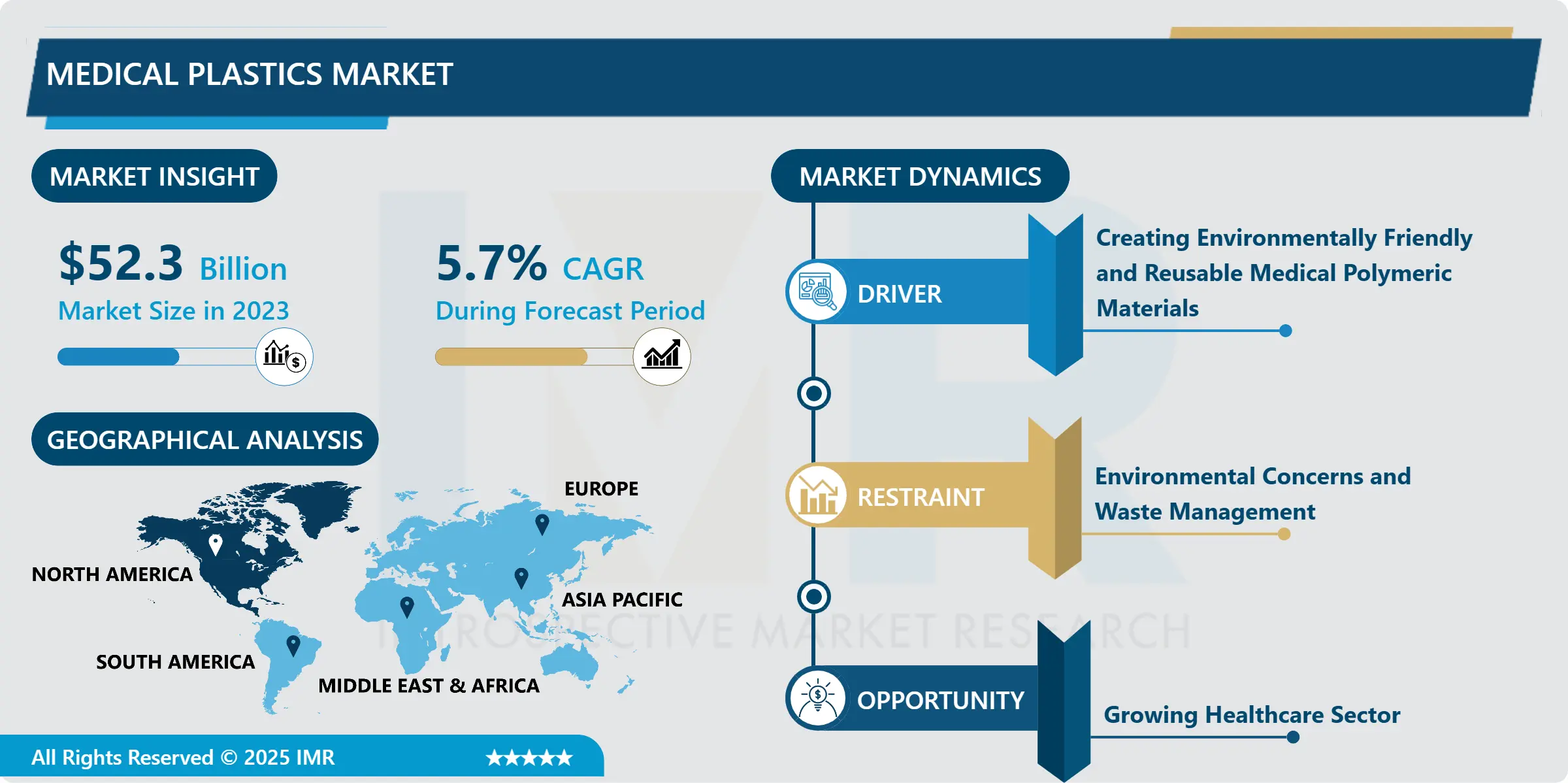
Medical Plastics Market Trend Analysis:
Creating environmentally friendly and reusable medical polymeric materials
- Another strong theme that is currently observable in the medical plastics market is sustainability because many manufacturers have aimed at creating environmentally friendly and reusable medical polymeric materials. The pressures to adopt such practices are occasioned by increasing concerns in environmental degradation and the enactment of policies on management of medical waste.
- One other interesting development concerns more extensive application of higher technologies like the 3D printing and nanotechnology in the creation of medical plastics. These technologies allow the development of individualized medical products and implants, benefitting patients and companies who produce devices, as lead times decrease, and overall costs reduce.
Growing healthcare sector
- The Asia-Pacific region has huge potential for medical plastics market due to the growing healthcare sector and increasing access to the MED device market. Bernard and184 report that there is high demand for low-priced and high-quality medical devices in the global market especially in Asia countries such as China and India, which presents good opportunities for growth.
- Also, the increasing trend of home healthcare and point of care diagnostics make portable medical devices a need, which in turn are made using lightweight and durable medical plastics. This trend creates new opportunities for product advancement and market growth around the world.
Medical Plastics Market Segment Analysis:
Medical Plastics Market is Segmented on the basis of Type, Application, End-User, and Region
By Type, Polyethylene (PE) segment is expected to dominate the market during the forecast period
- Medical plastics by type meet various demand in medicine, PVC and polyethylene are generally applied to disposable medical good; while high-performance implants, instruments and other parts are made of PEEK and other superior polymers.
- The widespread use of PE in syringes, tubing, and packaging contributes significantly to its market share. Its excellent chemical resistance and biocompatibility make it suitable for a wide range of medical environments. Moreover, the rising demand for single-use medical devices is further fueling the growth of the PE segment. Ongoing innovation in polymer technology is also enhancing the performance characteristics of PE, reinforcing its dominance in the medical plastics market.
By Application, Disposables segment expected to held the largest share
- The disposables segment is projected to lead the medical plastics market, driven primarily by the increasing use of single-use medical products. This surge is largely due to heightened infection control measures and the global emphasis on hygiene and patient safety. Medical disposables such as syringes, IV bags, gloves, and catheters—are in high demand across hospitals and clinics.
- While disposables dominate, instruments and implants also contribute steadily to market growth. Advancements in material science and technology have enhanced the performance and durability of reusable medical instruments. Additionally, the global rise in surgical procedures, fueled by aging populations and chronic disease prevalence, is supporting consistent demand for implants and surgical tools. The combination of infection control protocols and ongoing healthcare infrastructure development is expected to further strengthen the disposables segment.
Medical Plastics Market Regional Insights:
North America is Expected to Dominate the Market Over the Forecast period
- On the basis of region, North America dominates medical plastics market because it has strong infrastructure of healthcare and high health care spending. It is also home to – and enjoys high growth rates in – the production of technologically sophisticated medical devices aided by well-developed regulatory policies and research endeavours.
- Further, chronic diseases have grown and common due to the rising number of geriatrics in both the USA and Canada creating a higher demand for medical devices and disposables. This along with the increased focus of the region to adopt more effective and sustainable technologies will propel the market further.
Active Key Players in the Medical Plastics Market:
- Arkema (France)
- BASF SE (Germany)
- Celanese Corporation (United States)
- Covestro AG (Germany)
- Eastman Chemical Company (United States)
- Ensinger (Germany)
- Evonik Industries AG (Germany)
- Röchling SE & Co. KG (Germany)
- SABIC (Saudi Arabia)
- Tekni-Plex (United States)
- Other Active Players
|
Medical Plastics Market |
|||
|
Base Year: |
2023 |
Forecast Period: |
2024-2032 |
|
Historical Data: |
2017 to 2023 |
Market Size in 2023: |
USD 52.3 Billion |
|
Forecast Period 2024-32 CAGR: |
5.70 % |
Market Size in 2032: |
USD 86.13 Billion |
|
Segments Covered: |
By Type |
|
|
|
By Application |
|
||
|
By End-User |
|
||
|
By Region |
|
||
|
Key Market Drivers: |
|
||
|
Key Market Restraints: |
|
||
|
Key Opportunities: |
|
||
|
Companies Covered in the report: |
|
||
Chapter 1: Introduction
1.1 Scope and Coverage
Chapter 2:Executive Summary
Chapter 3: Market Landscape
3.1 Market Dynamics
3.1.1 Drivers
3.1.2 Restraints
3.1.3 Opportunities
3.1.4 Challenges
3.2 Market Trend Analysis
3.3 PESTLE Analysis
3.4 Porter's Five Forces Analysis
3.5 Industry Value Chain Analysis
3.6 Ecosystem
3.7 Regulatory Landscape
3.8 Price Trend Analysis
3.9 Patent Analysis
3.10 Technology Evolution
3.11 Investment Pockets
3.12 Import-Export Analysis
Chapter 4: Medical Plastics Market by Type
4.1 Medical Plastics Market Snapshot and Growth Engine
4.2 Medical Plastics Market Overview
4.3 Polyethylene (PE)
4.3.1 Introduction and Market Overview
4.3.2 Historic and Forecasted Market Size in Value USD and Volume Units (2017-2032F)
4.3.3 Key Market Trends, Growth Factors and Opportunities
4.3.4 Polyethylene (PE): Geographic Segmentation Analysis
4.4 Polypropylene (PP)
4.4.1 Introduction and Market Overview
4.4.2 Historic and Forecasted Market Size in Value USD and Volume Units (2017-2032F)
4.4.3 Key Market Trends, Growth Factors and Opportunities
4.4.4 Polypropylene (PP): Geographic Segmentation Analysis
4.5 Polycarbonate (PC)
4.5.1 Introduction and Market Overview
4.5.2 Historic and Forecasted Market Size in Value USD and Volume Units (2017-2032F)
4.5.3 Key Market Trends, Growth Factors and Opportunities
4.5.4 Polycarbonate (PC): Geographic Segmentation Analysis
4.6 Polyvinyl Chloride (PVC)
4.6.1 Introduction and Market Overview
4.6.2 Historic and Forecasted Market Size in Value USD and Volume Units (2017-2032F)
4.6.3 Key Market Trends, Growth Factors and Opportunities
4.6.4 Polyvinyl Chloride (PVC): Geographic Segmentation Analysis
4.7 Acrylonitrile Butadiene Styrene (ABS)
4.7.1 Introduction and Market Overview
4.7.2 Historic and Forecasted Market Size in Value USD and Volume Units (2017-2032F)
4.7.3 Key Market Trends, Growth Factors and Opportunities
4.7.4 Acrylonitrile Butadiene Styrene (ABS): Geographic Segmentation Analysis
4.8 Polystyrene (PS)
4.8.1 Introduction and Market Overview
4.8.2 Historic and Forecasted Market Size in Value USD and Volume Units (2017-2032F)
4.8.3 Key Market Trends, Growth Factors and Opportunities
4.8.4 Polystyrene (PS): Geographic Segmentation Analysis
4.9 Polyetheretherketone (PEEK)
4.9.1 Introduction and Market Overview
4.9.2 Historic and Forecasted Market Size in Value USD and Volume Units (2017-2032F)
4.9.3 Key Market Trends, Growth Factors and Opportunities
4.9.4 Polyetheretherketone (PEEK): Geographic Segmentation Analysis
Chapter 5: Medical Plastics Market by Application
5.1 Medical Plastics Market Snapshot and Growth Engine
5.2 Medical Plastics Market Overview
5.3 Disposables
5.3.1 Introduction and Market Overview
5.3.2 Historic and Forecasted Market Size in Value USD and Volume Units (2017-2032F)
5.3.3 Key Market Trends, Growth Factors and Opportunities
5.3.4 Disposables: Geographic Segmentation Analysis
5.4 Prosthetics
5.4.1 Introduction and Market Overview
5.4.2 Historic and Forecasted Market Size in Value USD and Volume Units (2017-2032F)
5.4.3 Key Market Trends, Growth Factors and Opportunities
5.4.4 Prosthetics: Geographic Segmentation Analysis
5.5 Medical Instruments & Tools
5.5.1 Introduction and Market Overview
5.5.2 Historic and Forecasted Market Size in Value USD and Volume Units (2017-2032F)
5.5.3 Key Market Trends, Growth Factors and Opportunities
5.5.4 Medical Instruments & Tools: Geographic Segmentation Analysis
5.6 Drug Delivery Systems
5.6.1 Introduction and Market Overview
5.6.2 Historic and Forecasted Market Size in Value USD and Volume Units (2017-2032F)
5.6.3 Key Market Trends, Growth Factors and Opportunities
5.6.4 Drug Delivery Systems: Geographic Segmentation Analysis
5.7 Implants
5.7.1 Introduction and Market Overview
5.7.2 Historic and Forecasted Market Size in Value USD and Volume Units (2017-2032F)
5.7.3 Key Market Trends, Growth Factors and Opportunities
5.7.4 Implants: Geographic Segmentation Analysis
5.8 Others.
5.8.1 Introduction and Market Overview
5.8.2 Historic and Forecasted Market Size in Value USD and Volume Units (2017-2032F)
5.8.3 Key Market Trends, Growth Factors and Opportunities
5.8.4 Others.: Geographic Segmentation Analysis
Chapter 6: Medical Plastics Market by End-User
6.1 Medical Plastics Market Snapshot and Growth Engine
6.2 Medical Plastics Market Overview
6.3 Hospitals
6.3.1 Introduction and Market Overview
6.3.2 Historic and Forecasted Market Size in Value USD and Volume Units (2017-2032F)
6.3.3 Key Market Trends, Growth Factors and Opportunities
6.3.4 Hospitals: Geographic Segmentation Analysis
6.4 Clinics
6.4.1 Introduction and Market Overview
6.4.2 Historic and Forecasted Market Size in Value USD and Volume Units (2017-2032F)
6.4.3 Key Market Trends, Growth Factors and Opportunities
6.4.4 Clinics: Geographic Segmentation Analysis
6.5 Research Organizations
6.5.1 Introduction and Market Overview
6.5.2 Historic and Forecasted Market Size in Value USD and Volume Units (2017-2032F)
6.5.3 Key Market Trends, Growth Factors and Opportunities
6.5.4 Research Organizations: Geographic Segmentation Analysis
6.6 Diagnostic Laboratories
6.6.1 Introduction and Market Overview
6.6.2 Historic and Forecasted Market Size in Value USD and Volume Units (2017-2032F)
6.6.3 Key Market Trends, Growth Factors and Opportunities
6.6.4 Diagnostic Laboratories: Geographic Segmentation Analysis
Chapter 7: Company Profiles and Competitive Analysis
7.1 Competitive Landscape
7.1.1 Competitive Benchmarking
7.1.2 Medical Plastics Market Share by Manufacturer (2023)
7.1.3 Industry BCG Matrix
7.1.4 Heat Map Analysis
7.1.5 Mergers and Acquisitions
7.2 SABIC (SAUDI ARABIA)
7.2.1 Company Overview
7.2.2 Key Executives
7.2.3 Company Snapshot
7.2.4 Role of the Company in the Market
7.2.5 Sustainability and Social Responsibility
7.2.6 Operating Business Segments
7.2.7 Product Portfolio
7.2.8 Business Performance
7.2.9 Key Strategic Moves and Recent Developments
7.2.10 SWOT Analysis
7.3 CELANESE CORPORATION (UNITED STATES)
7.4 BASF SE (GERMANY)
7.5 ARKEMA (FRANCE)
7.6 EVONIK INDUSTRIES AG (GERMANY)
7.7 EASTMAN CHEMICAL COMPANY (UNITED STATES)
7.8 COVESTRO AG (GERMANY)
7.9 RÖCHLING SE & CO. KG (GERMANY)
7.10 TEKNI-PLEX (UNITED STATES)
7.11 ENSINGER (GERMANY)
7.12 OTHER ACTIVE PLAYERS
Chapter 8: Global Medical Plastics Market By Region
8.1 Overview
8.2. North America Medical Plastics Market
8.2.1 Key Market Trends, Growth Factors and Opportunities
8.2.2 Top Key Companies
8.2.3 Historic and Forecasted Market Size by Segments
8.2.4 Historic and Forecasted Market Size By Type
8.2.4.1 Polyethylene (PE)
8.2.4.2 Polypropylene (PP)
8.2.4.3 Polycarbonate (PC)
8.2.4.4 Polyvinyl Chloride (PVC)
8.2.4.5 Acrylonitrile Butadiene Styrene (ABS)
8.2.4.6 Polystyrene (PS)
8.2.4.7 Polyetheretherketone (PEEK)
8.2.5 Historic and Forecasted Market Size By Application
8.2.5.1 Disposables
8.2.5.2 Prosthetics
8.2.5.3 Medical Instruments & Tools
8.2.5.4 Drug Delivery Systems
8.2.5.5 Implants
8.2.5.6 Others.
8.2.6 Historic and Forecasted Market Size By End-User
8.2.6.1 Hospitals
8.2.6.2 Clinics
8.2.6.3 Research Organizations
8.2.6.4 Diagnostic Laboratories
8.2.7 Historic and Forecast Market Size by Country
8.2.7.1 US
8.2.7.2 Canada
8.2.7.3 Mexico
8.3. Eastern Europe Medical Plastics Market
8.3.1 Key Market Trends, Growth Factors and Opportunities
8.3.2 Top Key Companies
8.3.3 Historic and Forecasted Market Size by Segments
8.3.4 Historic and Forecasted Market Size By Type
8.3.4.1 Polyethylene (PE)
8.3.4.2 Polypropylene (PP)
8.3.4.3 Polycarbonate (PC)
8.3.4.4 Polyvinyl Chloride (PVC)
8.3.4.5 Acrylonitrile Butadiene Styrene (ABS)
8.3.4.6 Polystyrene (PS)
8.3.4.7 Polyetheretherketone (PEEK)
8.3.5 Historic and Forecasted Market Size By Application
8.3.5.1 Disposables
8.3.5.2 Prosthetics
8.3.5.3 Medical Instruments & Tools
8.3.5.4 Drug Delivery Systems
8.3.5.5 Implants
8.3.5.6 Others.
8.3.6 Historic and Forecasted Market Size By End-User
8.3.6.1 Hospitals
8.3.6.2 Clinics
8.3.6.3 Research Organizations
8.3.6.4 Diagnostic Laboratories
8.3.7 Historic and Forecast Market Size by Country
8.3.7.1 Russia
8.3.7.2 Bulgaria
8.3.7.3 The Czech Republic
8.3.7.4 Hungary
8.3.7.5 Poland
8.3.7.6 Romania
8.3.7.7 Rest of Eastern Europe
8.4. Western Europe Medical Plastics Market
8.4.1 Key Market Trends, Growth Factors and Opportunities
8.4.2 Top Key Companies
8.4.3 Historic and Forecasted Market Size by Segments
8.4.4 Historic and Forecasted Market Size By Type
8.4.4.1 Polyethylene (PE)
8.4.4.2 Polypropylene (PP)
8.4.4.3 Polycarbonate (PC)
8.4.4.4 Polyvinyl Chloride (PVC)
8.4.4.5 Acrylonitrile Butadiene Styrene (ABS)
8.4.4.6 Polystyrene (PS)
8.4.4.7 Polyetheretherketone (PEEK)
8.4.5 Historic and Forecasted Market Size By Application
8.4.5.1 Disposables
8.4.5.2 Prosthetics
8.4.5.3 Medical Instruments & Tools
8.4.5.4 Drug Delivery Systems
8.4.5.5 Implants
8.4.5.6 Others.
8.4.6 Historic and Forecasted Market Size By End-User
8.4.6.1 Hospitals
8.4.6.2 Clinics
8.4.6.3 Research Organizations
8.4.6.4 Diagnostic Laboratories
8.4.7 Historic and Forecast Market Size by Country
8.4.7.1 Germany
8.4.7.2 UK
8.4.7.3 France
8.4.7.4 The Netherlands
8.4.7.5 Italy
8.4.7.6 Spain
8.4.7.7 Rest of Western Europe
8.5. Asia Pacific Medical Plastics Market
8.5.1 Key Market Trends, Growth Factors and Opportunities
8.5.2 Top Key Companies
8.5.3 Historic and Forecasted Market Size by Segments
8.5.4 Historic and Forecasted Market Size By Type
8.5.4.1 Polyethylene (PE)
8.5.4.2 Polypropylene (PP)
8.5.4.3 Polycarbonate (PC)
8.5.4.4 Polyvinyl Chloride (PVC)
8.5.4.5 Acrylonitrile Butadiene Styrene (ABS)
8.5.4.6 Polystyrene (PS)
8.5.4.7 Polyetheretherketone (PEEK)
8.5.5 Historic and Forecasted Market Size By Application
8.5.5.1 Disposables
8.5.5.2 Prosthetics
8.5.5.3 Medical Instruments & Tools
8.5.5.4 Drug Delivery Systems
8.5.5.5 Implants
8.5.5.6 Others.
8.5.6 Historic and Forecasted Market Size By End-User
8.5.6.1 Hospitals
8.5.6.2 Clinics
8.5.6.3 Research Organizations
8.5.6.4 Diagnostic Laboratories
8.5.7 Historic and Forecast Market Size by Country
8.5.7.1 China
8.5.7.2 India
8.5.7.3 Japan
8.5.7.4 South Korea
8.5.7.5 Malaysia
8.5.7.6 Thailand
8.5.7.7 Vietnam
8.5.7.8 The Philippines
8.5.7.9 Australia
8.5.7.10 New Zealand
8.5.7.11 Rest of APAC
8.6. Middle East & Africa Medical Plastics Market
8.6.1 Key Market Trends, Growth Factors and Opportunities
8.6.2 Top Key Companies
8.6.3 Historic and Forecasted Market Size by Segments
8.6.4 Historic and Forecasted Market Size By Type
8.6.4.1 Polyethylene (PE)
8.6.4.2 Polypropylene (PP)
8.6.4.3 Polycarbonate (PC)
8.6.4.4 Polyvinyl Chloride (PVC)
8.6.4.5 Acrylonitrile Butadiene Styrene (ABS)
8.6.4.6 Polystyrene (PS)
8.6.4.7 Polyetheretherketone (PEEK)
8.6.5 Historic and Forecasted Market Size By Application
8.6.5.1 Disposables
8.6.5.2 Prosthetics
8.6.5.3 Medical Instruments & Tools
8.6.5.4 Drug Delivery Systems
8.6.5.5 Implants
8.6.5.6 Others.
8.6.6 Historic and Forecasted Market Size By End-User
8.6.6.1 Hospitals
8.6.6.2 Clinics
8.6.6.3 Research Organizations
8.6.6.4 Diagnostic Laboratories
8.6.7 Historic and Forecast Market Size by Country
8.6.7.1 Turkiye
8.6.7.2 Bahrain
8.6.7.3 Kuwait
8.6.7.4 Saudi Arabia
8.6.7.5 Qatar
8.6.7.6 UAE
8.6.7.7 Israel
8.6.7.8 South Africa
8.7. South America Medical Plastics Market
8.7.1 Key Market Trends, Growth Factors and Opportunities
8.7.2 Top Key Companies
8.7.3 Historic and Forecasted Market Size by Segments
8.7.4 Historic and Forecasted Market Size By Type
8.7.4.1 Polyethylene (PE)
8.7.4.2 Polypropylene (PP)
8.7.4.3 Polycarbonate (PC)
8.7.4.4 Polyvinyl Chloride (PVC)
8.7.4.5 Acrylonitrile Butadiene Styrene (ABS)
8.7.4.6 Polystyrene (PS)
8.7.4.7 Polyetheretherketone (PEEK)
8.7.5 Historic and Forecasted Market Size By Application
8.7.5.1 Disposables
8.7.5.2 Prosthetics
8.7.5.3 Medical Instruments & Tools
8.7.5.4 Drug Delivery Systems
8.7.5.5 Implants
8.7.5.6 Others.
8.7.6 Historic and Forecasted Market Size By End-User
8.7.6.1 Hospitals
8.7.6.2 Clinics
8.7.6.3 Research Organizations
8.7.6.4 Diagnostic Laboratories
8.7.7 Historic and Forecast Market Size by Country
8.7.7.1 Brazil
8.7.7.2 Argentina
8.7.7.3 Rest of SA
Chapter 9 Analyst Viewpoint and Conclusion
9.1 Recommendations and Concluding Analysis
9.2 Potential Market Strategies
Chapter 10 Research Methodology
10.1 Research Process
10.2 Primary Research
10.3 Secondary Research
|
Medical Plastics Market |
|||
|
Base Year: |
2023 |
Forecast Period: |
2024-2032 |
|
Historical Data: |
2017 to 2023 |
Market Size in 2023: |
USD 52.3 Billion |
|
Forecast Period 2024-32 CAGR: |
5.70 % |
Market Size in 2032: |
USD 86.13 Billion |
|
Segments Covered: |
By Type |
|
|
|
By Application |
|
||
|
By End-User |
|
||
|
By Region |
|
||
|
Key Market Drivers: |
|
||
|
Key Market Restraints: |
|
||
|
Key Opportunities: |
|
||
|
Companies Covered in the report: |
|
||


