




Global Instant Soups Market Overview
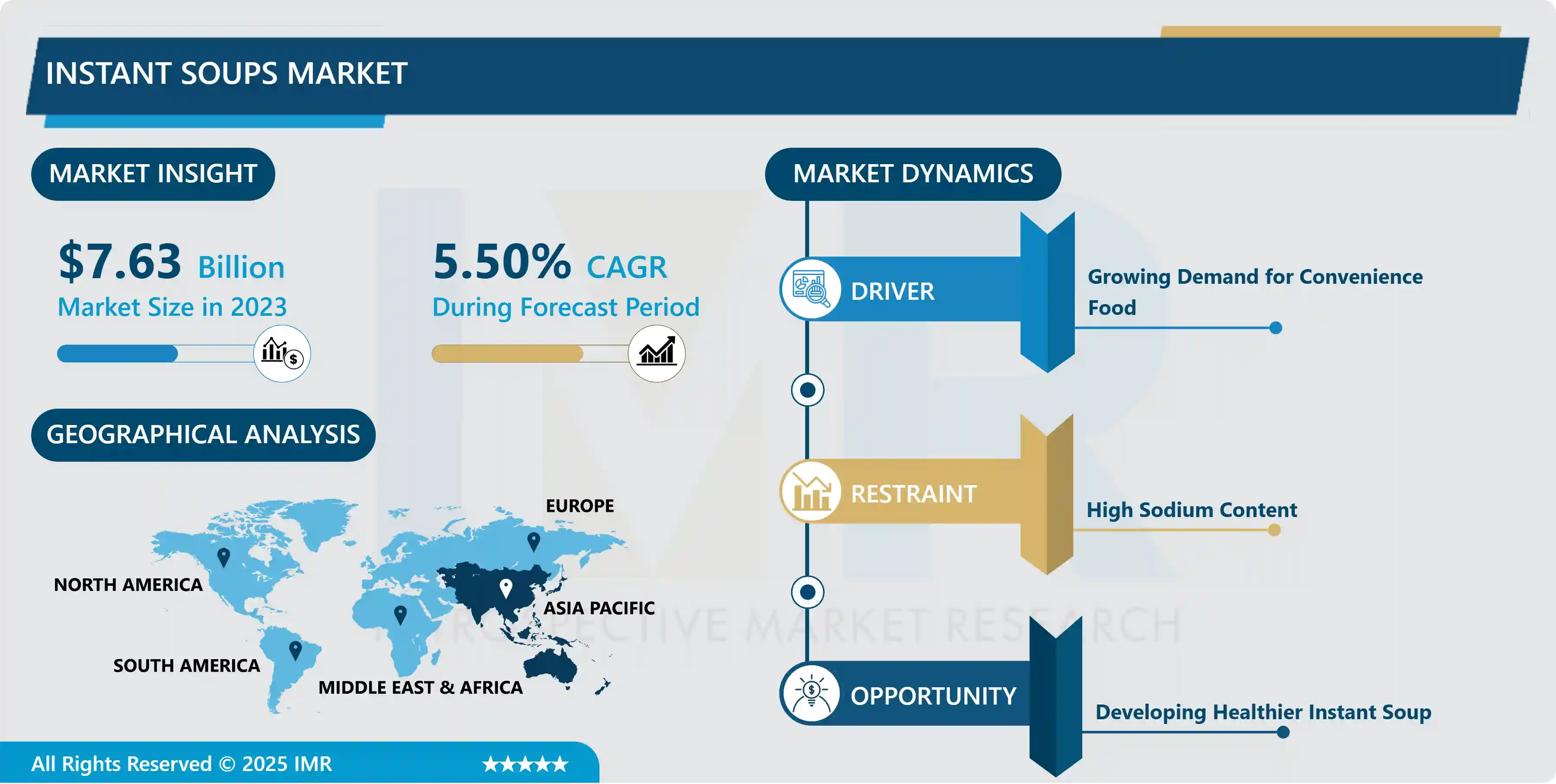
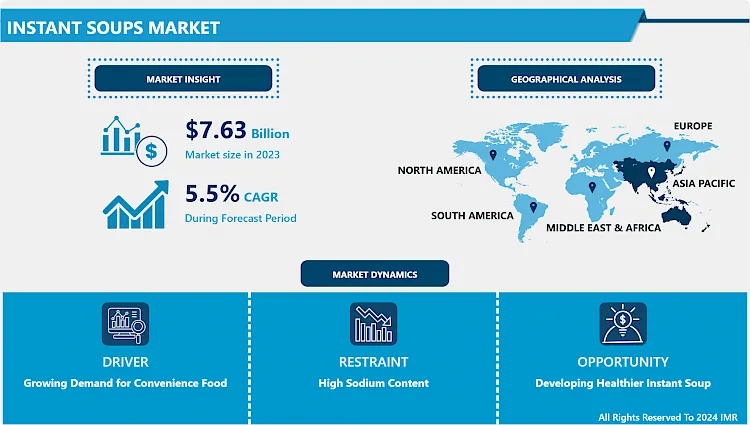
Global Instant Soups Market size is expected to grow from USD 7.63 Billion in 2023 to USD 12.35 Billion by 2032, at a CAGR of 5.5% during the forecast period (2024–2032)
-
Instant soups are a type of soup that is designed to be prepared quickly and easily. They are typically made by drying or dehydrating vegetables, noodles, and other ingredients and then adding them to hot water. Instant soups are a popular convenience food, and they can be a healthy and nutritious option, especially when made with low-sodium broth and plenty of vegetables.
-
The use of instant soups extends to various scenarios where a convenient and time-saving meal option is desired. They are particularly favoured by individuals with busy lifestyles or those lacking the time and resources for traditional cooking. Instant soups find utility in backpacking, camping, and emergency preparedness kits, providing a lightweight and easily storable food option. Additionally, their versatility allows for customization with the addition of fresh ingredients like vegetables or protein, catering to individual taste preferences.
-
The advantages of instant soups lie in their quick preparation, convenience, and extended shelf life. They offer a practical solution for individuals seeking a warm and nourishing meal without the lengthy cooking process. Their lightweight and compact packaging makes them ideal for travel and situations where space is limited. With a variety of flavours available, instant soups provide a quick and accessible way to enjoy a comforting bowl of soup, making them a popular choice for those looking for a convenient and time-efficient meal option in today's fast-paced world.
Instant Soups Market Trend Analysis:
Growing Demand for Convenience Food
-
In an increasingly fast-paced lifestyle, consumers are actively seeking quick and hassle-free meal solutions that seamlessly fit into their hectic schedules. Convenience foods, known for their ease of preparation, minimal cooking time, and often ready-to-eat or instant options, perfectly address this need. The shift in consumer preferences towards time-saving food choices has substantially fueled the widespread popularity of convenience foods, appealing to a broad spectrum of demographics.
-
The rising prevalence of households led by working professionals, single individuals, and dual-income families has significantly increased the demand for swift and convenient meal options. Ready-to-eat meals, pre-packaged snacks, and instant food products cater to the necessity for efficient and readily available sustenance. Additionally, the surge in urbanization has resulted in the proliferation of convenience stores and online platforms, providing consumers with convenient access to a diverse array of time-saving food choices.
-
Moreover, the global trend towards urbanization, coupled with the concurrent increase in disposable incomes, has heightened the demand for on-the-go and ready-to-eat food items. Convenience foods not only save time but also offer a multitude of choices, ranging from frozen meals to instant soups and snacks, effectively meeting the varied tastes and preferences of consumers. The growing recognition of convenience foods as a practical solution for the contemporary fast-paced lifestyle continues to serve as a significant driver for the expansion of markets within the food industry.
Developing Healthier Instant Soup
-
Instant soups have been synonymous with convenience rather than health, often containing elevated levels of sodium and preservatives. However, the escalating focus on health-conscious living has generated a rising demand for instant soups that prioritize nutritional value while retaining the inherent quick and convenient nature of the product.
-
This changing consumer preference aligns with broader trends in the food industry, marked by an increased emphasis on delivering healthier alternatives across diverse product categories. Healthier instant soups can be enhanced with natural ingredients, reduced sodium content, and fewer additives, providing consumers with a wholesome and guilt-free meal option. The incorporation of superfoods, vegetables, and lean proteins into instant soup formulations not only addresses the demand for healthier choices but also taps into the wider wellness movement. Manufacturers stand to differentiate and innovate their products by integrating health-centric features, capturing a market share that values both convenience and well-being.
-
Furthermore, the development of healthier instant soups is in harmony with evolving dietary trends favouring plant-based and organic ingredients. By addressing nutritional concerns and ensuring transparent labelling, companies operating in the instant soup market can position their products as integral components of a balanced and nutritious diet, appealing to health-conscious consumers. The pursuit of crafting healthier instant soup options presents a strategic avenue for market growth, catering to a demographic seeking quick, convenient, and nutritionally sound meal solutions.
Instant Soups Market Segment Analysis:
Instant Soups Market Segmented on the basis of Nature, Source, Form, End-User and Distribution Channel
By Distribution Channel, Hypermarkets/Supermarkets segment is expected to dominate the market during the forecast period
-
Hypermarkets and supermarkets emerge as the primary driving force behind the growth of diverse markets, particularly within the food industry. These retail giants serve as comprehensive hubs, offering consumers a consolidated shopping experience that encompasses instant soups and various convenience foods. The dominance of hypermarkets and supermarkets is rooted in their expansive product selections, competitive pricing strategies, and strategically positioned locations, drawing in a broad consumer demographic.
-
The attraction of accessing a broad assortment of instant soups in one location, coupled with the ability to compare different brands and varieties, amplifies the appeal of hypermarkets and supermarkets. Furthermore, the substantial shelf space and promotional initiatives within these retail settings significantly contribute to heightened visibility and increased sales of instant soup products. In response to the growing consumer demand for convenience and variety, hypermarkets and supermarkets play a pivotal and influential role in shaping and sustaining the upward trajectory of the market for instant soups.
Instant Soups Market Regional Insights:
Asia Pacific is Expected to Dominate the Market Over the Forecast period
-
Asia Pacific asserts itself as the primary driving force behind the growth of diverse markets, propelled by its rapidly expanding population, burgeoning middle class, and escalating consumer spending. The region's dynamic economic landscape, characterized by robust industrialization and urbanization, creates fertile ground for thriving market scenarios. The demand for convenience foods, including instant soups, is experiencing substantial growth due to evolving lifestyles and an increasing inclination towards time-saving meal solutions.
-
The dominance of Asia Pacific is amplified by its rich culinary diversity and a growing appreciation for international cuisines, leading to a heightened adoption of convenient and ready-to-eat options such as instant soups. The region's significance is further underscored by the presence of key emerging markets characterized by a burgeoning consumer base and evolving dietary preferences. as economic prosperity and lifestyle transitory Instant Solutions persist in the region, Asia Pacific remains instrumental in shaping and sustaining the rising path of the market for instant soups.
Key Players Covered in Instant Soups Market:
-
The Kraft Heinz Co. (U.S.)
-
Conagra Brands Inc. (U.S.)
-
General Mills Inc. (U.S.)
-
B&G Foods, Inc. (U.S.)
-
Frontier Soups (Canada)
-
Premier Foods Plc. (UK)
-
Baxters Food Group Ltd (UK)
-
Unilever PLC (Netherlands)
-
Nestle SA (Switzerland)
-
Monte Cudine (Uruguay)
-
Capital Foods Pvt. Ltd. (India)
-
La Herbal (India) (India)
-
Nissin Foods Holdings Co. Ltd. (Japan)
-
House Foods Group Inc. (Japan)
-
Chotiwat Manufacturing Public Co. Ltd (Thailand)
-
Ottogi Co. Ltd. (South Korea)
-
Tat Hui Foods Pte. Ltd. (Singapore) and Other Major Players
Key Industry Developments in the Instant Soups Market:
- In January 2024, Tata Consumer Products announced the acquisition of 100% equity shares of Capital Foods, the owner of ‘Ching’s Secret’ and ‘Smith & Jones’ brands, in a phased manner. The acquisition involved an upfront purchase of 75% equity, with the remaining 25% to be acquired within three years. This strategic move enabled Tata Consumer to expand its portfolio in fast-growing categories, including Desi Chinese. Ching’s Secret, a market leader in multiple categories, including soups, solidified its position with strong products.
|
Instant Soups Market |
|||
|
Base Year: |
2023 |
Forecast Period: |
2024-2032 |
|
Historical Data: |
2017 to 2023 |
Market Size in 2023: |
USD 7.63 Bn. |
|
Forecast Period 2024-32 CAGR: |
5.5% |
Market Size in 2032: |
USD 12.35 Mn. |
|
Segments Covered: |
By Nature |
|
|
|
By Source |
|
||
|
By Form |
|
||
|
By End-Users |
|
||
|
By Distribution Channel |
|
||
|
By Region |
|
||
|
Key Market Drivers: |
|
||
|
Key Market Restraints: |
|
||
|
Key Opportunities: |
|
||
|
Companies Covered in the report: |
|
||
Chapter 1: Introduction
1.1 Scope and Coverage
Chapter 2:Executive Summary
Chapter 3: Market Landscape
3.1 Market Dynamics
3.1.1 Drivers
3.1.2 Restraints
3.1.3 Opportunities
3.1.4 Challenges
3.2 Market Trend Analysis
3.3 PESTLE Analysis
3.4 Porter's Five Forces Analysis
3.5 Industry Value Chain Analysis
3.6 Ecosystem
3.7 Regulatory Landscape
3.8 Price Trend Analysis
3.9 Patent Analysis
3.10 Technology Evolution
3.11 Investment Pockets
3.12 Import-Export Analysis
Chapter 4: Instant Soups Market by Nature (2018-2032)
4.1 Instant Soups Market Snapshot and Growth Engine
4.2 Market Overview
4.3 Organic
4.3.1 Introduction and Market Overview
4.3.2 Historic and Forecasted Market Size in Value USD and Volume Units
4.3.3 Key Market Trends, Growth Factors, and Opportunities
4.3.4 Geographic Segmentation Analysis
4.4 Conventional
Chapter 5: Instant Soups Market by Source (2018-2032)
5.1 Instant Soups Market Snapshot and Growth Engine
5.2 Market Overview
5.3 Animal Sourced
5.3.1 Introduction and Market Overview
5.3.2 Historic and Forecasted Market Size in Value USD and Volume Units
5.3.3 Key Market Trends, Growth Factors, and Opportunities
5.3.4 Geographic Segmentation Analysis
5.4 Plant Sourced
Chapter 6: Instant Soups Market by Form (2018-2032)
6.1 Instant Soups Market Snapshot and Growth Engine
6.2 Market Overview
6.3 Dry Instant Soup
6.3.1 Introduction and Market Overview
6.3.2 Historic and Forecasted Market Size in Value USD and Volume Units
6.3.3 Key Market Trends, Growth Factors, and Opportunities
6.3.4 Geographic Segmentation Analysis
6.4 Liquid Instant Soup
Chapter 7: Instant Soups Market by End-Users (2018-2032)
7.1 Instant Soups Market Snapshot and Growth Engine
7.2 Market Overview
7.3 Foodservice Industry
7.3.1 Introduction and Market Overview
7.3.2 Historic and Forecasted Market Size in Value USD and Volume Units
7.3.3 Key Market Trends, Growth Factors, and Opportunities
7.3.4 Geographic Segmentation Analysis
7.4 Household
Chapter 8: Instant Soups Market by Distribution Channel (2018-2032)
8.1 Instant Soups Market Snapshot and Growth Engine
8.2 Market Overview
8.3 Hypermarkets/Supermarkets
8.3.1 Introduction and Market Overview
8.3.2 Historic and Forecasted Market Size in Value USD and Volume Units
8.3.3 Key Market Trends, Growth Factors, and Opportunities
8.3.4 Geographic Segmentation Analysis
8.4 Specialty Stores
8.5 Convenience Stores
8.6 Online Retail
Chapter 9: Company Profiles and Competitive Analysis
9.1 Competitive Landscape
9.1.1 Competitive Benchmarking
9.1.2 Instant Soups Market Share by Manufacturer (2024)
9.1.3 Industry BCG Matrix
9.1.4 Heat Map Analysis
9.1.5 Mergers and Acquisitions
9.2 CARGILL (UNITED STATES)
9.2.1 Company Overview
9.2.2 Key Executives
9.2.3 Company Snapshot
9.2.4 Role of the Company in the Market
9.2.5 Sustainability and Social Responsibility
9.2.6 Operating Business Segments
9.2.7 Product Portfolio
9.2.8 Business Performance
9.2.9 Key Strategic Moves and Recent Developments
9.2.10 SWOT Analysis
9.3 ADM (UNITED STATES)
9.4 BUNGE (UNITED STATES)
9.5 LUCAS MEYER (CANADA)
9.6 DANISCO (DENMARK)
9.7 LIPOID (SWITZERLAND)
9.8 DENOFA (NORWAY)
9.9 SHANKAR SOYA CONCEPTS (INDIA)
9.10 JIUSAN GROUP (CHINA)
9.11 MERYA'S LECITHIN (CHINA)
9.12 GUSHEN BIOLOGICAL TECHNOLOGY (CHINA)
9.13 SHANDONG BOHI INDUSTRY (CHINA)
9.14 SIWEI PHOSPHOLIPID (CHINA)
9.15 TIANJIN HEXIYUAN LECITHIN TECHNOLOGY (CHINA)
9.16 BEIJING YUAN HUA MEI LECITHIN SCI-TECH (CHINA)
9.17
Chapter 10: Global Instant Soups Market By Region
10.1 Overview
10.2. North America Instant Soups Market
10.2.1 Key Market Trends, Growth Factors and Opportunities
10.2.2 Top Key Companies
10.2.3 Historic and Forecasted Market Size by Segments
10.2.4 Historic and Forecasted Market Size by Nature
10.2.4.1 Organic
10.2.4.2 Conventional
10.2.5 Historic and Forecasted Market Size by Source
10.2.5.1 Animal Sourced
10.2.5.2 Plant Sourced
10.2.6 Historic and Forecasted Market Size by Form
10.2.6.1 Dry Instant Soup
10.2.6.2 Liquid Instant Soup
10.2.7 Historic and Forecasted Market Size by End-Users
10.2.7.1 Foodservice Industry
10.2.7.2 Household
10.2.8 Historic and Forecasted Market Size by Distribution Channel
10.2.8.1 Hypermarkets/Supermarkets
10.2.8.2 Specialty Stores
10.2.8.3 Convenience Stores
10.2.8.4 Online Retail
10.2.9 Historic and Forecast Market Size by Country
10.2.9.1 US
10.2.9.2 Canada
10.2.9.3 Mexico
10.3. Eastern Europe Instant Soups Market
10.3.1 Key Market Trends, Growth Factors and Opportunities
10.3.2 Top Key Companies
10.3.3 Historic and Forecasted Market Size by Segments
10.3.4 Historic and Forecasted Market Size by Nature
10.3.4.1 Organic
10.3.4.2 Conventional
10.3.5 Historic and Forecasted Market Size by Source
10.3.5.1 Animal Sourced
10.3.5.2 Plant Sourced
10.3.6 Historic and Forecasted Market Size by Form
10.3.6.1 Dry Instant Soup
10.3.6.2 Liquid Instant Soup
10.3.7 Historic and Forecasted Market Size by End-Users
10.3.7.1 Foodservice Industry
10.3.7.2 Household
10.3.8 Historic and Forecasted Market Size by Distribution Channel
10.3.8.1 Hypermarkets/Supermarkets
10.3.8.2 Specialty Stores
10.3.8.3 Convenience Stores
10.3.8.4 Online Retail
10.3.9 Historic and Forecast Market Size by Country
10.3.9.1 Russia
10.3.9.2 Bulgaria
10.3.9.3 The Czech Republic
10.3.9.4 Hungary
10.3.9.5 Poland
10.3.9.6 Romania
10.3.9.7 Rest of Eastern Europe
10.4. Western Europe Instant Soups Market
10.4.1 Key Market Trends, Growth Factors and Opportunities
10.4.2 Top Key Companies
10.4.3 Historic and Forecasted Market Size by Segments
10.4.4 Historic and Forecasted Market Size by Nature
10.4.4.1 Organic
10.4.4.2 Conventional
10.4.5 Historic and Forecasted Market Size by Source
10.4.5.1 Animal Sourced
10.4.5.2 Plant Sourced
10.4.6 Historic and Forecasted Market Size by Form
10.4.6.1 Dry Instant Soup
10.4.6.2 Liquid Instant Soup
10.4.7 Historic and Forecasted Market Size by End-Users
10.4.7.1 Foodservice Industry
10.4.7.2 Household
10.4.8 Historic and Forecasted Market Size by Distribution Channel
10.4.8.1 Hypermarkets/Supermarkets
10.4.8.2 Specialty Stores
10.4.8.3 Convenience Stores
10.4.8.4 Online Retail
10.4.9 Historic and Forecast Market Size by Country
10.4.9.1 Germany
10.4.9.2 UK
10.4.9.3 France
10.4.9.4 The Netherlands
10.4.9.5 Italy
10.4.9.6 Spain
10.4.9.7 Rest of Western Europe
10.5. Asia Pacific Instant Soups Market
10.5.1 Key Market Trends, Growth Factors and Opportunities
10.5.2 Top Key Companies
10.5.3 Historic and Forecasted Market Size by Segments
10.5.4 Historic and Forecasted Market Size by Nature
10.5.4.1 Organic
10.5.4.2 Conventional
10.5.5 Historic and Forecasted Market Size by Source
10.5.5.1 Animal Sourced
10.5.5.2 Plant Sourced
10.5.6 Historic and Forecasted Market Size by Form
10.5.6.1 Dry Instant Soup
10.5.6.2 Liquid Instant Soup
10.5.7 Historic and Forecasted Market Size by End-Users
10.5.7.1 Foodservice Industry
10.5.7.2 Household
10.5.8 Historic and Forecasted Market Size by Distribution Channel
10.5.8.1 Hypermarkets/Supermarkets
10.5.8.2 Specialty Stores
10.5.8.3 Convenience Stores
10.5.8.4 Online Retail
10.5.9 Historic and Forecast Market Size by Country
10.5.9.1 China
10.5.9.2 India
10.5.9.3 Japan
10.5.9.4 South Korea
10.5.9.5 Malaysia
10.5.9.6 Thailand
10.5.9.7 Vietnam
10.5.9.8 The Philippines
10.5.9.9 Australia
10.5.9.10 New Zealand
10.5.9.11 Rest of APAC
10.6. Middle East & Africa Instant Soups Market
10.6.1 Key Market Trends, Growth Factors and Opportunities
10.6.2 Top Key Companies
10.6.3 Historic and Forecasted Market Size by Segments
10.6.4 Historic and Forecasted Market Size by Nature
10.6.4.1 Organic
10.6.4.2 Conventional
10.6.5 Historic and Forecasted Market Size by Source
10.6.5.1 Animal Sourced
10.6.5.2 Plant Sourced
10.6.6 Historic and Forecasted Market Size by Form
10.6.6.1 Dry Instant Soup
10.6.6.2 Liquid Instant Soup
10.6.7 Historic and Forecasted Market Size by End-Users
10.6.7.1 Foodservice Industry
10.6.7.2 Household
10.6.8 Historic and Forecasted Market Size by Distribution Channel
10.6.8.1 Hypermarkets/Supermarkets
10.6.8.2 Specialty Stores
10.6.8.3 Convenience Stores
10.6.8.4 Online Retail
10.6.9 Historic and Forecast Market Size by Country
10.6.9.1 Turkiye
10.6.9.2 Bahrain
10.6.9.3 Kuwait
10.6.9.4 Saudi Arabia
10.6.9.5 Qatar
10.6.9.6 UAE
10.6.9.7 Israel
10.6.9.8 South Africa
10.7. South America Instant Soups Market
10.7.1 Key Market Trends, Growth Factors and Opportunities
10.7.2 Top Key Companies
10.7.3 Historic and Forecasted Market Size by Segments
10.7.4 Historic and Forecasted Market Size by Nature
10.7.4.1 Organic
10.7.4.2 Conventional
10.7.5 Historic and Forecasted Market Size by Source
10.7.5.1 Animal Sourced
10.7.5.2 Plant Sourced
10.7.6 Historic and Forecasted Market Size by Form
10.7.6.1 Dry Instant Soup
10.7.6.2 Liquid Instant Soup
10.7.7 Historic and Forecasted Market Size by End-Users
10.7.7.1 Foodservice Industry
10.7.7.2 Household
10.7.8 Historic and Forecasted Market Size by Distribution Channel
10.7.8.1 Hypermarkets/Supermarkets
10.7.8.2 Specialty Stores
10.7.8.3 Convenience Stores
10.7.8.4 Online Retail
10.7.9 Historic and Forecast Market Size by Country
10.7.9.1 Brazil
10.7.9.2 Argentina
10.7.9.3 Rest of SA
Chapter 11 Analyst Viewpoint and Conclusion
11.1 Recommendations and Concluding Analysis
11.2 Potential Market Strategies
Chapter 12 Research Methodology
12.1 Research Process
12.2 Primary Research
12.3 Secondary Research
|
Instant Soups Market |
|||
|
Base Year: |
2023 |
Forecast Period: |
2024-2032 |
|
Historical Data: |
2017 to 2023 |
Market Size in 2023: |
USD 7.63 Bn. |
|
Forecast Period 2024-32 CAGR: |
5.5% |
Market Size in 2032: |
USD 12.35 Mn. |
|
Segments Covered: |
By Nature |
|
|
|
By Source |
|
||
|
By Form |
|
||
|
By End-Users |
|
||
|
By Distribution Channel |
|
||
|
By Region |
|
||
|
Key Market Drivers: |
|
||
|
Key Market Restraints: |
|
||
|
Key Opportunities: |
|
||
|
Companies Covered in the report: |
|
||
Frequently Asked Questions :
The forecast period in the Instant Soups market research report is 2024-2032.
The Kraft Heinz Co. (U.S.), The Hain Celestial Group Inc. (U.S), Conagra Brands Inc. (U.S.), General Mills Inc. (U.S.),B&G Foods, Inc. (U.S.), Frontier Soups (Canada), Premier Foods Plc. (UK),Baxters Food Group Ltd (UK), Unilever PLC (Netherlands),Nestle SA (Switzerland), Monte Cudine (Uruguay), Capital Foods Pvt. Ltd. (India), La Herbal (India) (India),Nissin Foods Holdings Co. Ltd. (Japan), House Foods Group Inc. (Japan), Chotiwat Manufacturing Public Co. Ltd (Thailand), Ottogi Co. Ltd.(South Korea), Tat Hui Foods Pte. Ltd. (Singapore), and Other Major Players


