Generative AI in Analytics Market Synopsis:
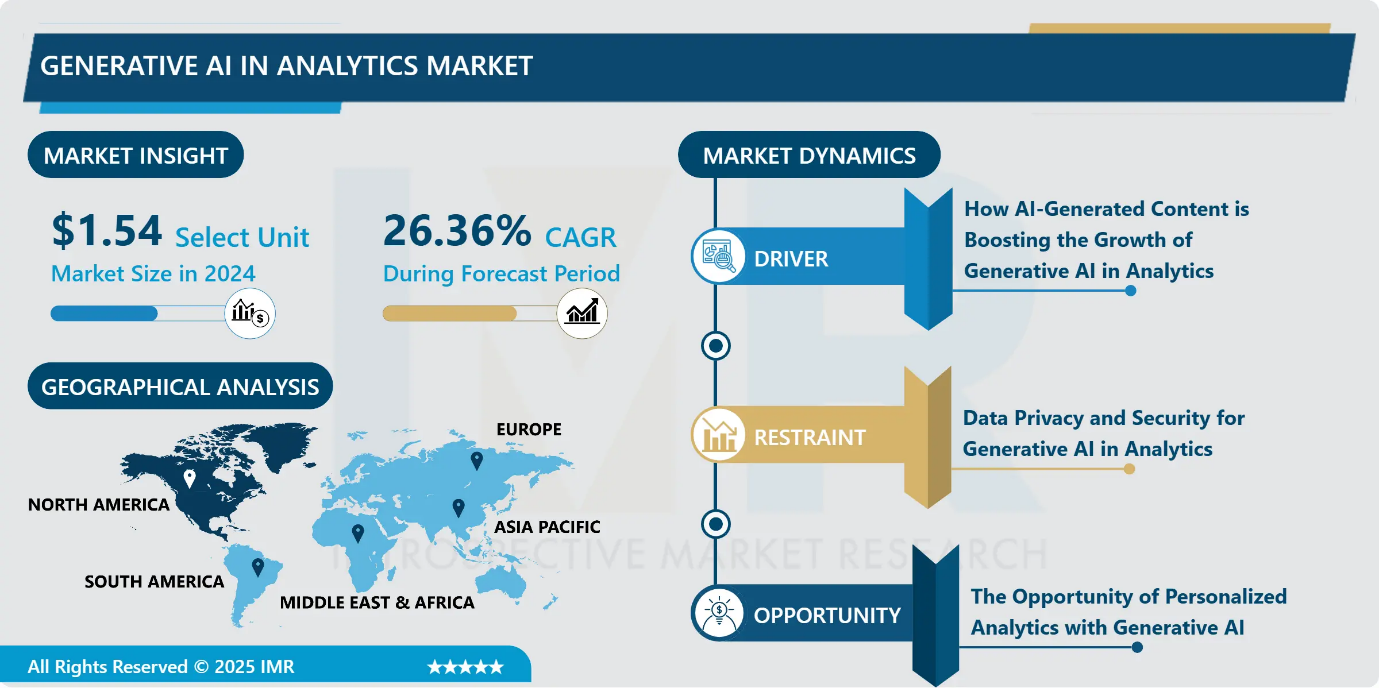
Generative AI in Analytics Market Size Was Valued at USD 1.54 Billion in 2024, and is Projected to Reach USD 20.19 Billion by 2035, Growing at a CAGR of 26.36% From 2025–2035.
Generative AI in analytics is a part of artificial intelligence that focuses on creating smart models and algorithms. These tools can generate new and useful data, insights, or content by studying existing information and patterns. Instead of just analysing data like traditional methods, generative AI can create fresh ideas and help discover hidden connections in data that might otherwise be missed. This ability supports innovation, helps businesses make better decisions, and finds new opportunities in large amounts of information.
However, the market for generative AI in analytics is influenced by global trade changes, such as shifting tariffs and trade relations between countries. These rapid changes can affect how companies invest in and use AI technologies. Because of this, reports and forecasts about the market are regularly updated to reflect the latest situations. These updates include advice and strategies to help businesses adapt to the fast-changing international environment.
The main technologies behind generative AI in analytics include machine learning, natural language processing, deep learning, computer vision, and robotic process automation. Machine learning allows computers to learn from data and improve their performance without needing specific programming for each task. These technologies are often used through cloud services or installed directly on company systems (on-premises). They have many practical uses, such as improving data quality (data augmentation), detecting unusual data patterns (anomaly detection), creating text (text generation), running simulations, and making predictions (forecasting).
Overall, generative AI in analytics is a powerful tool that uses advanced technology to turn data into valuable new insights and creative content.
Generative AI in Analytics Market Growth and Trend Analysis:
Generative AI in Analytics Market Growth Driver - How AI-Generated Content is Boosting the Growth of Generative AI in Analytics
-
The rise of AI-generated content is a major factor driving the growth of the generative AI market in analytics. AI-generated content means digital materials like text, images, or videos created using artificial intelligence technologies. This content is becoming more popular because it can quickly produce personalized and relevant information for users, which helps keep them interested and engaged. At the same time, it lowers costs for businesses by reducing the need for manual work.
- Generative AI models work by analysing large amounts of data to find patterns and trends. They then use these insights to create new content such as articles, reports, or creative projects. This ability to produce useful and customized content efficiently is very valuable across many industries.
- For example, in early 2024, a company called DOIT Software shared data showing how popular ChatGPT, a generative AI platform, has become. Around 57 million people used ChatGPT in 2022, and this number grew rapidly to 100 million by January 2023. This shows how fast AI-generated content is being accepted and used by people around the world.
- Because of this growing demand for AI-generated content, businesses are investing more in generative AI tools that can analyse data and produce content automatically. This trend is expected to keep driving the growth of the generative AI market in analytics in the coming years.
Generative AI in Analytics Market Limiting Factor-Data Privacy and Security for Generative AI in Analytics
-
Generative AI in analytics is a powerful technology that creates new insights, reports, and content by analysing large amounts of data. However, one major restraint slowing down its full potential is the concern over data privacy and security.
- Generative AI systems need access to vast volumes of data to work well. This data often includes sensitive information such as personal details, financial records, or confidential business information. Because of this, companies using generative AI must be very careful to protect this data from leaks or unauthorized access. If this data falls into the wrong hands, it can lead to serious problems like identity theft, financial loss, or damage to a company’s reputation.
- In addition to these risks, there are strict laws and regulations in many countries designed to protect people’s privacy. For example, rules like the European Union’s GDPR or California’s CCPA set clear limits on how data can be collected, stored, and used. Companies must follow these rules carefully when using generative AI, which can be complicated and costly.
- These privacy concerns and legal requirements create a barrier for businesses. They may hesitate to use generative AI fully because they worry about breaking the rules or risking data breaches. This restraint slows down the adoption of generative AI technology in analytics, especially for companies dealing with very sensitive or personal data.
- In summary, data privacy and security concerns are a key challenge for generative AI in analytics. Businesses need strong protections and clear rules to safely benefit from this innovative technology.
Generative AI in Analytics Market Expansion Opportunity-The Opportunity of Personalized Analytics with Generative AI
-
One of the biggest opportunities in generative AI for analytics is the ability to create personalized insights and reports. Personalized analytics means that the AI can study data and then generate information that is specially designed for a specific user, business, or situation instead of giving the same general results to everyone.
- Generative AI uses smart algorithms to understand the unique needs and preferences of different users. For example, it can create custom reports that focus on the most important data for a particular business or individual. It can also make forecasts or predictions that fit the exact conditions of that business, helping decision-makers see what might happen in the future based on their specific situation.
- This personalization is very valuable because it helps companies make better, faster decisions. When the information is tailored just for them, businesses can act more confidently and efficiently. For customers, personalized analytics can improve their experience by offering more relevant services, products, or advice based on their individual behaviour or preferences.
- Because of these benefits, personalized analytics powered by generative AI is opening new doors in many industries. Companies in healthcare, finance, retail, and more are starting to use AI-driven personalized insights to solve problems and create new opportunities.
- In short, personalized analytics is a powerful chance for generative AI to help businesses grow, serve their customers better, and explore new markets. It makes AI not just smart, but also more useful and focused on what each user really needs.Top of FormBottom of Form
Generative AI in Analytics Market Challenge and Risk - The Challenge of Ensuring Quality and Reliability in Generative AI Data
-
One of the biggest challenges faced by generative AI in analytics is making sure the data and insights it creates are accurate and reliable. Generative AI learns by studying large amounts of existing data to find patterns and generate new information. But if the data it learns from is incomplete, outdated, or biased, the AI can produce wrong or unfair results.
- For example, if an AI system is trained on data that mostly represents one group of people or one type of situation, it might not work well for others. This can lead to biased insights that favour certain groups and ignore others, which is unfair and can cause serious problems for businesses relying on these results.
- Also, sometimes the AI may make mistakes because it is guessing or predicting based on patterns, which might not always be correct. This can lead to poor decisions if companies trust the AI blindly without checking the results carefully.
- Ensuring the accuracy and fairness of AI-generated data is very important but also very difficult. It requires constant monitoring, updating the data, and improving the AI models. Companies also need experts who understand both AI and the business to check and interpret the AI’s outputs carefully.
- In short, while generative AI offers powerful new ways to analyse data, the challenge of maintaining high quality and reliable results remains. Solving this challenge is key to making AI a trustworthy and useful tool for businesses everywhere.
Generative AI in Analytics Market Segment Analysis:
Generative AI in Analytics Market is segmented based on Type, Application, End-Users, and Region
By Type, Generative AI in Analytics segment is expected to dominate the market during the forecast period
-
Generative AI in analytics uses different technologies to help businesses understand and use their data better. Two of the most important technologies are Machine Learning (ML) and Natural Language Processing (NLP).
- Machine Learning (ML) is a type of artificial intelligence that helps systems learn from data without being programmed for every specific task. Instead of following fixed rules, ML systems look at large sets of data, find patterns, and use them to make predictions or decisions. For example, ML can look at sales data from past years and predict how much a company might sell next month. This helps businesses make smarter choices based on real data trends. ML is very useful for spotting changes in customer behaviour, identifying risks, and improving future planning.
- Natural Language Processing (NLP) is another powerful part of generative AI. It allows AI systems to read, understand, and even write human language. In analytics, NLP is often used to turn complicated data into easy-to-understand reports or summaries. For example, instead of reading through thousands of customer reviews, NLP can analyse the text and tell a business what most customers liked or disliked. It can also help generate clear summaries from large documents, saving time and effort.
- Together, ML and NLP make generative AI in analytics smarter and more helpful. They help turn big, messy data into useful insights that businesses can use to grow, improve services, and make better decisions.
By Application, Generative AI in Analytics segment held the largest share in 2024
-
Generative AI in analytics is being used in many helpful ways to make business processes smarter and more efficient. Two important applications are Data Augmentation and Anomaly Detection.
- Data Augmentation is the process of creating new data based on the data a company already has. This is useful because AI systems need a lot of data to learn and work well. Sometimes, there isn’t enough real data available, especially for rare situations. Generative AI can help by making similar, artificial data that still follows the same patterns as the original. This helps improve the performance of AI models by giving them more examples to learn from. For example, in the healthcare industry, if there are only a few images of a rare disease, generative AI can create more images based on those few, helping doctors and systems detect it better in the future.
- Anomaly Detection means finding data points that don’t follow the usual pattern. These unusual data points, called anomalies, can be signs of problems or special events. Generative AI can learn what normal data looks like and then spot anything that seems out of place. For example, in finance, it can detect if someone is using a credit card in a strange way, which might mean fraud. In manufacturing, it can catch defects in products early by spotting abnormal patterns.
- In short, generative AI helps businesses improve data quality and catch important issues early, making operations smoother and smarter.
Generative AI in Analytics Market Regional Insights:
The Generative AI in Analytics market is growing quickly all around the world. Each region is contributing in its own way, depending on its technology, investment, and demand.
- North America is currently the largest and most advanced market for generative AI in analytics. It holds around 41% to 50% of the global market share. This strong position is mainly because of the region’s well-developed technology systems, large number of leading AI companies, and strong investment in research and innovation. The United States, in particular, is home to many of the world’s top tech firms, research institutions, and AI startups that are actively working to improve generative AI tools used in data analytics.
- Many industries in North America, such as finance, healthcare, retail, and manufacturing, have already started using generative AI to improve decision-making, customer experience, and business operations. These industries are early adopters of new technologies and are willing to invest in AI tools that help them analyse large amounts of data more quickly and accurately.
- In addition, the region has strong support from both the private sector and government when it comes to digital innovation and AI development. Organizations are also focusing on ethical AI use and data privacy, which has helped increase trust and adoption of these technologies.
- Overall, North America’s mix of advanced technology, skilled workforce, high investment levels, and early use of AI across industries makes it the leader in the generative AI in analytics market. The region is expected to maintain its top position for the next several year.
Generative AI in Analytics Market Active Players:
- AI Superior (Germany)
- Alation (USA)
- AMS (Applied Marketing Science) (USA)
- AnswerRocket (USA)
- Anthropic (USA)
- AWS (USA)
- Clarifai (USA)
- Cortexica (UK)
- Databricks (USA)
- GenRocket (USA)
- Google (USA)
- IBM (USA)
- MachEye (USA)
- Meta (USA)
- Microsoft (USA)
- MindsDB (USA)
- Omneky (USA)
- OpenAI (USA)
- Oracle (USA)
- PwC (UK)
- Salesforce (USA)
- SAP (Germany)
- Scale AI (USA)
- Seldon (UK)
- Snowflake (USA)
- Synthesis AI (USA)
- Syntho (Netherlands)
- Uniphore (USA)
- YouScan (Ukraine)
- Zilliz (USA)
- Other active players
|
Generative AI in Analytics Market |
|||
|
Base Year: |
2024 |
Forecast Period: |
2025-2035 |
|
Historical Data: |
2018 to 2024 |
Market Size in 2024: |
USD 1.54 Billion
|
|
Forecast Period 2025-35 CAGR: |
26.36% |
Market Size in 2035: |
USD 20.19 Billion |
|
Segments Covered: |
By Technology Type |
|
|
|
By Application |
|
||
|
By Deployment |
|
||
|
By Region |
|
||
|
Growth Driver: |
|
||
|
Limiting Factor |
|
||
|
Expansion Opportunity |
|
||
|
Challenge and Risk |
|
||
|
Companies Covered in the Report: |
|
||
Chapter 1: Introduction
1.1 Scope and Coverage
Chapter 2:Executive Summary
Chapter 3: Market Landscape
3.1 Market Dynamics and Opportunity Analysis
3.1.1 Growth Drivers
3.1.2 Limiting Factors
3.1.3 Growth Opportunities
3.1.4 Challenges and Risks
3.2 Market Trend Analysis
3.3 Industry Ecosystem
3.4 Industry Value Chain Mapping
3.5 Strategic PESTLE Overview
3.6 Porter's Five Forces Framework
3.7 Regulatory Framework
3.8 Pricing Trend Analysis
3.9 Intellectual Property Review
3.10 Technology Evolution
3.11 Import-Export Analysis
3.12 Consumer Behavior Analysis
3.13 Investment Pocket Analysis
3.14 Go-To Market Strategy
Chapter 4: Generative AI in Analytics Market by Technology (2018-2035)
4.1 Generative AI in Analytics Market Snapshot and Growth Engine
4.2 Market Overview
4.3 Machine Learning
4.3.1 Introduction and Market Overview
4.3.2 Historic and Forecasted Market Size in Value USD and Volume Units
4.3.3 Key Market Trends, Growth Factors, and Opportunities
4.3.4 Geographic Segmentation Analysis
4.4 Natural Language Processing
4.5 Deep Learning
4.6 Computer Vision
4.7 Robotic Process Automation
Chapter 5: Generative AI in Analytics Market by Application (2018-2035)
5.1 Generative AI in Analytics Market Snapshot and Growth Engine
5.2 Market Overview
5.3 Data Augmentation
5.3.1 Introduction and Market Overview
5.3.2 Historic and Forecasted Market Size in Value USD and Volume Units
5.3.3 Key Market Trends, Growth Factors, and Opportunities
5.3.4 Geographic Segmentation Analysis
5.4 Anomaly Detection
5.5 Text Generation
5.6 Simulation and Forecasting
Chapter 6: Generative AI in Analytics Market by Deployment (2018-2035)
6.1 Generative AI in Analytics Market Snapshot and Growth Engine
6.2 Market Overview
6.3 Cloud-Based
6.3.1 Introduction and Market Overview
6.3.2 Historic and Forecasted Market Size in Value USD and Volume Units
6.3.3 Key Market Trends, Growth Factors, and Opportunities
6.3.4 Geographic Segmentation Analysis
6.4 On-Premise
Chapter 7: Company Profiles and Competitive Analysis
7.1 Competitive Landscape
7.1.1 Competitive Benchmarking
7.1.2 Generative AI in Analytics Market Share by Manufacturer/Service Provider(2024)
7.1.3 Industry BCG Matrix
7.1.4 PArtnerships, Mergers & Acquisitions
7.2 AI SUPERIOR (GERMANY)
7.2.1 Company Overview
7.2.2 Key Executives
7.2.3 Company Snapshot
7.2.4 Role of the Company in the Market
7.2.5 Sustainability and Social Responsibility
7.2.6 Operating Business Segments
7.2.7 Product Portfolio
7.2.8 Business Performance
7.2.9 Recent News & Developments
7.2.10 SWOT Analysis
7.3 ALATION (USA)
7.4 AMS (APPLIED MARKETING SCIENCE) (USA)
7.5 ANSWERROCKET (USA)
7.6 ANTHROPIC (USA)
7.7 AWS (USA)
7.8 CLARIFAI (USA)
7.9 CORTEXICA (UK)
7.10 DATABRICKS (USA)
7.11 GENROCKET (USA)
7.12 GOOGLE (USA)
7.13 IBM (USA)
7.14 MACHEYE (USA)
7.15 META (USA)
7.16 MICROSOFT (USA)
7.17 MINDSDB (USA)
7.18 OMNEKY (USA)
7.19 OPENAI (USA)
7.20 ORACLE (USA)
7.21 PWC (UK)
7.22 SALESFORCE (USA)
7.23 SAP (GERMANY)
7.24 SCALE AI (USA)
7.25 SELDON (UK)
7.26 SNOWFLAKE (USA)
7.27 SYNTHESIS AI (USA)
7.28 SYNTHO (NETHERLANDS)
7.29 UNIPHORE (USA)
7.30 YOUSCAN (UKRAINE)
7.31 ZILLIZ (USA)
7.32 AND OTHER ACTIVE PLAYERS.
Chapter 8: Global Generative AI in Analytics Market By Region
8.1 Overview
8.2. North America Generative AI in Analytics Market
8.2.1 Key Market Trends, Growth Factors and Opportunities
8.2.2 Top Key Companies
8.2.3 Historic and Forecasted Market Size by Segments
8.2.4 Historic and Forecast Market Size by Country
8.2.4.1 US
8.2.4.2 Canada
8.2.4.3 Mexico
8.3. Eastern Europe Generative AI in Analytics Market
8.3.1 Key Market Trends, Growth Factors and Opportunities
8.3.2 Top Key Companies
8.3.3 Historic and Forecasted Market Size by Segments
8.3.4 Historic and Forecast Market Size by Country
8.3.4.1 Russia
8.3.4.2 Bulgaria
8.3.4.3 The Czech Republic
8.3.4.4 Hungary
8.3.4.5 Poland
8.3.4.6 Romania
8.3.4.7 Rest of Eastern Europe
8.4. Western Europe Generative AI in Analytics Market
8.4.1 Key Market Trends, Growth Factors and Opportunities
8.4.2 Top Key Companies
8.4.3 Historic and Forecasted Market Size by Segments
8.4.4 Historic and Forecast Market Size by Country
8.4.4.1 Germany
8.4.4.2 UK
8.4.4.3 France
8.4.4.4 The Netherlands
8.4.4.5 Italy
8.4.4.6 Spain
8.4.4.7 Rest of Western Europe
8.5. Asia Pacific Generative AI in Analytics Market
8.5.1 Key Market Trends, Growth Factors and Opportunities
8.5.2 Top Key Companies
8.5.3 Historic and Forecasted Market Size by Segments
8.5.4 Historic and Forecast Market Size by Country
8.5.4.1 China
8.5.4.2 India
8.5.4.3 Japan
8.5.4.4 South Korea
8.5.4.5 Malaysia
8.5.4.6 Thailand
8.5.4.7 Vietnam
8.5.4.8 The Philippines
8.5.4.9 Australia
8.5.4.10 New Zealand
8.5.4.11 Rest of APAC
8.6. Middle East & Africa Generative AI in Analytics Market
8.6.1 Key Market Trends, Growth Factors and Opportunities
8.6.2 Top Key Companies
8.6.3 Historic and Forecasted Market Size by Segments
8.6.4 Historic and Forecast Market Size by Country
8.6.4.1 Turkiye
8.6.4.2 Bahrain
8.6.4.3 Kuwait
8.6.4.4 Saudi Arabia
8.6.4.5 Qatar
8.6.4.6 UAE
8.6.4.7 Israel
8.6.4.8 South Africa
8.7. South America Generative AI in Analytics Market
8.7.1 Key Market Trends, Growth Factors and Opportunities
8.7.2 Top Key Companies
8.7.3 Historic and Forecasted Market Size by Segments
8.7.4 Historic and Forecast Market Size by Country
8.7.4.1 Brazil
8.7.4.2 Argentina
8.7.4.3 Rest of SA
Chapter 9 Analyst Viewpoint and Conclusion
Chapter 10 Our Thematic Research Methodology
10.1 Research Process
10.2 Primary Research
10.3 Secondary Research
Chapter 12 Case Study
Chapter 13 Appendix
13.1 Sources
13.2 List of Tables and figures
13.3 Short Forms and Citations
13.4 Assumption and Conversion
13.5 Disclaimer
|
Generative AI in Analytics Market |
|||
|
Base Year: |
2024 |
Forecast Period: |
2025-2035 |
|
Historical Data: |
2018 to 2024 |
Market Size in 2024: |
USD 1.54 Billion
|
|
Forecast Period 2025-35 CAGR: |
26.36% |
Market Size in 2035: |
USD 20.19 Billion |
|
Segments Covered: |
By Technology Type |
|
|
|
By Application |
|
||
|
By Deployment |
|
||
|
By Region |
|
||
|
Growth Driver: |
|
||
|
Limiting Factor |
|
||
|
Expansion Opportunity |
|
||
|
Challenge and Risk |
|
||
|
Companies Covered in the Report: |
|
||