




Crawler Cranes Market Synopsis:
Crawler Cranes Market Size Was Valued at USD 2.90 Billion in 2023, and is Projected to Reach USD 5.42 Billion by 2032, Growing at a CAGR of 7.2% From 2024-2032.
A crawler crane is an equipment used for lifting, relocating, and placing heavyweight materials at construction, industrial and other working places. They are assembled on a track so they are steady for movement on rough terrains, thus ideal for rocky or difficult terrains. These cranes are popular for use in construction, mining and other hefty industries where big lift projects are common.
Crawler cranes have tracks replacing wheels and offer more power and stability and working load; such are essential for working with laid booms in steep or rough terrain. Such a trend in the market is caused by the increase in infrastructure construction, the level of urbanization, and the demand for various large-scale equipment used in, for example, the oil and gas industry, shipbuilding, and electricity supply industries.
Crawler cranes exist in diverse dimension – small to the large ones for heavy works and everything in between. The major benefit that is associated with the crawler cranes is that they will be used where the wheels of crawler cranes might prove difficult to maneuver such as marshy or rough surfaces. These cranes are also employed in some specialized fields such as in civil engineering for erection of bridges and buildings, or in mining to extract minerals as wells as for placing heavy plant and machinery in the power secteur. The increased safety features, automation, and Fuel efficiency are the technologically driven factors further enhancing the growth of the market.
Increases in crane productivity have captured much attention from the market players through utilization of technologies such as telematics, machine learning and hydraulic. Other related factors include the increasing popularity of renting construction and lifting equipment in construction projects where hiring is preferred to purchasing due to the very high costs of acquiring crawler cranes.
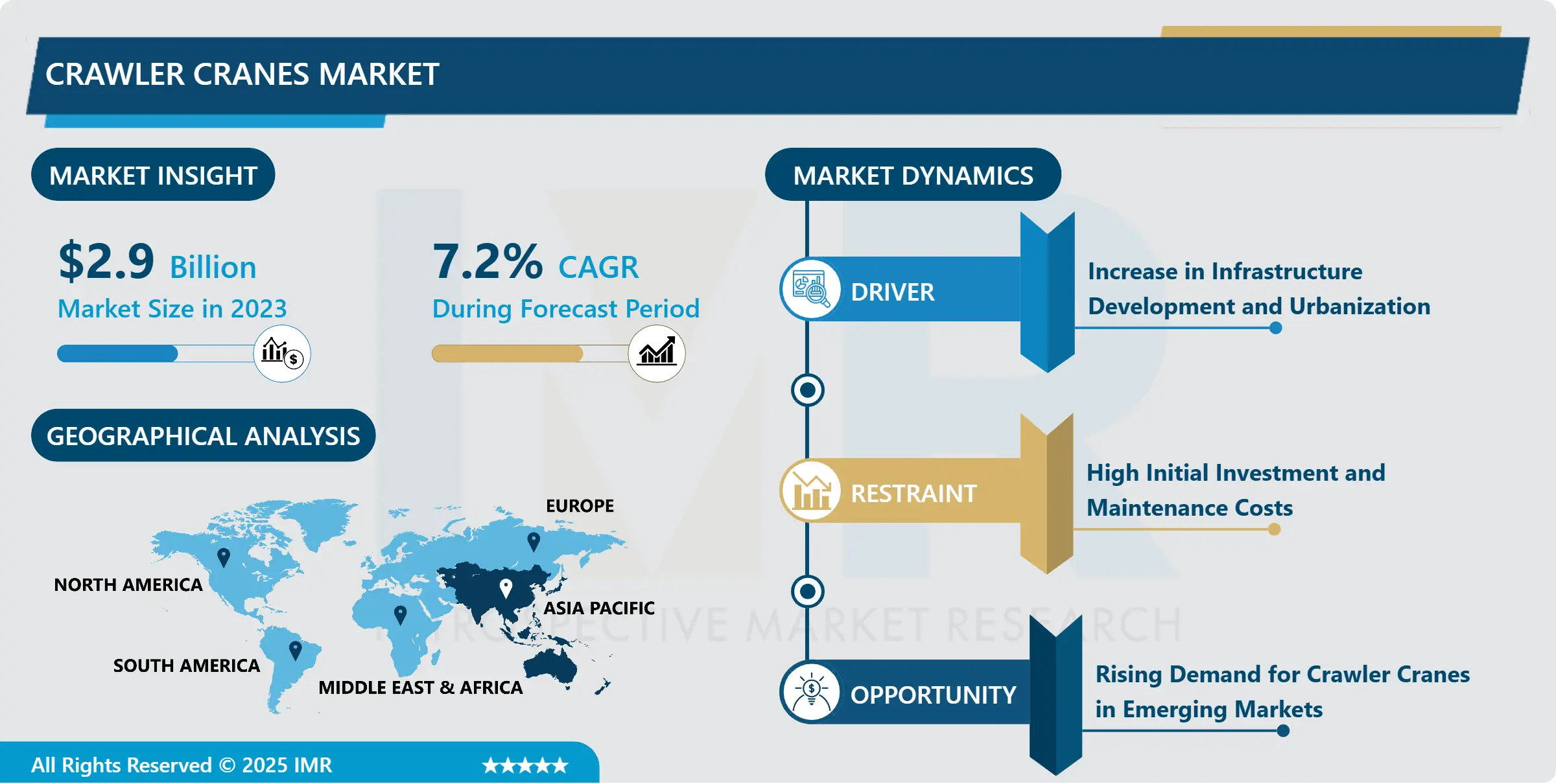
Crawler Cranes Market Trend Analysis:
Growing Adoption of Electric and Hybrid Crawler Cranes
-
Crawler cranes market stimulates increasingly greater use of electrical and hybrid machines. Electrical and hybrid crawl cranes are thus emerging as a viable option to the diesel cranes as the environmental standards are placed higher and companies search for way to save on carbon emissions. These cranes apart from satisfying the various regulatory requirements also provide better operating cost, lesser noise, and better fuel economy.
- In addition, the sustainability in construction and mining industries have improved investment in green technologies. Some of the cranes have both electric and diesel power; thus, they can be used in sensitive environmental conditions when the power and capacity are required for lifting. This trend is expected to remain the same as the manufacturers are aiming at increasing the affordability and efficiency of the electric and hybrid crawler cranes.
Rising Demand for Crawler Cranes in Emerging Markets
-
Developing nations of Asia-Pacific, Middle Eastern and African nations offer growth prospects for the crawler cranes market. These areas are vastly urbanizing and industrializing so the need for big infrastructure projects such as roads, bridges, and tall buildings is rapidly growing. These large and complex structures require crawler cranes for their construction process and as a tool they provide a stable and powerful lifting technique in these conditions.
- Further, the increasing oil and gas, mining and energy industries in these regions are again aiding in the demand of crawler cranes. With new oil fields being discovered or the mining activities increasing the demand for Heavy Lifting equipment to move and place machines is on the rise. These opportunities can be seized by manufacturers to develop more distribution channels in these developing industries which would require equipment that is suitable for use by those industries besides the fact that these industries are experiencing growth.
Crawler Cranes Market Segment Analysis:
Crawler Cranes Market Segmented on the basis of type, application, capacity, end user industry and region.
By Type, Heavy Crawler Cranes segment is expected to dominate the market during the forecast period
-
The Heavy Crawler Cranes segment is projected to lead the market during the forecast period due to its ability to lift loads exceeding 300 tons. These cranes are essential for large-scale operations such as the construction of high-rise buildings, bridges, and infrastructure megaprojects. Their enhanced lifting capacity and superior stability make them ideal for use on unstable ground, where other crane types may not perform effectively.
- The surge in demand for heavy-duty equipment in major construction projects has driven continuous innovation in crawler crane technology. As a result, heavy crawler cranes are increasingly being adopted in global infrastructure development, contributing significantly to the segment’s dominance in the market throughout the forecast period.
By Application, Construction segment expected to held the largest share
-
The Construction segment is anticipated to hold the largest share in the Crawler Cranes market during the forecast period. This dominance is driven by rapid urbanization, infrastructure development, and the rising number of large-scale construction projects worldwide. Crawler cranes are extensively used in building roads, bridges, commercial complexes, residential towers, and industrial facilities due to their high lifting capacity and mobility on uneven terrain. Their ability to handle heavy materials and equipment makes them vital for modern construction operations. Governments and private sectors are heavily investing in infrastructure upgrades and smart city projects, further fueling demand. As construction activities continue to expand globally, especially in emerging economies, the need for crawler cranes in this segment is expected to remain strong and consistent.
Crawler Cranes Market Regional Insights:
Asia Pacific is Expected to Dominate the Market Over the Forecast period
-
The Asia-Pacific region remains the most influential market for crawler cranes because of increased industrialization and Urbanization activity and better economic progress notably in China, India, and Japan. With the growing infrastructure demands in these countries the market for these crawler cranes has grown bigger. Due to increased population in urban areas and demands for larger infrastructural facilities including skyl scnsc, ircadai bridge and highways, there is enormous demand for such machinery like crawler ‘Chn CO
- Furthermore, growth in mining and oil & gas industries in Asia-Pacific region is also affecting the enhancement of crawler crane market. These sectors are therefore purposing important in utilization of crawler cranes as they continue to discover new resources and require convenient transport as well as installation of equipment. The increasing growth in manufacturing industries and increased concerns towards infrastructure industries make Asia-Pacific dominate the crawler cranes market globally.
Active Key Players in the Crawler Cranes Market:
- Liebherr Group (Germany)
- Terex Corporation (USA)
- SANY Group (China)
- Manitowoc (USA)
- Hitachi Sumitomo Heavy Industries Construction Crane Co., Ltd. (Japan)
- Tadano Ltd. (Japan)
- Kato Works Co., Ltd. (Japan)
- XCMG (China)
- Zoomlion Heavy Industry Science & Technology Co., Ltd. (China)
- Cargotec Corporation (Finland)
- Kobelco Construction Machinery Co., Ltd. (Japan)
- Sumitomo Heavy Industries (Japan)
- Other Active Players
Key Industry Developments in the Crawler Cranes Market:
- In July 2024, Tadano and Vestas announced a strategic collaboration to develop and market nacelle cranes specifically tailored for Vestas' V236 15 MW offshore wind turbines. This partnership is designed to enhance the offshore wind energy sector.
- In December 2023, Kobelco Construction Machinery Co., Ltd., offering a wide range of products including excavators and cranes introduced its new G-4 series hydraulic crawler cranes, featuring three models: the CKE900G-4 with a maximum lifting capacity of 100 metric tonnes at 3.6 meters, the CKE1350G-4 with a maximum lifting capacity of 150 metric tonnes at 4.4 meters, and the CKE2500G-4 with a maximum lifting capacity of 250 metric tonnes at 4.6 meters
- In December 2023, Sumitomo Heavy Industries Construction Cranes Co., Ltd. (HSC), a leading manufacturer of construction equipment, particularly crawler cranes launched the SCX2800A-3 crawler crane, which has a maximum lifting capacity of 275 metric tonnes and complies with EU Stage V exhaust emissions regulations.
- In July 2023, Link-Belt unveiled its 5th generation 218 lattice crawler crane, the 218|V, which enhances the capabilities of its predecessor, the 218 HSL. This new model is specifically designed for heavy-duty applications, providing improved performance and operator comfort.
|
Global Crawler Cranes Market |
|||
|
Base Year: |
2023 |
Forecast Period: |
2024-2032 |
|
Historical Data: |
2017 to 2023 |
Market Size in 2023: |
USD 2.90 Billion |
|
Forecast Period 2024-32 CAGR: |
7.2% |
Market Size in 2032: |
USD 5.42 Billion |
|
Segments Covered: |
By Type |
|
|
|
By Application |
|
||
|
By Capacity |
|
||
|
By End-User Industry |
|
||
|
By Region |
|
||
|
Key Market Drivers: |
|
||
|
Key Market Restraints: |
|
||
|
Key Opportunities: |
|
||
|
Companies Covered in the report: |
|
||
Chapter 1: Introduction
1.1 Scope and Coverage
Chapter 2:Executive Summary
Chapter 3: Market Landscape
3.1 Market Dynamics
3.1.1 Drivers
3.1.2 Restraints
3.1.3 Opportunities
3.1.4 Challenges
3.2 Market Trend Analysis
3.3 PESTLE Analysis
3.4 Porter's Five Forces Analysis
3.5 Industry Value Chain Analysis
3.6 Ecosystem
3.7 Regulatory Landscape
3.8 Price Trend Analysis
3.9 Patent Analysis
3.10 Technology Evolution
3.11 Investment Pockets
3.12 Import-Export Analysis
Chapter 4: Crawler Cranes Market by Type
4.1 Crawler Cranes Market Snapshot and Growth Engine
4.2 Crawler Cranes Market Overview
4.3 Heavy Crawler Cranes
4.3.1 Introduction and Market Overview
4.3.2 Historic and Forecasted Market Size in Value USD and Volume Units (2017-2032F)
4.3.3 Key Market Trends, Growth Factors and Opportunities
4.3.4 Heavy Crawler Cranes: Geographic Segmentation Analysis
4.4 Medium Crawler Cranes
4.4.1 Introduction and Market Overview
4.4.2 Historic and Forecasted Market Size in Value USD and Volume Units (2017-2032F)
4.4.3 Key Market Trends, Growth Factors and Opportunities
4.4.4 Medium Crawler Cranes: Geographic Segmentation Analysis
4.5 Small Crawler Cranes
4.5.1 Introduction and Market Overview
4.5.2 Historic and Forecasted Market Size in Value USD and Volume Units (2017-2032F)
4.5.3 Key Market Trends, Growth Factors and Opportunities
4.5.4 Small Crawler Cranes: Geographic Segmentation Analysis
Chapter 5: Crawler Cranes Market by Application
5.1 Crawler Cranes Market Snapshot and Growth Engine
5.2 Crawler Cranes Market Overview
5.3 Construction
5.3.1 Introduction and Market Overview
5.3.2 Historic and Forecasted Market Size in Value USD and Volume Units (2017-2032F)
5.3.3 Key Market Trends, Growth Factors and Opportunities
5.3.4 Construction: Geographic Segmentation Analysis
5.4 Oil & Gas
5.4.1 Introduction and Market Overview
5.4.2 Historic and Forecasted Market Size in Value USD and Volume Units (2017-2032F)
5.4.3 Key Market Trends, Growth Factors and Opportunities
5.4.4 Oil & Gas: Geographic Segmentation Analysis
5.5 Mining
5.5.1 Introduction and Market Overview
5.5.2 Historic and Forecasted Market Size in Value USD and Volume Units (2017-2032F)
5.5.3 Key Market Trends, Growth Factors and Opportunities
5.5.4 Mining: Geographic Segmentation Analysis
5.6 Shipbuilding
5.6.1 Introduction and Market Overview
5.6.2 Historic and Forecasted Market Size in Value USD and Volume Units (2017-2032F)
5.6.3 Key Market Trends, Growth Factors and Opportunities
5.6.4 Shipbuilding: Geographic Segmentation Analysis
5.7 Power Generation
5.7.1 Introduction and Market Overview
5.7.2 Historic and Forecasted Market Size in Value USD and Volume Units (2017-2032F)
5.7.3 Key Market Trends, Growth Factors and Opportunities
5.7.4 Power Generation: Geographic Segmentation Analysis
5.8 Other
5.8.1 Introduction and Market Overview
5.8.2 Historic and Forecasted Market Size in Value USD and Volume Units (2017-2032F)
5.8.3 Key Market Trends, Growth Factors and Opportunities
5.8.4 Other: Geographic Segmentation Analysis
Chapter 6: Crawler Cranes Market by Capacity
6.1 Crawler Cranes Market Snapshot and Growth Engine
6.2 Crawler Cranes Market Overview
6.3 Less than 100 tons
6.3.1 Introduction and Market Overview
6.3.2 Historic and Forecasted Market Size in Value USD and Volume Units (2017-2032F)
6.3.3 Key Market Trends, Growth Factors and Opportunities
6.3.4 Less than 100 tons: Geographic Segmentation Analysis
6.4 100 to 200 tons
6.4.1 Introduction and Market Overview
6.4.2 Historic and Forecasted Market Size in Value USD and Volume Units (2017-2032F)
6.4.3 Key Market Trends, Growth Factors and Opportunities
6.4.4 100 to 200 tons: Geographic Segmentation Analysis
6.5 200 to 500 tons
6.5.1 Introduction and Market Overview
6.5.2 Historic and Forecasted Market Size in Value USD and Volume Units (2017-2032F)
6.5.3 Key Market Trends, Growth Factors and Opportunities
6.5.4 200 to 500 tons: Geographic Segmentation Analysis
6.6 Above 500 tons
6.6.1 Introduction and Market Overview
6.6.2 Historic and Forecasted Market Size in Value USD and Volume Units (2017-2032F)
6.6.3 Key Market Trends, Growth Factors and Opportunities
6.6.4 Above 500 tons: Geographic Segmentation Analysis
Chapter 7: Crawler Cranes Market by End-User Industry
7.1 Crawler Cranes Market Snapshot and Growth Engine
7.2 Crawler Cranes Market Overview
7.3 Infrastructure
7.3.1 Introduction and Market Overview
7.3.2 Historic and Forecasted Market Size in Value USD and Volume Units (2017-2032F)
7.3.3 Key Market Trends, Growth Factors and Opportunities
7.3.4 Infrastructure: Geographic Segmentation Analysis
7.4 Energy
7.4.1 Introduction and Market Overview
7.4.2 Historic and Forecasted Market Size in Value USD and Volume Units (2017-2032F)
7.4.3 Key Market Trends, Growth Factors and Opportunities
7.4.4 Energy: Geographic Segmentation Analysis
7.5 Manufacturing
7.5.1 Introduction and Market Overview
7.5.2 Historic and Forecasted Market Size in Value USD and Volume Units (2017-2032F)
7.5.3 Key Market Trends, Growth Factors and Opportunities
7.5.4 Manufacturing: Geographic Segmentation Analysis
7.6 Utilities
7.6.1 Introduction and Market Overview
7.6.2 Historic and Forecasted Market Size in Value USD and Volume Units (2017-2032F)
7.6.3 Key Market Trends, Growth Factors and Opportunities
7.6.4 Utilities: Geographic Segmentation Analysis
7.7 Others
7.7.1 Introduction and Market Overview
7.7.2 Historic and Forecasted Market Size in Value USD and Volume Units (2017-2032F)
7.7.3 Key Market Trends, Growth Factors and Opportunities
7.7.4 Others: Geographic Segmentation Analysis
Chapter 8: Company Profiles and Competitive Analysis
8.1 Competitive Landscape
8.1.1 Competitive Benchmarking
8.1.2 Crawler Cranes Market Share by Manufacturer (2023)
8.1.3 Industry BCG Matrix
8.1.4 Heat Map Analysis
8.1.5 Mergers and Acquisitions
8.2 LIEBHERR GROUP (GERMANY)
8.2.1 Company Overview
8.2.2 Key Executives
8.2.3 Company Snapshot
8.2.4 Role of the Company in the Market
8.2.5 Sustainability and Social Responsibility
8.2.6 Operating Business Segments
8.2.7 Product Portfolio
8.2.8 Business Performance
8.2.9 Key Strategic Moves and Recent Developments
8.2.10 SWOT Analysis
8.3 TEREX CORPORATION (USA)
8.4 CATERPILLAR INC. (USA)
8.5 KATO WORKS CO. LTD. (JAPAN)
8.6 SANY GROUP (CHINA)
8.7 XCMG CONSTRUCTION MACHINERY CO. LTD. (CHINA)
8.8 MANITOWOC CRANE GROUP (USA)
8.9 HITACHI
8.10 CONSTRUCTION MACHINERY CO. LTD. (JAPAN)
8.11 ZOOMLION HEAVY INDUSTRY SCIENCE & TECHNOLOGY CO. LTD. (CHINA)
8.12 SUMITOMO HEAVY INDUSTRIES CONSTRUCTION CRANES CO. LTD. (JAPAN)
8.13 HYUNDAI CONSTRUCTION EQUIPMENT (SOUTH KOREA)
8.14 KOBELCO CONSTRUCTION MACHINERY CO. LTD. (JAPAN)
8.15 OTHER ACTIVE PLAYERS
Chapter 9: Global Crawler Cranes Market By Region
9.1 Overview
9.2. North America Crawler Cranes Market
9.2.1 Key Market Trends, Growth Factors and Opportunities
9.2.2 Top Key Companies
9.2.3 Historic and Forecasted Market Size by Segments
9.2.4 Historic and Forecasted Market Size By Type
9.2.4.1 Heavy Crawler Cranes
9.2.4.2 Medium Crawler Cranes
9.2.4.3 Small Crawler Cranes
9.2.5 Historic and Forecasted Market Size By Application
9.2.5.1 Construction
9.2.5.2 Oil & Gas
9.2.5.3 Mining
9.2.5.4 Shipbuilding
9.2.5.5 Power Generation
9.2.5.6 Other
9.2.6 Historic and Forecasted Market Size By Capacity
9.2.6.1 Less than 100 tons
9.2.6.2 100 to 200 tons
9.2.6.3 200 to 500 tons
9.2.6.4 Above 500 tons
9.2.7 Historic and Forecasted Market Size By End-User Industry
9.2.7.1 Infrastructure
9.2.7.2 Energy
9.2.7.3 Manufacturing
9.2.7.4 Utilities
9.2.7.5 Others
9.2.8 Historic and Forecast Market Size by Country
9.2.8.1 US
9.2.8.2 Canada
9.2.8.3 Mexico
9.3. Eastern Europe Crawler Cranes Market
9.3.1 Key Market Trends, Growth Factors and Opportunities
9.3.2 Top Key Companies
9.3.3 Historic and Forecasted Market Size by Segments
9.3.4 Historic and Forecasted Market Size By Type
9.3.4.1 Heavy Crawler Cranes
9.3.4.2 Medium Crawler Cranes
9.3.4.3 Small Crawler Cranes
9.3.5 Historic and Forecasted Market Size By Application
9.3.5.1 Construction
9.3.5.2 Oil & Gas
9.3.5.3 Mining
9.3.5.4 Shipbuilding
9.3.5.5 Power Generation
9.3.5.6 Other
9.3.6 Historic and Forecasted Market Size By Capacity
9.3.6.1 Less than 100 tons
9.3.6.2 100 to 200 tons
9.3.6.3 200 to 500 tons
9.3.6.4 Above 500 tons
9.3.7 Historic and Forecasted Market Size By End-User Industry
9.3.7.1 Infrastructure
9.3.7.2 Energy
9.3.7.3 Manufacturing
9.3.7.4 Utilities
9.3.7.5 Others
9.3.8 Historic and Forecast Market Size by Country
9.3.8.1 Russia
9.3.8.2 Bulgaria
9.3.8.3 The Czech Republic
9.3.8.4 Hungary
9.3.8.5 Poland
9.3.8.6 Romania
9.3.8.7 Rest of Eastern Europe
9.4. Western Europe Crawler Cranes Market
9.4.1 Key Market Trends, Growth Factors and Opportunities
9.4.2 Top Key Companies
9.4.3 Historic and Forecasted Market Size by Segments
9.4.4 Historic and Forecasted Market Size By Type
9.4.4.1 Heavy Crawler Cranes
9.4.4.2 Medium Crawler Cranes
9.4.4.3 Small Crawler Cranes
9.4.5 Historic and Forecasted Market Size By Application
9.4.5.1 Construction
9.4.5.2 Oil & Gas
9.4.5.3 Mining
9.4.5.4 Shipbuilding
9.4.5.5 Power Generation
9.4.5.6 Other
9.4.6 Historic and Forecasted Market Size By Capacity
9.4.6.1 Less than 100 tons
9.4.6.2 100 to 200 tons
9.4.6.3 200 to 500 tons
9.4.6.4 Above 500 tons
9.4.7 Historic and Forecasted Market Size By End-User Industry
9.4.7.1 Infrastructure
9.4.7.2 Energy
9.4.7.3 Manufacturing
9.4.7.4 Utilities
9.4.7.5 Others
9.4.8 Historic and Forecast Market Size by Country
9.4.8.1 Germany
9.4.8.2 UK
9.4.8.3 France
9.4.8.4 The Netherlands
9.4.8.5 Italy
9.4.8.6 Spain
9.4.8.7 Rest of Western Europe
9.5. Asia Pacific Crawler Cranes Market
9.5.1 Key Market Trends, Growth Factors and Opportunities
9.5.2 Top Key Companies
9.5.3 Historic and Forecasted Market Size by Segments
9.5.4 Historic and Forecasted Market Size By Type
9.5.4.1 Heavy Crawler Cranes
9.5.4.2 Medium Crawler Cranes
9.5.4.3 Small Crawler Cranes
9.5.5 Historic and Forecasted Market Size By Application
9.5.5.1 Construction
9.5.5.2 Oil & Gas
9.5.5.3 Mining
9.5.5.4 Shipbuilding
9.5.5.5 Power Generation
9.5.5.6 Other
9.5.6 Historic and Forecasted Market Size By Capacity
9.5.6.1 Less than 100 tons
9.5.6.2 100 to 200 tons
9.5.6.3 200 to 500 tons
9.5.6.4 Above 500 tons
9.5.7 Historic and Forecasted Market Size By End-User Industry
9.5.7.1 Infrastructure
9.5.7.2 Energy
9.5.7.3 Manufacturing
9.5.7.4 Utilities
9.5.7.5 Others
9.5.8 Historic and Forecast Market Size by Country
9.5.8.1 China
9.5.8.2 India
9.5.8.3 Japan
9.5.8.4 South Korea
9.5.8.5 Malaysia
9.5.8.6 Thailand
9.5.8.7 Vietnam
9.5.8.8 The Philippines
9.5.8.9 Australia
9.5.8.10 New Zealand
9.5.8.11 Rest of APAC
9.6. Middle East & Africa Crawler Cranes Market
9.6.1 Key Market Trends, Growth Factors and Opportunities
9.6.2 Top Key Companies
9.6.3 Historic and Forecasted Market Size by Segments
9.6.4 Historic and Forecasted Market Size By Type
9.6.4.1 Heavy Crawler Cranes
9.6.4.2 Medium Crawler Cranes
9.6.4.3 Small Crawler Cranes
9.6.5 Historic and Forecasted Market Size By Application
9.6.5.1 Construction
9.6.5.2 Oil & Gas
9.6.5.3 Mining
9.6.5.4 Shipbuilding
9.6.5.5 Power Generation
9.6.5.6 Other
9.6.6 Historic and Forecasted Market Size By Capacity
9.6.6.1 Less than 100 tons
9.6.6.2 100 to 200 tons
9.6.6.3 200 to 500 tons
9.6.6.4 Above 500 tons
9.6.7 Historic and Forecasted Market Size By End-User Industry
9.6.7.1 Infrastructure
9.6.7.2 Energy
9.6.7.3 Manufacturing
9.6.7.4 Utilities
9.6.7.5 Others
9.6.8 Historic and Forecast Market Size by Country
9.6.8.1 Turkiye
9.6.8.2 Bahrain
9.6.8.3 Kuwait
9.6.8.4 Saudi Arabia
9.6.8.5 Qatar
9.6.8.6 UAE
9.6.8.7 Israel
9.6.8.8 South Africa
9.7. South America Crawler Cranes Market
9.7.1 Key Market Trends, Growth Factors and Opportunities
9.7.2 Top Key Companies
9.7.3 Historic and Forecasted Market Size by Segments
9.7.4 Historic and Forecasted Market Size By Type
9.7.4.1 Heavy Crawler Cranes
9.7.4.2 Medium Crawler Cranes
9.7.4.3 Small Crawler Cranes
9.7.5 Historic and Forecasted Market Size By Application
9.7.5.1 Construction
9.7.5.2 Oil & Gas
9.7.5.3 Mining
9.7.5.4 Shipbuilding
9.7.5.5 Power Generation
9.7.5.6 Other
9.7.6 Historic and Forecasted Market Size By Capacity
9.7.6.1 Less than 100 tons
9.7.6.2 100 to 200 tons
9.7.6.3 200 to 500 tons
9.7.6.4 Above 500 tons
9.7.7 Historic and Forecasted Market Size By End-User Industry
9.7.7.1 Infrastructure
9.7.7.2 Energy
9.7.7.3 Manufacturing
9.7.7.4 Utilities
9.7.7.5 Others
9.7.8 Historic and Forecast Market Size by Country
9.7.8.1 Brazil
9.7.8.2 Argentina
9.7.8.3 Rest of SA
Chapter 10 Analyst Viewpoint and Conclusion
10.1 Recommendations and Concluding Analysis
10.2 Potential Market Strategies
Chapter 11 Research Methodology
11.1 Research Process
11.2 Primary Research
11.3 Secondary Research
|
Global Crawler Cranes Market |
|||
|
Base Year: |
2023 |
Forecast Period: |
2024-2032 |
|
Historical Data: |
2017 to 2023 |
Market Size in 2023: |
USD 2.90 Billion |
|
Forecast Period 2024-32 CAGR: |
7.2% |
Market Size in 2032: |
USD 5.42 Billion |
|
Segments Covered: |
By Type |
|
|
|
By Application |
|
||
|
By Capacity |
|
||
|
By End-User Industry |
|
||
|
By Region |
|
||
|
Key Market Drivers: |
|
||
|
Key Market Restraints: |
|
||
|
Key Opportunities: |
|
||
|
Companies Covered in the report: |
|
||


