Car Mat Market Synopsis:
Car Mat Market Size Was Valued at USD 6.09 Billion in 2024, and is Projected to Reach USD 10.32 Billion by 2035, Growing at a CAGR of 4.91% From 2025–2035.
Car mats are protective floor coverings placed inside vehicles to keep the interior clean, safe, and stylish. The car mat market encompasses the production and sale of floor coverings designed to protect vehicle interiors from dirt, wear, and moisture. These mats are essential for maintaining cleanliness and enhancing the aesthetic appeal of vehicles.
As of 2024, the global car mat market is valued at approximately USD 6.09 billion and is projected to reach around USD 10.32 billion by 2034, growing at a compound annual growth rate (CAGR) of about 4.91%. This growth is driven by increasing vehicle sales, heightened consumer awareness regarding vehicle maintenance, and a growing demand for customized and high-quality interior accessories.
Current market trends include a shift towards eco-friendly materials, such as recycled and biodegradable options, to meet environmental concerns. Additionally, there's a rising preference for custom-fit and all-weather mats that offer enhanced protection and align with consumers' aesthetic preferences. The expansion of e-commerce platforms has also facilitated easier access to a variety of car mat options, further propelling market growth.
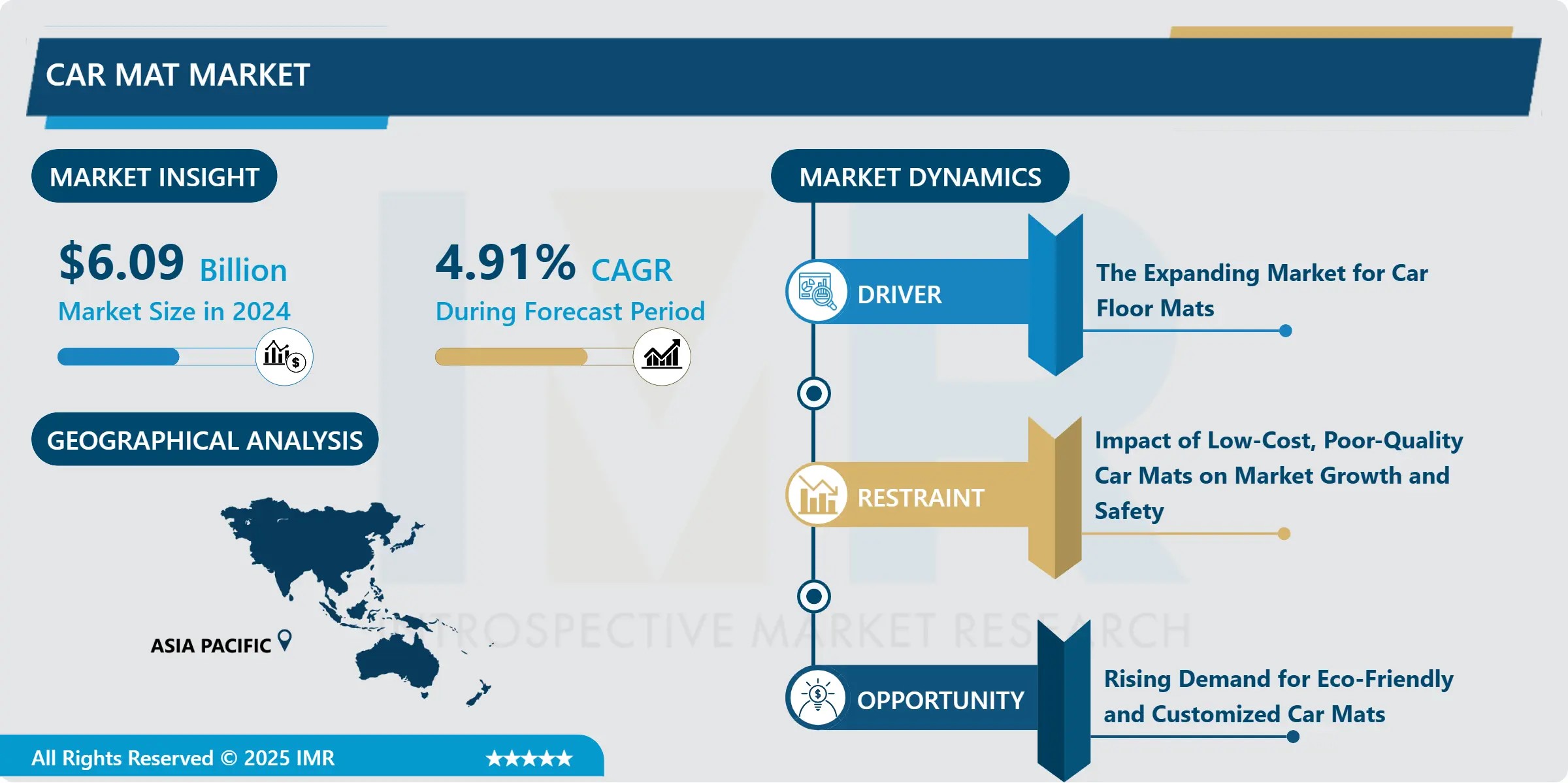
Car Mat Market Growth and Trend Analysis:
Car Mat Market Growth Driver- The Expanding Market for Car Floor Mats
- Car mats are protective floor coverings placed inside vehicles to keep the interior clean, safe, and stylish. They are made from materials like rubber, carpet, vinyl, or thermoplastic and are designed to trap dirt, water, and debris from passengers’ shoes. Car mats help maintain a clean cabin, protect the flooring from wear and tear, and can improve the car's resale value. They come in various types such as all-weather mats, custom-fit mats, and universal mats. These products are commonly sold through car dealers, aftermarket stores, and online platforms, making them an essential accessory for car owners worldwide.
- The car mat market is growing steadily due to rising vehicle sales and a growing focus on car interior aesthetics and cleanliness. As more people buy cars especially in developing countries, the demand for mats also increases. Car owners are more concerned with maintaining their vehicles, which includes using protective accessories like mats.
- Additionally, the rise in online shopping has made it easier to access a wide variety of mats. With increased awareness about car hygiene and customization, the market is expected to grow further, supported by innovations in materials and designs that enhance both comfort and durability.
Car Mat Market Limiting Factor - Impact of Low-Cost, Poor-Quality Car Mats on Market Growth and Safety
- The Car Mat market faces a major challenge due to the presence of low-cost, poor-quality products that undermine the market’s overall value. Many of these inexpensive mats, often sold in unorganized markets, fail to meet essential safety and durability standards. A key restraint in the car mat market is the presence of low-cost, poor-quality products that affect overall market value. Many cheap mats, especially those sold in unorganized markets, do not meet safety or durability standards. They wear out quickly, fail to stay in place, or may even slide under the pedals—causing safety risks. Additionally, price-sensitive consumers often prefer the lowest-priced options, making it difficult for premium brands to compete. This influx of substandard mats lowers profit margins for high-quality manufacturers and damages consumer trust.
- As a result, the growth of the organized, branded car mat segment slows down, highlighting the need for better quality control and consumer awareness to boost market development. This flood of low-end products can reduce profit margins for high-quality manufacturers and create trust issues among customers, slowing down the growth of the organized, branded market segment.
Car Mat Market Expansion Opportunity - Rising Demand for Eco-Friendly and Customized Car Mats
- A major opportunity in the car mat market is the growing demand for eco-friendly and customized car mats. As consumers become more environmentally conscious, they are seeking car mats made from recyclable, biodegradable, or sustainable materials. Alongside this, personalization is becoming a priority, with many car owners wanting mats that complement their vehicle’s interior or reflect their personal style. Companies can capitalize on these trends by offering customizable designs and launching eco-friendly product lines. Additionally, the growing popularity of electric vehicles (EVs), which often feature premium interiors, is driving demand for high-quality, tech-friendly car mats that provide enhanced comfort and functionality. Together, these trends are shaping the future of the car mat market toward sustainability and personalization.
- At the same time, many car owners prefer personalized mats that match the interior design or reflect their style. Companies can take advantage of this trend by offering customization options and launching eco-friendly product lines. Also, rising demand for electric vehicles (EVs), which often require high-end interiors, is creating opportunities for premium, branded, and tech-friendly car mats with better comfort and features.
Car Mat Market Challenge and Risk- Challenges of Standardization and Fit in the Car Mat Market
- A major challenge in the car mat market is the lack of standardization and fit across vehicle types. Many mats are sold as "universal," but they often don’t fit properly, leading to customer dissatisfaction. Custom-fit mats offer a better solution, but they require more manufacturing effort, model-specific data, and often cost more. Managing inventories for many vehicle types becomes complicated for manufacturers. Also, fake or counterfeit products with copied designs and logos pose a challenge to branded companies.
- Ensuring high-quality, safe, and perfectly fitting mats across different vehicle models remains a tough but essential task in this industry. However, producing these mats requires more complex manufacturing processes, access to detailed model-specific data, and higher costs. Inventory management becomes increasingly difficult for manufacturers dealing with multiple vehicle types. Additionally, counterfeit mats that copy brand designs and logos create further issues by damaging the reputation of trusted brands. Overcoming these challenges to deliver high-quality, safe, and well-fitting mats is essential for growth and consumer trust in the car mat industry.
Car Mat Market Segment Analysis:
Car Mat Market is segmented based on Type, Application, End-Users, and Region
By Type, Car Mat segment is expected to dominate the market during the forecast period
- Rubber car mats represent a significant segment in the global car mat market, primarily driven by their durability, practicality, and all-weather protection. These mats are made from high-quality rubber materials that can withstand harsh conditions, making them a preferred choice for consumers looking for long-term performance and easy maintenance.
- One of the key advantages of rubber mats is their resistance to water, mud, snow, and spills. This makes them especially popular in regions with extreme weather or for users who frequently drive in off-road or outdoor environments. Their ability to trap dirt and moisture helps protect the vehicle's interior flooring, thereby preserving the car’s resale value.
- Rubber mats are also non-slip and heavy-duty, which adds to vehicle safety by preventing mat movement underfoot while driving. They are often designed with deep grooves or raised edges to contain liquids and debris, preventing them from spilling over onto the car floor.
- In terms of market trends, rising awareness about vehicle hygiene and increasing sales of SUVs and trucks have contributed to the growth of this segment. Manufacturers are also focusing on eco-friendly rubber materials and improved designs to attract environmentally conscious consumers.
- Overall, the rubber car mat segment is expected to maintain steady growth due to its functionality, cost-efficiency, and adaptability to various driving conditions and vehicle types.
By Application, Car Mat segment held the largest share in 2024
The global car mat market is divided into two main categories based on how the vehicle is used as passenger vehicles and commercial vehicles. Each type has different needs and preferences when it comes to car mats.
Passenger Vehicles
- Passenger vehicles are mainly used for personal travel by individuals and families. People who own passenger cars usually care about how their car looks and feels inside. That’s why car mats made for these vehicles often focus on style, comfort, and design. These mats are usually made from materials like carpet fabric, which offer a soft and cozy feel. They come in many colours and styles to match the car’s interior, giving it a clean and attractive appearance. Besides looks, comfort is another important factor. Drivers and passengers often spend a lot of time in their cars, so they want mats that feel nice underfoot. These mats are often cut to fit the vehicle perfectly, giving a neat and customized feel.
Commercial Vehicles
- On the other hand, commercial vehicles are used for business or transportation services. These include taxis, trucks, delivery vans, and buses. Because these vehicles are used more often and in rougher conditions, the mats used in them need to be very strong and durable. Car mats for commercial use are usually made from tough materials like rubber or heavy-duty plastic. They are designed to protect the vehicle’s floor from dirt, water, spills, and heavy wear. These mats are easy to clean and can handle constant use without getting damaged. Since businesses often care more about function than appearance, these mats focus on practicality and long life.
- The conclusion is , car mats for passenger vehicles are chosen for their comfort and look, while those for commercial vehicles are picked for their strength and ability to handle tough conditions. As the number of vehicles on the road continues to grow, the demand for both types of mats is expected to increase. Understanding these differences helps companies design the right products for different customer needs.
Car Mat Market Regional Insights:
Asia-Pacific is Expected to Dominate the Market Over the Forecast Period
- The Asia-Pacific region is becoming a major force in the global car mat market. This region includes countries such as China, India, Japan, South Korea, and many Southeast Asian nations. One of the main reasons for this growth is the fast development of the automotive industry in these countries. As more people can afford to buy cars, the number of vehicles on the road is increasing quickly.
- Car ownership is rising especially in countries like China and India due to a growing middle class, rising income levels, and better living standards. As more people buy cars, the demand for car accessories, such as car mats, also goes up. Car mats are important because they help keep the car's interior clean and protected, and consumers are increasingly choosing mats that are both stylish and practical.
- Another important factor is the shift in consumer preferences. Today, customers are looking for more than just basic products. They want car mats that offer comfort, durability, and a stylish appearance. This is pushing companies to develop better-quality mats and expand their product ranges to meet the needs of different buyers.
- In addition, local and international car manufacturers are investing heavily in the Asia-Pacific region. This includes setting up factories, launching new models, and expanding their market reach. All of this adds to the demand for car accessories like mats.
- Overall, the Asia-Pacific region is playing a leading role in the global car mat market. Thanks to the fast growth of its automotive industry and rising customer demand, it is expected to hold a large share of the market in the coming years.
Car Mat Market Active Players
- 3M (U.S.)
- 3W (China)
- Auto Custom Carpet Inc. (U.S.)
- Autobo (China)
- Autotech Nonwovens Pvt Ltd. (India)
- Covercraft (U.S.)
- Flex (USA)
- Hayakawa Eastern Rubber Co (Japan)
- Hayashi Telempu (Japan)
- Husky Liners, Inc. (U.S.)
- IDEAL Automotive GmbH (Germany)
- Intro-Tech Automotive (USA)
- Japan Vilene Company (Japan)
- Kotobukiya Fronte Co (Japan)
- Kramer America (USA)
- Lloyd Mats (USA)
- Low & Bonar PLC (U.K.)
- MacNeil IP LLC (U.S.)
- MaxLiners (Thailand)
- Michelin (France)
- Moriden (Japan)
- RACEMARK International (U.S.)
- Sugihara Co (Japan)
- Suminoe Textile (Japan)
- Thermoflex (U.S.)
- Toyota Boshoku Corporation (Japan)
- Truck Hero (USA)
- U Ace (USA)
- Visscher-Caravelle BV (Netherlands)
- Walser GmbH (Austria)
|
Car Mat Market |
|||
|
Base Year: |
2024 |
Forecast Period: |
2025-2035 |
|
Historical Data: |
2018 to 2023 |
Market Size in 2024: |
USD 6.09 Billion |
|
Forecast Period 2025-32 CAGR: |
4.91% |
Market Size in 2035: |
USD 10.32 Billion |
|
Segments Covered: |
By Type |
|
|
|
By Product Type |
|
||
|
By Vehicle type |
|
||
|
End Use |
|
||
|
By Region |
|
||
|
Key Market Drivers: |
|
||
|
Key Market Restraints: |
|
||
|
Key Opportunities: |
|
||
|
Companies Covered in the Report: |
|
||
Chapter 1: Introduction
1.1 Scope and Coverage
Chapter 2:Executive Summary
Chapter 3: Market Landscape
3.1 Market Dynamics and Opportunity Analysis
3.1.1 Growth Drivers
3.1.2 Limiting Factors
3.1.3 Growth Opportunities
3.1.4 Challenges and Risks
3.2 Market Trend Analysis
3.3 Industry Ecosystem
3.4 Industry Value Chain Mapping
3.5 Strategic PESTLE Overview
3.6 Porter's Five Forces Framework
3.7 Regulatory Framework
3.8 Pricing Trend Analysis
3.9 Intellectual Property Review
3.10 Technology Evolution
3.11 Import-Export Analysis
3.12 Consumer Behavior Analysis
3.13 Investment Pocket Analysis
3.14 Go-To Market Strategy
Chapter 4: Car Mat Market by Type (2018-2035)
4.1 Car Mat Market Snapshot and Growth Engine
4.2 Market Overview
4.3 Rubber Floor Mats
4.3.1 Introduction and Market Overview
4.3.2 Historic and Forecasted Market Size in Value USD and Volume Units
4.3.3 Key Market Trends, Growth Factors, and Opportunities
4.3.4 Geographic Segmentation Analysis
4.4 Plastic Floor Mats
4.5 Textile Floor Mats
4.6 Carpet Floor Mats
4.7 Thermoplastic Elastomer (TPE) Mats
4.8 Others (Vinyl Floor Mats
4.9 Nylon Floor Mats
4.10 Leather Floor Mats
4.11 Thermoplastic Olefin (TPO) Mats)
Chapter 5: Car Mat Market by Product Type (2018-2035)
5.1 Car Mat Market Snapshot and Growth Engine
5.2 Market Overview
5.3 Luxury Floor Mats
5.3.1 Introduction and Market Overview
5.3.2 Historic and Forecasted Market Size in Value USD and Volume Units
5.3.3 Key Market Trends, Growth Factors, and Opportunities
5.3.4 Geographic Segmentation Analysis
5.4 Cargo Liners
5.5 All-Weather Mats
5.6 Custom Fit Mats
5.7 Universal Fit Mats
Chapter 6: Car Mat Market by Vehicle Type (2018-2035)
6.1 Car Mat Market Snapshot and Growth Engine
6.2 Market Overview
6.3 Passenger Cars
6.3.1 Introduction and Market Overview
6.3.2 Historic and Forecasted Market Size in Value USD and Volume Units
6.3.3 Key Market Trends, Growth Factors, and Opportunities
6.3.4 Geographic Segmentation Analysis
6.4 Light Commercial Vehicles
6.5 Heavy Commercial Vehicles
6.6 Electric Vehicles
6.7 Other Vehicle Types
Chapter 7: Car Mat Market by End Use (2018-2035)
7.1 Car Mat Market Snapshot and Growth Engine
7.2 Market Overview
7.3 Passenger Vehicles
7.3.1 Introduction and Market Overview
7.3.2 Historic and Forecasted Market Size in Value USD and Volume Units
7.3.3 Key Market Trends, Growth Factors, and Opportunities
7.3.4 Geographic Segmentation Analysis
7.4 Commercial Vehicles
Chapter 8: Company Profiles and Competitive Analysis
8.1 Competitive Landscape
8.1.1 Competitive Benchmarking
8.1.2 Car Mat Market Share by Manufacturer/Service Provider(2024)
8.1.3 Industry BCG Matrix
8.1.4 PArtnerships, Mergers & Acquisitions
8.2 3M (U.S.)
8.2.1 Company Overview
8.2.2 Key Executives
8.2.3 Company Snapshot
8.2.4 Role of the Company in the Market
8.2.5 Sustainability and Social Responsibility
8.2.6 Operating Business Segments
8.2.7 Product Portfolio
8.2.8 Business Performance
8.2.9 Recent News & Developments
8.2.10 SWOT Analysis
8.3 3W (CHINA)
8.4 AUTO CUSTOM CARPET INC. (U.S.)
8.5 AUTOBO (CHINA)
8.6 AUTOTECH NONWOVENS PVT LTD. (INDIA)
8.7 COVERCRAFT (U.S.)
8.8 AND FLEX (USA)
8.9 HUSKY LINERS
8.10 INC. (U.S.)
8.11 IDEAL AUTOMOTIVE GMBH (GERMANY)
8.12 AND INTRO-TECH AUTOMOTIVE (USA)
8.13 FRONTE CO (JAPAN)
8.14 KRAMER AMERICA (USA)
8.15 LLOYD MATS (USA)
8.16 LOW & BONAR PLC (U.K.)
8.17 MACNEIL IP LLC (U.S.)
8.18 MAXLINERS (THAILAND)
8.19 MICHELIN (FRANCE)
8.20 MORIDEN (JAPAN)
8.21 AND RACEMARK INTERNATIONAL (U.S.). SUGIHARA CO (JAPAN)
8.22 SUMINOE TEXTILE (JAPAN)
8.23 THERMOFLEX (U.S.)
8.24 TOYOTA BOSHOKU CORPORATION (JAPAN)
8.25 TRUCK HERO (USA)
8.26 U ACE (USA)
8.27 VISSCHER-CARAVELLE BV (NETHERLANDS)
8.28 AND WALSER GMBH (AUSTRIA)
8.29 OTHER ACTIVE PLAYERS
Chapter 9: Global Car Mat Market By Region
9.1 Overview
9.2. North America Car Mat Market
9.2.1 Key Market Trends, Growth Factors and Opportunities
9.2.2 Top Key Companies
9.2.3 Historic and Forecasted Market Size by Segments
9.2.4 Historic and Forecast Market Size by Country
9.2.4.1 US
9.2.4.2 Canada
9.2.4.3 Mexico
9.3. Eastern Europe Car Mat Market
9.3.1 Key Market Trends, Growth Factors and Opportunities
9.3.2 Top Key Companies
9.3.3 Historic and Forecasted Market Size by Segments
9.3.4 Historic and Forecast Market Size by Country
9.3.4.1 Russia
9.3.4.2 Bulgaria
9.3.4.3 The Czech Republic
9.3.4.4 Hungary
9.3.4.5 Poland
9.3.4.6 Romania
9.3.4.7 Rest of Eastern Europe
9.4. Western Europe Car Mat Market
9.4.1 Key Market Trends, Growth Factors and Opportunities
9.4.2 Top Key Companies
9.4.3 Historic and Forecasted Market Size by Segments
9.4.4 Historic and Forecast Market Size by Country
9.4.4.1 Germany
9.4.4.2 UK
9.4.4.3 France
9.4.4.4 The Netherlands
9.4.4.5 Italy
9.4.4.6 Spain
9.4.4.7 Rest of Western Europe
9.5. Asia Pacific Car Mat Market
9.5.1 Key Market Trends, Growth Factors and Opportunities
9.5.2 Top Key Companies
9.5.3 Historic and Forecasted Market Size by Segments
9.5.4 Historic and Forecast Market Size by Country
9.5.4.1 China
9.5.4.2 India
9.5.4.3 Japan
9.5.4.4 South Korea
9.5.4.5 Malaysia
9.5.4.6 Thailand
9.5.4.7 Vietnam
9.5.4.8 The Philippines
9.5.4.9 Australia
9.5.4.10 New Zealand
9.5.4.11 Rest of APAC
9.6. Middle East & Africa Car Mat Market
9.6.1 Key Market Trends, Growth Factors and Opportunities
9.6.2 Top Key Companies
9.6.3 Historic and Forecasted Market Size by Segments
9.6.4 Historic and Forecast Market Size by Country
9.6.4.1 Turkiye
9.6.4.2 Bahrain
9.6.4.3 Kuwait
9.6.4.4 Saudi Arabia
9.6.4.5 Qatar
9.6.4.6 UAE
9.6.4.7 Israel
9.6.4.8 South Africa
9.7. South America Car Mat Market
9.7.1 Key Market Trends, Growth Factors and Opportunities
9.7.2 Top Key Companies
9.7.3 Historic and Forecasted Market Size by Segments
9.7.4 Historic and Forecast Market Size by Country
9.7.4.1 Brazil
9.7.4.2 Argentina
9.7.4.3 Rest of SA
Chapter 10 Analyst Viewpoint and Conclusion
Chapter 11 Our Thematic Research Methodology
11.1 Research Process
11.2 Primary Research
11.3 Secondary Research
Chapter 12 Case Study
Chapter 13 Appendix
13.1 Sources
13.2 List of Tables and figures
13.3 Short Forms and Citations
13.4 Assumption and Conversion
13.5 Disclaimer
|
Car Mat Market |
|||
|
Base Year: |
2024 |
Forecast Period: |
2025-2035 |
|
Historical Data: |
2018 to 2023 |
Market Size in 2024: |
USD 6.09 Billion |
|
Forecast Period 2025-32 CAGR: |
4.91% |
Market Size in 2035: |
USD 10.32 Billion |
|
Segments Covered: |
By Type |
|
|
|
By Product Type |
|
||
|
By Vehicle type |
|
||
|
End Use |
|
||
|
By Region |
|
||
|
Key Market Drivers: |
|
||
|
Key Market Restraints: |
|
||
|
Key Opportunities: |
|
||
|
Companies Covered in the Report: |
|
||