




Global Blood Transfusion Diagnostics Market Overview
Global market for Blood Transfusion Diagnostics was estimated at USD 4.1 Billion in 2024 and is projected to reach USD 6.95 Billion by 2035, growing at a CAGR of 4.92% during the forecast period (2025-2035)
A blood transfusion is a medical treatment in which the recipient receives donated blood through a small tube inserted into a vein of the arm. This is a life-saving procedure that can help, replace blood lost due to surgery or injury or can replenish blood components lost due to chronic health conditions. Blood transfusion can also make up for the diseases that prevent the body from synthesizing blood or other blood components. The main purpose of blood transfusion diagnostics is to minimize the possibility of transmitting an infectious agent from a unit of donated blood to the recipient. Blood transfusion diagnostics got impedance in mid to late 1980s, when the first case of AIDS was reported in hemophiliacs and the first possible case of transfusion-associated AIDS was reported in an infant. To avoid such situations, governments around the world amended regulations for blood screening to prevent future infections through blood transfusion procedures. The advancement in technologies led to the production of kits & reagents that can detect the presence of contagious elements within minutes. The rise in the number of individuals suffering from health conditions that require blood transfusion is stimulating the growth of the blood transfusion diagnostics market over the forecast period.
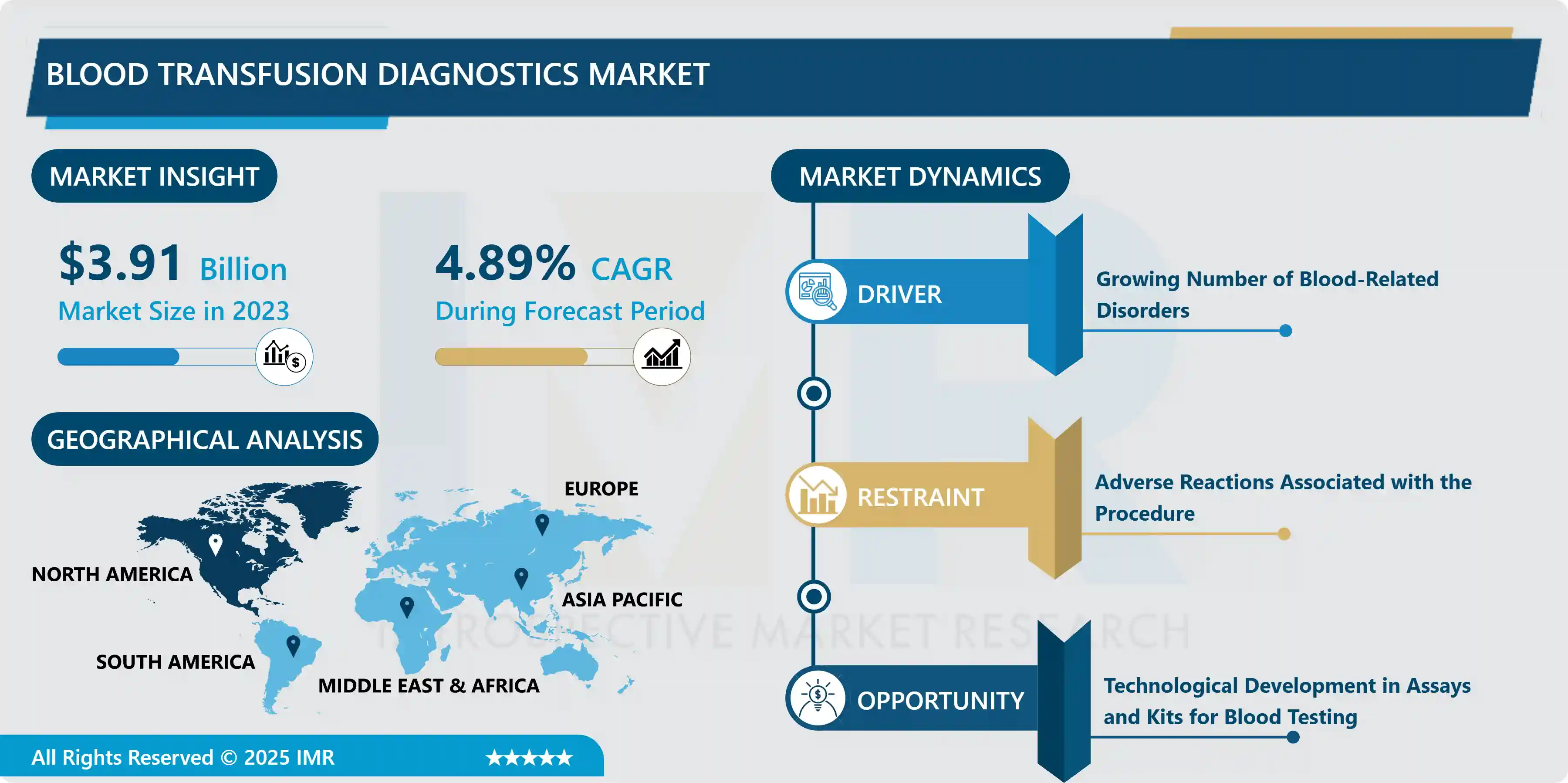
Key Factors And Market Dynamics of Blood Transfusion Diagnostics Market
Drivers:
- Transfusion-Transmissible Infections (TTI) markers (HIV antigen-antibody, HBsAg, anti-HCV, and syphilis) are regularly screened in blood transfusion facilities. The primary cause for this is to shorten the screening process so that blood or blood components, particularly labile components like platelets, can be delivered quickly. Reactive contributions are first separated and eliminated thus, reducing the chances of disease transfer through blood transfusion. There has been a significant rise in the number of individuals suffering from chronic conditions that require a routine blood supply to maintain the standard level of blood components. Moreover, accident cases require more blood units than normal transfusion methods thereby, propelling the demand for blood transfusion diagnostics market in the forecast period.
- There has been a rise in the number of blood donations across the globe. According to WHO, about 118.4 million blood donations are collected worldwide. Compared to 82 percent in lower-middle-income countries and 80.3 percent in low-income countries, 99.8 percent of samples are screened in high-income countries and 99.9 percent in upper-middle-income countries, following basic quality standards. Thus, this large-scale screening of donated blood has fueled the demand for blood transfusion diagnostics equipments.
Restraints:
- The negligence shown by some blood banks and hospitals regarding blood screening in low-income countries is the main factor hampering the development of the blood transfusion diagnostics market. Less spending on healthcare infrastructure and the lack of skilled professionals to handle automated diagnostics solutions in low- and middle-income countries has restrained the growth of the market in these regions. Moreover, the high costs of tests, instruments, and reagents utilized in blood screening methods are hindering the expansion of the blood transfusion diagnostics market.
Opportunities:
- The growing prevalence of chronic diseases such as anemia, cancer, liver & kidney disorders, hemophilia, sickle cell disease, and thrombocytopenia are creating a huge demand for blood components. According to WHO, anemia affects 1.62 billion people worldwide and most of them require blood to maintain healthy levels of red blood cell count. This increasing number of anemic individuals is surging the demand for blood transfusion diagnostics to prevent the transfer of infectious diseases. Furthermore, developed as well as developing countries are spreading awareness among individuals, regarding blood safety from infectious diseases through several campaigns. With the growing number of individuals suffering from cancer, and liver & kidney disorders the demand for blood is going to upsurge and so does for screening tests thereby, creating a profitable opportunity for the market players involved in the blood transfusion diagnostics market.
Market Segmentation
Segmentation Analysis of Blood Transfusion Diagnostics Market:
- Depending on the application, the disease screening segment is anticipated to have the highest share of the blood transfusion diagnostics market. Screening of blood plays an important role, as it eliminates or discards the blood that has the potential to pose a threat to the receiver's health conditions. An upsurge in the number of individuals undergoing surgical operations, and medical disorders that requires blood transfusion are the main factors creating a huge demand for blood screening procedures. Moreover, R&D activities to develop a single technique that can detect the presence of multiple pathogens are promoting the development of this segment over the analysis period.
- Depending on the technology, the nucleic acid amplification segment is predicted to lead the blood transfusion diagnostics market over the analysis period. Most of the blood banks worldwide utilize Nucleic acid testing (NAT), as these are fast and reliable as compared to other tests. NAT is 99.9 specific for the agent for which they are employed. Moreover, real-time PCR techniques have been widely utilized to detect the presence of flu viruses, and most recently for the detection of the SARS CoV-2 virus. The increasing popularity of the NAT test over the ELISA test due to the high specificity and sensitivity for viral pathogens is promoting the expansion of the NAT segment over the projected period.
- Depending on product type, the kits & reagents segment is expected to dominate the blood transfusion diagnostics market in the projected period. Screening of blood samples of different individuals can be done more efficiently with the usage of screening kits. Moreover, there are many kits available in the market that can detect multiple pathogens at a single time thus, the demand for kits & reagents is going to rise in the projected period.
- Depending on end-users, the hospital & blood banks segment is projected to lead the blood transfusion diagnostics market in the forecast period. The large number of individuals visiting blood banks and hospitals for blood donation is the major cause driving the growth of this segment. In these facilities before transfusion therapy, several diseases screening procedures are performed according to the regulatory standards set by the local governments. Standard tests such as HIV & syphilis screening, Rh & blood type, and hepatitis C are performed on the donated blood.
Regional Analysis of Blood Transfusion Diagnostics Market:
- The North American region is anticipated to have the highest share of the blood transfusion diagnostics market during the projected period. The market in the United States was estimated at US$ 912.8 million in the year 2020. The statistics reported by Community Blood Center show that 4.5 million Americans will need blood transfusion each year, and about 43,000 pints of blood donated is transfused each day in the U.S. and Canada. The rise in the number of individuals donating blood and the growing requirement for blood are the main factors stimulating the development of the blood transfusion diagnostics market in the forecast period.
- The European region is expected to have the second-highest share of the blood transfusion diagnostics market over the analysis period attributed to the rise in the number of blood donations campaign by private and government organizations. According to European Commission, 20 million units of blood were collected in the European region in the year 2019. With more population voluntarily donating blood, there has been a significant rise in the usage of blood screening tools to prevent the transfer of infectious diseases from donor to recipient. Furthermore, the increasing prevalence of liver and kidney disorders is fueling the demand for blood thereby, supporting the growth of the blood transfusion diagnostics market over the analysis period.
- The blood transfusion diagnostic market in the Asia-Pacific region is expected to have developed at the highest CAGR owing to the high prevalence of transfusion-transmissible infections in low-income countries. Initiatives are being taken by the government and private organizations to spread awareness about the importance of blood donations and to promote individuals to voluntarily donate blood. Asia-Pacific being the most densely populated region, the demand for blood screening is expected to rise in the coming years thus, consolidating the expansion of the blood transfusion diagnostics market in this region during the projected period.
Players Covered in Blood Transfusion Diagnostics Market are:
- Bio-Rad Laboratories Inc. (US) DiaSorin SpA (Italy)Bag Health Care GmbH (Germany)
- Grifols International SA (Spain)
- Hologic Inc. (the US)
- Immucor Inc. (the US)
- Abbott Laboratories (US)
- Ortho Clinical Diagnostics Inc. (the US)
- Quotient Ltd (Switzerland)
- F. Hoffmann-La Roche AG (Switzerland)
Recent Industry Developments In Blood Transfusion Diagnostics Market
- In January 2024, Bio-Rad Laboratories, Inc. a global leader in life science research and clinical diagnostic products, announced the launch of its first ultrasensitive multiplexed digital PCR assay, the ddPLEX ESR1 Mutation Detection Kit. The assay expands the company’s Droplet Digital PCR (ddPCR™) offering for the oncology market, where highly sensitive and multiplexed mutation detection assays aid translational research, therapy selection, and disease monitoring.
- In November 2023, Grifols one of the world’s leading producers of plasma-derived medicines and innovative diagnostic solutions, announced the launch of its new Grifols sCD38 solution, the industry’s first-ever soluble recombinant protein designed to block anti-CD38 antibodies in multiple myeloma patients receiving daratumumab therapy, ensuring quick and accurate blood transfusion tests that are critical for proper treatment.
|
Global Blood Transfusion Diagnostics Market |
|||
|
Base Year: |
2024 |
Forecast Period: |
2025-2035 |
|
Historical Data: |
2018 to 2023 |
Market Size in 2024: |
USD 4.1 Bn. |
|
Forecast Period 2025-35 CAGR: |
4.92% |
Market Size in 2035: |
USD 6.95 Bn. |
|
Segments Covered: |
By Type |
|
|
|
By Technology |
|
||
|
By Product Type |
|
||
|
|
|
||
|
By End-User |
|
||
|
By Region |
|
||
|
Key Market Drivers: |
|
||
|
Key Market Restraints: |
|
||
|
Key Opportunities: |
|
||
|
Companies Covered in the report: |
|
||
Chapter 1: Introduction
1.1 Scope and Coverage
Chapter 2:Executive Summary
Chapter 3: Market Landscape
3.1 Market Dynamics
3.1.1 Drivers
3.1.2 Restraints
3.1.3 Opportunities
3.1.4 Challenges
3.2 Market Trend Analysis
3.3 PESTLE Analysis
3.4 Porter's Five Forces Analysis
3.5 Industry Value Chain Analysis
3.6 Ecosystem
3.7 Regulatory Landscape
3.8 Price Trend Analysis
3.9 Patent Analysis
3.10 Technology Evolution
3.11 Investment Pockets
3.12 Import-Export Analysis
Chapter 4: Blood Transfusion Diagnostics Market by Type (2018-2035)
4.1 Blood Transfusion Diagnostics Market Snapshot and Growth Engine
4.2 Market Overview
4.3 Blood Grouping
4.3.1 Introduction and Market Overview
4.3.2 Historic and Forecasted Market Size in Value USD and Volume Units
4.3.3 Key Market Trends, Growth Factors, and Opportunities
4.3.4 Geographic Segmentation Analysis
4.4 Disease Screening
4.5 Research Studies
Chapter 5: Blood Transfusion Diagnostics Market by Technology (2018-2035)
5.1 Blood Transfusion Diagnostics Market Snapshot and Growth Engine
5.2 Market Overview
5.3 Nucleic Acid Amplification {Real-Time Pcr}
5.3.1 Introduction and Market Overview
5.3.2 Historic and Forecasted Market Size in Value USD and Volume Units
5.3.3 Key Market Trends, Growth Factors, and Opportunities
5.3.4 Geographic Segmentation Analysis
5.4 Elisa {Chemiluminescence Immunoassay}
5.5 Rapid Test
5.6 Western Blot
Chapter 6: Blood Transfusion Diagnostics Market by Product Type (2018-2035)
6.1 Blood Transfusion Diagnostics Market Snapshot and Growth Engine
6.2 Market Overview
6.3 Instruments
6.3.1 Introduction and Market Overview
6.3.2 Historic and Forecasted Market Size in Value USD and Volume Units
6.3.3 Key Market Trends, Growth Factors, and Opportunities
6.3.4 Geographic Segmentation Analysis
6.4 Kits & Reagents
Chapter 7: Blood Transfusion Diagnostics Market by End-User (2018-2035)
7.1 Blood Transfusion Diagnostics Market Snapshot and Growth Engine
7.2 Market Overview
7.3 Hospitals and Blood Banks
7.3.1 Introduction and Market Overview
7.3.2 Historic and Forecasted Market Size in Value USD and Volume Units
7.3.3 Key Market Trends, Growth Factors, and Opportunities
7.3.4 Geographic Segmentation Analysis
7.4 Diagnostic Laboratories
7.5 Plasma Fractionation Companies
Chapter 8: Company Profiles and Competitive Analysis
8.1 Competitive Landscape
8.1.1 Competitive Benchmarking
8.1.2 Blood Transfusion Diagnostics Market Share by Manufacturer (2024)
8.1.3 Industry BCG Matrix
8.1.4 Heat Map Analysis
8.1.5 Mergers and Acquisitions
8.2 ALIBABA GROUP
8.2.1 Company Overview
8.2.2 Key Executives
8.2.3 Company Snapshot
8.2.4 Role of the Company in the Market
8.2.5 Sustainability and Social Responsibility
8.2.6 Operating Business Segments
8.2.7 Product Portfolio
8.2.8 Business Performance
8.2.9 Key Strategic Moves and Recent Developments
8.2.10 SWOT Analysis
8.3 VROOM
8.4 OLX
8.5 CARS24
8.6 AUTOTRADER (COX AUTOMOTIVE)
8.7 TRUECAR
8.8 TRUEVALUE
8.9 FIRST CHOICE
8.10 MARUTI SUZUKI INDIA LTDPENSKECARS (PENSKE AUTOMOTIVE GROUP)
8.11 QUIKR
8.12 MAHINDRA FIRST CHOICE
8.13 GROUP 1 AUTOMOTIVE INCASBURY AUTOMOTIVE GROUP
8.14 HENDRICK AUTOMOTIVE GROUP
8.15 AUTONATION INCLITHIA MOTOR INCEBAY
8.16 CARMAX BUSINESS SERVICES LLCSCOUT24 AG
8.17 COX AUTOMOTIVE
8.18 SUN TOYOTA
Chapter 9: Global Blood Transfusion Diagnostics Market By Region
9.1 Overview
9.2. North America Blood Transfusion Diagnostics Market
9.2.1 Key Market Trends, Growth Factors and Opportunities
9.2.2 Top Key Companies
9.2.3 Historic and Forecasted Market Size by Segments
9.2.4 Historic and Forecasted Market Size by Type
9.2.4.1 Blood Grouping
9.2.4.2 Disease Screening
9.2.4.3 Research Studies
9.2.5 Historic and Forecasted Market Size by Technology
9.2.5.1 Nucleic Acid Amplification {Real-Time Pcr}
9.2.5.2 Elisa {Chemiluminescence Immunoassay}
9.2.5.3 Rapid Test
9.2.5.4 Western Blot
9.2.6 Historic and Forecasted Market Size by Product Type
9.2.6.1 Instruments
9.2.6.2 Kits & Reagents
9.2.7 Historic and Forecasted Market Size by End-User
9.2.7.1 Hospitals and Blood Banks
9.2.7.2 Diagnostic Laboratories
9.2.7.3 Plasma Fractionation Companies
9.2.8 Historic and Forecast Market Size by Country
9.2.8.1 US
9.2.8.2 Canada
9.2.8.3 Mexico
9.3. Eastern Europe Blood Transfusion Diagnostics Market
9.3.1 Key Market Trends, Growth Factors and Opportunities
9.3.2 Top Key Companies
9.3.3 Historic and Forecasted Market Size by Segments
9.3.4 Historic and Forecasted Market Size by Type
9.3.4.1 Blood Grouping
9.3.4.2 Disease Screening
9.3.4.3 Research Studies
9.3.5 Historic and Forecasted Market Size by Technology
9.3.5.1 Nucleic Acid Amplification {Real-Time Pcr}
9.3.5.2 Elisa {Chemiluminescence Immunoassay}
9.3.5.3 Rapid Test
9.3.5.4 Western Blot
9.3.6 Historic and Forecasted Market Size by Product Type
9.3.6.1 Instruments
9.3.6.2 Kits & Reagents
9.3.7 Historic and Forecasted Market Size by End-User
9.3.7.1 Hospitals and Blood Banks
9.3.7.2 Diagnostic Laboratories
9.3.7.3 Plasma Fractionation Companies
9.3.8 Historic and Forecast Market Size by Country
9.3.8.1 Russia
9.3.8.2 Bulgaria
9.3.8.3 The Czech Republic
9.3.8.4 Hungary
9.3.8.5 Poland
9.3.8.6 Romania
9.3.8.7 Rest of Eastern Europe
9.4. Western Europe Blood Transfusion Diagnostics Market
9.4.1 Key Market Trends, Growth Factors and Opportunities
9.4.2 Top Key Companies
9.4.3 Historic and Forecasted Market Size by Segments
9.4.4 Historic and Forecasted Market Size by Type
9.4.4.1 Blood Grouping
9.4.4.2 Disease Screening
9.4.4.3 Research Studies
9.4.5 Historic and Forecasted Market Size by Technology
9.4.5.1 Nucleic Acid Amplification {Real-Time Pcr}
9.4.5.2 Elisa {Chemiluminescence Immunoassay}
9.4.5.3 Rapid Test
9.4.5.4 Western Blot
9.4.6 Historic and Forecasted Market Size by Product Type
9.4.6.1 Instruments
9.4.6.2 Kits & Reagents
9.4.7 Historic and Forecasted Market Size by End-User
9.4.7.1 Hospitals and Blood Banks
9.4.7.2 Diagnostic Laboratories
9.4.7.3 Plasma Fractionation Companies
9.4.8 Historic and Forecast Market Size by Country
9.4.8.1 Germany
9.4.8.2 UK
9.4.8.3 France
9.4.8.4 The Netherlands
9.4.8.5 Italy
9.4.8.6 Spain
9.4.8.7 Rest of Western Europe
9.5. Asia Pacific Blood Transfusion Diagnostics Market
9.5.1 Key Market Trends, Growth Factors and Opportunities
9.5.2 Top Key Companies
9.5.3 Historic and Forecasted Market Size by Segments
9.5.4 Historic and Forecasted Market Size by Type
9.5.4.1 Blood Grouping
9.5.4.2 Disease Screening
9.5.4.3 Research Studies
9.5.5 Historic and Forecasted Market Size by Technology
9.5.5.1 Nucleic Acid Amplification {Real-Time Pcr}
9.5.5.2 Elisa {Chemiluminescence Immunoassay}
9.5.5.3 Rapid Test
9.5.5.4 Western Blot
9.5.6 Historic and Forecasted Market Size by Product Type
9.5.6.1 Instruments
9.5.6.2 Kits & Reagents
9.5.7 Historic and Forecasted Market Size by End-User
9.5.7.1 Hospitals and Blood Banks
9.5.7.2 Diagnostic Laboratories
9.5.7.3 Plasma Fractionation Companies
9.5.8 Historic and Forecast Market Size by Country
9.5.8.1 China
9.5.8.2 India
9.5.8.3 Japan
9.5.8.4 South Korea
9.5.8.5 Malaysia
9.5.8.6 Thailand
9.5.8.7 Vietnam
9.5.8.8 The Philippines
9.5.8.9 Australia
9.5.8.10 New Zealand
9.5.8.11 Rest of APAC
9.6. Middle East & Africa Blood Transfusion Diagnostics Market
9.6.1 Key Market Trends, Growth Factors and Opportunities
9.6.2 Top Key Companies
9.6.3 Historic and Forecasted Market Size by Segments
9.6.4 Historic and Forecasted Market Size by Type
9.6.4.1 Blood Grouping
9.6.4.2 Disease Screening
9.6.4.3 Research Studies
9.6.5 Historic and Forecasted Market Size by Technology
9.6.5.1 Nucleic Acid Amplification {Real-Time Pcr}
9.6.5.2 Elisa {Chemiluminescence Immunoassay}
9.6.5.3 Rapid Test
9.6.5.4 Western Blot
9.6.6 Historic and Forecasted Market Size by Product Type
9.6.6.1 Instruments
9.6.6.2 Kits & Reagents
9.6.7 Historic and Forecasted Market Size by End-User
9.6.7.1 Hospitals and Blood Banks
9.6.7.2 Diagnostic Laboratories
9.6.7.3 Plasma Fractionation Companies
9.6.8 Historic and Forecast Market Size by Country
9.6.8.1 Turkiye
9.6.8.2 Bahrain
9.6.8.3 Kuwait
9.6.8.4 Saudi Arabia
9.6.8.5 Qatar
9.6.8.6 UAE
9.6.8.7 Israel
9.6.8.8 South Africa
9.7. South America Blood Transfusion Diagnostics Market
9.7.1 Key Market Trends, Growth Factors and Opportunities
9.7.2 Top Key Companies
9.7.3 Historic and Forecasted Market Size by Segments
9.7.4 Historic and Forecasted Market Size by Type
9.7.4.1 Blood Grouping
9.7.4.2 Disease Screening
9.7.4.3 Research Studies
9.7.5 Historic and Forecasted Market Size by Technology
9.7.5.1 Nucleic Acid Amplification {Real-Time Pcr}
9.7.5.2 Elisa {Chemiluminescence Immunoassay}
9.7.5.3 Rapid Test
9.7.5.4 Western Blot
9.7.6 Historic and Forecasted Market Size by Product Type
9.7.6.1 Instruments
9.7.6.2 Kits & Reagents
9.7.7 Historic and Forecasted Market Size by End-User
9.7.7.1 Hospitals and Blood Banks
9.7.7.2 Diagnostic Laboratories
9.7.7.3 Plasma Fractionation Companies
9.7.8 Historic and Forecast Market Size by Country
9.7.8.1 Brazil
9.7.8.2 Argentina
9.7.8.3 Rest of SA
Chapter 10 Analyst Viewpoint and Conclusion
10.1 Recommendations and Concluding Analysis
10.2 Potential Market Strategies
Chapter 11 Research Methodology
11.1 Research Process
11.2 Primary Research
11.3 Secondary Research
|
Global Blood Transfusion Diagnostics Market |
|||
|
Base Year: |
2024 |
Forecast Period: |
2025-2035 |
|
Historical Data: |
2018 to 2023 |
Market Size in 2024: |
USD 4.1 Bn. |
|
Forecast Period 2025-35 CAGR: |
4.92% |
Market Size in 2035: |
USD 6.95 Bn. |
|
Segments Covered: |
By Type |
|
|
|
By Technology |
|
||
|
By Product Type |
|
||
|
|
|
||
|
By End-User |
|
||
|
By Region |
|
||
|
Key Market Drivers: |
|
||
|
Key Market Restraints: |
|
||
|
Key Opportunities: |
|
||
|
Companies Covered in the report: |
|
||


