Automotive Radiator Market Synopsis:
Automotive Radiator Market Size Was Valued at USD 8.60 Billion in 2023, and is Projected to Reach USD 13.57 Billion by 2032, Growing at a CAGR of 5.20% From 2024-2032.
Automotive radiator industry is the business that is involved in the designing, production as well as provision of radiators that are used in vehicles to control their engines’ temperature. A radiator is an essential part of automobile cooling system its primary function is to regulate the temperature of the engine since most engines generate a lot of heat during work. The market offers all types of radiators: from aluminum, copper and brass radiators with their own benefits in terms of efficiency or weight, and cost. Some factors to promote the automotive radiator market include the rising car production, new innovations in automotive systems, growing concerns for green cars, and the need for efficiency improvement in vehicles’ engines. In addition, the interest in electric vehicles (EVs) and the specific cooling demands elevated by these vehicles is also defining the market.
The automotive radiator market has been experiencing a slow, but steady growth, mainly as a result of the growing need for automobile and highest regard for automotive efficiency. Radiators that help regulate the engine temperature by facilitating heat exchange are increasing infiltration rates as utilized in ICE vehicles and EVs. The emerging trends show that as the international automotive industry approaches the goal of sustainability, radiators are becoming more efficient in the energy and performance aspect, as well as the recycling capability. Precise to this trend, market players are moving towards material that can be lighter in weight such as aluminum that provide better heat dissipation/ corrosion resistance hence enhancing the efficiency of the vehicle.
Apart from vehicle manufacturing, there are new environmental standards that provide the market conditions for enhanced radiators that reduce carbon emission and enhance fuel consumption. An ongoing transition to electric, hybrids and other efficient car models is also increasing the need for vehicles with radiators that will addresses needs of new powertrains. In addition, the advancement in electric vehicle and the rising customer concern in vehicle maintenance and reliability is impacting the aftermarket segment. These trends are predicted to continue to fuel growth in the automotive radiator market, as several key trends develop and technology improves in enhancing the properties of fuel-efficient and environmentally friendly vehicles.
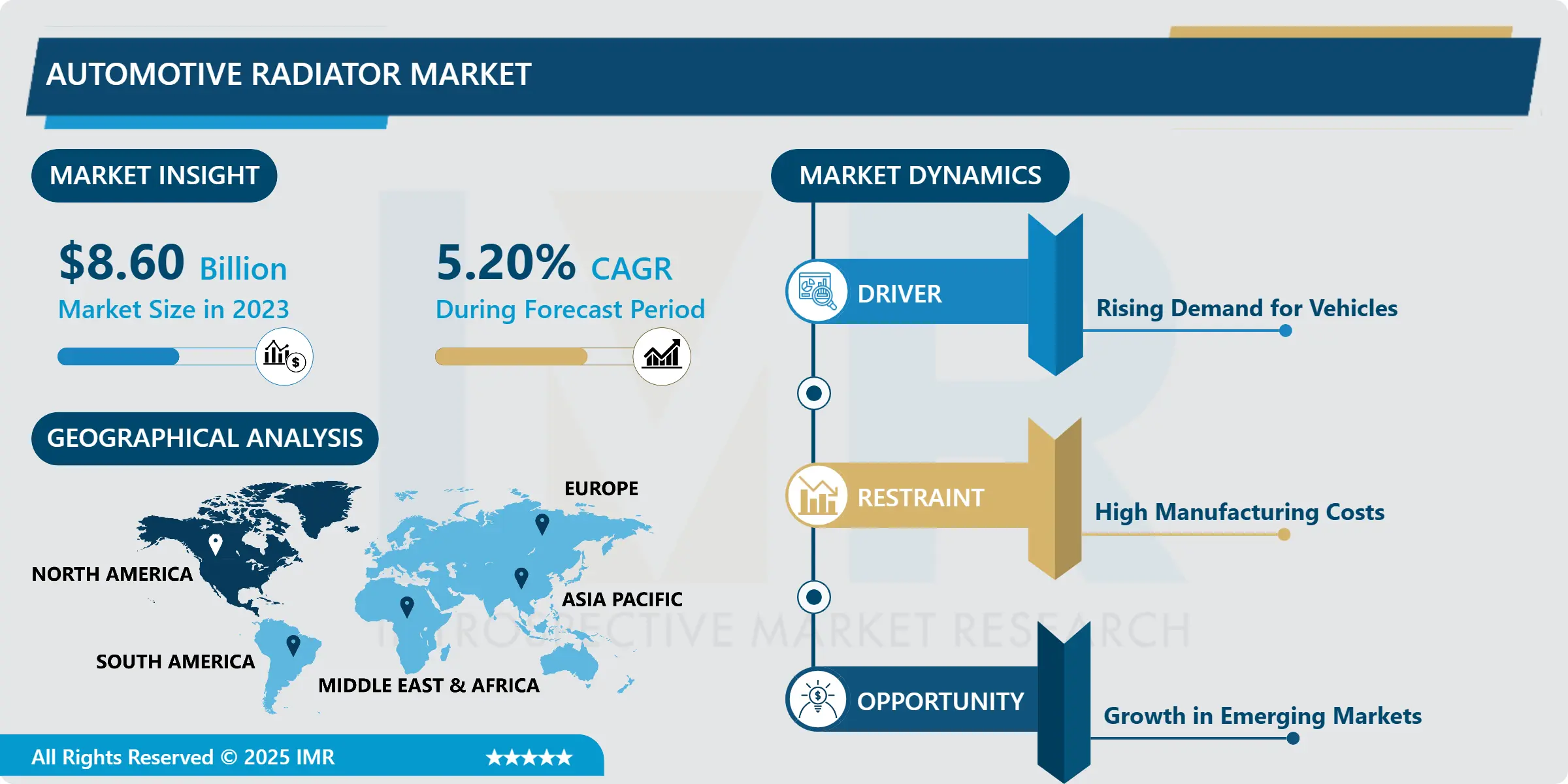
Automotive Radiator Market Trend Analysis:
Efficiency, Sustainability, and EV Integration
- A current trend in the automotive radiator market is that consumers require advanced and eco-friendly products. With the focus on sustainability in the automotive industry and ever increasing environmental standards being implemented across various car makers the drive towards improving the radiator consistently and reducing any negative environmental effect is one that has been driven by the manufacturers. This includes the following; technology of superior materials in the heat dissipation process and reduced power usage. Moreover, the increase in demand to reduce effects of climate change through car emissions is pushing for use of light-materials and technology that enhances cooling required for better vehicle performance and more fuel efficiency not forgetting low emissions.
- Except for conventional vehicle uses, the emergence of electric vehicles has added needs when it comes to radiators such as battery cooler-radiators. EV batteries create a lot of heat when in use, thus requiring coolants that provide efficient service and safety. This has put pressure on car makers and fashioners to improve on the design of the radiator using various materials such as aluminum and composites. This offers a greater thermal conducting material with low weight within the component, which is vital for enhancing the efficiency of EVs. This change to more focused EV radiator developments is driving evolutional research and improvements as companies move to develop specific solutions for the cooling needs of electric vehicles.
Automotive Radiator Market Driven by Electric and Hybrid Vehicles
- The growing popularity of EVs are a major opportunity for the automotive radiator market, as EVs have a different cooling system, when compared to ICE vehicles. While ICE vehicles mostly demand cooling for the engine only, EVs demand unique cooling methods for the high potentage batteries and electric drive systems. This transition to EVs and hybrids is in turn increasing the need to find new types of cooling to improve heat transfer, prolong battery life, and increase vehicle lifetime. Consequently, vendor of radiators receive an opportunity to design new technologies for such specific needs and thus have the capacity to meet new requirements of electric vehicles market.
- Other opportunities: Developments in aluminum and other lighter materials, as well as advanced composites, add more support to radiator makers in this promising new setting. Such materials are not only being useful in the reduction of the mass of radiators, which is pivotal in the increase of vehicle efficiency as well as range but also in the increase of the general performance of the cooling systems. The automotive manufacturers can use these materials to develop radiator that is competitive in price as well as performance packed to meet the next generation automobiles. The automotive radiator market is expected to witness growth driven by rising global concern for fuel efficiency, battery durability, and environmental concerns as auto manufacturers across electric and hybrid vehicles seek cooling solutions.
Automotive Radiator Market Segment Analysis:
Automotive Radiator Market Segmented on the basis of Radiator Type, Material Type, Vehicle Type, and Region.
By Radiator Type, Down Flow segment is expected to dominate the market during the forecast period
- Down flow radiators are especially familiar for using the efficacious and straightforward concept in automobile cooling system. This kind of a radiator distributes coolant from top to bottom of the radiator with cooling fins through which the heat can be released. The hot is circulated downwards in which case it is cooled as it radiates heat to the surrounding air with assistance of the vehicles movement or a fan. This is because the design makes provision for an effective heat exchange which enables the engine to be cooked to the required temperatures. Down flow radiators are used extensively in some older models and some current models in which space is a constraint and simplicity is the order of the day. And so they remain a perennial favourite in some volkswagen car market segments due to the fact that they are easy on the pocket.
- That is why even with a large number of radiator models with improved design, the global market for down flow radiators remains stable thanks to their reliability and relatively low cost. These radiators are most commonly found in inexpensive, and also, older models, where the major priority is the functionality rather than the innovation. Although the cross flow types are gradually being incorporated in the newer vehicles because of the superior performance, the down flow types have not lost their utility among the manufactures, especially in the regions where cheap production of cars is still in vogue. This steady demand is due the fact that down flow radiators remain relevant when it comes to the fundamental cooling of several different models of vehicles.
By Vehicle Type, Heavy Commercial Vehicle (HCV) segment expected to held the largest share
- Radiators are crucial components in heavy commercial vehicle (HCV) where HCV managing high temperatures needed to be kept within operating range under conditions of load and demand. Trucks sometimes have more horsepower than cars, buses, and large freight cars that are having large engines which need the cooling capacity. Therefore, durability, efficiency and capacity are mounting points of concern regarding the radiators in this segment. Copper/brass radiators are preferred because are very durable and provide high reliability under adverse working conditions. These materials promote superior heat transfer and are rated to tackle challenging duties, well suited to heavy commercial vehicles.
- But at the moment, the aluminum/plastic radiators are slowly making their way to the HCV market because they are light, inexpensive and do not decrease heat dissipation. These radiators offer a well-reasoned compromise which while effective for heat dissipation also presents a solution for how to decrease the overall weight of a vehicle, which is paramount to increasing fuel economy. Due to the recent changes in emissions regulations and fuel efficiency standards, HCV manufacturers are increasingly embracing more enhanced cooling systems that minor in those light materials. In this respect, the need for such high-performance radiators remains persistently on an upward trend with both the conventional copper/brass and the new generation aluminium/plastic radiators now fulfilling the metamorphosis well sought out by the heavy commercial vehicle market.
Automotive Radiator Market Regional Insights:
North America is Expected to Dominate the Market Over the Forecast period
- Automotive radiator market is very prominent in North America due to increased demand for automotive vehicles and also well-developed automotive industry across United States and Canada. Both countries have enormous numbers of automobile production stakeholders including automobile manufacturers and a population that prefers new fashionable automobiles. This demand is supported by the region’s propensity to embrace technological change in automotive innovation. Since new vehicle technologies come up and with car makers opting for electric and hybrid vehicles the thermal management systems have been call for. Radiators which are used heavily within car cooling systems are being redesigned in order to cater for these newer forms of car types, where standard cooling options may not be suitable. The enduring trend and development of vehicle performance and the constant monitoring of the temperature of the engines create requirements for renewed kinds of radiators.
- Further, vehicle electrification is also driving the need for radiators for electric and hybrid cars as these have unprecedented powertrain and battery systems that have called for new approaches to cooling. As well, with reduction of emission levels and increasing the fuel efficiency standards increasing the demand for more efficient, durable and sustainable radiators to manufacture. Trends in environmentally conscious designs act as a precursor to the advancement of the radiator technologies; for instance lightweight high performant materials that meet these criteria and are also considered sustainable in automotive applications. Consequently, the North American market for automotive radiators is expanding rapidly owing to innovation in car manufacturing technology and the subsequent regulatory standards for improvement of auto-cooling systems.
Active Key Players in the Automotive Radiator Market:
- Anhui Fengyang Radiator Co. Ltd.,
- Behr GmbH & Co.KG.,
- Calsonic Kansei Corp.,
- Delphi Automotive plc,
- Denso Corporation,
- Dongfeng Radiator Co. Ltd.,
- Faret International Holdings Limited,
- Guangdong Faret Auto Radiator Co. Ltd.,
- Joint Radiator Factory, Keihin Corp.,
- Modine Manufacturing Co.,
- Sanden Corp. and Yonghong Radiator Company,
- Shandong Houfeng Group,
- Tianjin Auto radiator Co. Ltd.,
- Valeo SA,
- Visteon Corp
- Other Active Players
|
Automotive Radiator Market |
|||
|
Base Year: |
2023 |
Forecast Period: |
2024-2032 |
|
Historical Data: |
2017 to 2023 |
Market Size in 2023: |
USD 8.60 Billion |
|
Forecast Period 2024-32 CAGR: |
5.20% |
Market Size in 2032: |
USD 13.57 Billion |
|
Segments Covered: |
By Radiator Type |
|
|
|
By Material Type |
|
||
|
By Vehicle Type |
|
||
|
By Region |
|
||
|
Key Market Drivers: |
|
||
|
Key Market Restraints: |
|
||
|
Key Opportunities: |
|
||
|
Companies Covered in the report: |
|
||
Chapter 1: Introduction
1.1 Scope and Coverage
Chapter 2:Executive Summary
Chapter 3: Market Landscape
3.1 Market Dynamics
3.1.1 Drivers
3.1.2 Restraints
3.1.3 Opportunities
3.1.4 Challenges
3.2 Market Trend Analysis
3.3 PESTLE Analysis
3.4 Porter's Five Forces Analysis
3.5 Industry Value Chain Analysis
3.6 Ecosystem
3.7 Regulatory Landscape
3.8 Price Trend Analysis
3.9 Patent Analysis
3.10 Technology Evolution
3.11 Investment Pockets
3.12 Import-Export Analysis
Chapter 4: Automotive Radiator Market by Radiator Type
4.1 Automotive Radiator Market Snapshot and Growth Engine
4.2 Automotive Radiator Market Overview
4.3 Down Flow and Cross Flow
4.3.1 Introduction and Market Overview
4.3.2 Historic and Forecasted Market Size in Value USD and Volume Units (2017-2032F)
4.3.3 Key Market Trends, Growth Factors and Opportunities
4.3.4 Down Flow and Cross Flow: Geographic Segmentation Analysis
Chapter 5: Automotive Radiator Market by Material Type
5.1 Automotive Radiator Market Snapshot and Growth Engine
5.2 Automotive Radiator Market Overview
5.3 Copper/Brass
5.3.1 Introduction and Market Overview
5.3.2 Historic and Forecasted Market Size in Value USD and Volume Units (2017-2032F)
5.3.3 Key Market Trends, Growth Factors and Opportunities
5.3.4 Copper/Brass: Geographic Segmentation Analysis
5.4 Aluminum/Plastic
5.4.1 Introduction and Market Overview
5.4.2 Historic and Forecasted Market Size in Value USD and Volume Units (2017-2032F)
5.4.3 Key Market Trends, Growth Factors and Opportunities
5.4.4 Aluminum/Plastic: Geographic Segmentation Analysis
5.5 and Aluminum
5.5.1 Introduction and Market Overview
5.5.2 Historic and Forecasted Market Size in Value USD and Volume Units (2017-2032F)
5.5.3 Key Market Trends, Growth Factors and Opportunities
5.5.4 and Aluminum: Geographic Segmentation Analysis
Chapter 6: Automotive Radiator Market by Vehicle Type
6.1 Automotive Radiator Market Snapshot and Growth Engine
6.2 Automotive Radiator Market Overview
6.3 Passenger Car
6.3.1 Introduction and Market Overview
6.3.2 Historic and Forecasted Market Size in Value USD and Volume Units (2017-2032F)
6.3.3 Key Market Trends, Growth Factors and Opportunities
6.3.4 Passenger Car: Geographic Segmentation Analysis
6.4 Light Commercial Vehicle (LCV)
6.4.1 Introduction and Market Overview
6.4.2 Historic and Forecasted Market Size in Value USD and Volume Units (2017-2032F)
6.4.3 Key Market Trends, Growth Factors and Opportunities
6.4.4 Light Commercial Vehicle (LCV): Geographic Segmentation Analysis
6.5 Heavy Commercial Vehicle (HCV).
6.5.1 Introduction and Market Overview
6.5.2 Historic and Forecasted Market Size in Value USD and Volume Units (2017-2032F)
6.5.3 Key Market Trends, Growth Factors and Opportunities
6.5.4 Heavy Commercial Vehicle (HCV). : Geographic Segmentation Analysis
Chapter 7: Company Profiles and Competitive Analysis
7.1 Competitive Landscape
7.1.1 Competitive Benchmarking
7.1.2 Automotive Radiator Market Share by Manufacturer (2023)
7.1.3 Industry BCG Matrix
7.1.4 Heat Map Analysis
7.1.5 Mergers and Acquisitions
7.2 ANHUI FENGYANG RADIATOR CO. LTD.
7.2.1 Company Overview
7.2.2 Key Executives
7.2.3 Company Snapshot
7.2.4 Role of the Company in the Market
7.2.5 Sustainability and Social Responsibility
7.2.6 Operating Business Segments
7.2.7 Product Portfolio
7.2.8 Business Performance
7.2.9 Key Strategic Moves and Recent Developments
7.2.10 SWOT Analysis
7.3 BEHR GMBH & CO.KG.
7.4 CALSONIC KANSEI CORP.
7.5 DELPHI AUTOMOTIVE PLC
7.6 DENSO CORPORATION
7.7 DONGFENG RADIATOR CO. LTD.
7.8 FARET INTERNATIONAL HOLDINGS LIMITED
7.9 GUANGDONG FARET AUTO RADIATOR CO. LTD.
7.10 JOINT RADIATOR FACTORY
7.11 KEIHIN CORP.
7.12 MODINE MANUFACTURING CO.
7.13 SANDEN CORP. AND YONGHONG RADIATOR COMPANY
7.14 SHANDONG HOUFENG GROUP
7.15 TIANJIN AUTO RADIATOR CO. LTD.
7.16 VALEO SA
7.17 AND VISTEON CORP
7.18 OTHER ACTIVE PLAYERS
Chapter 8: Global Automotive Radiator Market By Region
8.1 Overview
8.2. North America Automotive Radiator Market
8.2.1 Key Market Trends, Growth Factors and Opportunities
8.2.2 Top Key Companies
8.2.3 Historic and Forecasted Market Size by Segments
8.2.4 Historic and Forecasted Market Size By Radiator Type
8.2.4.1 Down Flow and Cross Flow
8.2.5 Historic and Forecasted Market Size By Material Type
8.2.5.1 Copper/Brass
8.2.5.2 Aluminum/Plastic
8.2.5.3 and Aluminum
8.2.6 Historic and Forecasted Market Size By Vehicle Type
8.2.6.1 Passenger Car
8.2.6.2 Light Commercial Vehicle (LCV)
8.2.6.3 Heavy Commercial Vehicle (HCV).
8.2.7 Historic and Forecast Market Size by Country
8.2.7.1 US
8.2.7.2 Canada
8.2.7.3 Mexico
8.3. Eastern Europe Automotive Radiator Market
8.3.1 Key Market Trends, Growth Factors and Opportunities
8.3.2 Top Key Companies
8.3.3 Historic and Forecasted Market Size by Segments
8.3.4 Historic and Forecasted Market Size By Radiator Type
8.3.4.1 Down Flow and Cross Flow
8.3.5 Historic and Forecasted Market Size By Material Type
8.3.5.1 Copper/Brass
8.3.5.2 Aluminum/Plastic
8.3.5.3 and Aluminum
8.3.6 Historic and Forecasted Market Size By Vehicle Type
8.3.6.1 Passenger Car
8.3.6.2 Light Commercial Vehicle (LCV)
8.3.6.3 Heavy Commercial Vehicle (HCV).
8.3.7 Historic and Forecast Market Size by Country
8.3.7.1 Bulgaria
8.3.7.2 The Czech Republic
8.3.7.3 Hungary
8.3.7.4 Poland
8.3.7.5 Romania
8.3.7.6 Rest of Eastern Europe
8.4. Western Europe Automotive Radiator Market
8.4.1 Key Market Trends, Growth Factors and Opportunities
8.4.2 Top Key Companies
8.4.3 Historic and Forecasted Market Size by Segments
8.4.4 Historic and Forecasted Market Size By Radiator Type
8.4.4.1 Down Flow and Cross Flow
8.4.5 Historic and Forecasted Market Size By Material Type
8.4.5.1 Copper/Brass
8.4.5.2 Aluminum/Plastic
8.4.5.3 and Aluminum
8.4.6 Historic and Forecasted Market Size By Vehicle Type
8.4.6.1 Passenger Car
8.4.6.2 Light Commercial Vehicle (LCV)
8.4.6.3 Heavy Commercial Vehicle (HCV).
8.4.7 Historic and Forecast Market Size by Country
8.4.7.1 Germany
8.4.7.2 UK
8.4.7.3 France
8.4.7.4 Netherlands
8.4.7.5 Italy
8.4.7.6 Russia
8.4.7.7 Spain
8.4.7.8 Rest of Western Europe
8.5. Asia Pacific Automotive Radiator Market
8.5.1 Key Market Trends, Growth Factors and Opportunities
8.5.2 Top Key Companies
8.5.3 Historic and Forecasted Market Size by Segments
8.5.4 Historic and Forecasted Market Size By Radiator Type
8.5.4.1 Down Flow and Cross Flow
8.5.5 Historic and Forecasted Market Size By Material Type
8.5.5.1 Copper/Brass
8.5.5.2 Aluminum/Plastic
8.5.5.3 and Aluminum
8.5.6 Historic and Forecasted Market Size By Vehicle Type
8.5.6.1 Passenger Car
8.5.6.2 Light Commercial Vehicle (LCV)
8.5.6.3 Heavy Commercial Vehicle (HCV).
8.5.7 Historic and Forecast Market Size by Country
8.5.7.1 China
8.5.7.2 India
8.5.7.3 Japan
8.5.7.4 South Korea
8.5.7.5 Malaysia
8.5.7.6 Thailand
8.5.7.7 Vietnam
8.5.7.8 The Philippines
8.5.7.9 Australia
8.5.7.10 New Zealand
8.5.7.11 Rest of APAC
8.6. Middle East & Africa Automotive Radiator Market
8.6.1 Key Market Trends, Growth Factors and Opportunities
8.6.2 Top Key Companies
8.6.3 Historic and Forecasted Market Size by Segments
8.6.4 Historic and Forecasted Market Size By Radiator Type
8.6.4.1 Down Flow and Cross Flow
8.6.5 Historic and Forecasted Market Size By Material Type
8.6.5.1 Copper/Brass
8.6.5.2 Aluminum/Plastic
8.6.5.3 and Aluminum
8.6.6 Historic and Forecasted Market Size By Vehicle Type
8.6.6.1 Passenger Car
8.6.6.2 Light Commercial Vehicle (LCV)
8.6.6.3 Heavy Commercial Vehicle (HCV).
8.6.7 Historic and Forecast Market Size by Country
8.6.7.1 Turkey
8.6.7.2 Bahrain
8.6.7.3 Kuwait
8.6.7.4 Saudi Arabia
8.6.7.5 Qatar
8.6.7.6 UAE
8.6.7.7 Israel
8.6.7.8 South Africa
8.7. South America Automotive Radiator Market
8.7.1 Key Market Trends, Growth Factors and Opportunities
8.7.2 Top Key Companies
8.7.3 Historic and Forecasted Market Size by Segments
8.7.4 Historic and Forecasted Market Size By Radiator Type
8.7.4.1 Down Flow and Cross Flow
8.7.5 Historic and Forecasted Market Size By Material Type
8.7.5.1 Copper/Brass
8.7.5.2 Aluminum/Plastic
8.7.5.3 and Aluminum
8.7.6 Historic and Forecasted Market Size By Vehicle Type
8.7.6.1 Passenger Car
8.7.6.2 Light Commercial Vehicle (LCV)
8.7.6.3 Heavy Commercial Vehicle (HCV).
8.7.7 Historic and Forecast Market Size by Country
8.7.7.1 Brazil
8.7.7.2 Argentina
8.7.7.3 Rest of SA
Chapter 9 Analyst Viewpoint and Conclusion
9.1 Recommendations and Concluding Analysis
9.2 Potential Market Strategies
Chapter 10 Research Methodology
10.1 Research Process
10.2 Primary Research
10.3 Secondary Research
|
Automotive Radiator Market |
|||
|
Base Year: |
2023 |
Forecast Period: |
2024-2032 |
|
Historical Data: |
2017 to 2023 |
Market Size in 2023: |
USD 8.60 Billion |
|
Forecast Period 2024-32 CAGR: |
5.20% |
Market Size in 2032: |
USD 13.57 Billion |
|
Segments Covered: |
By Radiator Type |
|
|
|
By Material Type |
|
||
|
By Vehicle Type |
|
||
|
By Region |
|
||
|
Key Market Drivers: |
|
||
|
Key Market Restraints: |
|
||
|
Key Opportunities: |
|
||
|
Companies Covered in the report: |
|
||