




Poultry Anticoccodial Drugs Market Synopsis:
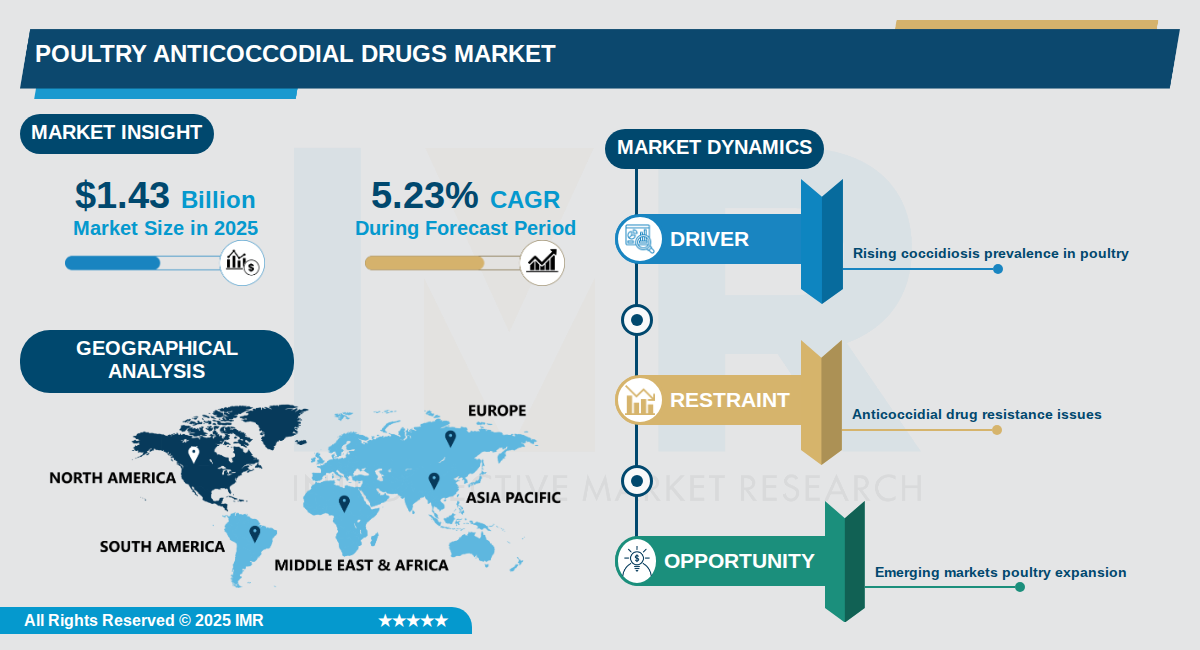
Poultry Anticoccodial Drugs Market Size Was Valued at USD 1.43 Billion in 2025, and is Projected to Reach USD 2.38 Billion by 2035, Growing at a CAGR of 5.23% From 2025-2035.
The Poultry Anticoccidial Drugs Market is estimated at $1.43 billion in 2025 and is projected to reach $2.38 billion by 2035, growing at a compound annual growth rate (CAGR) of 5.23%. This market encompasses medications designed to prevent and treat coccidiosis, a parasitic disease caused by Eimeria protozoans that significantly impacts poultry health and productivity. North America currently holds the largest market share due to advanced poultry production systems and proactive adoption of anticoccidial strategies.
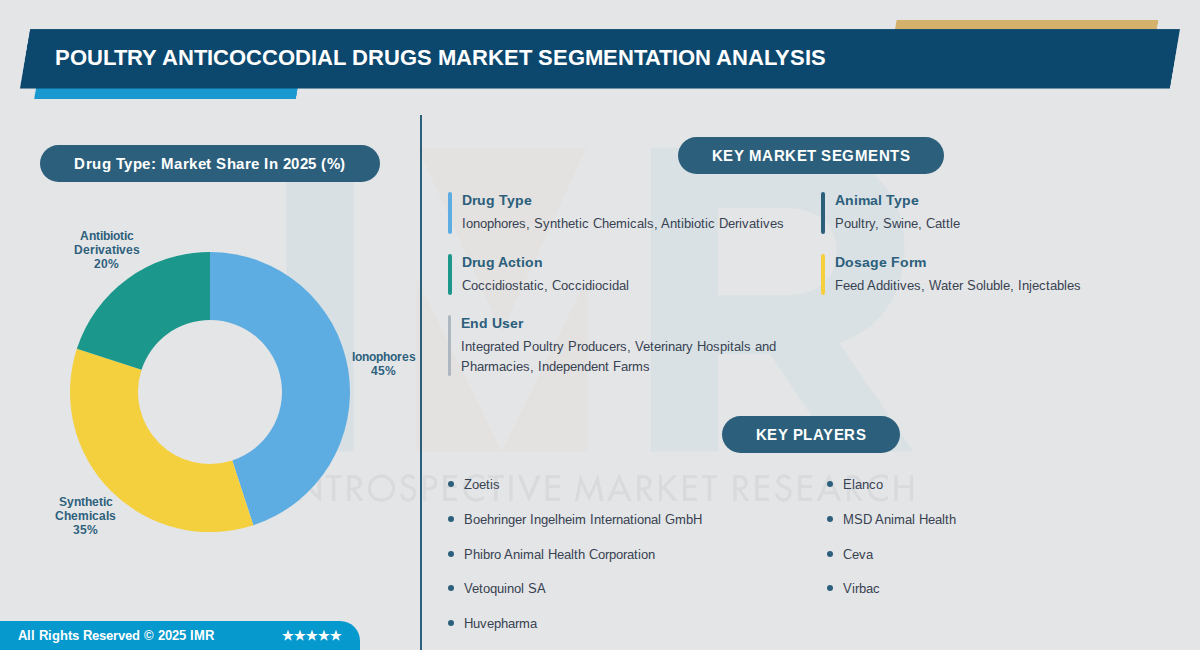
Ionophores dominate the market with over 51% share in 2025, valued for their cost-effectiveness, broad-spectrum activity, and slower resistance development backed by decades of field data. Other segments include antibiotics, sulfonamides, biologics, and emerging botanicals, which are growing fastest at a 7.18% CAGR driven by demand for residue-free poultry. Key players such as Elanco, Zoetis, Merck Animal Health, and Boehringer Ingelheim compete through innovations, regional launches, and partnerships.
Asia-Pacific is the fastest-growing region, fueled by rapid industrialization of poultry farming in countries like China, India, Brazil, and Southeast Asia, where poultry production is expanding at 3-7% annually. Europe faces constraints from regulatory bans on certain synthetics, while North America leads with sophisticated rotation programs and biosecurity measures. The market is moderately concentrated, with distribution through veterinary clinics, hospitals, and pharmacies.
Poultry Anticoccodial Drugs Market Trend Analysis:
Shift to Botanical and Phytogenic Alternatives
- Botanical anticoccidials are growing at a 7.18% CAGR, outpacing all other classes due to consumer demand for residue-free poultry and regulators tightening antimicrobial feed additives. Companies like Chr. Hansen Holding A/S and Kemin Industries are leading with phytogenic blends that reduce chemical residues while maintaining efficacy against coccidiosis. North American producers adopt these ahead of other regions through rotation programs, ensuring slower resistance buildup.
- In Europe, stringent antimicrobial-use restrictions are accelerating the pivot to botanical blends, with suppliers documenting residue-free status to secure premium shelf placement for brands like residue-free chicken from integrators. This trend foreshadows global standards, as European validation becomes essential for export molecules from firms like Phibro Animal Health. Vaccination protocols combined with botanicals are replacing traditional synthetics, boosting flock health without antibiotics.
- South America sees multinationals like Elanco Animal Health localizing premix facilities in Brazil to blend botanicals with ionophores, shortening lead times amid currency volatility. This hybrid approach addresses patchy cold-chain issues while meeting rising demand for sustainable poultry production.
Development of Hybrid Synthetic-Natural Formulations
- Manufacturers are creating hybrid feed additives combining synthetic ionophores with natural phytogenics to comply with EU bans on certain chemicals while preserving efficacy. Elanco Animal Health, Zoetis, and Merck Animal Health invest heavily in R&D for these blends, addressing drug-resistant coccidia strains that threaten 3% annual poultry production growth. Ionophores hold 51.78% market share in 2025 for their cost-effectiveness and broad-spectrum activity.
- Huvepharma's August 2024 FDA approval of COXIDIN 90 (monensin) Type C medicated feeds exemplifies innovation, preventing coccidiosis in broiler chickens, laying hens, and breeders across North America. These hybrids support large-scale programs with half a century of field data, minimizing resistance compared to pure synthetics. Producers integrate them into preventive-health protocols amid tightening biosecurity.
- Asia-Pacific modern farms in China and India adopt precision delivery systems for hybrids, countering heat stress with immune-modulating additives from Japanese and South Korean innovators like Vetoquinol SA.
Expansion in Emerging Poultry Markets
- Asia-Pacific leads as the fastest-growing region with 5-7% annual anticoccidial adoption in Brazil, China, and India, driven by industrialized poultry scaling and 3% global production rise. Local generic producers create pricing pressures, while integrators in Southeast Asia rely on synthetics for modern farms versus traditional remedies for smallholders. North America dominates overall but emerging markets capture rising shares through multinationals siting facilities.
- South America and Middle East & Africa boost demand as poultry integrators expand, with Phibro Animal Health and Impextraco localizing packaging in Brazil and South Africa to navigate cold-chain gaps. Currency volatility slows premium uptake, but poultry meat and egg consumption surges necessitate coccidiosis control. Gulf facilities shorten lead times for 349 million USD feed anticoccidials market by 2034.
Poultry Anticoccodial Drugs Market Segment Analysis:
Poultry Anticoccodial Drugs Market is Segmented on the basis of By Drug Type, By Animal Type, By Drug Action
By Drug Type, Ionophores segment is expected to dominate the market during the forecast period
- Ionophores dominate due to their broad-spectrum efficacy against Eimeria species prevalent in poultry and cost-effectiveness in large-scale broiler production.
- They are extensively used in rotation programs to combat resistance, with over 70% of global poultry operations relying on ionophore-based feed additives.
By Animal Type, Poultry segment is expected to dominate the market during the forecast period
- Poultry leads overwhelmingly due to massive global production volumes and high coccidiosis incidence in intensive broiler and layer farming systems.
- Annual economic losses from avian coccidiosis exceed $12 billion, driving consistent demand for anticoccidials in chickens, turkeys, and layers.
By Drug Action, Coccidiostatic segment is expected to dominate the market during the forecast period
- Coccidiostatic drugs dominate as they prevent coccidia multiplication in early stages, ideal for prophylactic use in high-density poultry environments.
- Their sustained release in feed supports long-term control in broiler cycles, preferred over curative coccidiocidal options for economic efficiency.
By Dosage Form, Feed Additives segment is expected to dominate the market during the forecast period
- Feed additives lead due to seamless integration into automated poultry feeding systems, ensuring uniform drug distribution across flocks.
- They enable precise dosing in intensive farming, minimizing labor costs and supporting 24/7 prophylaxis in broiler operations.
By End User, Integrated Poultry Producers segment is expected to dominate the market during the forecast period
- Integrated producers dominate with vertically controlled supply chains, enabling optimized anticoccidial rotation and resistance monitoring programs.
- Major players like Tyson and BRF invest in in-house testing and customized drug protocols for export compliance and productivity.
Poultry Anticoccodial Drugs Market Regional Insights:
North America is Expected to Dominate the Market Over the Forecast Period
- North America dominates the Poultry Anticoccidial Drugs Market, holding the largest market share in 2025, primarily driven by the United States, Canada, and Mexico. The region faces high prevalence of coccidiosis in poultry, causing significant economic losses from reduced productivity and mortality. This drives strong demand for effective anticoccidial treatments across large-scale poultry operations.
- Advanced infrastructure supports industrialized poultry production, with government programs providing financial aid for modern disease management. For example, Canada's March 2024 funding initiative allocated up to USD 1.7 million for livestock health, enhancing accessibility for small and medium producers. Strict regulations ensure high-quality drug adoption, bolstering market growth.
- Major players like Elanco Animal Health, Zoetis, and Merck Animal Health have a strong presence, investing in innovative ionophore and synthetic formulations. Recent developments focus on addressing resistance through rotation programs and natural alternatives. North America's mature market benefits from these companies' R&D, maintaining its leadership position.
Active Key Players in the Poultry Anticoccodial Drugs Market:
- Zoetis (USA)
- Elanco (USA)
- Boehringer Ingelheim International GmbH (Germany)
- MSD Animal Health (USA)
- Phibro Animal Health Corporation (USA)
- Ceva (France)
- Vetoquinol SA (France)
- Virbac (France)
- Huvepharma (Bulgaria)
- HIPRA (Spain)
- Impextraco NV (Belgium)
- Biochem Pharma (Belgium)
- Bayer AG (Germany)
- Merck Animal Health (USA)
- Kemin Industries (USA)
- Chr. Hansen Holding A/S (Denmark)
- Nutreco NV (Netherlands)
- Dosh Pharmaceuticals Private Limited (India)
- Other Active Players
|
Poultry Anticoccodial Drugs Market |
|||
|
Base Year: |
2025 |
Forecast Period: |
2025-2035 |
|
Historical Data: |
2018 to 2025 |
Market Size in 2025: |
USD 1.43 Billion |
|
Forecast Period 2025-2035 CAGR: |
5.23 % |
Market Size in 2035: |
USD 2.38 Billion |
|
Segments Covered: |
By Drug Type |
|
|
|
By Animal Type |
|
||
|
By Drug Action |
|
||
|
By Dosage Form |
|
||
|
By End User |
|
||
|
By Region |
|
||
|
Key Market Drivers: |
|
||
|
Key Market Restraints: |
|
||
|
Key Opportunities: |
|
||
|
Companies Covered in the report: |
|
||
Chapter 1: Introduction
1.1 Scope and Coverage
Chapter 2: Executive Summary
Chapter 3: Market Landscape
3.1 Market Dynamics and Opportunity Analysis
3.1.1 Growth Drivers
3.1.2 Limiting Factors
3.1.3 Growth Opportunities
3.1.4 Challenges and Risks
3.2 Market Trend Analysis
3.3 Industry Ecosystem
3.4 Industry Value Chain Mapping
3.5 Strategic PESTLE Overview
3.6 Porter's Five Forces Framework
3.7 Regulatory Framework
3.8 Pricing Trend Analysis
3.9 Intellectual Property Review
3.10 Technology Evolution
3.11 Import-Export Analysis
3.12 Consumer Behavior Analysis
3.13 Investment Pocket Analysis
3.14 Go-To Market Strategy
Chapter 4: Poultry Anticoccodial Drugs Market by Drug Type (2018-2035)
4.1 Poultry Anticoccodial Drugs Market Snapshot and Growth Engine
4.2 Market Overview
4.3 Ionophores
4.3.1 Introduction and Market Overview
4.3.2 Historic and Forecasted Market Size in Value USD and Volume Units
4.3.3 Key Market Trends, Growth Factors, and Opportunities
4.3.4 Geographic Segmentation Analysis
4.4 Synthetic Chemicals
4.5 Antibiotic Derivatives
Chapter 5: Poultry Anticoccodial Drugs Market by Animal Type (2018-2035)
5.1 Poultry Anticoccodial Drugs Market Snapshot and Growth Engine
5.2 Market Overview
5.3 Poultry
5.3.1 Introduction and Market Overview
5.3.2 Historic and Forecasted Market Size in Value USD and Volume Units
5.3.3 Key Market Trends, Growth Factors, and Opportunities
5.3.4 Geographic Segmentation Analysis
5.4 Swine
5.5 Cattle
Chapter 6: Poultry Anticoccodial Drugs Market by Drug Action (2018-2035)
6.1 Poultry Anticoccodial Drugs Market Snapshot and Growth Engine
6.2 Market Overview
6.3 Coccidiostatic
6.3.1 Introduction and Market Overview
6.3.2 Historic and Forecasted Market Size in Value USD and Volume Units
6.3.3 Key Market Trends, Growth Factors, and Opportunities
6.3.4 Geographic Segmentation Analysis
6.4 Coccidiocidal
Chapter 7: Poultry Anticoccodial Drugs Market by Dosage Form (2018-2035)
7.1 Poultry Anticoccodial Drugs Market Snapshot and Growth Engine
7.2 Market Overview
7.3 Feed Additives
7.3.1 Introduction and Market Overview
7.3.2 Historic and Forecasted Market Size in Value USD and Volume Units
7.3.3 Key Market Trends, Growth Factors, and Opportunities
7.3.4 Geographic Segmentation Analysis
7.4 Water Soluble
7.5 Injectables
Chapter 8: Poultry Anticoccodial Drugs Market by End User (2018-2035)
8.1 Poultry Anticoccodial Drugs Market Snapshot and Growth Engine
8.2 Market Overview
8.3 Integrated Poultry Producers
8.3.1 Introduction and Market Overview
8.3.2 Historic and Forecasted Market Size in Value USD and Volume Units
8.3.3 Key Market Trends, Growth Factors, and Opportunities
8.3.4 Geographic Segmentation Analysis
8.4 Veterinary Hospitals and Pharmacies
8.5 Independent Farms
Chapter 9: Company Profiles and Competitive Analysis
9.1 Competitive Landscape
9.1.1 Competitive Benchmarking
9.1.2 Poultry Anticoccodial Drugs Market Share by Manufacturer/Service Provider (2025)
9.1.3 Industry BCG Matrix
9.1.4 Partnerships, Mergers & Acquisitions
9.2 ZOETIS
9.2.1 Company Overview
9.2.2 Key Executives
9.2.3 Company Snapshot
9.2.4 Role of the Company in the Market
9.2.5 Sustainability and Social Responsibility
9.2.6 Operating Business Segments
9.2.7 Product Portfolio
9.2.8 Business Performance
9.2.9 Recent News & Developments
9.2.10 SWOT Analysis
9.3 ELANCO
9.4 BOEHRINGER INGELHEIM INTERNATIONAL GMBH
9.5 MSD ANIMAL HEALTH
9.6 PHIBRO ANIMAL HEALTH CORPORATION
9.7 CEVA
9.8 VETOQUINOL SA
9.9 VIRBAC
9.10 HUVEPHARMA
9.11 HIPRA
9.12 IMPEXTRACO NV
9.13 BIOCHEM PHARMA
9.14 BAYER AG
9.15 MERCK ANIMAL HEALTH
9.16 KEMIN INDUSTRIES
9.17 CHR. HANSEN HOLDING A/S
9.18 NUTRECO NV
9.19 DOSH PHARMACEUTICALS PRIVATE LIMITED
Chapter 10: Global Poultry Anticoccodial Drugs Market By Region
10.1 Overview
10.2. North America Poultry Anticoccodial Drugs Market
10.2.1 Key Market Trends, Growth Factors and Opportunities
10.2.2 Top Key Companies
10.2.3 Historic and Forecasted Market Size by Segments
10.2.4 Historic and Forecast Market Size by Country
10.3. Eastern Europe Poultry Anticoccodial Drugs Market
10.3.1 Key Market Trends, Growth Factors and Opportunities
10.3.2 Top Key Companies
10.3.3 Historic and Forecasted Market Size by Segments
10.3.4 Historic and Forecast Market Size by Country
10.4. Western Europe Poultry Anticoccodial Drugs Market
10.4.1 Key Market Trends, Growth Factors and Opportunities
10.4.2 Top Key Companies
10.4.3 Historic and Forecasted Market Size by Segments
10.4.4 Historic and Forecast Market Size by Country
10.5. Asia Pacific Poultry Anticoccodial Drugs Market
10.5.1 Key Market Trends, Growth Factors and Opportunities
10.5.2 Top Key Companies
10.5.3 Historic and Forecasted Market Size by Segments
10.5.4 Historic and Forecast Market Size by Country
10.6. Middle East & Africa Poultry Anticoccodial Drugs Market
10.6.1 Key Market Trends, Growth Factors and Opportunities
10.6.2 Top Key Companies
10.6.3 Historic and Forecasted Market Size by Segments
10.6.4 Historic and Forecast Market Size by Country
10.7. South America Poultry Anticoccodial Drugs Market
10.7.1 Key Market Trends, Growth Factors and Opportunities
10.7.2 Top Key Companies
10.7.3 Historic and Forecasted Market Size by Segments
10.7.4 Historic and Forecast Market Size by Country
Chapter 11: Analyst Viewpoint and Conclusion
Chapter 12: Research Methodology
12.1 Research Process
12.2 Primary Research
12.3 Secondary Research
Chapter 13: Case Study
Chapter 14: Appendix
14.1 Sources
14.2 List of Tables and Figures
14.3 Short Forms and Citations
14.4 Assumption and Conversion
14.5 Disclaimer
|
Poultry Anticoccodial Drugs Market |
|||
|
Base Year: |
2025 |
Forecast Period: |
2025-2035 |
|
Historical Data: |
2018 to 2025 |
Market Size in 2025: |
USD 1.43 Billion |
|
Forecast Period 2025-2035 CAGR: |
5.23 % |
Market Size in 2035: |
USD 2.38 Billion |
|
Segments Covered: |
By Drug Type |
|
|
|
By Animal Type |
|
||
|
By Drug Action |
|
||
|
By Dosage Form |
|
||
|
By End User |
|
||
|
By Region |
|
||
|
Key Market Drivers: |
|
||
|
Key Market Restraints: |
|
||
|
Key Opportunities: |
|
||
|
Companies Covered in the report: |
|
||


