




Wi-Fi Range Extender Market Synopsis
Wi-Fi Range Extender Market Size Was Valued at USD 1.97 Billion in 2024 and is Projected to Reach USD 4.14 Billion by 2032, Growing at a CAGR of 9.72% From 2025-2032.
A Wi-Fi Range Extender, also known as a Wi-Fi repeater or booster, is a device designed to extend the coverage area of a wireless network. This device is particularly useful in situations where the existing Wi-Fi signal is weak or does not reach certain areas within a home or office. The primary function of a Wi-Fi Range Extender is to capture the existing Wi-Fi signal and rebroadcast it to extend the coverage range.
Wi-Fi range extenders are easy to install and typically come with user-friendly setup processes. Many models feature a simple plug-and-play design, allowing users to connect the extender to a power source and configure it through a web interface or a dedicated mobile app. Some advanced models may even support features like dual-band functionality, enabling them to operate on both the 2.4GHz and 5GHz frequency bands for improved performance.
The setup process for a Wi-Fi range extender is generally straightforward and involves connecting the device to a power source, accessing its configuration interface through a web browser, and following the provided instructions to connect it to the existing Wi-Fi network. Global home Wi-Fi router and extender market prospects are expected to be growing as a result of the exponentially growing urbanization and population of the world. The key manufacturers of residential Wi-Fi routers and extenders have been introducing new products, and protocols that are excepted to grow the market during the forecast period.
Although public Wi-Fi hotspots are a welcome service for many people, there are many concerns over the safety of information accessed over these networks. As of 2017, around 59 percent of people stated that they had logged in to a personal email account over public Wi-Fi, while 56 percent stated that they had logged in to their social media accounts.
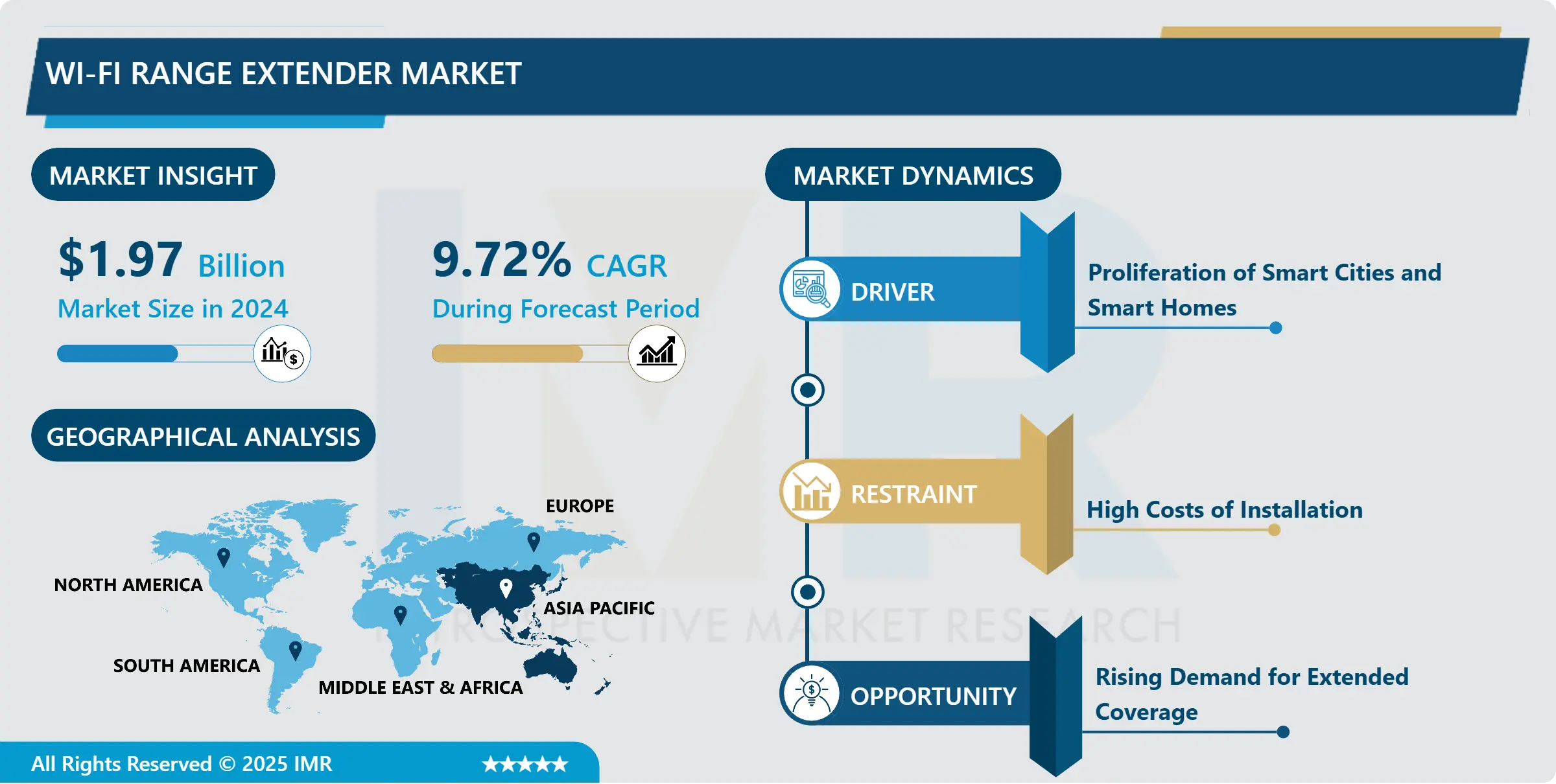

Wi-Fi Range Extender Market Trend Analysis
Wi-Fi Range Extender Market Driving Fators- Proliferation of Smart Cities and Smart Homes
- Smart cities leverage a network of interconnected devices and sensors to enhance the efficiency of various services, ranging from transportation and energy management to public safety and healthcare. These systems heavily rely on wireless communication, predominantly Wi-Fi, to facilitate data exchange and real-time monitoring. The deployment of Wi-Fi range extenders becomes crucial in expanding the coverage of these networks, ensuring a consistent and strong connection across diverse urban landscapes.
- Within smart homes, the adoption of Internet of Things (IoT) devices and smart appliances has surged, creating an ecosystem where various devices communicate with each other for streamlined automation and enhanced user experience. From smart thermostats and lighting systems to security cameras and entertainment devices, these technologies rely on Wi-Fi connectivity. However, the reach of a standard Wi-Fi router may be limited, especially in larger homes or those with multiple floors. Wi-Fi range extenders address this limitation by amplifying and extending the wireless signal, providing comprehensive coverage throughout the entire smart home.
- The increasing demand for Wi-Fi range extenders can also be attributed to the growing prevalence of remote work and online education. As more individuals work and study from home, the need for a reliable and extended Wi-Fi range becomes crucial to ensure uninterrupted connectivity and productivity. Smart cities leverage advanced technologies to enhance efficiency, sustainability, and the overall quality of life for residents. Central to the success of these initiatives is a reliable and pervasive Wi-Fi network
Wi-Fi Range Extender Market Opportunity- Rising Demand for Extended Coverage creates an Opportunity Wi-Fi Range Extender Market
- The rising demand for extended coverage presents significant opportunities for the Wi-Fi range extender market. As the reliance on wireless connectivity continues to grow, there is an increasing need to address coverage gaps and ensure seamless connectivity across larger areas. Wi-Fi range extenders play a crucial role in expanding the reach of existing wireless networks, catering to homes, offices, and public spaces.
- With the proliferation of smart devices, IoT (Internet of Things) applications, and the adoption of high-bandwidth activities like online streaming and gaming, users are seeking reliable and widespread Wi-Fi coverage. This demand is driving the market for Wi-Fi range extenders, as they offer a cost-effective solution to enhance and amplify existing Wi-Fi signals.
- Additionally, advancements in technology, such as the development of mesh networking and Wi-Fi 6 standards, further contribute to the growth of the range extender market. These innovations enable faster and more efficient data transmission, meeting the requirements of modern wireless communication.

Wi-Fi Range Extender Market Segment Analysis:
Wi-Fi Range Extender Market Segmented on the basis of type, Product, Standard Network, Frequency, Sales Channel, and end-users.
By Type, Indoor Wi-Fi segment is expected to dominate the market during the forecast period
- Indoor Wi-Fi segment is anticipated to assert its dominance. This projection is rooted in the increasing demand for seamless and robust wireless connectivity within enclosed spaces, driven by the proliferation of smart devices and the burgeoning trend of IoT (Internet of Things) adoption in homes and offices.
- Indoor Wi-Fi Range Extenders play a pivotal role in enhancing the coverage and strength of wireless networks within buildings, addressing challenges related to dead zones and signal degradation. The escalating need for high-speed and reliable internet connectivity, especially in urban and densely populated areas, further propels the prominence of Indoor Wi-Fi Range Extenders.
- Moreover, the surge in remote working and digital activities has intensified the reliance on strong and stable Wi-Fi signals indoors, fostering the deployment of Indoor Wi-Fi Range Extenders. As technological advancements continue to drive innovations in wireless communication, the Indoor Wi-Fi segment is poised to maintain its market dominance, offering consumers and businesses a scalable solution to optimize their indoor connectivity experience.
By Product, Extenders and Repeaters segment held the largest share in 2024
- The Extenders and Repeaters segment is anticipated to lead the market due to its versatility and effectiveness in boosting Wi-Fi range. Consumers are increasingly relying on these devices to eliminate signal gaps and enhance the overall connectivity experience. Extenders not only extend the coverage area but also contribute to improved data transfer speeds, making them a preferred choice for users seeking reliable and high-performance Wi-Fi solutions.
- The growing adoption of smart devices, IoT applications, and bandwidth-intensive activities further propels the demand for Wi-Fi range extenders. As technological advancements continue to drive innovation in this segment, the Extenders and Repeaters market is positioned for sustained growth, addressing the evolving connectivity needs of a digitally connected world. This dominance underscores the crucial role that Wi-Fi range extenders play in ensuring seamless and robust wireless communication networks.
Wi-Fi Range Extender Market Regional Insights:
Asia Pacific is Expected to Dominate the Market Over the Forecast period
- The Asia Pacific region is poised to emerge as a dominant force in the Wi-Fi Range Extender market, driven by a confluence of factors that underscore its rapid growth and adoption. With a burgeoning population, increasing urbanization, and a rising demand for seamless connectivity, the need for robust and extended Wi-Fi coverage has become paramount in the region.
- Countries like China, India, Japan, and South Korea are witnessing a surge in internet usage, fueled by the proliferation of smart devices and a growing digital economy. The demand for Wi-Fi range extenders, which enhance the reach and performance of wireless networks, is experiencing a substantial upswing.
- Government initiatives promoting digital connectivity, coupled with the expansion of telecommunications infrastructure, further catalyse the market's growth. The escalating trend of remote work, online education, and smart home applications amplifies the significance of reliable and widespread Wi-Fi coverage, positioning Wi-Fi range extenders as essential solutions.
- Market players are capitalizing on this opportunity by introducing innovative products and technologies tailored to the diverse needs of the Asia Pacific consumer base. As the region continues to embrace the digital era, the Wi-Fi range extender market is poised for sustained dominance in the dynamic landscape of the Asia Pacific.
Wi-Fi Range Extender Market Top Key Players:
- JUNIPER NETWORKS INC. (U.S.)
- RUCKUS WIRELESS INC. (U.S.)
- MOTOROLA SOLUTIONS INC. (U.S.)
- NETGEAR INC. (U.S.)
- CISCO SYSTEMS INC. (U.S.)
- LINKSYS GROUP INC. (U.S.)
- TRENDNET, INC. (U.S.)
- MIKROTIK (US.)
- UBIQUITI NETWORKS (U.S.)
- ARUBA NETWORKS (HEWLETT PACKARD ENTERPRISE DEVELOPMENT LP) (U.S.)
- BRITISH TELECOMMUNICATIONS (BT) (UNITED KINGDOM)
- AMPLIFI (NEW YORK)
- ASUS (TAIWAN)
- TENDA (CHINA)
- EDIMAX (TAIWAN)
- ZYXEL (TAIWAN)
- D-LINK CORPORATION (TAIWAN)
- TP-LINK TECHNOLOGIES CO. LTD (HONG KONG)
- WAVLINK (CHINA)
- XIAOMI (CHINA)
- SHENZHEN TENDA TECHNOLOGY CO., LTD. (CHINA)
- HUAWEI TECHNOLOGIES CO. LTD (CHINA)
- GL. INET (HONG KONG)
- NETCOMM WIRELESS (AUSTRALIA)
- Other Active Players
Key Industry Developments in the Wi-Fi Range Extender Market:
-
In April 2024, HPE Aruba Networking introduced high-capacity Wi-Fi 7 access points to improve enterprise security and address AI and IoT challenges, New Wi-Fi 7 wireless access points provide comprehensive AI-ready edge IT solutions to provide secure, high-performance user and IoT connectivity for capturing and routing data for AI training and inferencing, Hewlett Packard Enterprise launched Wi-Fi 7 access points (APs) that provide up to 30% more capacity for wireless traffic than competitive products. The new APs also strengthen network security and improve location-based services to provide connectivity for demanding enterprise AI, Internet of Things (IoT), location, and security applications.
-
In January 2023, TRENDnet, one of the global pioneers in reliable SMB and consumer networking and surveillance solutions, announced the opening of new offices in Mexico City's financial center. TRENDnet's new consolidated headquarters helps it better service partners in Mexico and other regions of Latin America.
|
Global Wi-Fi Range Extender Market |
|||
|
Base Year: |
2024 |
Forecast Period: |
2025-2032 |
|
Historical Data: |
2018 to 2023 |
Market Size in 2024: |
USD 1.97 Bn. |
|
Forecast Period 2024-32 CAGR: |
9.72% |
Market Size in 2032: |
USD 4.14 Bn. |
|
Segments Covered: |
By Type |
|
|
|
By Product |
|
||
|
By Standard Network |
|
||
|
By Frequency |
|
||
|
By Sales Channel |
|
||
|
By End User |
|
||
|
By Region |
|
||
|
Key Market Drivers: |
|
||
|
Key Market Restraints: |
|
||
|
Key Opportunities: |
|
||
|
Companies Covered in the report: |
|
||
Chapter 1: Introduction
1.1 Scope and Coverage
Chapter 2:Executive Summary
Chapter 3: Market Landscape
3.1 Market Dynamics
3.1.1 Drivers
3.1.2 Restraints
3.1.3 Opportunities
3.1.4 Challenges
3.2 Market Trend Analysis
3.3 PESTLE Analysis
3.4 Porter's Five Forces Analysis
3.5 Industry Value Chain Analysis
3.6 Ecosystem
3.7 Regulatory Landscape
3.8 Price Trend Analysis
3.9 Patent Analysis
3.10 Technology Evolution
3.11 Investment Pockets
3.12 Import-Export Analysis
Chapter 4: Wi-Fi Range Extender Market by Type (2018-2032)
4.1 Wi-Fi Range Extender Market Snapshot and Growth Engine
4.2 Market Overview
4.3 Indoor Wi-Fi
4.3.1 Introduction and Market Overview
4.3.2 Historic and Forecasted Market Size in Value USD and Volume Units
4.3.3 Key Market Trends, Growth Factors, and Opportunities
4.3.4 Geographic Segmentation Analysis
4.4 Outdoor Wi-Fi
Chapter 5: Wi-Fi Range Extender Market by Product (2018-2032)
5.1 Wi-Fi Range Extender Market Snapshot and Growth Engine
5.2 Market Overview
5.3 EXTENDERS AND REPEATERS
5.3.1 Introduction and Market Overview
5.3.2 Historic and Forecasted Market Size in Value USD and Volume Units
5.3.3 Key Market Trends, Growth Factors, and Opportunities
5.3.4 Geographic Segmentation Analysis
5.4 ACCESS POINTS
5.5 ANTENNAS
Chapter 6: Wi-Fi Range Extender Market by Standard Network (2018-2032)
6.1 Wi-Fi Range Extender Market Snapshot and Growth Engine
6.2 Market Overview
6.3 802.11AC
6.3.1 Introduction and Market Overview
6.3.2 Historic and Forecasted Market Size in Value USD and Volume Units
6.3.3 Key Market Trends, Growth Factors, and Opportunities
6.3.4 Geographic Segmentation Analysis
6.4 802.11N
6.5 802.11AX
Chapter 7: Wi-Fi Range Extender Market by Frequency (2018-2032)
7.1 Wi-Fi Range Extender Market Snapshot and Growth Engine
7.2 Market Overview
7.3 Single-Band
7.3.1 Introduction and Market Overview
7.3.2 Historic and Forecasted Market Size in Value USD and Volume Units
7.3.3 Key Market Trends, Growth Factors, and Opportunities
7.3.4 Geographic Segmentation Analysis
7.4 Dual-Band
7.5 Tri-Band
7.6 Band
Chapter 8: Wi-Fi Range Extender Market by Sales Channel (2018-2032)
8.1 Wi-Fi Range Extender Market Snapshot and Growth Engine
8.2 Market Overview
8.3 E-Commerce
8.3.1 Introduction and Market Overview
8.3.2 Historic and Forecasted Market Size in Value USD and Volume Units
8.3.3 Key Market Trends, Growth Factors, and Opportunities
8.3.4 Geographic Segmentation Analysis
8.4 Retail Stores
Chapter 9: Wi-Fi Range Extender Market by End User (2018-2032)
9.1 Wi-Fi Range Extender Market Snapshot and Growth Engine
9.2 Market Overview
9.3 Residential
9.3.1 Introduction and Market Overview
9.3.2 Historic and Forecasted Market Size in Value USD and Volume Units
9.3.3 Key Market Trends, Growth Factors, and Opportunities
9.3.4 Geographic Segmentation Analysis
9.4 Commercial
9.5 Industrial
Chapter 10: Company Profiles and Competitive Analysis
10.1 Competitive Landscape
10.1.1 Competitive Benchmarking
10.1.2 Wi-Fi Range Extender Market Share by Manufacturer (2024)
10.1.3 Industry BCG Matrix
10.1.4 Heat Map Analysis
10.1.5 Mergers and Acquisitions
10.2 U.S. CONCRETE INC. (US)
10.2.1 Company Overview
10.2.2 Key Executives
10.2.3 Company Snapshot
10.2.4 Role of the Company in the Market
10.2.5 Sustainability and Social Responsibility
10.2.6 Operating Business Segments
10.2.7 Product Portfolio
10.2.8 Business Performance
10.2.9 Key Strategic Moves and Recent Developments
10.2.10 SWOT Analysis
10.3 MARTIN MARIETTA MATERIALS INC. (US)
10.4 VULCAN MATERIALS COMPANY (US)
10.5 CEMEX S.A.B. DE C.V. (MEXICO)
10.6 EUROCEMENT GROUP (RUSSIA)
10.7 HEIDELBERGCEMENT AG (GERMANY)
10.8 BREEDON GROUP PLC (UK)
10.9 RMC GROUP PLC (UK)
10.10 COLAS SA (FRANCE)
10.11 BUZZI UNICEM S.P.A. (ITALY)
10.12 LAFARGEHOLCIM LTD. (SWITZERLAND)
10.13 CRH PLC (IRELAND)
10.14 ANHUI CONCH CEMENT COMPANY LIMITED (CHINA)
10.15 CHINA NATIONAL BUILDING MATERIAL COMPANY LIMITED (CHINA)
10.16 DALMIA BHARAT LIMITED (INDIA)
10.17 ULTRATECH CEMENT LIMITED (INDIA)
10.18 TAIHEIYO CEMENT CORPORATION (JAPAN)
10.19 SIAM CEMENT GROUP (THAILAND)
10.20 CEMEX PHILIPPINES GROUP OF COMPANIES (PHILIPPINES)
10.21 HOLCIM PHILIPPINES INC. (PHILIPPINES)
10.22 SEMEN INDONESIA (INDONESIA)
10.23 VOTORANTIM CIMENTOS S.A. (BRAZIL)
10.24 TAIWAN CEMENT CORPORATION (TAIWAN)
10.25
Chapter 11: Global Wi-Fi Range Extender Market By Region
11.1 Overview
11.2. North America Wi-Fi Range Extender Market
11.2.1 Key Market Trends, Growth Factors and Opportunities
11.2.2 Top Key Companies
11.2.3 Historic and Forecasted Market Size by Segments
11.2.4 Historic and Forecasted Market Size by Type
11.2.4.1 Indoor Wi-Fi
11.2.4.2 Outdoor Wi-Fi
11.2.5 Historic and Forecasted Market Size by Product
11.2.5.1 EXTENDERS AND REPEATERS
11.2.5.2 ACCESS POINTS
11.2.5.3 ANTENNAS
11.2.6 Historic and Forecasted Market Size by Standard Network
11.2.6.1 802.11AC
11.2.6.2 802.11N
11.2.6.3 802.11AX
11.2.7 Historic and Forecasted Market Size by Frequency
11.2.7.1 Single-Band
11.2.7.2 Dual-Band
11.2.7.3 Tri-Band
11.2.7.4 Band
11.2.8 Historic and Forecasted Market Size by Sales Channel
11.2.8.1 E-Commerce
11.2.8.2 Retail Stores
11.2.9 Historic and Forecasted Market Size by End User
11.2.9.1 Residential
11.2.9.2 Commercial
11.2.9.3 Industrial
11.2.10 Historic and Forecast Market Size by Country
11.2.10.1 US
11.2.10.2 Canada
11.2.10.3 Mexico
11.3. Eastern Europe Wi-Fi Range Extender Market
11.3.1 Key Market Trends, Growth Factors and Opportunities
11.3.2 Top Key Companies
11.3.3 Historic and Forecasted Market Size by Segments
11.3.4 Historic and Forecasted Market Size by Type
11.3.4.1 Indoor Wi-Fi
11.3.4.2 Outdoor Wi-Fi
11.3.5 Historic and Forecasted Market Size by Product
11.3.5.1 EXTENDERS AND REPEATERS
11.3.5.2 ACCESS POINTS
11.3.5.3 ANTENNAS
11.3.6 Historic and Forecasted Market Size by Standard Network
11.3.6.1 802.11AC
11.3.6.2 802.11N
11.3.6.3 802.11AX
11.3.7 Historic and Forecasted Market Size by Frequency
11.3.7.1 Single-Band
11.3.7.2 Dual-Band
11.3.7.3 Tri-Band
11.3.7.4 Band
11.3.8 Historic and Forecasted Market Size by Sales Channel
11.3.8.1 E-Commerce
11.3.8.2 Retail Stores
11.3.9 Historic and Forecasted Market Size by End User
11.3.9.1 Residential
11.3.9.2 Commercial
11.3.9.3 Industrial
11.3.10 Historic and Forecast Market Size by Country
11.3.10.1 Russia
11.3.10.2 Bulgaria
11.3.10.3 The Czech Republic
11.3.10.4 Hungary
11.3.10.5 Poland
11.3.10.6 Romania
11.3.10.7 Rest of Eastern Europe
11.4. Western Europe Wi-Fi Range Extender Market
11.4.1 Key Market Trends, Growth Factors and Opportunities
11.4.2 Top Key Companies
11.4.3 Historic and Forecasted Market Size by Segments
11.4.4 Historic and Forecasted Market Size by Type
11.4.4.1 Indoor Wi-Fi
11.4.4.2 Outdoor Wi-Fi
11.4.5 Historic and Forecasted Market Size by Product
11.4.5.1 EXTENDERS AND REPEATERS
11.4.5.2 ACCESS POINTS
11.4.5.3 ANTENNAS
11.4.6 Historic and Forecasted Market Size by Standard Network
11.4.6.1 802.11AC
11.4.6.2 802.11N
11.4.6.3 802.11AX
11.4.7 Historic and Forecasted Market Size by Frequency
11.4.7.1 Single-Band
11.4.7.2 Dual-Band
11.4.7.3 Tri-Band
11.4.7.4 Band
11.4.8 Historic and Forecasted Market Size by Sales Channel
11.4.8.1 E-Commerce
11.4.8.2 Retail Stores
11.4.9 Historic and Forecasted Market Size by End User
11.4.9.1 Residential
11.4.9.2 Commercial
11.4.9.3 Industrial
11.4.10 Historic and Forecast Market Size by Country
11.4.10.1 Germany
11.4.10.2 UK
11.4.10.3 France
11.4.10.4 The Netherlands
11.4.10.5 Italy
11.4.10.6 Spain
11.4.10.7 Rest of Western Europe
11.5. Asia Pacific Wi-Fi Range Extender Market
11.5.1 Key Market Trends, Growth Factors and Opportunities
11.5.2 Top Key Companies
11.5.3 Historic and Forecasted Market Size by Segments
11.5.4 Historic and Forecasted Market Size by Type
11.5.4.1 Indoor Wi-Fi
11.5.4.2 Outdoor Wi-Fi
11.5.5 Historic and Forecasted Market Size by Product
11.5.5.1 EXTENDERS AND REPEATERS
11.5.5.2 ACCESS POINTS
11.5.5.3 ANTENNAS
11.5.6 Historic and Forecasted Market Size by Standard Network
11.5.6.1 802.11AC
11.5.6.2 802.11N
11.5.6.3 802.11AX
11.5.7 Historic and Forecasted Market Size by Frequency
11.5.7.1 Single-Band
11.5.7.2 Dual-Band
11.5.7.3 Tri-Band
11.5.7.4 Band
11.5.8 Historic and Forecasted Market Size by Sales Channel
11.5.8.1 E-Commerce
11.5.8.2 Retail Stores
11.5.9 Historic and Forecasted Market Size by End User
11.5.9.1 Residential
11.5.9.2 Commercial
11.5.9.3 Industrial
11.5.10 Historic and Forecast Market Size by Country
11.5.10.1 China
11.5.10.2 India
11.5.10.3 Japan
11.5.10.4 South Korea
11.5.10.5 Malaysia
11.5.10.6 Thailand
11.5.10.7 Vietnam
11.5.10.8 The Philippines
11.5.10.9 Australia
11.5.10.10 New Zealand
11.5.10.11 Rest of APAC
11.6. Middle East & Africa Wi-Fi Range Extender Market
11.6.1 Key Market Trends, Growth Factors and Opportunities
11.6.2 Top Key Companies
11.6.3 Historic and Forecasted Market Size by Segments
11.6.4 Historic and Forecasted Market Size by Type
11.6.4.1 Indoor Wi-Fi
11.6.4.2 Outdoor Wi-Fi
11.6.5 Historic and Forecasted Market Size by Product
11.6.5.1 EXTENDERS AND REPEATERS
11.6.5.2 ACCESS POINTS
11.6.5.3 ANTENNAS
11.6.6 Historic and Forecasted Market Size by Standard Network
11.6.6.1 802.11AC
11.6.6.2 802.11N
11.6.6.3 802.11AX
11.6.7 Historic and Forecasted Market Size by Frequency
11.6.7.1 Single-Band
11.6.7.2 Dual-Band
11.6.7.3 Tri-Band
11.6.7.4 Band
11.6.8 Historic and Forecasted Market Size by Sales Channel
11.6.8.1 E-Commerce
11.6.8.2 Retail Stores
11.6.9 Historic and Forecasted Market Size by End User
11.6.9.1 Residential
11.6.9.2 Commercial
11.6.9.3 Industrial
11.6.10 Historic and Forecast Market Size by Country
11.6.10.1 Turkiye
11.6.10.2 Bahrain
11.6.10.3 Kuwait
11.6.10.4 Saudi Arabia
11.6.10.5 Qatar
11.6.10.6 UAE
11.6.10.7 Israel
11.6.10.8 South Africa
11.7. South America Wi-Fi Range Extender Market
11.7.1 Key Market Trends, Growth Factors and Opportunities
11.7.2 Top Key Companies
11.7.3 Historic and Forecasted Market Size by Segments
11.7.4 Historic and Forecasted Market Size by Type
11.7.4.1 Indoor Wi-Fi
11.7.4.2 Outdoor Wi-Fi
11.7.5 Historic and Forecasted Market Size by Product
11.7.5.1 EXTENDERS AND REPEATERS
11.7.5.2 ACCESS POINTS
11.7.5.3 ANTENNAS
11.7.6 Historic and Forecasted Market Size by Standard Network
11.7.6.1 802.11AC
11.7.6.2 802.11N
11.7.6.3 802.11AX
11.7.7 Historic and Forecasted Market Size by Frequency
11.7.7.1 Single-Band
11.7.7.2 Dual-Band
11.7.7.3 Tri-Band
11.7.7.4 Band
11.7.8 Historic and Forecasted Market Size by Sales Channel
11.7.8.1 E-Commerce
11.7.8.2 Retail Stores
11.7.9 Historic and Forecasted Market Size by End User
11.7.9.1 Residential
11.7.9.2 Commercial
11.7.9.3 Industrial
11.7.10 Historic and Forecast Market Size by Country
11.7.10.1 Brazil
11.7.10.2 Argentina
11.7.10.3 Rest of SA
Chapter 12 Analyst Viewpoint and Conclusion
12.1 Recommendations and Concluding Analysis
12.2 Potential Market Strategies
Chapter 13 Research Methodology
13.1 Research Process
13.2 Primary Research
13.3 Secondary Research
|
Global Wi-Fi Range Extender Market |
|||
|
Base Year: |
2024 |
Forecast Period: |
2025-2032 |
|
Historical Data: |
2018 to 2023 |
Market Size in 2024: |
USD 1.97 Bn. |
|
Forecast Period 2024-32 CAGR: |
9.72% |
Market Size in 2032: |
USD 4.14 Bn. |
|
Segments Covered: |
By Type |
|
|
|
By Product |
|
||
|
By Standard Network |
|
||
|
By Frequency |
|
||
|
By Sales Channel |
|
||
|
By End User |
|
||
|
By Region |
|
||
|
Key Market Drivers: |
|
||
|
Key Market Restraints: |
|
||
|
Key Opportunities: |
|
||
|
Companies Covered in the report: |
|
||


