




Smart PPE Market Synopsis :
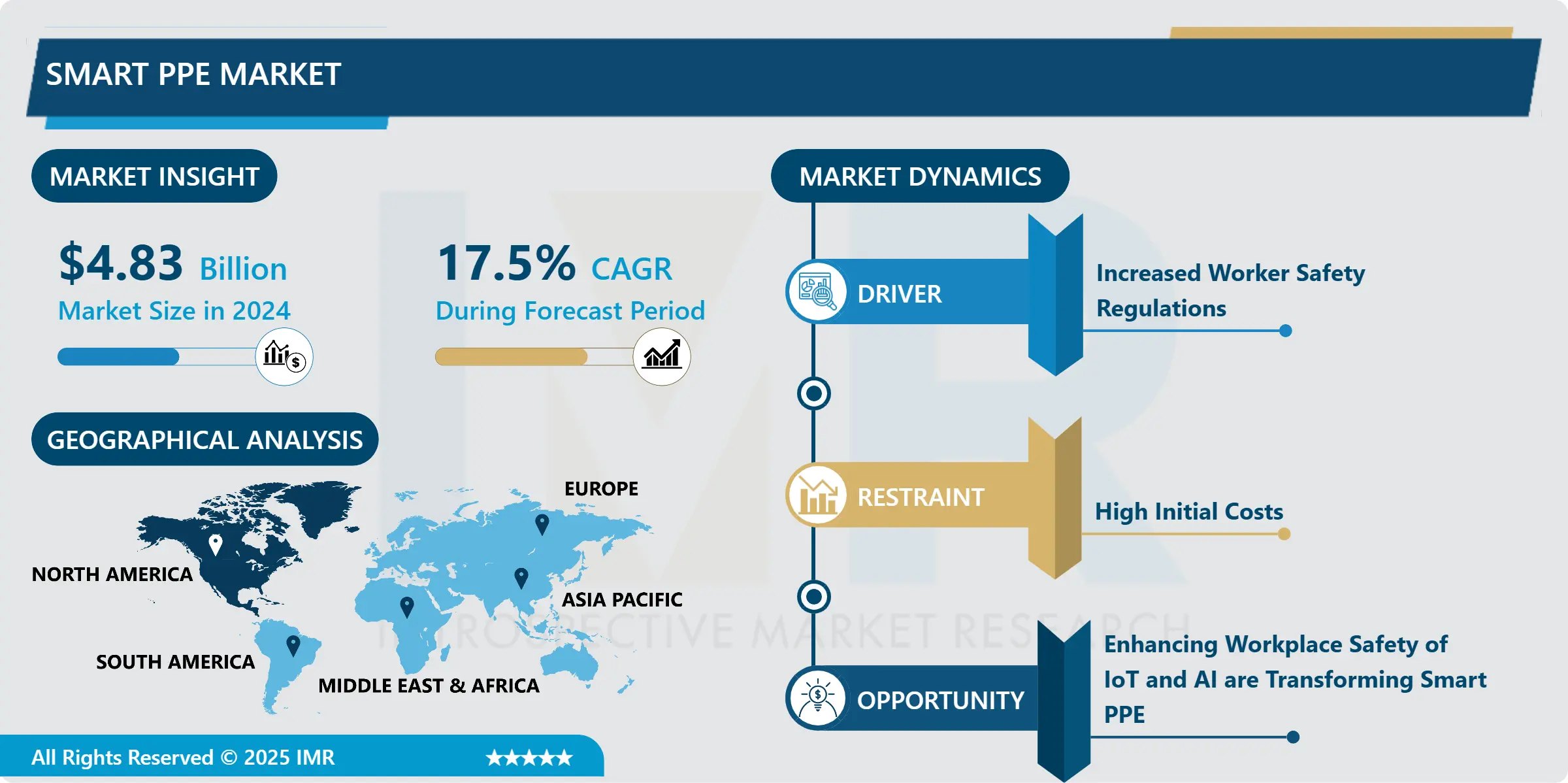
Smart PPE Market Size Was Valued at USD 4.83 Billion in 2024, and is Projected to Reach USD 28.47 Billion by 2035, Growing at a CAGR of 17.5% from 2025-2035.
The smart PPE (Personal Protective Equipment) market is growing fast as more companies look for better ways to protect their workers. Smart PPE includes safety gear like helmets, vests, gloves, and glasses that have built-in technology such as sensors and wireless connections. These devices can track a worker’s health, movements, and the environment around them. For example, a smart helmet can alert a worker if the temperature gets too high or if dangerous gases are nearby. This helps prevent accidents and keeps workers safe in real-time.
The demand for smart PPE is increasing, especially in industries like construction, mining, oil & gas, manufacturing, and healthcare, where workers often face dangerous conditions. New safety rules from governments and the need to monitor health after the COVID-19 pandemic have also pushed more companies to adopt smart PPE.
However, there are still some challenges. Smart PPE is more expensive than regular safety gear, and many older workplaces have outdated systems that don’t work well with new technology. Some companies also worry about how the data collected from workers will be used and protected. Even with these issues, smart PPE is expected to become more common as technology improves and more businesses see the value in keeping their workers safe with smart tools.
Smart PPE Market Growth and Trend Analysis:
Smart PPE Market Growth Driver - Increased Worker Safety Regulations
-
Extensive adoption of smart PPE across various sectors, such as construction, manufacturing, oil & gas and mining, is significantly being impelled by increasingly strict worker safety regulations. The governmental and regulatory agencies have prescribed stricter safety standards-with which organizations must comply through using new and advanced personal protective equipment as well as guaranteed worker safety.
- Conventional personal protective equipment isn't truly up to most of these requirements, particularly in high-risk settings. Smart personal protective equipment, which have sensors and real-time monitoring capability, can attend to the regulations detect hazards, monitors health, and provides alerts as and when necessary. For example, smart helmets and wearable vests can detect dangerous gas levels and high temperatures or vibrations, enabling a swift response to emerging risks. Seamless integration of smart PPE data into safety management systems also helps to track compliance and improve safety protocols. With safety legislation getting stricter, smart PPE is vital to ensuring that compliance while enhancing workplace safety.
Smart PPE Market Limiting Factor - High Initial Costs
-
An important obstacle on the way to the widespread acceptance of smart PPE involves high initial costs, especially for small or medium-sized businesses (SMBs). Smart PPE consists of advanced technologies such as sensors, communication systems, and wearable electronics, designed with excellent quality for their reliability and the life that they can take in hazardous environments. These advanced features dramatically increase the price differential between smart PPE and traditional protective equipment. For SMBs operating on a tight budget, investing in such technology may feel a bit prohibitive, not just due to the equipment itself; they may have to invest in training and infrastructure for integration. Undoubtedly, in the long term, reduced workplace injuries, increased productivity, and improved regulatory compliance will outweigh the initial investments cost. But for many smaller businesses, justifying an upfront investment for achieving that savings can be problematic. This cost barrier reduces the use of smart PPE, most particularly in those industries where the budgets are really tight or where safety standard practices are not stringently applied.
Smart PPE Market Expansion Opportunity- Enhancing Workplace Safety of IoT and AI are Transforming Smart PPE
-
The integration of IoT (Internet of Things) and AI (Artificial Intelligence) is playing a big role in the growth of the smart PPE (Personal Protective Equipment) market. By using IoT, smart PPE can connect to other devices and systems, making it possible to collect real-time data from the user and their environment. For example, smart helmets, vests, or eyewear can monitor things like body temperature, heart rate, or exposure to harmful gases. This data is then sent to a central system where AI can analyse it. With AI, companies can detect patterns and predict potential risks before they become serious problems. This helps in taking quick action to avoid accidents or health issues.
- For instance, if a worker’s body temperature rises suddenly, the system can send an alert to the supervisor to provide help. This kind of predictive technology increases workplace safety and helps reduce downtime due to injuries. It also gives employers better control over safety measures and makes it easier to follow regulations. The ability to track and analyse safety data over time also helps in improving future safety plans. Overall, the combination of IoT and AI makes smart PPE more useful, intelligent, and reliable, encouraging more industries to invest in these advanced safety solutions.
Smart PPE Market Challenge and Risk – Bridging Smart PPE with Existing Systems
-
One of the major challenges in the smart PPE market is the difficulty of integrating new smart safety equipment with existing, older systems in many workplaces. Many companies still use traditional safety systems or outdated infrastructure that were not designed to work with smart technologies. This makes it hard to connect new smart PPE devices like wearable sensors, smart helmets, or connected goggles with current systems such as building controls, employee tracking software, or safety management platforms. For example, if a smart vest is designed to send real-time health data, but the company’s existing software cannot receive or understand that data, the full benefits of the smart PPE are lost. This creates a gap between the technology's potential and its actual use. Also, upgrading old systems or training staff to handle new technologies can be expensive and time-consuming, especially for small and medium-sized businesses. Some companies may be hesitant to invest in smart PPE because of these complications. Without smooth integration, the smart PPE may not work properly, or it may create confusion and delays instead of improving safety. This slows down the adoption of smart PPE in industries that could benefit the most from it. To overcome this challenge, developers need to create more user-friendly and compatible solutions, and companies must be willing to invest in modernizing their systems gradually.
Smart PPE Market Segment Analysis:
Smart PPE Market is segmented based on Type, Application, End-Users, and Region
By Type, Smart PPE Segment is Expected to Dominate the Market During the Forecast Period
-
Smart clothing is the most widely used type of smart personal protective equipment (PPE) because it offers full-body coverage and helps monitor a worker’s health and safety in real time. These are regular-looking garments like shirts, jackets, or vests that have built-in sensors and wireless technology. These sensors can track things like heart rate, body temperature, posture, movement, and fatigue levels. The data is then sent to a connected system, where supervisors can monitor each worker's condition. If any warning signs are found such as a sudden increase in temperature or unusual heart rate an alert can be sent to take quick action.
- Smart clothing is used in many industries such as construction, mining, healthcare, and manufacturing, where workers are exposed to physical stress and possible safety risks. One of the biggest advantages is that it can collect more detailed health data than other types of smart PPE because it covers a larger part of the body.
- It also helps in improving productivity and reducing downtime due to injuries or illness. Over time, the data collected from smart clothing can also be used to make better safety plans and train workers more effectively. As technology becomes more affordable and easier to use, more companies are adopting smart clothing to keep their workers safe and connected on the job.
By Application, Smart PPE Segment Held the Largest Share in 2024
-
Smart clothing plays a very important role in the oil and gas industry, where workers often face dangerous and extreme working conditions. In this industry, employees may work in hot, flammable, or toxic environments, sometimes in remote areas. Smart clothing provides not only physical protection but also real-time monitoring of workers' health and surroundings. These garments can be designed to be flame-resistant or explosion-proof, which is crucial in places where gas leaks or fires are possible.
- The built-in sensors in smart clothing can detect signs of fatigue, abnormal heart rate, dehydration, or exposure to harmful gases. They can also include GPS tracking, which is helpful in keeping track of workers who are spread out across large or isolated job sites. If a worker is in danger or has a health issue, the system can send immediate alerts to supervisors or emergency teams, allowing them to respond quickly and possibly prevent serious accidents.
- In such high-risk jobs, safety is a top priority, and smart clothing helps companies stay compliant with strict health and safety regulations. It also boosts worker confidence, knowing they are being monitored and protected. Over time, smart clothing can reduce the number of workplace injuries and improve overall productivity. As the oil and gas industry continues to adopt digital solutions, smart clothing is becoming a key investment for improving worker safety and operational efficiency.
Smart PPE Market Regional Insights:
North America is Expected to Dominate the Market Over the Forecast Period
North America is currently the top region in terms of market size. In particular, the United States is leading because it has strong laws and regulations to protect workers. There is also a high level of awareness about worker health and safety, especially after the COVID-19 pandemic. Many companies are quick to adopt new technologies, which has helped smart PPE grow faster in this region.
Industries such as construction, oil and gas, manufacturing, and healthcare in North America are now using smart PPE to monitor workers’ health in real time, detect potential hazards, and reduce the number of workplace accidents. Employers see smart PPE as a good investment because it helps keep employees safe, prevents injuries, and improves productivity.
The U.S. government and private companies also support innovation in workplace safety, which further encourages the use of smart gear like smart helmets, connected vests, and sensor-equipped clothing. As a result, the market for smart PPE in North America continues to grow steadily.
Even though other regions are catching up, North America is expected to stay ahead for the near future due to its early use of digital technology, strong infrastructure, and focus on worker safety. This makes the region a key driver in the global smart PPE market.
Smart PPE Market Active Players:
- 3M Company (USA)
- Alpha Pro Tech, Ltd. (Canada)
- Ansell Ltd. (Australia)
- Bae Systems (UK)
- Blackline Safety Corp. (Canada)
- Bullard (USA)
- Corvex Connected Worker (USA)
- D3O (UK)
- Daqri (USA)
- Delta Plus Group (France)
- Drägerwerk AG & Co. KGaA (Germany)
- DuPont de Nemours, Inc. (USA)
- GETAC Technology Corporation (Taiwan)
- Guardhat Inc. (USA)
- Honeywell Analytics (Sperian Protection) (USA)
- Honeywell International Inc. (USA)
- Intellinium (France)
- Kenzen Inc. (USA)
- MCR Safety (USA)
- MSA Safety Incorporated (USA)
- RealWear Inc. (USA)
- Seebo Interactive (Israel)
- Sioen Industries (Belgium)
- SmartCap Technologies (Australia)
- StrongArm Technologies, Inc. (USA)
- Techtion (South Korea)
- Tenacious Holdings (Ergodyne) (USA)
- Uvex Group (Germany)
- Vuzix Corporation (USA)
- Wearable Technologies Ltd. (UK)
- Other Active Players
Key Industry Developments in the Smart PPE Market:
- In March 31, 2025, AI-Based PPE Debut in Maharashtra, India :Maharashtra’s Industry Minister Uday Samant unveiled an AI-powered PPE system built by Extremus Safety Pvt. Ltd. This new gear includes real-time hazard detection, smart monitoring, and predictive safety alerts designed to protect industrial workers from risks marking a significant step toward modernizing workplace safety in India
- In May 20, 2025 – DuPont & Epicore Partner to Integrate Sweat-Sensing Wearables DuPont and Epicore Biosystems announced a game-changing collaboration combining DuPont's protective garments with Epicore’s sweat-sensing ‘Connected Hydration’ technology. This innovation enables wearable biometric monitoring of hydration levels and heat stress especially important in high-risk industries facing tighter heat illness regulations
|
Smart PPE Market |
|||
|
Base Year: |
2024 |
Forecast Period: |
2025-2035 |
|
Historical Data: |
2018 to 2024 |
Market Size in 2024: |
USD 4.83?Billion |
|
Forecast Period 2025-35 CAGR: |
17.5 % |
Market Size in 2035: |
USD 28.47 Billion |
|
Segments Covered: |
By Type |
|
|
|
By End-user
|
|
||
|
By Region |
|
||
|
Growth Driver: |
|
||
|
Limiting Factor |
|
||
|
Expansion Opportunity |
|
||
|
Challenge and Risk |
|
||
|
Companies Covered in the Report: |
|
||
Chapter 1: Introduction
1.1 Scope and Coverage
Chapter 2:Executive Summary
Chapter 3: Market Landscape
3.1 Market Dynamics and Opportunity Analysis
3.1.1 Growth Drivers
3.1.2 Limiting Factors
3.1.3 Growth Opportunities
3.1.4 Challenges and Risks
3.2 Market Trend Analysis
3.3 Industry Ecosystem
3.4 Industry Value Chain Mapping
3.5 Strategic PESTLE Overview
3.6 Porter's Five Forces Framework
3.7 Regulatory Framework
3.8 Pricing Trend Analysis
3.9 Intellectual Property Review
3.10 Technology Evolution
3.11 Import-Export Analysis
3.12 Consumer Behavior Analysis
3.13 Investment Pocket Analysis
3.14 Go-To Market Strategy
Chapter 4: Smart Ppe Market by Type (2018-2035)
4.1 Smart Ppe Market Snapshot and Growth Engine
4.2 Market Overview
4.3 Eye and Face Protection
4.3.1 Introduction and Market Overview
4.3.2 Historic and Forecasted Market Size in Value USD and Volume Units
4.3.3 Key Market Trends, Growth Factors, and Opportunities
4.3.4 Geographic Segmentation Analysis
4.4 Hearing Protection
4.5 Head Protection
4.6 Fall Protection
4.7 Smart Clothing
4.8 Other Types
Chapter 5: Smart Ppe Market by End-User Industry (2018-2035)
5.1 Smart Ppe Market Snapshot and Growth Engine
5.2 Market Overview
5.3 Construction
5.3.1 Introduction and Market Overview
5.3.2 Historic and Forecasted Market Size in Value USD and Volume Units
5.3.3 Key Market Trends, Growth Factors, and Opportunities
5.3.4 Geographic Segmentation Analysis
5.4 Mining
5.5 Oil and Gas
5.6 Manufacturing
5.7 Automotive
5.8 Other End-user Industries
Chapter 6: Company Profiles and Competitive Analysis
6.1 Competitive Landscape
6.1.1 Competitive Benchmarking
6.1.2 Smart Ppe Market Share by Manufacturer/Service Provider(2024)
6.1.3 Industry BCG Matrix
6.1.4 PArtnerships, Mergers & Acquisitions
6.2 3M COMPANY (USA)
6.2.1 Company Overview
6.2.2 Key Executives
6.2.3 Company Snapshot
6.2.4 Role of the Company in the Market
6.2.5 Sustainability and Social Responsibility
6.2.6 Operating Business Segments
6.2.7 Product Portfolio
6.2.8 Business Performance
6.2.9 Recent News & Developments
6.2.10 SWOT Analysis
6.3 ALPHA PRO TECH
6.4 LTD. (CANADA)
6.5 ANSELL LTD. (AUSTRALIA)
6.6 BAE SYSTEMS (UK)
6.7 BLACKLINE SAFETY CORP. (CANADA)
6.8 BULLARD (USA)
6.9 CORVEX CONNECTED WORKER (USA)
6.10 D3O (UK)
6.11 DAQRI (USA)
6.12 DELTA PLUS GROUP (FRANCE)
6.13 DRÄGERWERK AG & CO. KGAA (GERMANY)
6.14 DUPONT DE NEMOURS
6.15 INC. (USA)
6.16 GETAC TECHNOLOGY CORPORATION (TAIWAN)
6.17 GUARDHAT INC. (USA)
6.18 HONEYWELL ANALYTICS (SPERIAN PROTECTION) (USA)
6.19 HONEYWELL INTERNATIONAL INC. (USA)
6.20 INTELLINIUM (FRANCE)
6.21 KENZEN INC. (USA)
6.22 MCR SAFETY (USA)
6.23 MSA SAFETY INCORPORATED (USA)
6.24 REALWEAR INC. (USA)
6.25 SEEBO INTERACTIVE (ISRAEL)
6.26 SIOEN INDUSTRIES (BELGIUM)
6.27 SMARTCAP TECHNOLOGIES (AUSTRALIA)
6.28 STRONGARM TECHNOLOGIES
6.29 INC. (USA)
6.30 TECHTION (SOUTH KOREA)
6.31 TENACIOUS HOLDINGS (ERGODYNE) (USA)
6.32 UVEX GROUP (GERMANY)
6.33 VUZIX CORPORATION (USA)
6.34 WEARABLE TECHNOLOGIES LTD. (UK)
6.35 AND OTHER ACTIVE PLAYERS.
Chapter 7: Global Smart Ppe Market By Region
7.1 Overview
7.2. North America Smart Ppe Market
7.2.1 Key Market Trends, Growth Factors and Opportunities
7.2.2 Top Key Companies
7.2.3 Historic and Forecasted Market Size by Segments
7.2.4 Historic and Forecast Market Size by Country
7.2.4.1 US
7.2.4.2 Canada
7.2.4.3 Mexico
7.3. Eastern Europe Smart Ppe Market
7.3.1 Key Market Trends, Growth Factors and Opportunities
7.3.2 Top Key Companies
7.3.3 Historic and Forecasted Market Size by Segments
7.3.4 Historic and Forecast Market Size by Country
7.3.4.1 Russia
7.3.4.2 Bulgaria
7.3.4.3 The Czech Republic
7.3.4.4 Hungary
7.3.4.5 Poland
7.3.4.6 Romania
7.3.4.7 Rest of Eastern Europe
7.4. Western Europe Smart Ppe Market
7.4.1 Key Market Trends, Growth Factors and Opportunities
7.4.2 Top Key Companies
7.4.3 Historic and Forecasted Market Size by Segments
7.4.4 Historic and Forecast Market Size by Country
7.4.4.1 Germany
7.4.4.2 UK
7.4.4.3 France
7.4.4.4 The Netherlands
7.4.4.5 Italy
7.4.4.6 Spain
7.4.4.7 Rest of Western Europe
7.5. Asia Pacific Smart Ppe Market
7.5.1 Key Market Trends, Growth Factors and Opportunities
7.5.2 Top Key Companies
7.5.3 Historic and Forecasted Market Size by Segments
7.5.4 Historic and Forecast Market Size by Country
7.5.4.1 China
7.5.4.2 India
7.5.4.3 Japan
7.5.4.4 South Korea
7.5.4.5 Malaysia
7.5.4.6 Thailand
7.5.4.7 Vietnam
7.5.4.8 The Philippines
7.5.4.9 Australia
7.5.4.10 New Zealand
7.5.4.11 Rest of APAC
7.6. Middle East & Africa Smart Ppe Market
7.6.1 Key Market Trends, Growth Factors and Opportunities
7.6.2 Top Key Companies
7.6.3 Historic and Forecasted Market Size by Segments
7.6.4 Historic and Forecast Market Size by Country
7.6.4.1 Turkiye
7.6.4.2 Bahrain
7.6.4.3 Kuwait
7.6.4.4 Saudi Arabia
7.6.4.5 Qatar
7.6.4.6 UAE
7.6.4.7 Israel
7.6.4.8 South Africa
7.7. South America Smart Ppe Market
7.7.1 Key Market Trends, Growth Factors and Opportunities
7.7.2 Top Key Companies
7.7.3 Historic and Forecasted Market Size by Segments
7.7.4 Historic and Forecast Market Size by Country
7.7.4.1 Brazil
7.7.4.2 Argentina
7.7.4.3 Rest of SA
Chapter 8 Analyst Viewpoint and Conclusion
Chapter 9 Our Thematic Research Methodology
9.1 Research Process
9.2 Primary Research
9.3 Secondary Research
Chapter 10 Case Study
Chapter 11 Appendix
11.1 Sources
11.2 List of Tables and figures
11.3 Short Forms and Citations
11.4 Assumption and Conversion
11.5 Disclaimer
|
Smart PPE Market |
|||
|
Base Year: |
2024 |
Forecast Period: |
2025-2035 |
|
Historical Data: |
2018 to 2024 |
Market Size in 2024: |
USD 4.83?Billion |
|
Forecast Period 2025-35 CAGR: |
17.5 % |
Market Size in 2035: |
USD 28.47 Billion |
|
Segments Covered: |
By Type |
|
|
|
By End-user
|
|
||
|
By Region |
|
||
|
Growth Driver: |
|
||
|
Limiting Factor |
|
||
|
Expansion Opportunity |
|
||
|
Challenge and Risk |
|
||
|
Companies Covered in the Report: |
|
||


