Sleep Aids Market Synopsis:
Sleep Aids Market Size Was Valued at USD 86.91 Billion in 2023, and is Projected to Reach USD 162.49 Billion by 2032, Growing at a CAGR of 7.2% From 2024-2032.
The Sleep Aids Market therefore comprises products and services that help customers get better sleep, or treat conditions such as insomnia, sleep apnea, and restless leg syndrome. This market ranges from solutions such as mattresses, medications, sleep apnoea devices, sleep laboratories targeting the poor sleepers. Inability to sleep well and increased cases of sleep disorders, coupled with an aging global population, are some of the factors have been driving this market.
The Sleep Aids Market has shown significant growth in the past few years primarily due to the increase in the demand of the sleep disorder treatment and the importance of sleep that is well known in today’s world. Due to increases prevalence of life styles changes and increase pressure, people are having sleepless nights leading to the expansion of this market. Market is also associated with the ongoing enhancements in healthcare with better detection procedure of sleep disorders such as Sleep Labs and polysomnography and better cures for sleep disorders. Also, non-pharmacological therapies like mattresses and pillows have also gained acceptance to consumers seeking sleep medicines.
In my opinion, the segmentation of the market demonstrates the fact that there is a great variety of customers with sleep problems. Product areas are in the mattresses and pillows that ensure proper positioning and support during sleep; sleep, wake, and physical disorders that cause short-term or chronic insomnia, and sleep apnea device that is innovatively used to manage conditions that negatively affect normal breathing while asleep. In addition to these consumer products, sleep laboratories are used to diagnose an individual’s sleep pattern. These products have differing distribution channels as the sales have also shifted along with the e-commerce trends that have contributed to a significant source of revenue especially as more customers prefer one-stop shopping.
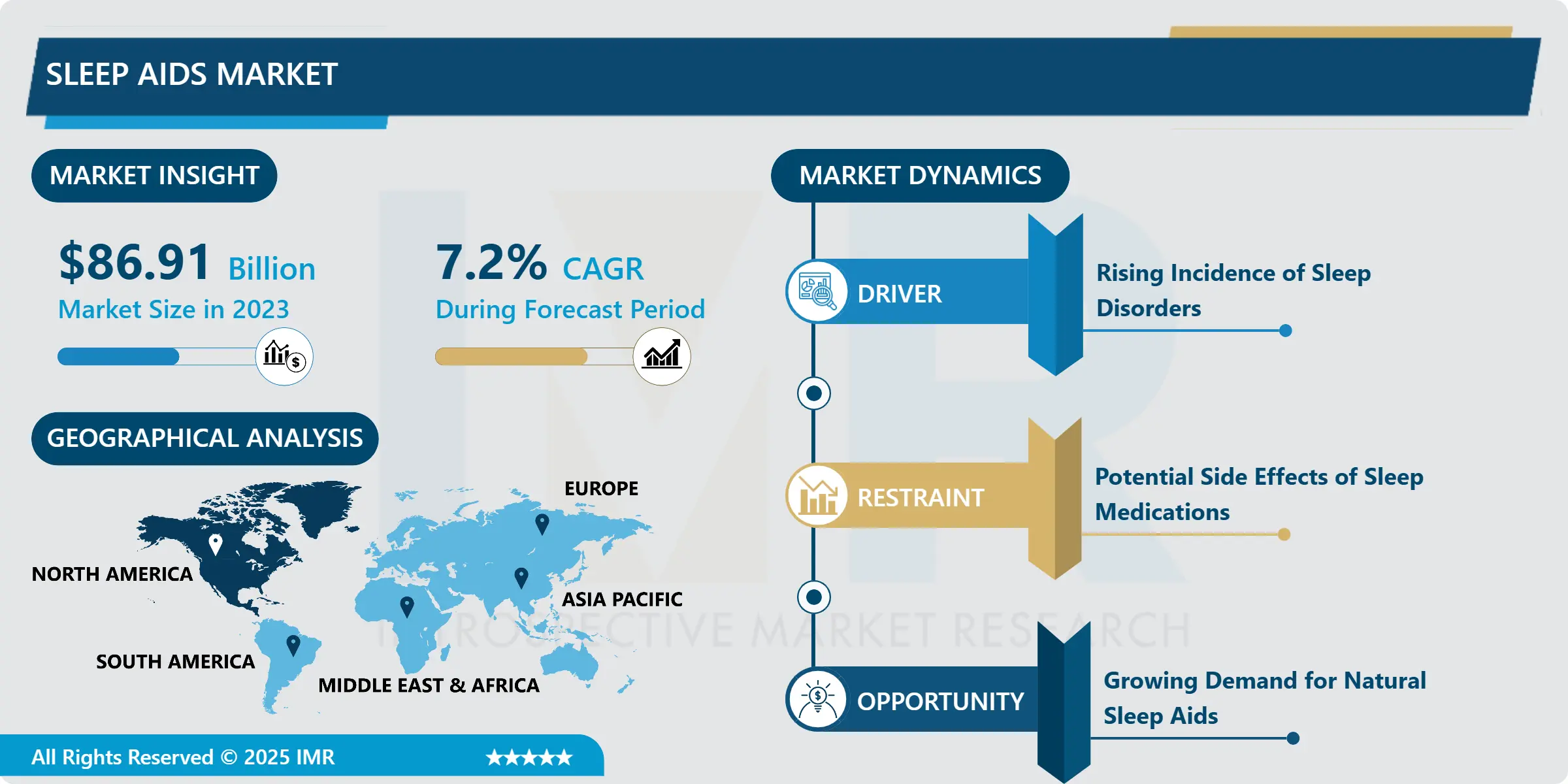
Sleep Aids Market Trend Analysis:
Increasing Use of Wearable Sleep Trackers
- Technology is used in sleep aids and the most important type of assistance is sleep trackers that help the people understand the quality of their sleep. Sleep tracking is becoming popular due to the by-products in the wearable technology industry, smartwatches and fitness tracker devices with sensors support this feature. These devices include information about the duration of sleep, the quality of the sleep that is enjoyed and anyone who uses the device gets information about disturbances that occur when they are asleep and all this is with a view of bringing about change in the human behavior.
- Industry for wearable sleep trackers is advancing since it does not involve invasive methods and it is rather inexpensive. Most wearables have integrated sleep coaching in such a way that based on the data they collect about the user, they offer advice on how the user might want to modify their sleeping habits. Given that consumers have decided to pay a lot of attention to their health, the use of wearable sleep trackers is expected to persist as a factor in the growth of the Sleep Aids Market.
Growing Demand for Natural Sleep Aids
- The growing need for natural sleep products due to customer’s demand for non-pharmacological sleep products. The current trends include the use of aromatherapy products like herbal teas, oils as well as standardized supplements like melatonin and valerian root. This shift is especially remarkable among those individuals who are concerned with possible side effects of most conventional products for sleep, but are looking for improved sleep quality.
- This demand is also an excellent chance for manufacturers to increase their product ranges, offering more natural products and hence reaching out to a wider client base. As a result, manufactures have embarked on research and development to come up with products from natural products. A promising opportunity is to target a market of consumers interested in practical but soft sleep aids, which indicates a growth opportunity in the Sleep Aids Market.
Sleep Aids Market Segment Analysis:
Sleep Aids Market is Segmented on the basis of Product type, Distribution Channel, Sleep Disorder and Region.
By Product Type, Mattresses & Pillows segment is expected to dominate the market during the forecast period
- Sleep Aids Market definitely encompasses a great deal of variation where it targets the different needs of sleep. Mattresses & Pillows form part of the most sought after non-pharmaceutical products that are aimed at giving ergonomic support and comfort to foster a better sleep. Sleep Laboratories contribute generally to the diagnostic process particularly where there are issues that have to be followed and monitored for close examination and detection. Fragile products comprise medications with nonprescription and prescription drugs for people who desire temporary sleep problems solutions such as Insomnia, on the other hand, Sleep Apnea Devices are designed to address respiratory disorders that affect sleep in some people.
- Meanwhile, each type of product targets different customers as is characteristic of the market. Such flexibility is helpful for different people since they can select the options that appeal to them and complement the therapies they already use, like mattresses and pillows or actual machines like sleep apnea CPAP. Because of the product differentiation in this market, the companies are able to access a large number of consumers, thus increasing this market’s growth.
By Distribution Channel, Hospital Pharmacies segment expected to held the largest share
- The Sleep Aids Market has multiple points of contact with the consumer through the channel of distribution of which the Hospital Pharmacies and Retail Pharmacies are the key channels for prescribed sleep aids and medical devices. These channels guarantee that people can have a variety of controlled and authorized products under the supervision of a doctor in particular with the diseases that require a prescription. Internet markets and especially Online Pharmacies have become more and more relevant as they provide with a) convenience; b) wider variety; and c) cheaper prices.
- E-commerce has changed the market structure through which consumers can fuze sleep aids without physically visiting a store. The possibility to arrange sales online has made it more convenient for the consumer to browse through many different products, select the ones that they would like to buy based on the reviews about the products, and then decide as to what solutions to go for. As growth in the reach of digital retail channels persists, the same can be said about the distribution of Sleep Aids Market growth among businesses.
Sleep Aids Market Regional Insights:
North America is Expected to Dominate the Market Over the Forecast period
- North America continues to be the most significant region to achieve high sales figures in Sleep Aids Market as a result of increased knowledge of the value of sleep and sound health care systems. It also has high incidences of sleep disorders that have been seen to be brought about by stress, which creates a market for sleeping capsules. Furthermore, The North American market help the leading position due to the advanced pharmaceutical industry and significant spending to work on new products and services related to sleep disorder treatments. North America’s has monopoly within the market because of improved diagnostic facilities and the new technologies such as wearable sleep devices and quality sleep labs. Wellness, especially sleep, has garnered augmented consumer expenditure, especially in the U.S., and hence drives the region.
Active Key Players in the Sleep Aids Market:
- Apnea Sciences Corporation (USA)
- Cadwell Industries, Inc. (USA)
- Drive DeVilbiss Healthcare (USA)
- GlaxoSmithKline plc (UK)
- Koninklijke Philips N.V. (Netherlands)
- Merck & Co., Inc. (USA)
- Natus Medical Incorporated (USA)
- Pfizer Inc. (USA)
- ResMed Inc. (USA)
- Sanofi S.A. (France)
- Sleep Number Corporation (USA)
- Takeda Pharmaceutical Company Limited (Japan)
- Other Active Players
Key Industry Developments in the Sleep Aids Market:
- In June 2024, Wakefit introduced an AI-powered mattress and tracker to enhance sleep quality. Wakefit's Regul8 and Track8 leverage AI technology to enhance sleep quality.
- In May 2024, Jazz Pharmaceuticals PLC unveiled its plans for SLEEP 2024, the 38th annual meeting of the Associated Professional Sleep Societies, which took place in Houston, Texas, from June 1 to 5, 2024. The company will showcase 13 abstracts, five of them late-breaking, highlighting fresh insights from its diverse sleep medicine portfolio.
|
Sleep Aids Market |
|||
|
Base Year: |
2023 |
Forecast Period: |
2024-2032 |
|
Historical Data: |
2017 to 2023 |
Market Size in 2023: |
USD 86.91 Billion |
|
Forecast Period 2024-32 CAGR: |
7.2% |
Market Size in 2032: |
USD 162.49 Billion |
|
Segments Covered: |
By Product Type |
|
|
|
By Sleep Disorder |
|
||
|
By Distribution Channel |
|
||
|
By Region |
|
||
|
Key Market Drivers: |
|
||
|
Key Market Restraints: |
|
||
|
Key Opportunities: |
|
||
|
Companies Covered in the report: |
|
||
1.1 Scope and Coverage
Chapter 2:Executive Summary
Chapter 3: Market Landscape
3.1 Industry Dynamics and Opportunity Analysis
3.1.1 Growth Drivers
3.1.2 Limiting Factors
3.1.3 Growth Opportunities
3.1.4 Challenges and Risks
3.2 Market Trend Analysis
3.3 Strategic Pestle Overview
3.4 Porter's Five Forces Analysis
3.5 Industry Value Chain Mapping
3.6 Regulatory Framework
3.7 Princing Trend Analysis
3.8 Patent Analysis
3.9 Technology Evolution
3.10 Investment Pockets
3.11 Import-Export Analysis
Chapter 4: Sleep Aids Market by Product Type
4.1 Sleep Aids Market Snapshot and Growth Engine
4.2 Sleep Aids Market Overview
4.3 Mattresses & Pillows
4.3.1 Introduction and Market Overview
4.3.2 Historic and Forecasted Market Size in Value USD and Volume Units (2017-2032F)
4.3.3 Mattresses & Pillows: Geographic Segmentation Analysis
4.4 Sleep Laboratories
4.4.1 Introduction and Market Overview
4.4.2 Historic and Forecasted Market Size in Value USD and Volume Units (2017-2032F)
4.4.3 Sleep Laboratories: Geographic Segmentation Analysis
4.5 Medications
4.5.1 Introduction and Market Overview
4.5.2 Historic and Forecasted Market Size in Value USD and Volume Units (2017-2032F)
4.5.3 Medications: Geographic Segmentation Analysis
4.6 Sleep Apnea Devices
4.6.1 Introduction and Market Overview
4.6.2 Historic and Forecasted Market Size in Value USD and Volume Units (2017-2032F)
4.6.3 Sleep Apnea Devices: Geographic Segmentation Analysis
Chapter 5: Sleep Aids Market by Sleep Disorder
5.1 Sleep Aids Market Snapshot and Growth Engine
5.2 Sleep Aids Market Overview
5.3 Insomnia
5.3.1 Introduction and Market Overview
5.3.2 Historic and Forecasted Market Size in Value USD and Volume Units (2017-2032F)
5.3.3 Insomnia: Geographic Segmentation Analysis
5.4 Sleep Apnea
5.4.1 Introduction and Market Overview
5.4.2 Historic and Forecasted Market Size in Value USD and Volume Units (2017-2032F)
5.4.3 Sleep Apnea: Geographic Segmentation Analysis
5.5 Restless Legs Syndrome
5.5.1 Introduction and Market Overview
5.5.2 Historic and Forecasted Market Size in Value USD and Volume Units (2017-2032F)
5.5.3 Restless Legs Syndrome: Geographic Segmentation Analysis
5.6 Narcolepsy
5.6.1 Introduction and Market Overview
5.6.2 Historic and Forecasted Market Size in Value USD and Volume Units (2017-2032F)
5.6.3 Narcolepsy: Geographic Segmentation Analysis
5.7 Others
5.7.1 Introduction and Market Overview
5.7.2 Historic and Forecasted Market Size in Value USD and Volume Units (2017-2032F)
5.7.3 Others: Geographic Segmentation Analysis
Chapter 6: Sleep Aids Market by Distribution Channel
6.1 Sleep Aids Market Snapshot and Growth Engine
6.2 Sleep Aids Market Overview
6.3 Hospital Pharmacies
6.3.1 Introduction and Market Overview
6.3.2 Historic and Forecasted Market Size in Value USD and Volume Units (2017-2032F)
6.3.3 Hospital Pharmacies: Geographic Segmentation Analysis
6.4 Retail Pharmacies
6.4.1 Introduction and Market Overview
6.4.2 Historic and Forecasted Market Size in Value USD and Volume Units (2017-2032F)
6.4.3 Retail Pharmacies: Geographic Segmentation Analysis
6.5 Online Pharmacies
6.5.1 Introduction and Market Overview
6.5.2 Historic and Forecasted Market Size in Value USD and Volume Units (2017-2032F)
6.5.3 Online Pharmacies: Geographic Segmentation Analysis
6.6 E-commerce
6.6.1 Introduction and Market Overview
6.6.2 Historic and Forecasted Market Size in Value USD and Volume Units (2017-2032F)
6.6.3 E-commerce: Geographic Segmentation Analysis
Chapter 7: Company Profiles and Competitive Analysis
7.1 Competitive Landscape
7.1.1 Competitive Benchmarking
7.1.2 Sleep Aids Market Share by Manufacturer (2023)
7.1.3 Concentration Ratio(CR5)
7.1.4 Heat Map Analysis
7.1.5 Mergers and Acquisitions
7.2 RESMED INC. (USA)
7.2.1 Company Overview
7.2.2 Key Executives
7.2.3 Company Snapshot
7.2.4 Operating Business Segments
7.2.5 Product Portfolio
7.2.6 Business Performance
7.2.7 Key Strategic Moves and Recent Developments
7.3 KONINKLIJKE PHILIPS N.V. (NETHERLANDS)
7.4 PFIZER INC. (USA)
7.5 SANOFI S.A. (FRANCE)
7.6 MERCK & CO. INC. (USA)
7.7 DRIVE DEVILBISS HEALTHCARE (USA)
7.8 SLEEP NUMBER CORPORATION (USA)
7.9 GLAXOSMITHKLINE PLC (UK)
7.10 OTHER ACTIVE PLAYERS
Chapter 8: Global Sleep Aids Market By Region
8.1 Overview
8.2. North America Sleep Aids Market
8.2.1 Historic and Forecasted Market Size by Segments
8.2.2 Historic and Forecasted Market Size By Product Type
8.2.2.1 Mattresses & Pillows
8.2.2.2 Sleep Laboratories
8.2.2.3 Medications
8.2.2.4 Sleep Apnea Devices
8.2.3 Historic and Forecasted Market Size By Sleep Disorder
8.2.3.1 Insomnia
8.2.3.2 Sleep Apnea
8.2.3.3 Restless Legs Syndrome
8.2.3.4 Narcolepsy
8.2.3.5 Others
8.2.4 Historic and Forecasted Market Size By Distribution Channel
8.2.4.1 Hospital Pharmacies
8.2.4.2 Retail Pharmacies
8.2.4.3 Online Pharmacies
8.2.4.4 E-commerce
8.2.5 Historic and Forecast Market Size by Country
8.2.5.1 US
8.2.5.2 Canada
8.2.5.3 Mexico
8.3. Eastern Europe Sleep Aids Market
8.3.1 Historic and Forecasted Market Size by Segments
8.3.2 Historic and Forecasted Market Size By Product Type
8.3.2.1 Mattresses & Pillows
8.3.2.2 Sleep Laboratories
8.3.2.3 Medications
8.3.2.4 Sleep Apnea Devices
8.3.3 Historic and Forecasted Market Size By Sleep Disorder
8.3.3.1 Insomnia
8.3.3.2 Sleep Apnea
8.3.3.3 Restless Legs Syndrome
8.3.3.4 Narcolepsy
8.3.3.5 Others
8.3.4 Historic and Forecasted Market Size By Distribution Channel
8.3.4.1 Hospital Pharmacies
8.3.4.2 Retail Pharmacies
8.3.4.3 Online Pharmacies
8.3.4.4 E-commerce
8.3.5 Historic and Forecast Market Size by Country
8.3.5.1 Bulgaria
8.3.5.2 The Czech Republic
8.3.5.3 Hungary
8.3.5.4 Poland
8.3.5.5 Romania
8.3.5.6 Rest of Eastern Europe
8.4. Western Europe Sleep Aids Market
8.4.1 Historic and Forecasted Market Size by Segments
8.4.2 Historic and Forecasted Market Size By Product Type
8.4.2.1 Mattresses & Pillows
8.4.2.2 Sleep Laboratories
8.4.2.3 Medications
8.4.2.4 Sleep Apnea Devices
8.4.3 Historic and Forecasted Market Size By Sleep Disorder
8.4.3.1 Insomnia
8.4.3.2 Sleep Apnea
8.4.3.3 Restless Legs Syndrome
8.4.3.4 Narcolepsy
8.4.3.5 Others
8.4.4 Historic and Forecasted Market Size By Distribution Channel
8.4.4.1 Hospital Pharmacies
8.4.4.2 Retail Pharmacies
8.4.4.3 Online Pharmacies
8.4.4.4 E-commerce
8.4.5 Historic and Forecast Market Size by Country
8.4.5.1 Germany
8.4.5.2 UK
8.4.5.3 France
8.4.5.4 Netherlands
8.4.5.5 Italy
8.4.5.6 Russia
8.4.5.7 Spain
8.4.5.8 Rest of Western Europe
8.5. Asia Pacific Sleep Aids Market
8.5.1 Historic and Forecasted Market Size by Segments
8.5.2 Historic and Forecasted Market Size By Product Type
8.5.2.1 Mattresses & Pillows
8.5.2.2 Sleep Laboratories
8.5.2.3 Medications
8.5.2.4 Sleep Apnea Devices
8.5.3 Historic and Forecasted Market Size By Sleep Disorder
8.5.3.1 Insomnia
8.5.3.2 Sleep Apnea
8.5.3.3 Restless Legs Syndrome
8.5.3.4 Narcolepsy
8.5.3.5 Others
8.5.4 Historic and Forecasted Market Size By Distribution Channel
8.5.4.1 Hospital Pharmacies
8.5.4.2 Retail Pharmacies
8.5.4.3 Online Pharmacies
8.5.4.4 E-commerce
8.5.5 Historic and Forecast Market Size by Country
8.5.5.1 China
8.5.5.2 India
8.5.5.3 Japan
8.5.5.4 South Korea
8.5.5.5 Malaysia
8.5.5.6 Thailand
8.5.5.7 Vietnam
8.5.5.8 The Philippines
8.5.5.9 Australia
8.5.5.10 New Zealand
8.5.5.11 Rest of APAC
8.6. Middle East & Africa Sleep Aids Market
8.6.1 Historic and Forecasted Market Size by Segments
8.6.2 Historic and Forecasted Market Size By Product Type
8.6.2.1 Mattresses & Pillows
8.6.2.2 Sleep Laboratories
8.6.2.3 Medications
8.6.2.4 Sleep Apnea Devices
8.6.3 Historic and Forecasted Market Size By Sleep Disorder
8.6.3.1 Insomnia
8.6.3.2 Sleep Apnea
8.6.3.3 Restless Legs Syndrome
8.6.3.4 Narcolepsy
8.6.3.5 Others
8.6.4 Historic and Forecasted Market Size By Distribution Channel
8.6.4.1 Hospital Pharmacies
8.6.4.2 Retail Pharmacies
8.6.4.3 Online Pharmacies
8.6.4.4 E-commerce
8.6.5 Historic and Forecast Market Size by Country
8.6.5.1 Turkey
8.6.5.2 Bahrain
8.6.5.3 Kuwait
8.6.5.4 Saudi Arabia
8.6.5.5 Qatar
8.6.5.6 UAE
8.6.5.7 Israel
8.6.5.8 South Africa
8.7. South America Sleep Aids Market
8.7.1 Historic and Forecasted Market Size by Segments
8.7.2 Historic and Forecasted Market Size By Product Type
8.7.2.1 Mattresses & Pillows
8.7.2.2 Sleep Laboratories
8.7.2.3 Medications
8.7.2.4 Sleep Apnea Devices
8.7.3 Historic and Forecasted Market Size By Sleep Disorder
8.7.3.1 Insomnia
8.7.3.2 Sleep Apnea
8.7.3.3 Restless Legs Syndrome
8.7.3.4 Narcolepsy
8.7.3.5 Others
8.7.4 Historic and Forecasted Market Size By Distribution Channel
8.7.4.1 Hospital Pharmacies
8.7.4.2 Retail Pharmacies
8.7.4.3 Online Pharmacies
8.7.4.4 E-commerce
8.7.5 Historic and Forecast Market Size by Country
8.7.5.1 Brazil
8.7.5.2 Argentina
8.7.5.3 Rest of SA
Chapter 9 Analyst Viewpoint and Conclusion
9.1 Recommendations and Concluding Analysis
9.2 Potential Market Strategies
Chapter 10 Research Methodology
10.1 Research Process
10.2 Primary Research
10.3 Secondary Research
|
Sleep Aids Market |
|||
|
Base Year: |
2023 |
Forecast Period: |
2024-2032 |
|
Historical Data: |
2017 to 2023 |
Market Size in 2023: |
USD 86.91 Billion |
|
Forecast Period 2024-32 CAGR: |
7.2% |
Market Size in 2032: |
USD 162.49 Billion |
|
Segments Covered: |
By Product Type |
|
|
|
By Sleep Disorder |
|
||
|
By Distribution Channel |
|
||
|
By Region |
|
||
|
Key Market Drivers: |
|
||
|
Key Market Restraints: |
|
||
|
Key Opportunities: |
|
||
|
Companies Covered in the report: |
|
||