




Rainwater Harvesting Market Synopsis:
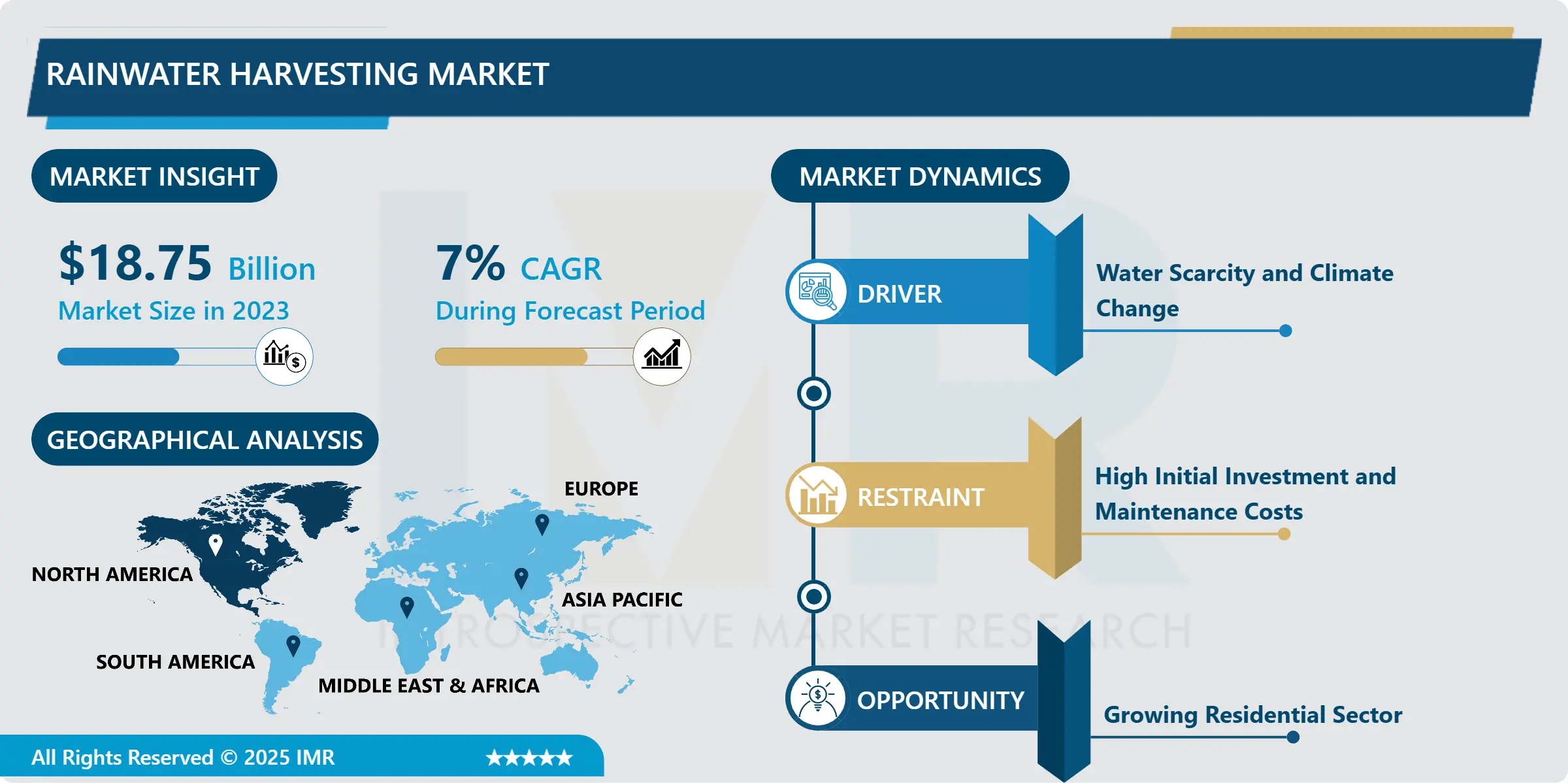
Rainwater Harvesting Market Size Was Valued at USD 18.75 Billion in 2023, and is Projected to Reach USD 34.47 Billion by 2032, Growing at a CAGR of 7.00% From 2024-2032.
Rainwater Harvesting Market is the system or business of capturing, conveying, storing and treating rainwater for purposes such as irrigation, landscaping, industrial usage and drinking. Rainwater harvesting technologies and systems including tanks, filters, pumps and purification systems for harvesting rainwater fall under this market. They include; rising water demand, improving water use efficiency as dictated by government policies, and better management, of water resources. The market comprises offerings for residential, commercial, and industrial applications in various locations around the world.
The Rainwater harvesting market is in its growing stage and has a vast potential hence it has expanded its demand across the globe due to development of consciousness and cognizance about water scarcity problems and need for an effective water conservation measures. Rainwater harvesting is a system where rainwater that falls on the surface like rooftops is either captured and stored in a reservoirs to used for uses like irrigation, industrial purposes and other domestic uses. The following factors have been observed to have a positive impact on this market; Changing lifestyle, growth in urbanization, growing water consumption, and encouragement from the government to save water. The technologies used in the construction of rainwater harvesting systems have become more enhanced and cheap; thus the systems can be installed by many people in various categories such as residential, commercial and industrial categories.
Reflecting on geographical demographics, North America and European countries lag the rainwater harvesting market significantly due to the increased awareness and stringent rules and regulations related to water conservation in these areas. Asia-Pacific is expected to experience the highest rate of growth due to rising water shortages, incentives offered by its governments, and rising sense of appreciation of rainwater harvesting systems. It is also has beneficiary implication of innovations made on the storage of water and also the incorporation of smart water use such as in irrigation. Additional advancements such as integration of IoT and smart technology in the rainwater harvesting systems are expected to enhance the growth in this market which enhances the real time controls and monitoring of water usage and wastage.
Rainwater Harvesting Market Trend Analysis:
Technological Advancements and Market Growth in Rainwater Harvesting
-
Increasing consciousness of the absolute requirement for water and effective usage has resulted in the installation of rain harvesting systems. The rainwater harvesting systems comprise of structural systems which harvest, store and use rainwater mainly for non-portable uses including irrigation, toilet flushing and washing of car and yards as well as landscaping, hence minimizing on the use of water from the municipal sources. Both in the urban and rural of the country, rainwater harvesting is now regarded as one of the most viable ways of looking for solution to the shortage of water, or even for better management of water resources. This trend is well illustrated in areas that are scarce of water, using rainwater harvesting is a cost effective way of ensuring adequate supply of water for use by the people and besides it comes as an advance way of preserving water as compared to other costly and expensive ways of sourcing water such as having to drill wells.
- The growth of rainwater harvesting market has been boosted by increased investment in technology. There are now automatic ones hence enhancing rainwater harvesting, though it can be easily managed. Ideally, such systems can check and regulate the flow of water as well as the storage of the harvested rainwater, while improving on system efficiency and decreasing on system maintenance. This technological development is now offering the harvested rainwater a host of other applications such as usage in industrial processes and as coolant which in turn extend the possibility of the market for rainwater harvesting and cause more people to invest into it.
Technological Innovations and Smart City Trend
-
New technologies that include automatic rain water collection, purification techniques have greatly improved the feasibility and affordability of rain water harvesting projects. The above innovations best practises with regards to the process of collecting rain water in proper systems of storage and filtration for uses such as watering of gardens, and cleaning of toilets. Sensors and real-time monitoring systems that are incorporated in the systems play a vital role of making them easy to regulate concern water in an efficient way. Thus, as these technologies develop it not only becomes easier to harvest water but it also becomes a more feasible as well as a more desirable solution to conventional water sources where water is quickly becoming a scarce resource.
- In the same regard, smart city initiatives as well as trends in city urbanization are opening other opportunities for integration of rainwater harvesting systems. Since cities are growing and becoming urbanized, challenges in water management still persist. The application of rainwater harvesting systems offers several opportunities for cities such as managing urban floods, decreasing pressure on the municipal water supply networks, and improving the sustainability profile. These systems are in compliance with smart city objectives of enhancing the sustainability of the environment and the overall preparedness to climate change, therefore should form part of the blueprints of future cities.
Rainwater Harvesting Market Segment Analysis:
Rainwater Harvesting Market is Segmented on the basis of By Type, Harvesting Method, Installation, and by Region
By Type, Rain Barrel System segment is expected to dominate the market during the forecast period
-
The rain barrel technique is the most popular type of rainwater harvesting technologies across the world. It captures water through a pipe from the roof through a gutter and siphons it into a container – a barrel. The accumulated water can therefore be utilized in several unportable uses such as watering plants, washing, and even for gardening. Suitability of rain barrels: Rain barrels are highly suitable for domestic use due to there Hoe simple and affordable they are especially in regions where precipitation is relatively frequent. Despite the fact that they make use of water, they are easy to install, not very many pipes compound the system, and once installed does not need much attention. However the ability of rain barrels is a little less, as the tanks we count here are small enough to store water collected from rooftops, it is not for large agricultural or industrial use where large capacity of water storage is required.
- They are especially useful in making a reduction on the use of water from the urban water supply for outdoor use. They collect rainwater that otherwise would flow out unutilized and assisting the homeowner in water conservation, therefore, low water bills. Although they are very efficient for themselves, their storage capacity cannot accommodate large Agricultural or Industrial usages. Consequently, rain barrels can only be of much usefulness to homeowners with small yards and gardens or for farmers with limited acreage or industries that require only minimal water control, but not for large-scale commercial agriculture or for large industries.
By Installation, Industrial segment expected to held the largest share
-
Industrial rain water harvesting systems are used to cater large quantities of water required for industrial use in factories, manufacturing industries etc. These systems are designed to handle large amounts of water and frequently, contain both elevated and subsurface storage capabilities. The water that is produced can be reused for cooling, washing of equipment and in most other industrial uses. Industrial systems are larger and far more complicated than residential or commercial systems, thereby making them costly to install and maintain. However, the mains benefits relate to long term cost savings which include a saving on the water bills in the long-run because there will be less utilization of municipal water sources and therefore water will be conserved. Further, these systems also effectively support sustainable use of water resources by reducing the negative effects of industrial water consumption.
- Industrial rainwater harvesting systems are further sub divided into rainwater harvesting systems that may fulfill detailed requirements of certain industries. Rainwater collected saves routine industrial water needs and also helps in decreasing the extent of water implemented with subsequent technologies, which significantly cuts costs and wastes. These systems are useful for industries as an actual means of improving water efficiency in their production processes and meeting water usage standards to support corporate sustainable development initiatives. By enhancing the filtration and storage systems, the harvested water is pure enough to allow various industrial applications and makes these efficient structures a perfect solution for companies who strive to improve water management in order to reduce the impact on the environment.
Rainwater Harvesting Market Regional Insights:
North America is Expected to Dominate the Market Over the Forecast period
-
North America’s rainwater harvesting market is being propelled partly by stringent water conservation laws and the increasing use of sustainable building practices. Currently, both the United States of America and Canada observe significant increases in usage of rainwater harvesting systems in homes, institutions, and industries. More often these systems are beginning to be seen as necessary tools in the reduction of water usage and control of storm water drainage. Rainwater harvesting is largely promoted and enhanced through government special offers, grants and subsidies, which increase the effectiveness of these solutions for the developers and owners of the properties. This regulatory drive for sustainability and environmentalism is also creating a beneficial climate for market development in the area as well.
- New incentives provided by the governments in North America are also helping to further promote the market. These financial incentives reduce the initial costs that are likely to be incurred in establishing rain water harvesting systems thus making the system more attractive to property owners. Also, the legal premise is gradually shifting toward sustainable construction, including the installation of rainwater harvesting systems in the United States and Canada. This strong cooperation between regulatory framework and financial rewards should stimulate further growth of the rainwater harvesting market in North America and propel both private and public sectors to improve water management practices due to further water scarcity.
Active Key Players in the Rainwater Harvesting Market:
- Rainwater Harvesting Ltd,
- FILTRACON,
- Watts Water Technologies,
- Heritage Water Tanks,
- Water Field Technologies Pvt. Ltd.,
- Innovative Water Solutions LLC,
- Kingspan,
- Graf UK Ltd,
- Harvest Rain,
- Water Field Technologies Pvt. Ltd.,
- Rainwater Connection,
- Tosca Tech Rain Water Harvesting System,
- B.S. Rain Harvesting Co.,
- Ashwath Infratech, and Other Active Players
|
Global Rainwater Harvesting Market |
|||
|
Base Year: |
2023 |
Forecast Period: |
2024-2032 |
|
Historical Data: |
2017 to 2023 |
Market Size in 2023: |
USD 18.75 Billion |
|
Forecast Period 2024-32 CAGR: |
7.00% |
Market Size in 2032: |
USD 34.47 Billion |
|
|
By Type |
|
|
|
By Harvesting Method |
|
||
|
By Installation |
|
||
|
By Region |
|
||
|
Key Market Drivers: |
|
||
|
Key Market Restraints: |
|
||
|
Key Opportunities: |
|
||
|
Companies Covered in the report: |
|
||
Chapter 1: Introduction
1.1 Scope and Coverage
Chapter 2:Executive Summary
Chapter 3: Market Landscape
3.1 Market Dynamics
3.1.1 Drivers
3.1.2 Restraints
3.1.3 Opportunities
3.1.4 Challenges
3.2 Market Trend Analysis
3.3 PESTLE Analysis
3.4 Porter's Five Forces Analysis
3.5 Industry Value Chain Analysis
3.6 Ecosystem
3.7 Regulatory Landscape
3.8 Price Trend Analysis
3.9 Patent Analysis
3.10 Technology Evolution
3.11 Investment Pockets
3.12 Import-Export Analysis
Chapter 4: Rainwater Harvesting Market by Type
4.1 Rainwater Harvesting Market Snapshot and Growth Engine
4.2 Rainwater Harvesting Market Overview
4.3 (Bench Top Type and Portable Type
4.3.1 Introduction and Market Overview
4.3.2 Historic and Forecasted Market Size in Value USD and Volume Units (2017-2032F)
4.3.3 Key Market Trends, Growth Factors and Opportunities
4.3.4 (Bench Top Type and Portable Type: Geographic Segmentation Analysis
Chapter 5: Rainwater Harvesting Market by Applications
5.1 Rainwater Harvesting Market Snapshot and Growth Engine
5.2 Rainwater Harvesting Market Overview
5.3 (Pharmaceutics
5.3.1 Introduction and Market Overview
5.3.2 Historic and Forecasted Market Size in Value USD and Volume Units (2017-2032F)
5.3.3 Key Market Trends, Growth Factors and Opportunities
5.3.4 (Pharmaceutics: Geographic Segmentation Analysis
5.4 Research and Development in Academia
5.4.1 Introduction and Market Overview
5.4.2 Historic and Forecasted Market Size in Value USD and Volume Units (2017-2032F)
5.4.3 Key Market Trends, Growth Factors and Opportunities
5.4.4 Research and Development in Academia: Geographic Segmentation Analysis
5.5 Industrial Sector
5.5.1 Introduction and Market Overview
5.5.2 Historic and Forecasted Market Size in Value USD and Volume Units (2017-2032F)
5.5.3 Key Market Trends, Growth Factors and Opportunities
5.5.4 Industrial Sector: Geographic Segmentation Analysis
5.6 Life Sciences
5.6.1 Introduction and Market Overview
5.6.2 Historic and Forecasted Market Size in Value USD and Volume Units (2017-2032F)
5.6.3 Key Market Trends, Growth Factors and Opportunities
5.6.4 Life Sciences: Geographic Segmentation Analysis
5.7 Material Sciences
5.7.1 Introduction and Market Overview
5.7.2 Historic and Forecasted Market Size in Value USD and Volume Units (2017-2032F)
5.7.3 Key Market Trends, Growth Factors and Opportunities
5.7.4 Material Sciences: Geographic Segmentation Analysis
5.8 Carbon Materials
5.8.1 Introduction and Market Overview
5.8.2 Historic and Forecasted Market Size in Value USD and Volume Units (2017-2032F)
5.8.3 Key Market Trends, Growth Factors and Opportunities
5.8.4 Carbon Materials: Geographic Segmentation Analysis
5.9 Semiconductors
5.9.1 Introduction and Market Overview
5.9.2 Historic and Forecasted Market Size in Value USD and Volume Units (2017-2032F)
5.9.3 Key Market Trends, Growth Factors and Opportunities
5.9.4 Semiconductors: Geographic Segmentation Analysis
5.10 and Others
5.10.1 Introduction and Market Overview
5.10.2 Historic and Forecasted Market Size in Value USD and Volume Units (2017-2032F)
5.10.3 Key Market Trends, Growth Factors and Opportunities
5.10.4 and Others: Geographic Segmentation Analysis
Chapter 6: Company Profiles and Competitive Analysis
6.1 Competitive Landscape
6.1.1 Competitive Benchmarking
6.1.2 Rainwater Harvesting Market Share by Manufacturer (2023)
6.1.3 Industry BCG Matrix
6.1.4 Heat Map Analysis
6.1.5 Mergers and Acquisitions
6.2 RAINWATER HARVESTING LTD
6.2.1 Company Overview
6.2.2 Key Executives
6.2.3 Company Snapshot
6.2.4 Role of the Company in the Market
6.2.5 Sustainability and Social Responsibility
6.2.6 Operating Business Segments
6.2.7 Product Portfolio
6.2.8 Business Performance
6.2.9 Key Strategic Moves and Recent Developments
6.2.10 SWOT Analysis
6.3 FILTRACON
6.4 WATTS WATER TECHNOLOGIES
6.5 HERITAGE WATER TANKS
6.6 WATER FIELD TECHNOLOGIES PVT. LTD.
6.7 INNOVATIVE WATER SOLUTIONS LLC
6.8 KINGSPAN
6.9 GRAF UK LTD
6.10 HARVEST RAIN
6.11 WATER FIELD TECHNOLOGIES PVT. LTD.
6.12 RAINWATER CONNECTION
6.13 TOSCA TECH RAIN WATER HARVESTING SYSTEM
6.14 B.S. RAIN HARVESTING CO.
6.15 AND ASHWATH INFRATECH
6.16 OTHER ACTIVE PLAYERS
Chapter 7: Global Rainwater Harvesting Market By Region
7.1 Overview
7.2. North America Rainwater Harvesting Market
7.2.1 Key Market Trends, Growth Factors and Opportunities
7.2.2 Top Key Companies
7.2.3 Historic and Forecasted Market Size by Segments
7.2.4 Historic and Forecasted Market Size By Type
7.2.4.1 (Bench Top Type and Portable Type
7.2.5 Historic and Forecasted Market Size By Applications
7.2.5.1 (Pharmaceutics
7.2.5.2 Research and Development in Academia
7.2.5.3 Industrial Sector
7.2.5.4 Life Sciences
7.2.5.5 Material Sciences
7.2.5.6 Carbon Materials
7.2.5.7 Semiconductors
7.2.5.8 and Others
7.2.6 Historic and Forecast Market Size by Country
7.2.6.1 US
7.2.6.2 Canada
7.2.6.3 Mexico
7.3. Eastern Europe Rainwater Harvesting Market
7.3.1 Key Market Trends, Growth Factors and Opportunities
7.3.2 Top Key Companies
7.3.3 Historic and Forecasted Market Size by Segments
7.3.4 Historic and Forecasted Market Size By Type
7.3.4.1 (Bench Top Type and Portable Type
7.3.5 Historic and Forecasted Market Size By Applications
7.3.5.1 (Pharmaceutics
7.3.5.2 Research and Development in Academia
7.3.5.3 Industrial Sector
7.3.5.4 Life Sciences
7.3.5.5 Material Sciences
7.3.5.6 Carbon Materials
7.3.5.7 Semiconductors
7.3.5.8 and Others
7.3.6 Historic and Forecast Market Size by Country
7.3.6.1 Russia
7.3.6.2 Bulgaria
7.3.6.3 The Czech Republic
7.3.6.4 Hungary
7.3.6.5 Poland
7.3.6.6 Romania
7.3.6.7 Rest of Eastern Europe
7.4. Western Europe Rainwater Harvesting Market
7.4.1 Key Market Trends, Growth Factors and Opportunities
7.4.2 Top Key Companies
7.4.3 Historic and Forecasted Market Size by Segments
7.4.4 Historic and Forecasted Market Size By Type
7.4.4.1 (Bench Top Type and Portable Type
7.4.5 Historic and Forecasted Market Size By Applications
7.4.5.1 (Pharmaceutics
7.4.5.2 Research and Development in Academia
7.4.5.3 Industrial Sector
7.4.5.4 Life Sciences
7.4.5.5 Material Sciences
7.4.5.6 Carbon Materials
7.4.5.7 Semiconductors
7.4.5.8 and Others
7.4.6 Historic and Forecast Market Size by Country
7.4.6.1 Germany
7.4.6.2 UK
7.4.6.3 France
7.4.6.4 The Netherlands
7.4.6.5 Italy
7.4.6.6 Spain
7.4.6.7 Rest of Western Europe
7.5. Asia Pacific Rainwater Harvesting Market
7.5.1 Key Market Trends, Growth Factors and Opportunities
7.5.2 Top Key Companies
7.5.3 Historic and Forecasted Market Size by Segments
7.5.4 Historic and Forecasted Market Size By Type
7.5.4.1 (Bench Top Type and Portable Type
7.5.5 Historic and Forecasted Market Size By Applications
7.5.5.1 (Pharmaceutics
7.5.5.2 Research and Development in Academia
7.5.5.3 Industrial Sector
7.5.5.4 Life Sciences
7.5.5.5 Material Sciences
7.5.5.6 Carbon Materials
7.5.5.7 Semiconductors
7.5.5.8 and Others
7.5.6 Historic and Forecast Market Size by Country
7.5.6.1 China
7.5.6.2 India
7.5.6.3 Japan
7.5.6.4 South Korea
7.5.6.5 Malaysia
7.5.6.6 Thailand
7.5.6.7 Vietnam
7.5.6.8 The Philippines
7.5.6.9 Australia
7.5.6.10 New Zealand
7.5.6.11 Rest of APAC
7.6. Middle East & Africa Rainwater Harvesting Market
7.6.1 Key Market Trends, Growth Factors and Opportunities
7.6.2 Top Key Companies
7.6.3 Historic and Forecasted Market Size by Segments
7.6.4 Historic and Forecasted Market Size By Type
7.6.4.1 (Bench Top Type and Portable Type
7.6.5 Historic and Forecasted Market Size By Applications
7.6.5.1 (Pharmaceutics
7.6.5.2 Research and Development in Academia
7.6.5.3 Industrial Sector
7.6.5.4 Life Sciences
7.6.5.5 Material Sciences
7.6.5.6 Carbon Materials
7.6.5.7 Semiconductors
7.6.5.8 and Others
7.6.6 Historic and Forecast Market Size by Country
7.6.6.1 Turkiye
7.6.6.2 Bahrain
7.6.6.3 Kuwait
7.6.6.4 Saudi Arabia
7.6.6.5 Qatar
7.6.6.6 UAE
7.6.6.7 Israel
7.6.6.8 South Africa
7.7. South America Rainwater Harvesting Market
7.7.1 Key Market Trends, Growth Factors and Opportunities
7.7.2 Top Key Companies
7.7.3 Historic and Forecasted Market Size by Segments
7.7.4 Historic and Forecasted Market Size By Type
7.7.4.1 (Bench Top Type and Portable Type
7.7.5 Historic and Forecasted Market Size By Applications
7.7.5.1 (Pharmaceutics
7.7.5.2 Research and Development in Academia
7.7.5.3 Industrial Sector
7.7.5.4 Life Sciences
7.7.5.5 Material Sciences
7.7.5.6 Carbon Materials
7.7.5.7 Semiconductors
7.7.5.8 and Others
7.7.6 Historic and Forecast Market Size by Country
7.7.6.1 Brazil
7.7.6.2 Argentina
7.7.6.3 Rest of SA
Chapter 8 Analyst Viewpoint and Conclusion
8.1 Recommendations and Concluding Analysis
8.2 Potential Market Strategies
Chapter 9 Research Methodology
9.1 Research Process
9.2 Primary Research
9.3 Secondary Research
|
Global Rainwater Harvesting Market |
|||
|
Base Year: |
2023 |
Forecast Period: |
2024-2032 |
|
Historical Data: |
2017 to 2023 |
Market Size in 2023: |
USD 18.75 Billion |
|
Forecast Period 2024-32 CAGR: |
7.00% |
Market Size in 2032: |
USD 34.47 Billion |
|
|
By Type |
|
|
|
By Harvesting Method |
|
||
|
By Installation |
|
||
|
By Region |
|
||
|
Key Market Drivers: |
|
||
|
Key Market Restraints: |
|
||
|
Key Opportunities: |
|
||
|
Companies Covered in the report: |
|
||


