




Proton Pump Inhibitors Market Synopsis:
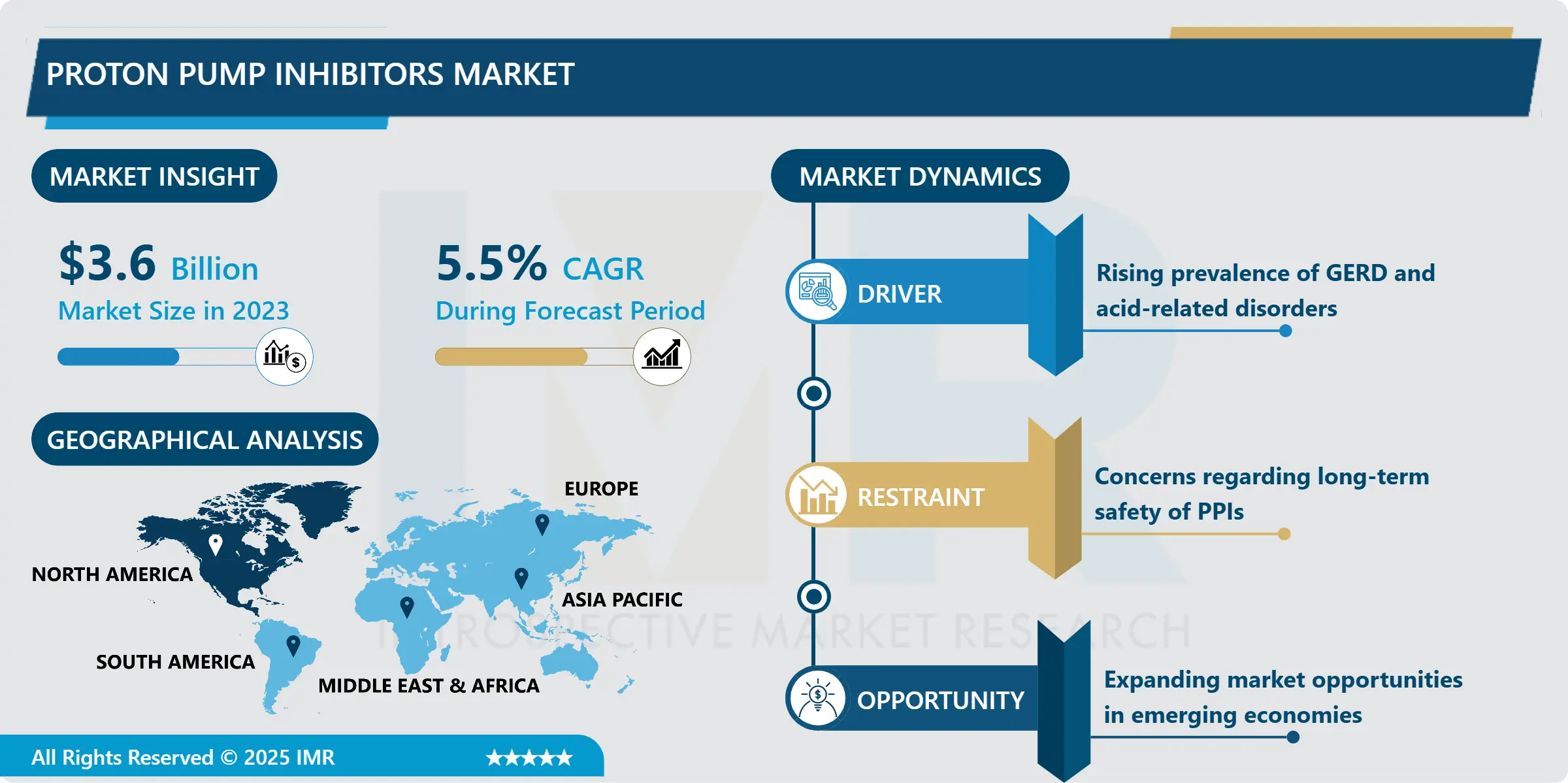
Proton Pump Inhibitors Market Size Was Valued at USD 3.6 Billion in 2023, and is Projected to Reach USD 5.8 Billion by 2032, Growing at a CAGR of 5.5% From 2024-2032.
Proton Pump Inhibitors (PPIs) are a class of medications that function on the principle of aciding the amount of stomach acid. These drugs are prescribed for various ailments like GERD, ulcers and Zollinger Ellison syndrome. PPIs operate by binding to the pump within the stomach lining that produces acid and this leads to the control of the symptoms related to increased levels of acid production. The drugs featured within the Proton Pump Inhibitors market include omeprazole, esomeprazole, pantoprazole, lansoprazole among others for both prescription and over the counter purposes globally.
Proton Pump Inhibitors has seen steady growth in the past decade owing to evolving lifestyles, growing incidences of gastrointestinal problems, aging population, overall increase in the Standard of Living and related factors mile largening the incidence of acid related diseases therefore putting up a growing demand for Proton Pump Inhibitors. The market is stimulated by the need to escalate the treatment of diseases such as GERD and ulcers which occur in millions of people. Hence, the prescription based as well as the Counter OTC supplies of PPIs have experience a high demand, therefore driving the growth of global market. Costs: The market features a relatively high amount of generic formulations indicating that PPIs are generally available to patients.
Steady development of new remedies and increased health consciousness shall be continued in the market, especially with the development of emerging nations. The change of prescription PPI from Counter drugs over the counter has led to the increase of market. However, controversies that involve the long-term health risks associated with the consumption of PPIs for example the conclusions that the drugs cause kidney disease and dementia might affect the market. Further, market rivalry with other acid-suppressing drugs, such as H2 receptor antagonists, is one of the trends that threatens the market dynamics.
Proton Pump Inhibitors Market Trend Analysis:
Increasing Use of Over-the-Counter PPIs
- Another key issue that emerged from the analysis of the Proton Pump Inhibitors market is the growing tendency of making PPIs available without prescription. While prescription to OTC change has increase accessibility and reach of PPIs, specially in North America and Europeans where LMICs are taking the reform based acid reflux and related conditions. This is so because acquiring drugs does not require the services of a doctor, and there is increasing concern about GERD treatment. As for the trend, Manufacturers are coming up with different forms of OTC, making it easy for patients to access cheap and quality treatment. The OTC segment is expected to have fairly good growth throughout the forecast period thus adding a pinch to the overall growth of the market.
Growing Opportunities in Emerging Markets
- The worlds upcoming markets especially the Asia-Pacific and Latin America region prove vast potential for the growth of the Proton Pump Inhibitors market. These regions are seeing a spike in incidences of gastroenterological diseases due to transition in diets, stressed lifestyles and a developing urban culture. In addition, the elevated costs in these regions to deal with ailments, together with the enhancement in the availability of healthcare, have played the key roles in boosting the diagnosis and treatment of acid-related diseases. China and India with their large pool of population are expected to be the prominent market for the players operating in the said market. Moreover, a relatively slow implementation of healthcare insurance policies in these areas highly decided to help augment a demand for PPIs accompanied by prescription-only medications.
Proton Pump Inhibitors Market Segment Analysis:
Proton Pump Inhibitors Market is Segmented on the basis of type, Disease Indication, Dosage Form, and Region.
By Type, Omeprazole segment is expected to dominate the market during the forecast period
- By studying the market share of each type of PPIs, it is found that Omeprazole segment will have maximum market share during the forecast period. Omeprazole is one of the most widely used and effective PPIs owing to the drug’s effectiveness in managing GERD, ulcers as well as other acid-related health complications. It is affordable and is available as prescription medication and Over the Counter drugs; it also has few side effects. Besides, it is backed by so many generic versions which makes it available to all patient all over the economic classes. Therefore, the Omeprazole segment remains as dominant as before in terms of market share and commanded a large share of the Global PPI market revenue.
By Disease Indication, Ulcers segment expected to held the largest share
- When considering the various disease indications for markets, the Ulcers segment is expected to dominate the markets for the duration of the forecast period. Eradication of Helicobacter pylori and the healing of active peptic ulcers: a systematic review of short- and long-term outcomes after high-dose proton pump inhibitor treatment for acid suppression, Opac exams for peptic ulcers include both gastric and duodenal ulcers. Ulcers have been realized to be on the high side due to effects like use of NSAIDs, Helicobacter pylori, and other life issues. This is why PPI is often regarded as the first – line treatment for ulcer because it easily decreases the levels of stomach acid and promotes the repair and healing of its lining. Increasing cases of ulcers have gone hand in hand with needs in PPI treatments and hence is the largest segment in terms of revenues.
Proton Pump Inhibitors Market Regional Insights:
North America is Expected to Dominate the Market Over the Forecast period
- At present the market for Proton Pump Inhibitors is anticipated to develop most dynamically in North America which is likely to remain the largest market for PPIs in 2023 due to the high incidencer of GERD and other acid-related disorders in the region. It captures nearly half of the worldwide market and is followed by Europe because of their well-developed healthcare system, higher utilization of OTC and prescription PPIs and well- informed populace about health care. Projected market shares indicated that North America has the largest share of the global PPI market at approximately 35% in 2023. Besides, the generic availability of PPIs and the region’s high per capita health care expenditure has strengthen the position as the largest market.
Active Key Players in the Proton Pump Inhibitors Market:
- Abbott Laboratories (USA)
- AstraZeneca (UK)
- Aurobindo Pharma (India)
- Bayer AG (Germany)
- Cipla (India)
- Dr. Reddy’s Laboratories (India)
- GlaxoSmithKline (UK)
- Johnson & Johnson (USA)
- Mylan (USA)
- Novartis (Switzerland)
- Pfizer (USA)
- Sanofi (France)
- Sun Pharmaceuticals (India)
- Takeda Pharmaceuticals (Japan)
- Teva Pharmaceuticals (Israel), and Other Active Players
|
Proton Pump Inhibitors Market |
|||
|
Base Year: |
2023 |
Forecast Period: |
2024-2032 |
|
Historical Data: |
2017 to 2023 |
Market Size in 2023: |
USD 3.6 Billion |
|
Forecast Period 2024-32 CAGR: |
5.5% |
Market Size in 2032: |
USD 5.8 Billion |
|
Segments Covered: |
By Type |
|
|
|
By Disease Indication |
|
||
|
By Dosage Form |
|
||
|
By Region |
|
||
|
Key Market Drivers: |
|
||
|
Key Market Restraints: |
|
||
|
Key Opportunities: |
|
||
|
Companies Covered in the report: |
|
||
Chapter 1: Introduction
1.1 Scope and Coverage
Chapter 2:Executive Summary
Chapter 3: Market Landscape
3.1 Market Dynamics
3.1.1 Drivers
3.1.2 Restraints
3.1.3 Opportunities
3.1.4 Challenges
3.2 Market Trend Analysis
3.3 PESTLE Analysis
3.4 Porter's Five Forces Analysis
3.5 Industry Value Chain Analysis
3.6 Ecosystem
3.7 Regulatory Landscape
3.8 Price Trend Analysis
3.9 Patent Analysis
3.10 Technology Evolution
3.11 Investment Pockets
3.12 Import-Export Analysis
Chapter 4: Proton Pump Inhibitors Market by Type
4.1 Proton Pump Inhibitors Market Snapshot and Growth Engine
4.2 Proton Pump Inhibitors Market Overview
4.3 Omeprazole
4.3.1 Introduction and Market Overview
4.3.2 Historic and Forecasted Market Size in Value USD and Volume Units (2017-2032F)
4.3.3 Key Market Trends, Growth Factors and Opportunities
4.3.4 Omeprazole: Geographic Segmentation Analysis
4.4 Pantaprazole
4.4.1 Introduction and Market Overview
4.4.2 Historic and Forecasted Market Size in Value USD and Volume Units (2017-2032F)
4.4.3 Key Market Trends, Growth Factors and Opportunities
4.4.4 Pantaprazole: Geographic Segmentation Analysis
4.5 Rabeprazole
4.5.1 Introduction and Market Overview
4.5.2 Historic and Forecasted Market Size in Value USD and Volume Units (2017-2032F)
4.5.3 Key Market Trends, Growth Factors and Opportunities
4.5.4 Rabeprazole: Geographic Segmentation Analysis
4.6 Dexlansoprazole
4.6.1 Introduction and Market Overview
4.6.2 Historic and Forecasted Market Size in Value USD and Volume Units (2017-2032F)
4.6.3 Key Market Trends, Growth Factors and Opportunities
4.6.4 Dexlansoprazole: Geographic Segmentation Analysis
4.7 lansoprazole
4.7.1 Introduction and Market Overview
4.7.2 Historic and Forecasted Market Size in Value USD and Volume Units (2017-2032F)
4.7.3 Key Market Trends, Growth Factors and Opportunities
4.7.4 lansoprazole: Geographic Segmentation Analysis
4.8 Others
4.8.1 Introduction and Market Overview
4.8.2 Historic and Forecasted Market Size in Value USD and Volume Units (2017-2032F)
4.8.3 Key Market Trends, Growth Factors and Opportunities
4.8.4 Others: Geographic Segmentation Analysis
Chapter 5: Proton Pump Inhibitors Market by Disease Indication
5.1 Proton Pump Inhibitors Market Snapshot and Growth Engine
5.2 Proton Pump Inhibitors Market Overview
5.3 Ulcers
5.3.1 Introduction and Market Overview
5.3.2 Historic and Forecasted Market Size in Value USD and Volume Units (2017-2032F)
5.3.3 Key Market Trends, Growth Factors and Opportunities
5.3.4 Ulcers: Geographic Segmentation Analysis
5.4 Gastroesophageal Reflux Disease
5.4.1 Introduction and Market Overview
5.4.2 Historic and Forecasted Market Size in Value USD and Volume Units (2017-2032F)
5.4.3 Key Market Trends, Growth Factors and Opportunities
5.4.4 Gastroesophageal Reflux Disease: Geographic Segmentation Analysis
5.5 Others
5.5.1 Introduction and Market Overview
5.5.2 Historic and Forecasted Market Size in Value USD and Volume Units (2017-2032F)
5.5.3 Key Market Trends, Growth Factors and Opportunities
5.5.4 Others: Geographic Segmentation Analysis
Chapter 6: Proton Pump Inhibitors Market by Dosage Form
6.1 Proton Pump Inhibitors Market Snapshot and Growth Engine
6.2 Proton Pump Inhibitors Market Overview
6.3 Tablet
6.3.1 Introduction and Market Overview
6.3.2 Historic and Forecasted Market Size in Value USD and Volume Units (2017-2032F)
6.3.3 Key Market Trends, Growth Factors and Opportunities
6.3.4 Tablet: Geographic Segmentation Analysis
6.4 Capsules
6.4.1 Introduction and Market Overview
6.4.2 Historic and Forecasted Market Size in Value USD and Volume Units (2017-2032F)
6.4.3 Key Market Trends, Growth Factors and Opportunities
6.4.4 Capsules: Geographic Segmentation Analysis
6.5 Injection
6.5.1 Introduction and Market Overview
6.5.2 Historic and Forecasted Market Size in Value USD and Volume Units (2017-2032F)
6.5.3 Key Market Trends, Growth Factors and Opportunities
6.5.4 Injection: Geographic Segmentation Analysis
6.6 Others
6.6.1 Introduction and Market Overview
6.6.2 Historic and Forecasted Market Size in Value USD and Volume Units (2017-2032F)
6.6.3 Key Market Trends, Growth Factors and Opportunities
6.6.4 Others: Geographic Segmentation Analysis
Chapter 7: Company Profiles and Competitive Analysis
7.1 Competitive Landscape
7.1.1 Competitive Benchmarking
7.1.2 Proton Pump Inhibitors Market Share by Manufacturer (2023)
7.1.3 Industry BCG Matrix
7.1.4 Heat Map Analysis
7.1.5 Mergers and Acquisitions
7.2 ABBOTT LABORATORIES (USA)
7.2.1 Company Overview
7.2.2 Key Executives
7.2.3 Company Snapshot
7.2.4 Role of the Company in the Market
7.2.5 Sustainability and Social Responsibility
7.2.6 Operating Business Segments
7.2.7 Product Portfolio
7.2.8 Business Performance
7.2.9 Key Strategic Moves and Recent Developments
7.2.10 SWOT Analysis
7.3 ASTRAZENECA (UK)
7.4 AUROBINDO PHARMA (INDIA)
7.5 BAYER AG (GERMANY)
7.6 CIPLA (INDIA)
7.7 DR. REDDY’S LABORATORIES (INDIA)
7.8 GLAXOSMITHKLINE (UK)
7.9 JOHNSON & JOHNSON (USA)
7.10 MYLAN (USA)
7.11 NOVARTIS (SWITZERLAND)
7.12 PFIZER (USA)
7.13 SANOFI (FRANCE)
7.14 SUN PHARMACEUTICALS (INDIA)
7.15 TAKEDA PHARMACEUTICALS (JAPAN)
7.16 TEVA PHARMACEUTICALS (ISRAEL)
7.17 OTHER ACTIVE PLAYERS KEY PLAYERS
7.18 OTHER ACTIVE PLAYERS
Chapter 8: Global Proton Pump Inhibitors Market By Region
8.1 Overview
8.2. North America Proton Pump Inhibitors Market
8.2.1 Key Market Trends, Growth Factors and Opportunities
8.2.2 Top Key Companies
8.2.3 Historic and Forecasted Market Size by Segments
8.2.4 Historic and Forecasted Market Size By Type
8.2.4.1 Omeprazole
8.2.4.2 Pantaprazole
8.2.4.3 Rabeprazole
8.2.4.4 Dexlansoprazole
8.2.4.5 lansoprazole
8.2.4.6 Others
8.2.5 Historic and Forecasted Market Size By Disease Indication
8.2.5.1 Ulcers
8.2.5.2 Gastroesophageal Reflux Disease
8.2.5.3 Others
8.2.6 Historic and Forecasted Market Size By Dosage Form
8.2.6.1 Tablet
8.2.6.2 Capsules
8.2.6.3 Injection
8.2.6.4 Others
8.2.7 Historic and Forecast Market Size by Country
8.2.7.1 US
8.2.7.2 Canada
8.2.7.3 Mexico
8.3. Eastern Europe Proton Pump Inhibitors Market
8.3.1 Key Market Trends, Growth Factors and Opportunities
8.3.2 Top Key Companies
8.3.3 Historic and Forecasted Market Size by Segments
8.3.4 Historic and Forecasted Market Size By Type
8.3.4.1 Omeprazole
8.3.4.2 Pantaprazole
8.3.4.3 Rabeprazole
8.3.4.4 Dexlansoprazole
8.3.4.5 lansoprazole
8.3.4.6 Others
8.3.5 Historic and Forecasted Market Size By Disease Indication
8.3.5.1 Ulcers
8.3.5.2 Gastroesophageal Reflux Disease
8.3.5.3 Others
8.3.6 Historic and Forecasted Market Size By Dosage Form
8.3.6.1 Tablet
8.3.6.2 Capsules
8.3.6.3 Injection
8.3.6.4 Others
8.3.7 Historic and Forecast Market Size by Country
8.3.7.1 Russia
8.3.7.2 Bulgaria
8.3.7.3 The Czech Republic
8.3.7.4 Hungary
8.3.7.5 Poland
8.3.7.6 Romania
8.3.7.7 Rest of Eastern Europe
8.4. Western Europe Proton Pump Inhibitors Market
8.4.1 Key Market Trends, Growth Factors and Opportunities
8.4.2 Top Key Companies
8.4.3 Historic and Forecasted Market Size by Segments
8.4.4 Historic and Forecasted Market Size By Type
8.4.4.1 Omeprazole
8.4.4.2 Pantaprazole
8.4.4.3 Rabeprazole
8.4.4.4 Dexlansoprazole
8.4.4.5 lansoprazole
8.4.4.6 Others
8.4.5 Historic and Forecasted Market Size By Disease Indication
8.4.5.1 Ulcers
8.4.5.2 Gastroesophageal Reflux Disease
8.4.5.3 Others
8.4.6 Historic and Forecasted Market Size By Dosage Form
8.4.6.1 Tablet
8.4.6.2 Capsules
8.4.6.3 Injection
8.4.6.4 Others
8.4.7 Historic and Forecast Market Size by Country
8.4.7.1 Germany
8.4.7.2 UK
8.4.7.3 France
8.4.7.4 The Netherlands
8.4.7.5 Italy
8.4.7.6 Spain
8.4.7.7 Rest of Western Europe
8.5. Asia Pacific Proton Pump Inhibitors Market
8.5.1 Key Market Trends, Growth Factors and Opportunities
8.5.2 Top Key Companies
8.5.3 Historic and Forecasted Market Size by Segments
8.5.4 Historic and Forecasted Market Size By Type
8.5.4.1 Omeprazole
8.5.4.2 Pantaprazole
8.5.4.3 Rabeprazole
8.5.4.4 Dexlansoprazole
8.5.4.5 lansoprazole
8.5.4.6 Others
8.5.5 Historic and Forecasted Market Size By Disease Indication
8.5.5.1 Ulcers
8.5.5.2 Gastroesophageal Reflux Disease
8.5.5.3 Others
8.5.6 Historic and Forecasted Market Size By Dosage Form
8.5.6.1 Tablet
8.5.6.2 Capsules
8.5.6.3 Injection
8.5.6.4 Others
8.5.7 Historic and Forecast Market Size by Country
8.5.7.1 China
8.5.7.2 India
8.5.7.3 Japan
8.5.7.4 South Korea
8.5.7.5 Malaysia
8.5.7.6 Thailand
8.5.7.7 Vietnam
8.5.7.8 The Philippines
8.5.7.9 Australia
8.5.7.10 New Zealand
8.5.7.11 Rest of APAC
8.6. Middle East & Africa Proton Pump Inhibitors Market
8.6.1 Key Market Trends, Growth Factors and Opportunities
8.6.2 Top Key Companies
8.6.3 Historic and Forecasted Market Size by Segments
8.6.4 Historic and Forecasted Market Size By Type
8.6.4.1 Omeprazole
8.6.4.2 Pantaprazole
8.6.4.3 Rabeprazole
8.6.4.4 Dexlansoprazole
8.6.4.5 lansoprazole
8.6.4.6 Others
8.6.5 Historic and Forecasted Market Size By Disease Indication
8.6.5.1 Ulcers
8.6.5.2 Gastroesophageal Reflux Disease
8.6.5.3 Others
8.6.6 Historic and Forecasted Market Size By Dosage Form
8.6.6.1 Tablet
8.6.6.2 Capsules
8.6.6.3 Injection
8.6.6.4 Others
8.6.7 Historic and Forecast Market Size by Country
8.6.7.1 Turkiye
8.6.7.2 Bahrain
8.6.7.3 Kuwait
8.6.7.4 Saudi Arabia
8.6.7.5 Qatar
8.6.7.6 UAE
8.6.7.7 Israel
8.6.7.8 South Africa
8.7. South America Proton Pump Inhibitors Market
8.7.1 Key Market Trends, Growth Factors and Opportunities
8.7.2 Top Key Companies
8.7.3 Historic and Forecasted Market Size by Segments
8.7.4 Historic and Forecasted Market Size By Type
8.7.4.1 Omeprazole
8.7.4.2 Pantaprazole
8.7.4.3 Rabeprazole
8.7.4.4 Dexlansoprazole
8.7.4.5 lansoprazole
8.7.4.6 Others
8.7.5 Historic and Forecasted Market Size By Disease Indication
8.7.5.1 Ulcers
8.7.5.2 Gastroesophageal Reflux Disease
8.7.5.3 Others
8.7.6 Historic and Forecasted Market Size By Dosage Form
8.7.6.1 Tablet
8.7.6.2 Capsules
8.7.6.3 Injection
8.7.6.4 Others
8.7.7 Historic and Forecast Market Size by Country
8.7.7.1 Brazil
8.7.7.2 Argentina
8.7.7.3 Rest of SA
Chapter 9 Analyst Viewpoint and Conclusion
9.1 Recommendations and Concluding Analysis
9.2 Potential Market Strategies
Chapter 10 Research Methodology
10.1 Research Process
10.2 Primary Research
10.3 Secondary Research
|
Proton Pump Inhibitors Market |
|||
|
Base Year: |
2023 |
Forecast Period: |
2024-2032 |
|
Historical Data: |
2017 to 2023 |
Market Size in 2023: |
USD 3.6 Billion |
|
Forecast Period 2024-32 CAGR: |
5.5% |
Market Size in 2032: |
USD 5.8 Billion |
|
Segments Covered: |
By Type |
|
|
|
By Disease Indication |
|
||
|
By Dosage Form |
|
||
|
By Region |
|
||
|
Key Market Drivers: |
|
||
|
Key Market Restraints: |
|
||
|
Key Opportunities: |
|
||
|
Companies Covered in the report: |
|
||


