




Posture Corrector Market Synopsis:
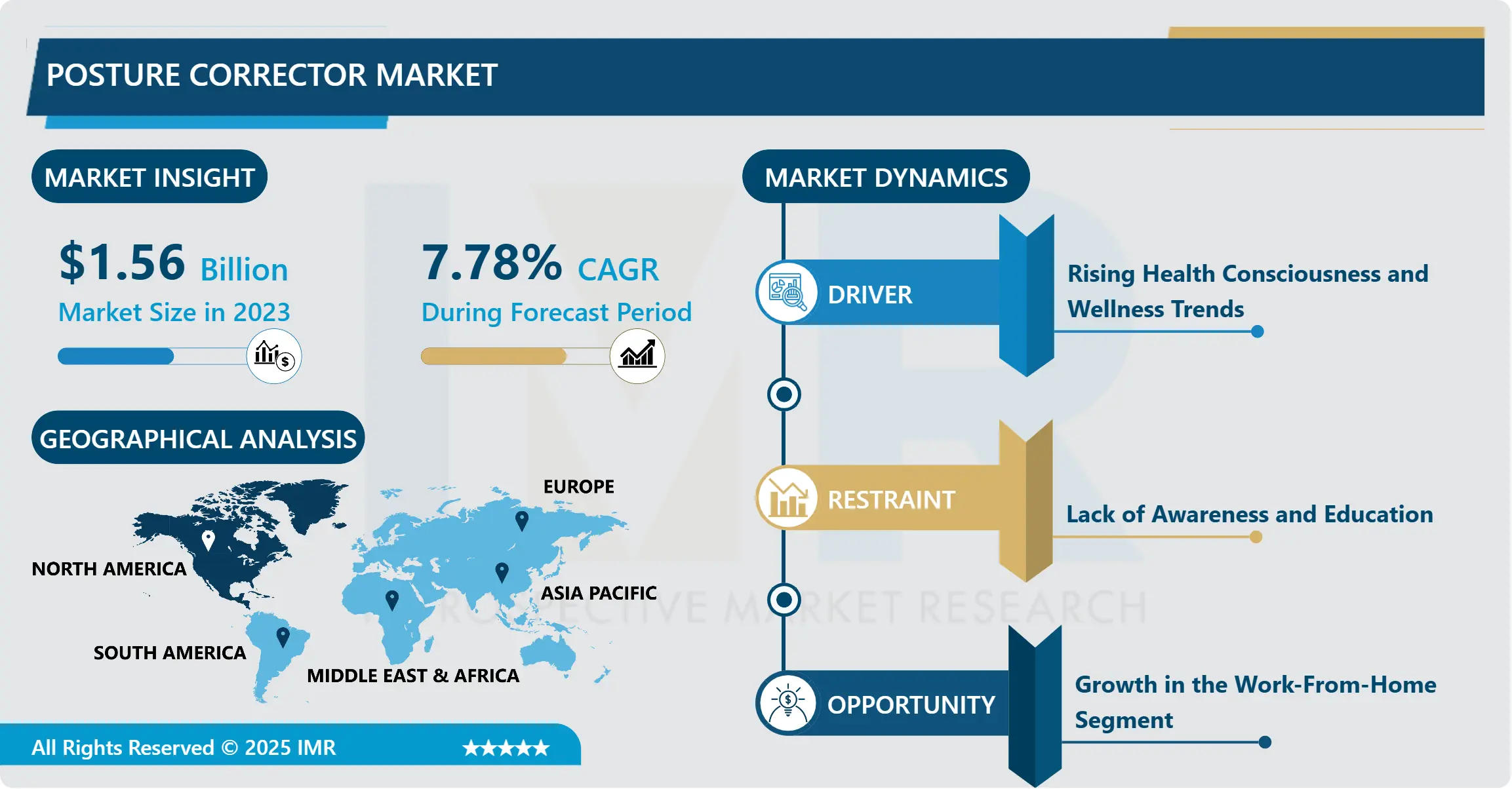
Posture Corrector Market Size Was Valued at USD 1.56 Billion in 2023, and is Projected to Reach USD 3.06 Billion by 2032, Growing at a CAGR of 7.78% From 2024-2032.
The postural Braces market encompasses devices intended to enhance or alter the users posture and mitigate negative impact of poor posture. People who spend most of their time sitting, standing, or who have poor posture often use these devices due to back, neck or shoulder pain. The market covers a wide group of products including the kinesiology tape and posture braces for those in various ages and physically active or sedentary lifestyles.
Posture has become a growing concern for many people due to backaches, neck pain and other ailments that are as a result of poor posture, hence the rising demand for the Posture corrector market. Sitting at market desks, cooking or washing dishes, and hours staring at screens have led to severe postural distortions, hence the present high demand for corrective appliances. With today’s generation considering their health more importantly, posture correcting devices have now emerged popularly.
The market consists of products like kinesiology tape, posture braces, sitting supports and many more which are targeted to solve different postural problems. These products are available in physical store and also in online stores hence extending market reach to a wider market segment. Besides, increase in information technology and increased emphasis on preventive healthcare and working from home advice has created a high demand for posture corrector devices due to adverse effects of sitting for long hours. The development of technological devices such as posture correcting appliances that display output in real time has also been a factor that has reinforced interest in these products.
People are using these products not just for treating pain but as a preventive measure as well is felt. The market has been bolstered by the capability proper posture brings to improved breathing, digestion and overall well-being. Furthermore, thanks to Internet shops, many customers prefer to choose a product regarding its service and cost of treatment of posture correction.
The expanded market niches of the posture corrector have given brands the opportunity to appeal to various individuals in different geographical locations globally. People approach the corrective devices radically in equal measure, along with men and women as well as children incorporating posture correction products into their respective routines. As these demands increase, producers are developing and expanding new products to address certain specific requirements like those that are appropriate for the office users or slim and portable ones for the consumers with an active lifestyle.
Posture Corrector Market Trend Analysis:
Rise of Smart Posture Correctors
- They found that one of the most influential trends in the Posture Corrector market is getting smarter, featuring smart posture correction devices. This technology includes sensors, mobile applications and wearable devices for real time correction of users’ posture. The incorporation of smart elements enables people to control their posture more effectively since they can monitor their advancement and be notified of times they slouched and started leaning forward. These devices are portable, and the public’s demand for wearable health tech, in general, is driving the demand for smart posture correctors.
- Not only do these smart devices fulfill a purpose, they are also more convenient and versatile than typical everyday physical products such as posture braces or kinesiology tapes. People do not need to be self-aware, and by themselves seek the appropriate correction of the spine or shift in one’s sitting position which is provided by the device. This trend is attractive not only for those people who have back or neck pain but also it targets those who want to maintain their overall good physical condition. The necessity for such innovative, simple products will remain high as technology remains to increasingly permeate the population’s existence.
Growth in the Work-From-Home Segment
- The growth of people working from home thus provides a good chance for the demand of Posture Corrector to improve. Current majored work culture involves employees sitting at their desks for many hours as work embraces remote working. This has lead to high incidences of musculoskeletal disorders, including back pain which can be managed by the use of ideal posture control gadgets. Manufacturers of adjustable office chairs and anti-sitting devices relating to ergonomic workplace designs are also benefiting from increased consumer interest in avoiding pain or further deterioration of their health due to sitting.
- Furthermore, as the working from home setup continues, there is a concern about posture when working at a computer to improve work efficiency and health. The opportunity is to engage this new remote working audience by providing posture correctors designed specifically for home office scenarios. Pain relief devices, Position control equipment; foldable lightweight back support or sitter aid can interest the freelancers to purchase them since they need the equipment to reduce the long time impacts of working continuously.
Posture Corrector Market Segment Analysis:
Posture Corrector Market is Segmented on the basis of Product, Distribution Channel, End User, and Region.
By Product, Kinesiology Tape segment is expected to dominate the market during the forecast period
- The Posture Corrector market is divided mainly into several product types such as kinesiology tape, sitting support devices, posture braces, and other. Kinesiology tape is common with the sporting fraternity as well as the physical rehabilitation segment since it holds the body without limiting mobility. This product is favorite among athletes as well as people who are experiencing some kind of an injury, yet it doesn’t limit movement in any way. Sitting support devices are popular and demanded more often because the public is getting to know about ergonomics, seating especially among office workers and those who stay seated for many hours.
- Another significant product within the market is posture braces that offer even greater stability to patients experiencing lasting back pain or needing adjustment to their position to an extent greater than that offered by the lumbar cushion. Such products are normally mobile and fabricated specially in a way that they have the flexibility that is essential in responding to the posture needs of an individual. Other products that exist within the market are the posture cushions, ergonomic pillow and even wearable posture detectors. As people make increasing use of such devices, manufacturers are developing and producing more diverse products – sleek and discrete, or technologically advanced, functionally reaching out to meet as many customer preferences as possible.
By End User, Men segment expected to held the largest share
- The Posture Corrector market is widely used by men and women of all ages, as well as children. Positives: Men wear posture correctors for correcting the back and shoulder posture and these may include sportsmen and workers on a desk. Women, on the other hand, are including posture corrector devices as some of the health enhancing products that they use. Most female posture correctors are flexible and stylish since they still have to maintain their posture while dressing decently.
- There are also Pediatric posture correctors being sold currently especially due to increase in sitting time among the young people today. Posture corrector devices for children are designed to be comfortable and can be adjusted, conform to the head and shoulders, so that children can comfortably wear them, because long-term posture problems that need to be solved by doctors may develop due to improper posture. Since the population becomes more aware of such problems, increasingly more parents are buying these goods in order the child wake up with good posture habits, thus, we see the emergence of the new segment on the market – corrections for children.
Posture Corrector Market Regional Insights:
North America is Expected to Dominate the Market Over the Forecast period
- North America is now the largest market share owner in the Posture Corrector market. The factors that have been fuelling the success of this region include availability of robust healthcare services, greater orientation of consumers towards Wellness, and rising emphasis on preventive healthcare services. Therefore, the increasing incidence of back and neck ache caused by laid-back life-style patterns with more people living into their seniority creates a favourable market for posture correction. North Americans are now able to conveniently buy digital health technologies and various products online via modified e-commerce platforms which are timely making consumers aware of purchasing posture correctors as part of their healthy lifestyles.
- The expansion in North America is complemented by a conducive retail environment and availability of quality as well as quality and innovative products. Firms in the region have vested themselves in exclusive innovation of postural correction technologically with smart wearables and ergonomically enhanced products. Moreover, so far in North America, healthcare professionals are recommending posture correction as a preventive measure that has informed people on the utility of posture correctors and has led to high usage among different age groups.
Active Key Players in the Posture Corrector Market:
- Mueller Sports Medicine (USA)
- PostureTech (USA)
- Back Embrace (USA)
- Vive Health (USA)
- Bauerfeind (Germany)
- Samsonite (USA)
- Fitterfirst (Canada)
- AirPhysio (Australia)
- Orthomotion (Germany)
- Truweo (USA)
- Corrective Posture (UK)
- Dorsal (USA)
- Other Active Players
|
Posture Corrector Market |
|||
|
Base Year: |
2023 |
Forecast Period: |
2024-2032 |
|
Historical Data: |
2017 to 2023 |
Market Size in 2023: |
USD 1.56 Billion |
|
Forecast Period 2024-32 CAGR: |
7.78% |
Market Size in 2032: |
USD 3.06 Billion |
|
Segments Covered: |
By Product |
|
|
|
By Distribution Channel |
|
||
|
By End User |
|
||
|
By Region |
|
||
|
Key Market Drivers: |
|
||
|
Key Market Restraints: |
|
||
|
Key Opportunities: |
|
||
|
Companies Covered in the report: |
|
||
Chapter 1: Introduction
1.1 Scope and Coverage
Chapter 2:Executive Summary
Chapter 3: Market Landscape
3.1 Market Dynamics
3.1.1 Drivers
3.1.2 Restraints
3.1.3 Opportunities
3.1.4 Challenges
3.2 Market Trend Analysis
3.3 PESTLE Analysis
3.4 Porter's Five Forces Analysis
3.5 Industry Value Chain Analysis
3.6 Ecosystem
3.7 Regulatory Landscape
3.8 Price Trend Analysis
3.9 Patent Analysis
3.10 Technology Evolution
3.11 Investment Pockets
3.12 Import-Export Analysis
Chapter 4: Posture Corrector Market by Product
4.1 Posture Corrector Market Snapshot and Growth Engine
4.2 Posture Corrector Market Overview
4.3 Kinesiology Tape
4.3.1 Introduction and Market Overview
4.3.2 Historic and Forecasted Market Size in Value USD and Volume Units (2017-2032F)
4.3.3 Key Market Trends, Growth Factors and Opportunities
4.3.4 Kinesiology Tape: Geographic Segmentation Analysis
4.4 Sitting Support Devices
4.4.1 Introduction and Market Overview
4.4.2 Historic and Forecasted Market Size in Value USD and Volume Units (2017-2032F)
4.4.3 Key Market Trends, Growth Factors and Opportunities
4.4.4 Sitting Support Devices: Geographic Segmentation Analysis
4.5 Posture Braces
4.5.1 Introduction and Market Overview
4.5.2 Historic and Forecasted Market Size in Value USD and Volume Units (2017-2032F)
4.5.3 Key Market Trends, Growth Factors and Opportunities
4.5.4 Posture Braces: Geographic Segmentation Analysis
4.6 Others
4.6.1 Introduction and Market Overview
4.6.2 Historic and Forecasted Market Size in Value USD and Volume Units (2017-2032F)
4.6.3 Key Market Trends, Growth Factors and Opportunities
4.6.4 Others: Geographic Segmentation Analysis
Chapter 5: Posture Corrector Market by Distribution Channel
5.1 Posture Corrector Market Snapshot and Growth Engine
5.2 Posture Corrector Market Overview
5.3 E- Commerce
5.3.1 Introduction and Market Overview
5.3.2 Historic and Forecasted Market Size in Value USD and Volume Units (2017-2032F)
5.3.3 Key Market Trends, Growth Factors and Opportunities
5.3.4 E- Commerce: Geographic Segmentation Analysis
5.4 Specialty Stores
5.4.1 Introduction and Market Overview
5.4.2 Historic and Forecasted Market Size in Value USD and Volume Units (2017-2032F)
5.4.3 Key Market Trends, Growth Factors and Opportunities
5.4.4 Specialty Stores: Geographic Segmentation Analysis
5.5 Pharmacy and Healthcare Stores
5.5.1 Introduction and Market Overview
5.5.2 Historic and Forecasted Market Size in Value USD and Volume Units (2017-2032F)
5.5.3 Key Market Trends, Growth Factors and Opportunities
5.5.4 Pharmacy and Healthcare Stores: Geographic Segmentation Analysis
Chapter 6: Posture Corrector Market by End-Use
6.1 Posture Corrector Market Snapshot and Growth Engine
6.2 Posture Corrector Market Overview
6.3 Men
6.3.1 Introduction and Market Overview
6.3.2 Historic and Forecasted Market Size in Value USD and Volume Units (2017-2032F)
6.3.3 Key Market Trends, Growth Factors and Opportunities
6.3.4 Men: Geographic Segmentation Analysis
6.4 Women
6.4.1 Introduction and Market Overview
6.4.2 Historic and Forecasted Market Size in Value USD and Volume Units (2017-2032F)
6.4.3 Key Market Trends, Growth Factors and Opportunities
6.4.4 Women: Geographic Segmentation Analysis
6.5 Kids
6.5.1 Introduction and Market Overview
6.5.2 Historic and Forecasted Market Size in Value USD and Volume Units (2017-2032F)
6.5.3 Key Market Trends, Growth Factors and Opportunities
6.5.4 Kids: Geographic Segmentation Analysis
Chapter 7: Company Profiles and Competitive Analysis
7.1 Competitive Landscape
7.1.1 Competitive Benchmarking
7.1.2 Posture Corrector Market Share by Manufacturer (2023)
7.1.3 Industry BCG Matrix
7.1.4 Heat Map Analysis
7.1.5 Mergers and Acquisitions
7.2 MUELLER SPORTS MEDICINE (USA)
7.2.1 Company Overview
7.2.2 Key Executives
7.2.3 Company Snapshot
7.2.4 Role of the Company in the Market
7.2.5 Sustainability and Social Responsibility
7.2.6 Operating Business Segments
7.2.7 Product Portfolio
7.2.8 Business Performance
7.2.9 Key Strategic Moves and Recent Developments
7.2.10 SWOT Analysis
7.3 POSTURETECH (USA)
7.4 BACK EMBRACE (USA)
7.5 VIVE HEALTH (USA)
7.6 BAUERFEIND (GERMANY)
7.7 SAMSONITE (USA)
7.8 FITTERFIRST (CANADA)
7.9 AIRPHYSIO (AUSTRALIA)
7.10 ORTHOMOTION (GERMANY)
7.11 TRUWEO (USA)
7.12 CORRECTIVE POSTURE (UK)
7.13 DORSAL (USA)
7.14 OTHER ACTIVE PLAYERS
Chapter 8: Global Posture Corrector Market By Region
8.1 Overview
8.2. North America Posture Corrector Market
8.2.1 Key Market Trends, Growth Factors and Opportunities
8.2.2 Top Key Companies
8.2.3 Historic and Forecasted Market Size by Segments
8.2.4 Historic and Forecasted Market Size By Product
8.2.4.1 Kinesiology Tape
8.2.4.2 Sitting Support Devices
8.2.4.3 Posture Braces
8.2.4.4 Others
8.2.5 Historic and Forecasted Market Size By Distribution Channel
8.2.5.1 E- Commerce
8.2.5.2 Specialty Stores
8.2.5.3 Pharmacy and Healthcare Stores
8.2.6 Historic and Forecasted Market Size By End-Use
8.2.6.1 Men
8.2.6.2 Women
8.2.6.3 Kids
8.2.7 Historic and Forecast Market Size by Country
8.2.7.1 US
8.2.7.2 Canada
8.2.7.3 Mexico
8.3. Eastern Europe Posture Corrector Market
8.3.1 Key Market Trends, Growth Factors and Opportunities
8.3.2 Top Key Companies
8.3.3 Historic and Forecasted Market Size by Segments
8.3.4 Historic and Forecasted Market Size By Product
8.3.4.1 Kinesiology Tape
8.3.4.2 Sitting Support Devices
8.3.4.3 Posture Braces
8.3.4.4 Others
8.3.5 Historic and Forecasted Market Size By Distribution Channel
8.3.5.1 E- Commerce
8.3.5.2 Specialty Stores
8.3.5.3 Pharmacy and Healthcare Stores
8.3.6 Historic and Forecasted Market Size By End-Use
8.3.6.1 Men
8.3.6.2 Women
8.3.6.3 Kids
8.3.7 Historic and Forecast Market Size by Country
8.3.7.1 Russia
8.3.7.2 Bulgaria
8.3.7.3 The Czech Republic
8.3.7.4 Hungary
8.3.7.5 Poland
8.3.7.6 Romania
8.3.7.7 Rest of Eastern Europe
8.4. Western Europe Posture Corrector Market
8.4.1 Key Market Trends, Growth Factors and Opportunities
8.4.2 Top Key Companies
8.4.3 Historic and Forecasted Market Size by Segments
8.4.4 Historic and Forecasted Market Size By Product
8.4.4.1 Kinesiology Tape
8.4.4.2 Sitting Support Devices
8.4.4.3 Posture Braces
8.4.4.4 Others
8.4.5 Historic and Forecasted Market Size By Distribution Channel
8.4.5.1 E- Commerce
8.4.5.2 Specialty Stores
8.4.5.3 Pharmacy and Healthcare Stores
8.4.6 Historic and Forecasted Market Size By End-Use
8.4.6.1 Men
8.4.6.2 Women
8.4.6.3 Kids
8.4.7 Historic and Forecast Market Size by Country
8.4.7.1 Germany
8.4.7.2 UK
8.4.7.3 France
8.4.7.4 The Netherlands
8.4.7.5 Italy
8.4.7.6 Spain
8.4.7.7 Rest of Western Europe
8.5. Asia Pacific Posture Corrector Market
8.5.1 Key Market Trends, Growth Factors and Opportunities
8.5.2 Top Key Companies
8.5.3 Historic and Forecasted Market Size by Segments
8.5.4 Historic and Forecasted Market Size By Product
8.5.4.1 Kinesiology Tape
8.5.4.2 Sitting Support Devices
8.5.4.3 Posture Braces
8.5.4.4 Others
8.5.5 Historic and Forecasted Market Size By Distribution Channel
8.5.5.1 E- Commerce
8.5.5.2 Specialty Stores
8.5.5.3 Pharmacy and Healthcare Stores
8.5.6 Historic and Forecasted Market Size By End-Use
8.5.6.1 Men
8.5.6.2 Women
8.5.6.3 Kids
8.5.7 Historic and Forecast Market Size by Country
8.5.7.1 China
8.5.7.2 India
8.5.7.3 Japan
8.5.7.4 South Korea
8.5.7.5 Malaysia
8.5.7.6 Thailand
8.5.7.7 Vietnam
8.5.7.8 The Philippines
8.5.7.9 Australia
8.5.7.10 New Zealand
8.5.7.11 Rest of APAC
8.6. Middle East & Africa Posture Corrector Market
8.6.1 Key Market Trends, Growth Factors and Opportunities
8.6.2 Top Key Companies
8.6.3 Historic and Forecasted Market Size by Segments
8.6.4 Historic and Forecasted Market Size By Product
8.6.4.1 Kinesiology Tape
8.6.4.2 Sitting Support Devices
8.6.4.3 Posture Braces
8.6.4.4 Others
8.6.5 Historic and Forecasted Market Size By Distribution Channel
8.6.5.1 E- Commerce
8.6.5.2 Specialty Stores
8.6.5.3 Pharmacy and Healthcare Stores
8.6.6 Historic and Forecasted Market Size By End-Use
8.6.6.1 Men
8.6.6.2 Women
8.6.6.3 Kids
8.6.7 Historic and Forecast Market Size by Country
8.6.7.1 Turkiye
8.6.7.2 Bahrain
8.6.7.3 Kuwait
8.6.7.4 Saudi Arabia
8.6.7.5 Qatar
8.6.7.6 UAE
8.6.7.7 Israel
8.6.7.8 South Africa
8.7. South America Posture Corrector Market
8.7.1 Key Market Trends, Growth Factors and Opportunities
8.7.2 Top Key Companies
8.7.3 Historic and Forecasted Market Size by Segments
8.7.4 Historic and Forecasted Market Size By Product
8.7.4.1 Kinesiology Tape
8.7.4.2 Sitting Support Devices
8.7.4.3 Posture Braces
8.7.4.4 Others
8.7.5 Historic and Forecasted Market Size By Distribution Channel
8.7.5.1 E- Commerce
8.7.5.2 Specialty Stores
8.7.5.3 Pharmacy and Healthcare Stores
8.7.6 Historic and Forecasted Market Size By End-Use
8.7.6.1 Men
8.7.6.2 Women
8.7.6.3 Kids
8.7.7 Historic and Forecast Market Size by Country
8.7.7.1 Brazil
8.7.7.2 Argentina
8.7.7.3 Rest of SA
Chapter 9 Analyst Viewpoint and Conclusion
9.1 Recommendations and Concluding Analysis
9.2 Potential Market Strategies
Chapter 10 Research Methodology
10.1 Research Process
10.2 Primary Research
10.3 Secondary Research
|
Posture Corrector Market |
|||
|
Base Year: |
2023 |
Forecast Period: |
2024-2032 |
|
Historical Data: |
2017 to 2023 |
Market Size in 2023: |
USD 1.56 Billion |
|
Forecast Period 2024-32 CAGR: |
7.78% |
Market Size in 2032: |
USD 3.06 Billion |
|
Segments Covered: |
By Product |
|
|
|
By Distribution Channel |
|
||
|
By End User |
|
||
|
By Region |
|
||
|
Key Market Drivers: |
|
||
|
Key Market Restraints: |
|
||
|
Key Opportunities: |
|
||
|
Companies Covered in the report: |
|
||


