
Published On : Mar 2026

Orthopedic Imaging Market Key Developments, Demand & Forecast Report (2024-2032)
Orthopedic Imaging Market by Modality (X-ray, CT, MRI, Ultrasound, Nuclear Imaging), Indication (Trauma Cases, Sport Injuries, Spinal Injuries, Arthritis, Bone Disorders, Musculoskeletal Cancer, Muscle Atrophy, Others), End Use (Hospitals, Diagnostic Imaging Centers, Others), and Region
- Report ID : 20417
- Category : Medical Devices
- Format :



Orthopedic Imaging Market Synopsis:
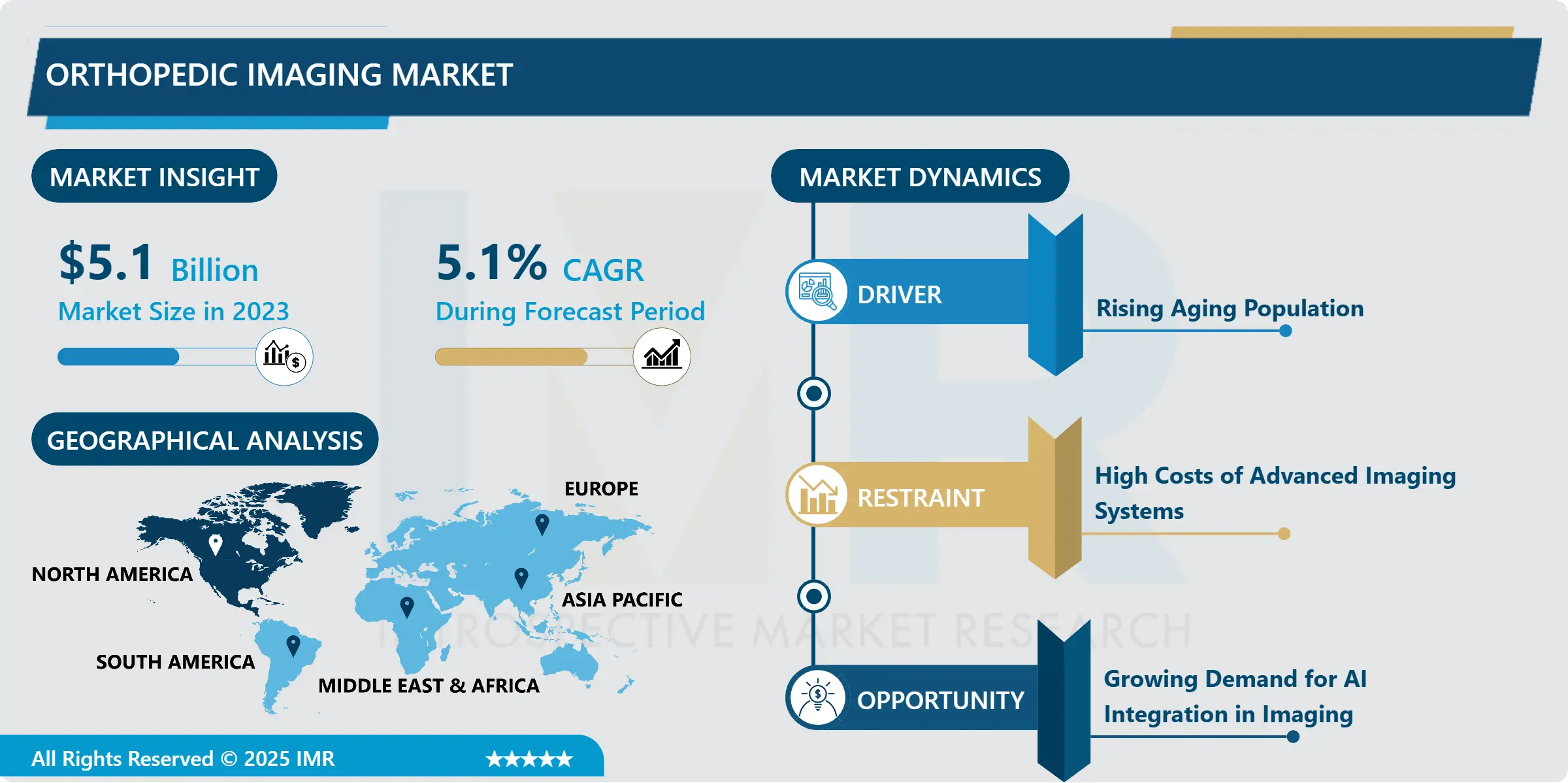
Orthopedic Imaging Market Size Was Valued at USD 5.1 Billion in 2023, and is Projected to Reach USD 7.9 Billion by 2032, Growing at a CAGR of 5.1% From 2024-2032.
The orthopedic imaging market refers to the segment of diagnostic imaging that focuses on visualizing the musculoskeletal system—including bones, joints, ligaments, and soft tissues—to diagnose, monitor, and treat orthopedic conditions. It encompasses various imaging modalities such as X-ray, MRI, CT scans, and ultrasound used in detecting trauma, bone disorders, and degenerative diseases.
The global orthopedic imaging market is witnessing significant growth driven by the rising prevalence of musculoskeletal disorders, sports injuries, and an aging population susceptible to orthopedic conditions. The growing demand for minimally invasive diagnostic techniques and technological advancements in imaging systems are also contributing to market expansion. Integration of AI and machine learning with diagnostic imaging is enhancing accuracy and reducing time to diagnosis.
Orthopedic imaging plays a crucial role in clinical decision-making by providing real-time, detailed visuals for evaluating bone fractures, joint abnormalities, and soft tissue injuries. X-rays remain the most commonly used modality due to their speed and affordability, while MRI and CT scans offer more detailed and 3D visualization required in complex diagnoses. The expanding use of imaging in post-operative monitoring is also supporting demand across healthcare settings.
Furthermore, market growth is supported by a surge in healthcare infrastructure investments and rising awareness among patients. Emerging markets, particularly in Asia-Pacific and Latin America, are showing accelerated adoption of advanced imaging techniques. Moreover, the collaboration between imaging technology companies and orthopedic care providers is leading to the development of customized imaging solutions tailored to specific orthopedic indications.
Orthopedic Imaging Market Trend Analysis:
Growing Geriatric Population and Associated Orthopedic Disorders
- The global increase in the geriatric population is a significant driver for the orthopedic imaging market. As individuals age, they become more susceptible to conditions such as osteoarthritis, osteoporosis, and degenerative joint diseases. These conditions often require imaging for diagnosis, progression tracking, and pre-surgical planning. According to WHO, the global population aged 60 years and above is expected to reach 2.1 billion by 2050, significantly expanding the patient pool needing orthopedic care.
- Older adults often suffer from multiple chronic conditions, making accurate imaging essential for safe and effective treatment planning. The demand for high-resolution and low-radiation imaging modalities, particularly MRI and digital X-rays, is rising among this demographic. Additionally, government-supported programs in developed nations to provide affordable diagnostic care to seniors are further bolstering the market.
AI Integration in Orthopedic Imaging
- The integration of artificial intelligence (AI) in orthopedic imaging presents a major opportunity for market growth. AI algorithms are being increasingly used for image enhancement, anomaly detection, and automated interpretation of imaging data, which can significantly reduce diagnostic errors and improve clinical workflow efficiency. This is particularly beneficial in high-volume diagnostic centers and hospitals facing radiologist shortages.
- Moreover, AI-powered imaging solutions can assist in real-time image analysis, predictive modeling, and surgical planning, especially for complex orthopedic cases. The trend toward personalized medicine is pushing for more precise imaging outcomes, and AI is proving essential in achieving this. Several startups and major imaging companies are investing heavily in AI research, promising an evolution in orthopedic imaging practices in the coming years.
Orthopedic Imaging Market Segment Analysis:
Orthopedic Imaging Market Segmented based on Modality, Indication, End Use, and Region.
By Modality, X-ray segment is expected to dominate the market during the forecast period
- X-ray remains the most commonly utilized imaging modality in orthopedic diagnostics due to its cost-effectiveness, wide accessibility, and quick turnaround time. It is particularly useful in diagnosing fractures, arthritis, and spinal deformities. Digital X-rays offer enhanced imaging quality with reduced radiation exposure, making them increasingly preferred in both hospital and outpatient settings.
- Despite advancements in MRI and CT, the basic necessity of X-ray imaging in preliminary orthopedic assessments ensures its continued dominance. Integration of digital technologies and mobile X-ray units is further extending the reach of X-ray imaging, particularly in emergency trauma and remote healthcare settings.
By Indication, Trauma Cases segment expected to held the largest share
- Trauma cases—including road accidents, falls, and workplace injuries—comprise a significant portion of orthopedic imaging demand. Timely imaging is crucial for accurately diagnosing fractures, dislocations, and soft tissue damage. In trauma scenarios, CT and X-ray are often the first-line modalities for rapid assessment and surgical planning.
- The rising number of trauma cases globally, especially in urban and industrial areas, is driving the adoption of advanced imaging systems in trauma centers and emergency departments. Integration of PACS (Picture Archiving and Communication System) and AI-driven image interpretation is further optimizing trauma care workflows.
Orthopedic Imaging Market Regional Insights:
North America is Expected to Dominate the Market Over the Forecast period
- North America is projected to lead the global orthopedic imaging market due to its well-established healthcare infrastructure, high adoption of advanced imaging technologies, and strong presence of key market players. The region also experiences a high incidence of orthopedic conditions, particularly due to its aging population and widespread sports and lifestyle-related injuries. Government reimbursement policies and increased healthcare spending are also aiding in market growth.
- Moreover, North America has been at the forefront of AI integration in medical imaging, with multiple FDA approvals for AI-powered diagnostic tools. Continuous R&D investment, coupled with strategic partnerships among hospitals and imaging companies, is further accelerating market innovation and expansion in this region.
Active Key Players in the Orthopedic Imaging Market:
- 3M Company (USA)
- Align Technology, Inc. (USA)
- American Orthodontics (USA)
- DB Orthodontics (UK)
- Dental Morelli Ltda (Brazil)
- Dentsply Sirona (USA)
- Dynaflex (USA)
- Forestadent Bernhard Förster GmbH (Germany)
- G&H Orthodontics (USA)
- GC Orthodontics Europe GmbH (Germany)
- Great Lakes Dental Technologies (USA)
- Henry Schein, Inc. (USA)
- JJ Orthodontics (India)
- Leone S.p.A. (Italy)
- Modern Orthodontics (India)
- Ormco Corporation (USA)
- Rocky Mountain Orthodontics (USA)
- Scheu-Dental GmbH (Germany)
- Shinye Odontology Products Co., Ltd. (China)
- TP Orthodontics, Inc. (USA), and Other Active Players
|
Global Orthopedic Imaging Market |
|||
|
Base Year: |
2023 |
Forecast Period: |
2024-2032 |
|
Historical Data: |
2017 to 2023 |
Market Size in 2023: |
USD 5.1 Billion |
|
Forecast Period 2024-32 CAGR: |
5.1% |
Market Size in 2032: |
USD 7.9 Billion |
|
Segments Covered: |
By Modality |
|
|
|
By Indication |
|
||
|
By End User |
|
||
|
By Region |
|
||
|
Key Market Drivers: |
|
||
|
Key Market Restraints: |
|
||
|
Key Opportunities: |
|
||
|
Companies Covered in the report: |
|
||
Chapter 1: Introduction
1.1 Scope and Coverage
Chapter 2:Executive Summary
Chapter 3: Market Landscape
3.1 Market Dynamics
3.1.1 Drivers
3.1.2 Restraints
3.1.3 Opportunities
3.1.4 Challenges
3.2 Market Trend Analysis
3.3 PESTLE Analysis
3.4 Porter's Five Forces Analysis
3.5 Industry Value Chain Analysis
3.6 Ecosystem
3.7 Regulatory Landscape
3.8 Price Trend Analysis
3.9 Patent Analysis
3.10 Technology Evolution
3.11 Investment Pockets
3.12 Import-Export Analysis
Chapter 4: Orthopedic Imaging Market by Modality
4.1 Orthopedic Imaging Market Snapshot and Growth Engine
4.2 Orthopedic Imaging Market Overview
4.3 X-ray
4.3.1 Introduction and Market Overview
4.3.2 Historic and Forecasted Market Size in Value USD and Volume Units (2017-2032F)
4.3.3 Key Market Trends, Growth Factors and Opportunities
4.3.4 X-ray: Geographic Segmentation Analysis
4.4 CT
4.4.1 Introduction and Market Overview
4.4.2 Historic and Forecasted Market Size in Value USD and Volume Units (2017-2032F)
4.4.3 Key Market Trends, Growth Factors and Opportunities
4.4.4 CT: Geographic Segmentation Analysis
4.5 MRI
4.5.1 Introduction and Market Overview
4.5.2 Historic and Forecasted Market Size in Value USD and Volume Units (2017-2032F)
4.5.3 Key Market Trends, Growth Factors and Opportunities
4.5.4 MRI: Geographic Segmentation Analysis
4.6 Ultrasound
4.6.1 Introduction and Market Overview
4.6.2 Historic and Forecasted Market Size in Value USD and Volume Units (2017-2032F)
4.6.3 Key Market Trends, Growth Factors and Opportunities
4.6.4 Ultrasound: Geographic Segmentation Analysis
4.7 Nuclear Imaging
4.7.1 Introduction and Market Overview
4.7.2 Historic and Forecasted Market Size in Value USD and Volume Units (2017-2032F)
4.7.3 Key Market Trends, Growth Factors and Opportunities
4.7.4 Nuclear Imaging: Geographic Segmentation Analysis
Chapter 5: Orthopedic Imaging Market by Indication
5.1 Orthopedic Imaging Market Snapshot and Growth Engine
5.2 Orthopedic Imaging Market Overview
5.3 Trauma Cases
5.3.1 Introduction and Market Overview
5.3.2 Historic and Forecasted Market Size in Value USD and Volume Units (2017-2032F)
5.3.3 Key Market Trends, Growth Factors and Opportunities
5.3.4 Trauma Cases: Geographic Segmentation Analysis
5.4 Sport Injuries
5.4.1 Introduction and Market Overview
5.4.2 Historic and Forecasted Market Size in Value USD and Volume Units (2017-2032F)
5.4.3 Key Market Trends, Growth Factors and Opportunities
5.4.4 Sport Injuries: Geographic Segmentation Analysis
5.5 Spinal Injuries
5.5.1 Introduction and Market Overview
5.5.2 Historic and Forecasted Market Size in Value USD and Volume Units (2017-2032F)
5.5.3 Key Market Trends, Growth Factors and Opportunities
5.5.4 Spinal Injuries: Geographic Segmentation Analysis
5.6 Arthritis
5.6.1 Introduction and Market Overview
5.6.2 Historic and Forecasted Market Size in Value USD and Volume Units (2017-2032F)
5.6.3 Key Market Trends, Growth Factors and Opportunities
5.6.4 Arthritis: Geographic Segmentation Analysis
5.7 Bone Disorders
5.7.1 Introduction and Market Overview
5.7.2 Historic and Forecasted Market Size in Value USD and Volume Units (2017-2032F)
5.7.3 Key Market Trends, Growth Factors and Opportunities
5.7.4 Bone Disorders: Geographic Segmentation Analysis
5.8 Musculoskeletal Cancer
5.8.1 Introduction and Market Overview
5.8.2 Historic and Forecasted Market Size in Value USD and Volume Units (2017-2032F)
5.8.3 Key Market Trends, Growth Factors and Opportunities
5.8.4 Musculoskeletal Cancer: Geographic Segmentation Analysis
5.9 Muscle Atrophy
5.9.1 Introduction and Market Overview
5.9.2 Historic and Forecasted Market Size in Value USD and Volume Units (2017-2032F)
5.9.3 Key Market Trends, Growth Factors and Opportunities
5.9.4 Muscle Atrophy: Geographic Segmentation Analysis
5.10 Others
5.10.1 Introduction and Market Overview
5.10.2 Historic and Forecasted Market Size in Value USD and Volume Units (2017-2032F)
5.10.3 Key Market Trends, Growth Factors and Opportunities
5.10.4 Others: Geographic Segmentation Analysis
Chapter 6: Orthopedic Imaging Market by End Use
6.1 Orthopedic Imaging Market Snapshot and Growth Engine
6.2 Orthopedic Imaging Market Overview
6.3 Hospitals
6.3.1 Introduction and Market Overview
6.3.2 Historic and Forecasted Market Size in Value USD and Volume Units (2017-2032F)
6.3.3 Key Market Trends, Growth Factors and Opportunities
6.3.4 Hospitals: Geographic Segmentation Analysis
6.4 Diagnostic Imaging Centers
6.4.1 Introduction and Market Overview
6.4.2 Historic and Forecasted Market Size in Value USD and Volume Units (2017-2032F)
6.4.3 Key Market Trends, Growth Factors and Opportunities
6.4.4 Diagnostic Imaging Centers: Geographic Segmentation Analysis
6.5 Others
6.5.1 Introduction and Market Overview
6.5.2 Historic and Forecasted Market Size in Value USD and Volume Units (2017-2032F)
6.5.3 Key Market Trends, Growth Factors and Opportunities
6.5.4 Others: Geographic Segmentation Analysis
Chapter 7: Company Profiles and Competitive Analysis
7.1 Competitive Landscape
7.1.1 Competitive Benchmarking
7.1.2 Orthopedic Imaging Market Share by Manufacturer (2023)
7.1.3 Industry BCG Matrix
7.1.4 Heat Map Analysis
7.1.5 Mergers and Acquisitions
7.2 CANON MEDICAL SYSTEMS CORPORATION (JAPAN)
7.2.1 Company Overview
7.2.2 Key Executives
7.2.3 Company Snapshot
7.2.4 Role of the Company in the Market
7.2.5 Sustainability and Social Responsibility
7.2.6 Operating Business Segments
7.2.7 Product Portfolio
7.2.8 Business Performance
7.2.9 Key Strategic Moves and Recent Developments
7.2.10 SWOT Analysis
7.3 CARESTREAM HEALTH (U.S.)
7.4 ESAOTE S.P.A. (ITALY)
7.5 FUJIFILM HOLDINGS CORPORATION (JAPAN)
7.6 GE HEALTHCARE (U.S.)
7.7 HOLOGIC INC. (U.S.)
7.8 HITACHI MEDICAL CORPORATION (JAPAN)
7.9 KONINKLIJKE PHILIPS N.V. (NETHERLANDS)
7.10 MINDRAY MEDICAL INTERNATIONAL LIMITED (CHINA)
7.11 PLANMED OY (FINLAND)
7.12 SAMSUNG MEDISON (SOUTH KOREA)
7.13 SIEMENS HEALTHINEERS AG (GERMANY)
7.14 SHIMADZU CORPORATION (JAPAN)
7.15 TOSHIBA MEDICAL SYSTEMS CORPORATION (JAPAN)
7.16 ZIEHM IMAGING GMBH (GERMANY)
7.17 OTHER ACTIVE PLAYERS
Chapter 8: Global Orthopedic Imaging Market By Region
8.1 Overview
8.2. North America Orthopedic Imaging Market
8.2.1 Key Market Trends, Growth Factors and Opportunities
8.2.2 Top Key Companies
8.2.3 Historic and Forecasted Market Size by Segments
8.2.4 Historic and Forecasted Market Size By Modality
8.2.4.1 X-ray
8.2.4.2 CT
8.2.4.3 MRI
8.2.4.4 Ultrasound
8.2.4.5 Nuclear Imaging
8.2.5 Historic and Forecasted Market Size By Indication
8.2.5.1 Trauma Cases
8.2.5.2 Sport Injuries
8.2.5.3 Spinal Injuries
8.2.5.4 Arthritis
8.2.5.5 Bone Disorders
8.2.5.6 Musculoskeletal Cancer
8.2.5.7 Muscle Atrophy
8.2.5.8 Others
8.2.6 Historic and Forecasted Market Size By End Use
8.2.6.1 Hospitals
8.2.6.2 Diagnostic Imaging Centers
8.2.6.3 Others
8.2.7 Historic and Forecast Market Size by Country
8.2.7.1 US
8.2.7.2 Canada
8.2.7.3 Mexico
8.3. Eastern Europe Orthopedic Imaging Market
8.3.1 Key Market Trends, Growth Factors and Opportunities
8.3.2 Top Key Companies
8.3.3 Historic and Forecasted Market Size by Segments
8.3.4 Historic and Forecasted Market Size By Modality
8.3.4.1 X-ray
8.3.4.2 CT
8.3.4.3 MRI
8.3.4.4 Ultrasound
8.3.4.5 Nuclear Imaging
8.3.5 Historic and Forecasted Market Size By Indication
8.3.5.1 Trauma Cases
8.3.5.2 Sport Injuries
8.3.5.3 Spinal Injuries
8.3.5.4 Arthritis
8.3.5.5 Bone Disorders
8.3.5.6 Musculoskeletal Cancer
8.3.5.7 Muscle Atrophy
8.3.5.8 Others
8.3.6 Historic and Forecasted Market Size By End Use
8.3.6.1 Hospitals
8.3.6.2 Diagnostic Imaging Centers
8.3.6.3 Others
8.3.7 Historic and Forecast Market Size by Country
8.3.7.1 Russia
8.3.7.2 Bulgaria
8.3.7.3 The Czech Republic
8.3.7.4 Hungary
8.3.7.5 Poland
8.3.7.6 Romania
8.3.7.7 Rest of Eastern Europe
8.4. Western Europe Orthopedic Imaging Market
8.4.1 Key Market Trends, Growth Factors and Opportunities
8.4.2 Top Key Companies
8.4.3 Historic and Forecasted Market Size by Segments
8.4.4 Historic and Forecasted Market Size By Modality
8.4.4.1 X-ray
8.4.4.2 CT
8.4.4.3 MRI
8.4.4.4 Ultrasound
8.4.4.5 Nuclear Imaging
8.4.5 Historic and Forecasted Market Size By Indication
8.4.5.1 Trauma Cases
8.4.5.2 Sport Injuries
8.4.5.3 Spinal Injuries
8.4.5.4 Arthritis
8.4.5.5 Bone Disorders
8.4.5.6 Musculoskeletal Cancer
8.4.5.7 Muscle Atrophy
8.4.5.8 Others
8.4.6 Historic and Forecasted Market Size By End Use
8.4.6.1 Hospitals
8.4.6.2 Diagnostic Imaging Centers
8.4.6.3 Others
8.4.7 Historic and Forecast Market Size by Country
8.4.7.1 Germany
8.4.7.2 UK
8.4.7.3 France
8.4.7.4 The Netherlands
8.4.7.5 Italy
8.4.7.6 Spain
8.4.7.7 Rest of Western Europe
8.5. Asia Pacific Orthopedic Imaging Market
8.5.1 Key Market Trends, Growth Factors and Opportunities
8.5.2 Top Key Companies
8.5.3 Historic and Forecasted Market Size by Segments
8.5.4 Historic and Forecasted Market Size By Modality
8.5.4.1 X-ray
8.5.4.2 CT
8.5.4.3 MRI
8.5.4.4 Ultrasound
8.5.4.5 Nuclear Imaging
8.5.5 Historic and Forecasted Market Size By Indication
8.5.5.1 Trauma Cases
8.5.5.2 Sport Injuries
8.5.5.3 Spinal Injuries
8.5.5.4 Arthritis
8.5.5.5 Bone Disorders
8.5.5.6 Musculoskeletal Cancer
8.5.5.7 Muscle Atrophy
8.5.5.8 Others
8.5.6 Historic and Forecasted Market Size By End Use
8.5.6.1 Hospitals
8.5.6.2 Diagnostic Imaging Centers
8.5.6.3 Others
8.5.7 Historic and Forecast Market Size by Country
8.5.7.1 China
8.5.7.2 India
8.5.7.3 Japan
8.5.7.4 South Korea
8.5.7.5 Malaysia
8.5.7.6 Thailand
8.5.7.7 Vietnam
8.5.7.8 The Philippines
8.5.7.9 Australia
8.5.7.10 New Zealand
8.5.7.11 Rest of APAC
8.6. Middle East & Africa Orthopedic Imaging Market
8.6.1 Key Market Trends, Growth Factors and Opportunities
8.6.2 Top Key Companies
8.6.3 Historic and Forecasted Market Size by Segments
8.6.4 Historic and Forecasted Market Size By Modality
8.6.4.1 X-ray
8.6.4.2 CT
8.6.4.3 MRI
8.6.4.4 Ultrasound
8.6.4.5 Nuclear Imaging
8.6.5 Historic and Forecasted Market Size By Indication
8.6.5.1 Trauma Cases
8.6.5.2 Sport Injuries
8.6.5.3 Spinal Injuries
8.6.5.4 Arthritis
8.6.5.5 Bone Disorders
8.6.5.6 Musculoskeletal Cancer
8.6.5.7 Muscle Atrophy
8.6.5.8 Others
8.6.6 Historic and Forecasted Market Size By End Use
8.6.6.1 Hospitals
8.6.6.2 Diagnostic Imaging Centers
8.6.6.3 Others
8.6.7 Historic and Forecast Market Size by Country
8.6.7.1 Turkiye
8.6.7.2 Bahrain
8.6.7.3 Kuwait
8.6.7.4 Saudi Arabia
8.6.7.5 Qatar
8.6.7.6 UAE
8.6.7.7 Israel
8.6.7.8 South Africa
8.7. South America Orthopedic Imaging Market
8.7.1 Key Market Trends, Growth Factors and Opportunities
8.7.2 Top Key Companies
8.7.3 Historic and Forecasted Market Size by Segments
8.7.4 Historic and Forecasted Market Size By Modality
8.7.4.1 X-ray
8.7.4.2 CT
8.7.4.3 MRI
8.7.4.4 Ultrasound
8.7.4.5 Nuclear Imaging
8.7.5 Historic and Forecasted Market Size By Indication
8.7.5.1 Trauma Cases
8.7.5.2 Sport Injuries
8.7.5.3 Spinal Injuries
8.7.5.4 Arthritis
8.7.5.5 Bone Disorders
8.7.5.6 Musculoskeletal Cancer
8.7.5.7 Muscle Atrophy
8.7.5.8 Others
8.7.6 Historic and Forecasted Market Size By End Use
8.7.6.1 Hospitals
8.7.6.2 Diagnostic Imaging Centers
8.7.6.3 Others
8.7.7 Historic and Forecast Market Size by Country
8.7.7.1 Brazil
8.7.7.2 Argentina
8.7.7.3 Rest of SA
Chapter 9 Analyst Viewpoint and Conclusion
9.1 Recommendations and Concluding Analysis
9.2 Potential Market Strategies
Chapter 10 Research Methodology
10.1 Research Process
10.2 Primary Research
10.3 Secondary Research
|
Global Orthopedic Imaging Market |
|||
|
Base Year: |
2023 |
Forecast Period: |
2024-2032 |
|
Historical Data: |
2017 to 2023 |
Market Size in 2023: |
USD 5.1 Billion |
|
Forecast Period 2024-32 CAGR: |
5.1% |
Market Size in 2032: |
USD 7.9 Billion |
|
Segments Covered: |
By Modality |
|
|
|
By Indication |
|
||
|
By End User |
|
||
|
By Region |
|
||
|
Key Market Drivers: |
|
||
|
Key Market Restraints: |
|
||
|
Key Opportunities: |
|
||
|
Companies Covered in the report: |
|
||
Frequently Asked Questions :
What would be the forecast period in the Orthopedic Imaging Market research report?
The forecast period in the Orthopedic Imaging Market research report is 2024-2032.
Who are the key players in the Orthopedic Imaging Market?
3M Company (USA), Align Technology, Inc. (USA), American Orthodontics (USA), DB Orthodontics (UK), Dental Morelli Ltda (Brazil), Dentsply Sirona (USA), Dynaflex (USA), Forestadent Bernhard F??rster GmbH (Germany), G&H Orthodontics (USA), GC Orthodontics Europe GmbH (Germany), Great Lakes Dental Technologies (USA), Henry Schein, Inc. (USA), JJ Orthodontics (India), Leone S.p.A. (Italy), Modern Orthodontics (India), Ormco Corporation (USA), Rocky Mountain Orthodontics (USA), Scheu-Dental GmbH (Germany), Shinye Odontology Products Co., Ltd. (China), TP Orthodontics, Inc. (USA), and Other Active Players.
What are the segments of the Orthopedic Imaging Market?
The Orthopedic Imaging Market is segmented into Modality, Indication, End Use, and Region. By Modality, the market is categorized into X-ray, CT, MRI, Ultrasound, and Nuclear Imaging. By Indication, the market is categorized into Trauma Cases, Sport Injuries, Spinal Injuries, Arthritis, Bone Disorders, Musculoskeletal Cancer, Muscle Atrophy, and Others. By End Use, the market is categorized into Hospitals, Diagnostic Imaging Centers, and Others. By region, it is analyzed across North America (U.S., Canada, Mexico), Eastern Europe (Russia, Bulgaria, The Czech Republic, Hungary, Poland, Romania, Rest of Eastern Europe), Western Europe (Germany, UK, France, Netherlands, Italy, Spain, Rest of Western Europe), Asia Pacific (China, India, Japan, South Korea, Malaysia, Thailand, Vietnam, The Philippines, Australia, New-Zealand, Rest of APAC), Middle East & Africa (T??rkiye, Bahrain, Kuwait, Saudi Arabia, Qatar, UAE, Israel, South Africa), South America (Brazil, Argentina, Rest of SA).
What is the Orthopedic Imaging Market?
The market for orthopedic imaging entails devices or equipment used in diagnosing or providing an estimate on the conditions affecting bones, joints, muscles and the nervous system. This market consists of modalities like X-ray, MRI, CT scans, Ultrasound, which assist the providers to gain clear visualization of bones or tissues for the necessary diagnosis or planning in the treatment process.
How big is the Orthopedic Imaging Market?
Orthopedic Imaging Market Size Was Valued at USD 5.1 Billion in 2023, and is Projected to Reach USD 7.9 Billion by 2032, Growing at a CAGR of 5.1% From 2024-2032.
Related Reports
Services Designed to Meet Your Priorities
Understand your customers' needs so can deliver better services and experiences.
Biodegradable Polymers Market - Analysis by Market Share
Medical DevicesPublished On : Mar 2026
Published On : Mar 2026