




Non-Invasive Aesthetic Treatment Market Synopsis:
Non-Invasive Aesthetic Treatment Market Size Was Valued at USD 63.2 Billion in 2023, and is Projected to Reach USD 285.45 Billion by 2032, Growing at a CAGR of 16.40% From 2024-2032.
The Non-Invasive Aesthetic Treatment Market comprises a wide category of aesthetic procedures with the purpose of improving a patient’s physical appearance without resorted to surgery or invasive methods. The common aesthetic treatments include botulinum toxin therapy or botox, collagen injection, facial peeling, laser epilation and microdermabrasion, lipo-suction and skin resurfacing, all treatments that seek to enhance facial and body contours, skin condition and general image. The market is not developed largely because consumer interest for safer and quicker cosmetic procedures compared to surgeries, technological advancement, self-care and beauty conscious, awareness of minimally invasive treatment increase greatly. Further, it collaborating with an increasing number of geriatric population who wish to look young, increase use of social media and celebrities and increased consumer disposable income particularly in the developed countries. These treatments can be easily accessed and little to no time is needed for recovery afterwards, there are fewer complications and the costs are considerably less than, for example, surgeries, which fuels the global trend of non-surgical cosmetic treatments.
The Non-Invasive Aesthetic Treatment Market has shown a lot of growth and development in recent years because of high demand of the global population for the treatment and procedures that provide result in minimal invasive treatments. Cosmetic procedures also classified as minimally invasive treatments could be Botox injection, dermal fillers, laser hair removal, chemical peel, body contouring, and skin resurfacing. The increase in the market size is also driven by improvements in treatment technology as they become safer, cheaper, and efficient. Cosmetic enhancements like lasers, radiofrequency, and ultrasound technologies have enhanced the efficiency and success of non-surgical treatments achieving consumers’ attention. Further, greater public perception about those treatments especially among the geriatric population in their search for anti aging solutions has also put the market for such procedures in high demand as people are looking for non invasive options to solve facial and body image imperfections.
The market is also growing with the help of social platforms: the need for self-identification is increasing, promoted by Instagram, TikTok, and YouTube, on which once a week, beauty and wellness bloggers advertise Plastic surgery. Therefore, there is an increased use of cosmetic treatments with the increased understanding of people of different gender regarding other improved options that are non-surgical. Market growth has been further driven by improved disposable income within the developed markets and the increasing emphasis within individuals’ lifestyle of self-care/well-being. In addition, Asian-Pacific, Latin American and Middle Eastern developing economies are also experiencing a growing demand for aesthetic operations resulting from increasing urbanization, enhanced medical systems and heightened aesthetic health consciousness. Such factors like patients’ awareness of unevalled procedures, increased demand for inexpensive aesthetic treatment procedures with minimal recovery time, and the availability of new opportunities in the non-minimally invasive aesthetic treatment market will create great opportunities for newcomers as well as existing competition in this vast field.
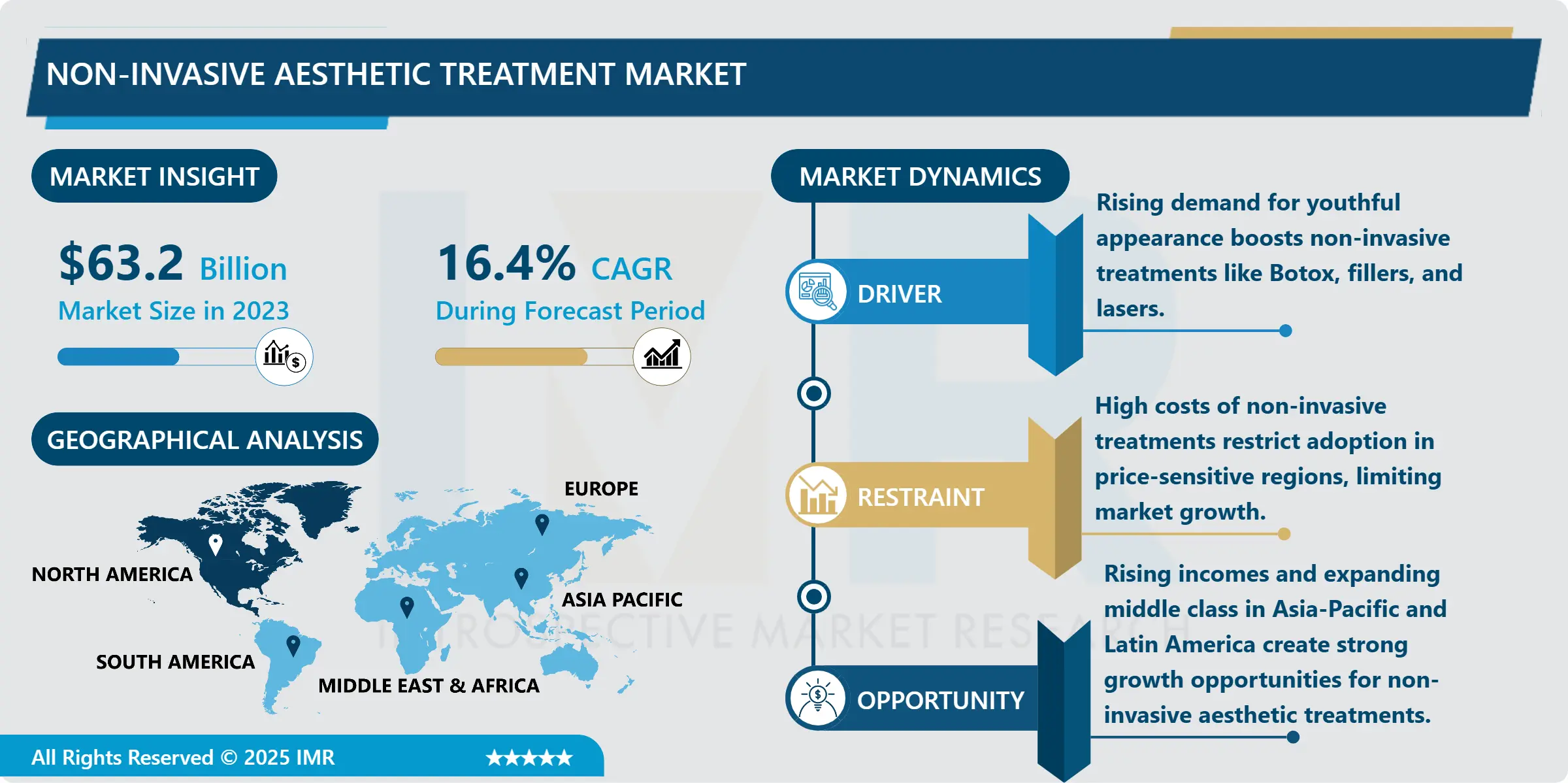
Non-Invasive Aesthetic Treatment Market Trend Analysis:
Rising Popularity of Preventative Aesthetic Treatments Among Younger Consumers
- That is, one of the defining features of the non-invasive aesthetic treatment market: its shifts in consumership tendencies and its purchased-product trajectories is the noted rise in popularity of preventative aesthetic treatments among young consumers. In the past Bottox and dermal fillers were mainly most by people in their middle age to minimise the effects of ageing. Still, a growing number of users aged between 20 and 30 years are increasingly seeking these treatments in anticipation of early development of wrinkles as well as other signs of aging. This shift is laudable as it indicates a move towards more of a maintenance oriented model as opposed to just responded reactive model to constituent complaints.
- Currently, it is seen that younger customer segments, including Millennials and Gen Z, are also attracted to such treatment as Botox injections, in which muscle of face is temporarily paralyzed, to prevent development of wrinkles, and dermal fillers designed for the facial volume and smoothness maintenance. It is shocking that this trend is being fueled by increased awareness of aesthetic procedures via the social media, the need to look young, and increased influence of celebrities. Therefore, in response to this new generation, clinics and practitioners provide services that are young and dynamic, affordable and less invasive, and can easily fit the busy timetables of their clients. The cosmetic enhancements diagnosed at this early stage are also considered self-care practices, and more people turn to face enhancements as a part of a healthy lifestyle.
Expanding Male Consumer Base Drives Growth in Non-Invasive Aesthetic Treatments
- Mass consciousness around male beauty and the steady increase in the number of male customers is becoming more significant as the driving force of the non-invasive aesthetic treatment market. Heretofore the beauty enhancement procedures that include Botox injections, dermal fillers and laser treatments among others have been confined to the female sex. This has been changing in recent years with more and more men seeking out fewer invasive options for improving their looks. Enhanced male consciousness of beauty or grooming, plus the social acceptance of beauty treatments, have created a new call for methods that can successfully treat and correct, such as wrinkles, face slackness, face volume deficiency and more. Promoting products through social networks and post-surgical image of the celebrity men, as well as changing perceptions of male care deepened the treatments that were seen as traditionally female.
- A number of aesthetic clinics and providers continue to adjust their services and learn how to develop unique marketing approaches to address men. This demographic wants as inconspicuous and natural a look as possible that will not emasculate but actually enhance the face. Patients especially the working men whose time is very valuable consider non-invasive treatments as they take very short duration, and they are not as risky as surgical procedures. Especially, Preventive cosmetic use of Botox, use of dermal fillers in facial sculpting and non-surgical lipo-suction for removal of excessive fats are on the rise. Since such treatments are now in high demand among men the non-invasive aesthetics market continues to actively penetrate new customer niches that will ensure its further growth and diversification.
Non-Invasive Aesthetic Treatment Market Segment Analysis:
Non-Invasive Aesthetic Treatment Market is Segmented on the basis of Type, Application, End User, and Region
By Type, Botox Injections segment is expected to dominate the market during the forecast period
- The Botox Injections segment is poised to remain the largest non-invasive aesthetic treatment during the forecast period owing to enhanced acceptance and efficiency in targeted counteracting of various issues. This type of botulinum toxin is most commonly used for line and wrinkle smoothing, namely in the forehead area, around the eyes and the area between the eyebrows. It operates based on the mechanism of temporarily immobilizing the muscle that leads to the formation of wrinkles therefore it is minimally invasive procedures. This non-surgical procedure is widely popular in cosmetic practice because patients can effectively and with minimal risk address the aesthetics of aging. This means that there will be more and more people who are looking for something that can be done in a week’s time or less and this is why Botox remains the undisputed king of the wrinkle prevention market.
- Furthermore, the market for Botox injections is further boosted by a growing trend in the use of cosmetology procedures by the younger generation, who prefers trying rejuvenation treatments beforehand, to avoid the signs of aging in the future. It has become popular among men as well, which was never an important market for using anti-aging treatments, which also explains why it is used frequently. This product falls under the beauty products section, and the increased concern for healthy and self-care, enhanced by the aspects of new social media and celebrities, has made the consumers be more concerned. They also vindicate Botox to an extent because of the capacity to cut cost outlay prominently as compared to surgical procedures and also, because it does not entail invasive processes. Therefore, the Botox Injections segment is anticipated to remain the clear market leaders in the global non-Sus vaginal aesthetic treatment market within the ability to create foreseen business by developed consumer knowledge and progress implemented in injections methods.
By Application, Anti-Aging segment expected to held the largest share
- The Anti Aging segment is expected to capture the largest market share in the non invasive aesthetic treatment market over the forecast period attributed to increasing global clientele seeking the anti aging treatments. With the increasing elderly population of the global population and more to the aged population in developed nations like North America and Europe, preference for non-surgical procedures for treatment of wrinkles, skin tightening and facial lift is rapidly increasing. Laser face lift, wrinkle reduction, laser skin resurfacing, chemical peels, as well as the ‘liquid face lift’ which involves botox injections and dermal fillers constitute a number of the most sought services because they address issues of aging such as wrinkles, loose skin and facial fat loss. As the search for the fountain of youth continues to intensify, more end users are now turning to non-surgical procedures that will only take a short time to yield results and are free from complications of surgery.
- The focus on preventive aging treatments across the subpopulation also remains one of the factors that define the demand for and growth of this segment. People in their early forties are seeking non-surgical procedures to withdraw the clock back and the desire for preventing aging still continues to grow. There is also increased number of young people on social media platforms and the cult of celebrities; beauty matters is among the top priorities of people and they are willing and able to spend money on the improvements. It has particularly affected millennials and generation Z child consumers who would rather inject themselves with Botox or dermal fillers to make their skin look seamless. Since aesthetic treatments are globally alleged to achieve youthful skin tone and texture across different age categories, the anti-aging application segment is anticipated to retain its market supremacy over the non-invasive aesthetic treatment solution market owing to the increasing demand and emergence of new opportunities in the global non-surgical cosmetic procedures market.
Non-Invasive Aesthetic Treatment Market Regional Insights:
North America is Expected to Dominate the Market Over the Forecast period
- The leading regional market over the mentioned forecast period, is likely to be North America, due to the high consumer awareness and advanced healthcare system in the region. The United States alone continues to be the leading consumer of aesthetic treatments, with Botox, face/dermal fillers, laser skin resurfacing, and body sculpting fairly prevalent. The subsequent culture of the cosmetic surgery, especially in United State of America who embodies cultures that value beauty over age hence the high demand for the non-surgical implants. These procedures are considered fast and cheaper than conventional surgery while providing outcomes with little to no time off. Furthermore, the increase in consumers’ disposable income and more so in the urban areas has been boosted by beauty-related expenditures since people are willing to spend more on beauty solutions than on expensive surgeries. The incorporation of other enhancement methods such as laser treatments and radiofrequency devices also become a good development to support non-invasive methods and considerably boost its popularity among different consumer market.
- Besides consumers’ interest, North America has a well-developed network of aesthetic clinics, dermatology practices, and medical spas that allow consumers to choose a great number of treatments. Education levels remain high among the consumers and they understand the various available treatments and the healthcare system in the region offers high quality services to its consumers. As more and more people are turning to preventative solutions, especially within the young group and as the number of male consumers interest in non-surgical operations increases, North America’s market remains to be constantly growing. The consumer choice is most influenced by social media influencers, celebrities and other public personalities endorsing this market and thus enhancing the overall market demand. When innovative technologies are unveiled, broader and better treatments with non-invasive procedures become available, North America should continue to lead demand and invest in non-invasive aesthetic treatment within the home market as well as from abroad.
Active Key Players in the Non-Invasive Aesthetic Treatment Market:
- Allergan (USA)
- BTL Industries (Czech Republic)
- Cutera (USA)
- Cynosure (USA)
- Galderma (Switzerland)
- Hugel (South Korea)
- Ipsen (France)
- Johnson & Johnson (USA)
- Lumenis (Israel)
- Medytox (South Korea)
- Merz Pharmaceuticals (Germany)
- Revance Therapeutics (USA)
- Sciton (USA)
- Syneron Candela (USA)
- Thermage (USA)
- Ulthera (USA)
- Venus Concept (Canada)
- Zimmer MedizinSysteme (Germany)
- Other Active Players
|
Global Non-Invasive Aesthetic Treatment Market |
|||
|
Base Year: |
2023 |
Forecast Period: |
2024-2032 |
|
Historical Data: |
2017 to 2023 |
Market Size in 2023: |
USD 63.2 Billion |
|
Forecast Period 2024-32 CAGR: |
16.40 % |
Market Size in 2032: |
USD 285.45 Billion |
|
Segments Covered: |
By Type |
|
|
|
By Application |
|
||
|
By End-User |
|
||
|
By Region |
|
||
|
Key Market Drivers: |
|
||
|
Key Market Restraints: |
|
||
|
Key Opportunities: |
|
||
|
Companies Covered in the report: |
|
||
Chapter 1: Introduction
1.1 Scope and Coverage
Chapter 2:Executive Summary
Chapter 3: Market Landscape
3.1 Market Dynamics
3.1.1 Drivers
3.1.2 Restraints
3.1.3 Opportunities
3.1.4 Challenges
3.2 Market Trend Analysis
3.3 PESTLE Analysis
3.4 Porter's Five Forces Analysis
3.5 Industry Value Chain Analysis
3.6 Ecosystem
3.7 Regulatory Landscape
3.8 Price Trend Analysis
3.9 Patent Analysis
3.10 Technology Evolution
3.11 Investment Pockets
3.12 Import-Export Analysis
Chapter 4: Non-Invasive Aesthetic Treatment Market by Type
4.1 Non-Invasive Aesthetic Treatment Market Snapshot and Growth Engine
4.2 Non-Invasive Aesthetic Treatment Market Overview
4.3 Botox Injections
4.3.1 Introduction and Market Overview
4.3.2 Historic and Forecasted Market Size in Value USD and Volume Units (2017-2032F)
4.3.3 Key Market Trends, Growth Factors and Opportunities
4.3.4 Botox Injections: Geographic Segmentation Analysis
4.4 Dermal Fillers
4.4.1 Introduction and Market Overview
4.4.2 Historic and Forecasted Market Size in Value USD and Volume Units (2017-2032F)
4.4.3 Key Market Trends, Growth Factors and Opportunities
4.4.4 Dermal Fillers: Geographic Segmentation Analysis
4.5 Laser Skin Resurfacing
4.5.1 Introduction and Market Overview
4.5.2 Historic and Forecasted Market Size in Value USD and Volume Units (2017-2032F)
4.5.3 Key Market Trends, Growth Factors and Opportunities
4.5.4 Laser Skin Resurfacing: Geographic Segmentation Analysis
4.6 Chemical Peels
4.6.1 Introduction and Market Overview
4.6.2 Historic and Forecasted Market Size in Value USD and Volume Units (2017-2032F)
4.6.3 Key Market Trends, Growth Factors and Opportunities
4.6.4 Chemical Peels: Geographic Segmentation Analysis
4.7 Microdermabrasion
4.7.1 Introduction and Market Overview
4.7.2 Historic and Forecasted Market Size in Value USD and Volume Units (2017-2032F)
4.7.3 Key Market Trends, Growth Factors and Opportunities
4.7.4 Microdermabrasion: Geographic Segmentation Analysis
4.8 Body Contouring
4.8.1 Introduction and Market Overview
4.8.2 Historic and Forecasted Market Size in Value USD and Volume Units (2017-2032F)
4.8.3 Key Market Trends, Growth Factors and Opportunities
4.8.4 Body Contouring: Geographic Segmentation Analysis
Chapter 5: Non-Invasive Aesthetic Treatment Market by Treatments
5.1 Non-Invasive Aesthetic Treatment Market Snapshot and Growth Engine
5.2 Non-Invasive Aesthetic Treatment Market Overview
5.3 Cryolipolysis
5.3.1 Introduction and Market Overview
5.3.2 Historic and Forecasted Market Size in Value USD and Volume Units (2017-2032F)
5.3.3 Key Market Trends, Growth Factors and Opportunities
5.3.4 Cryolipolysis: Geographic Segmentation Analysis
5.4 Ultrasound
5.4.1 Introduction and Market Overview
5.4.2 Historic and Forecasted Market Size in Value USD and Volume Units (2017-2032F)
5.4.3 Key Market Trends, Growth Factors and Opportunities
5.4.4 Ultrasound: Geographic Segmentation Analysis
5.5 Radiofrequency)
5.5.1 Introduction and Market Overview
5.5.2 Historic and Forecasted Market Size in Value USD and Volume Units (2017-2032F)
5.5.3 Key Market Trends, Growth Factors and Opportunities
5.5.4 Radiofrequency): Geographic Segmentation Analysis
5.6 Non-Surgical Hair Restoration
5.6.1 Introduction and Market Overview
5.6.2 Historic and Forecasted Market Size in Value USD and Volume Units (2017-2032F)
5.6.3 Key Market Trends, Growth Factors and Opportunities
5.6.4 Non-Surgical Hair Restoration: Geographic Segmentation Analysis
5.7 Thread Lifts.
5.7.1 Introduction and Market Overview
5.7.2 Historic and Forecasted Market Size in Value USD and Volume Units (2017-2032F)
5.7.3 Key Market Trends, Growth Factors and Opportunities
5.7.4 Thread Lifts.: Geographic Segmentation Analysis
Chapter 6: Non-Invasive Aesthetic Treatment Market by Application
6.1 Non-Invasive Aesthetic Treatment Market Snapshot and Growth Engine
6.2 Non-Invasive Aesthetic Treatment Market Overview
6.3 Anti-Aging
6.3.1 Introduction and Market Overview
6.3.2 Historic and Forecasted Market Size in Value USD and Volume Units (2017-2032F)
6.3.3 Key Market Trends, Growth Factors and Opportunities
6.3.4 Anti-Aging: Geographic Segmentation Analysis
6.4 Skin Rejuvenation
6.4.1 Introduction and Market Overview
6.4.2 Historic and Forecasted Market Size in Value USD and Volume Units (2017-2032F)
6.4.3 Key Market Trends, Growth Factors and Opportunities
6.4.4 Skin Rejuvenation: Geographic Segmentation Analysis
6.5 Body Contouring and Fat Reduction
6.5.1 Introduction and Market Overview
6.5.2 Historic and Forecasted Market Size in Value USD and Volume Units (2017-2032F)
6.5.3 Key Market Trends, Growth Factors and Opportunities
6.5.4 Body Contouring and Fat Reduction: Geographic Segmentation Analysis
6.6 Hair Restoration
6.6.1 Introduction and Market Overview
6.6.2 Historic and Forecasted Market Size in Value USD and Volume Units (2017-2032F)
6.6.3 Key Market Trends, Growth Factors and Opportunities
6.6.4 Hair Restoration: Geographic Segmentation Analysis
6.7 Facial Aesthetic Procedures
6.7.1 Introduction and Market Overview
6.7.2 Historic and Forecasted Market Size in Value USD and Volume Units (2017-2032F)
6.7.3 Key Market Trends, Growth Factors and Opportunities
6.7.4 Facial Aesthetic Procedures: Geographic Segmentation Analysis
Chapter 7: Non-Invasive Aesthetic Treatment Market by End User
7.1 Non-Invasive Aesthetic Treatment Market Snapshot and Growth Engine
7.2 Non-Invasive Aesthetic Treatment Market Overview
7.3 Clinics & Aesthetic Centers
7.3.1 Introduction and Market Overview
7.3.2 Historic and Forecasted Market Size in Value USD and Volume Units (2017-2032F)
7.3.3 Key Market Trends, Growth Factors and Opportunities
7.3.4 Clinics & Aesthetic Centers: Geographic Segmentation Analysis
7.4 Dermatology and Medical Spas
7.4.1 Introduction and Market Overview
7.4.2 Historic and Forecasted Market Size in Value USD and Volume Units (2017-2032F)
7.4.3 Key Market Trends, Growth Factors and Opportunities
7.4.4 Dermatology and Medical Spas: Geographic Segmentation Analysis
7.5 Hospitals
7.5.1 Introduction and Market Overview
7.5.2 Historic and Forecasted Market Size in Value USD and Volume Units (2017-2032F)
7.5.3 Key Market Trends, Growth Factors and Opportunities
7.5.4 Hospitals: Geographic Segmentation Analysis
Chapter 8: Company Profiles and Competitive Analysis
8.1 Competitive Landscape
8.1.1 Competitive Benchmarking
8.1.2 Non-Invasive Aesthetic Treatment Market Share by Manufacturer (2023)
8.1.3 Industry BCG Matrix
8.1.4 Heat Map Analysis
8.1.5 Mergers and Acquisitions
8.2 ALLERGAN (USA)
8.2.1 Company Overview
8.2.2 Key Executives
8.2.3 Company Snapshot
8.2.4 Role of the Company in the Market
8.2.5 Sustainability and Social Responsibility
8.2.6 Operating Business Segments
8.2.7 Product Portfolio
8.2.8 Business Performance
8.2.9 Key Strategic Moves and Recent Developments
8.2.10 SWOT Analysis
8.3 BTL INDUSTRIES (CZECH REPUBLIC)
8.4 CUTERA (USA)
8.5 CYNOSURE (USA)
8.6 GALDERMA (SWITZERLAND)
8.7 HUGEL (SOUTH KOREA)
8.8 IPSEN (FRANCE)
8.9 JOHNSON & JOHNSON (USA)
8.10 LUMENIS (ISRAEL)
8.11 MEDYTOX (SOUTH KOREA)
8.12 MERZ PHARMACEUTICALS (GERMANY)
8.13 REVANCE THERAPEUTICS (USA)
8.14 SCITON (USA)
8.15 SYNERON CANDELA (USA)
8.16 THERMAGE (USA)
8.17 ULTHERA (USA)
8.18 VENUS CONCEPT (CANADA)
8.19 ZIMMER MEDIZINSYSTEME (GERMANY)
8.20 OTHER ACTIVE PLAYERS
Chapter 9: Global Non-Invasive Aesthetic Treatment Market By Region
9.1 Overview
9.2. North America Non-Invasive Aesthetic Treatment Market
9.2.1 Key Market Trends, Growth Factors and Opportunities
9.2.2 Top Key Companies
9.2.3 Historic and Forecasted Market Size by Segments
9.2.4 Historic and Forecasted Market Size By Type
9.2.4.1 Botox Injections
9.2.4.2 Dermal Fillers
9.2.4.3 Laser Skin Resurfacing
9.2.4.4 Chemical Peels
9.2.4.5 Microdermabrasion
9.2.4.6 Body Contouring
9.2.5 Historic and Forecasted Market Size By Treatments
9.2.5.1 Cryolipolysis
9.2.5.2 Ultrasound
9.2.5.3 Radiofrequency)
9.2.5.4 Non-Surgical Hair Restoration
9.2.5.5 Thread Lifts.
9.2.6 Historic and Forecasted Market Size By Application
9.2.6.1 Anti-Aging
9.2.6.2 Skin Rejuvenation
9.2.6.3 Body Contouring and Fat Reduction
9.2.6.4 Hair Restoration
9.2.6.5 Facial Aesthetic Procedures
9.2.7 Historic and Forecasted Market Size By End User
9.2.7.1 Clinics & Aesthetic Centers
9.2.7.2 Dermatology and Medical Spas
9.2.7.3 Hospitals
9.2.8 Historic and Forecast Market Size by Country
9.2.8.1 US
9.2.8.2 Canada
9.2.8.3 Mexico
9.3. Eastern Europe Non-Invasive Aesthetic Treatment Market
9.3.1 Key Market Trends, Growth Factors and Opportunities
9.3.2 Top Key Companies
9.3.3 Historic and Forecasted Market Size by Segments
9.3.4 Historic and Forecasted Market Size By Type
9.3.4.1 Botox Injections
9.3.4.2 Dermal Fillers
9.3.4.3 Laser Skin Resurfacing
9.3.4.4 Chemical Peels
9.3.4.5 Microdermabrasion
9.3.4.6 Body Contouring
9.3.5 Historic and Forecasted Market Size By Treatments
9.3.5.1 Cryolipolysis
9.3.5.2 Ultrasound
9.3.5.3 Radiofrequency)
9.3.5.4 Non-Surgical Hair Restoration
9.3.5.5 Thread Lifts.
9.3.6 Historic and Forecasted Market Size By Application
9.3.6.1 Anti-Aging
9.3.6.2 Skin Rejuvenation
9.3.6.3 Body Contouring and Fat Reduction
9.3.6.4 Hair Restoration
9.3.6.5 Facial Aesthetic Procedures
9.3.7 Historic and Forecasted Market Size By End User
9.3.7.1 Clinics & Aesthetic Centers
9.3.7.2 Dermatology and Medical Spas
9.3.7.3 Hospitals
9.3.8 Historic and Forecast Market Size by Country
9.3.8.1 Russia
9.3.8.2 Bulgaria
9.3.8.3 The Czech Republic
9.3.8.4 Hungary
9.3.8.5 Poland
9.3.8.6 Romania
9.3.8.7 Rest of Eastern Europe
9.4. Western Europe Non-Invasive Aesthetic Treatment Market
9.4.1 Key Market Trends, Growth Factors and Opportunities
9.4.2 Top Key Companies
9.4.3 Historic and Forecasted Market Size by Segments
9.4.4 Historic and Forecasted Market Size By Type
9.4.4.1 Botox Injections
9.4.4.2 Dermal Fillers
9.4.4.3 Laser Skin Resurfacing
9.4.4.4 Chemical Peels
9.4.4.5 Microdermabrasion
9.4.4.6 Body Contouring
9.4.5 Historic and Forecasted Market Size By Treatments
9.4.5.1 Cryolipolysis
9.4.5.2 Ultrasound
9.4.5.3 Radiofrequency)
9.4.5.4 Non-Surgical Hair Restoration
9.4.5.5 Thread Lifts.
9.4.6 Historic and Forecasted Market Size By Application
9.4.6.1 Anti-Aging
9.4.6.2 Skin Rejuvenation
9.4.6.3 Body Contouring and Fat Reduction
9.4.6.4 Hair Restoration
9.4.6.5 Facial Aesthetic Procedures
9.4.7 Historic and Forecasted Market Size By End User
9.4.7.1 Clinics & Aesthetic Centers
9.4.7.2 Dermatology and Medical Spas
9.4.7.3 Hospitals
9.4.8 Historic and Forecast Market Size by Country
9.4.8.1 Germany
9.4.8.2 UK
9.4.8.3 France
9.4.8.4 The Netherlands
9.4.8.5 Italy
9.4.8.6 Spain
9.4.8.7 Rest of Western Europe
9.5. Asia Pacific Non-Invasive Aesthetic Treatment Market
9.5.1 Key Market Trends, Growth Factors and Opportunities
9.5.2 Top Key Companies
9.5.3 Historic and Forecasted Market Size by Segments
9.5.4 Historic and Forecasted Market Size By Type
9.5.4.1 Botox Injections
9.5.4.2 Dermal Fillers
9.5.4.3 Laser Skin Resurfacing
9.5.4.4 Chemical Peels
9.5.4.5 Microdermabrasion
9.5.4.6 Body Contouring
9.5.5 Historic and Forecasted Market Size By Treatments
9.5.5.1 Cryolipolysis
9.5.5.2 Ultrasound
9.5.5.3 Radiofrequency)
9.5.5.4 Non-Surgical Hair Restoration
9.5.5.5 Thread Lifts.
9.5.6 Historic and Forecasted Market Size By Application
9.5.6.1 Anti-Aging
9.5.6.2 Skin Rejuvenation
9.5.6.3 Body Contouring and Fat Reduction
9.5.6.4 Hair Restoration
9.5.6.5 Facial Aesthetic Procedures
9.5.7 Historic and Forecasted Market Size By End User
9.5.7.1 Clinics & Aesthetic Centers
9.5.7.2 Dermatology and Medical Spas
9.5.7.3 Hospitals
9.5.8 Historic and Forecast Market Size by Country
9.5.8.1 China
9.5.8.2 India
9.5.8.3 Japan
9.5.8.4 South Korea
9.5.8.5 Malaysia
9.5.8.6 Thailand
9.5.8.7 Vietnam
9.5.8.8 The Philippines
9.5.8.9 Australia
9.5.8.10 New Zealand
9.5.8.11 Rest of APAC
9.6. Middle East & Africa Non-Invasive Aesthetic Treatment Market
9.6.1 Key Market Trends, Growth Factors and Opportunities
9.6.2 Top Key Companies
9.6.3 Historic and Forecasted Market Size by Segments
9.6.4 Historic and Forecasted Market Size By Type
9.6.4.1 Botox Injections
9.6.4.2 Dermal Fillers
9.6.4.3 Laser Skin Resurfacing
9.6.4.4 Chemical Peels
9.6.4.5 Microdermabrasion
9.6.4.6 Body Contouring
9.6.5 Historic and Forecasted Market Size By Treatments
9.6.5.1 Cryolipolysis
9.6.5.2 Ultrasound
9.6.5.3 Radiofrequency)
9.6.5.4 Non-Surgical Hair Restoration
9.6.5.5 Thread Lifts.
9.6.6 Historic and Forecasted Market Size By Application
9.6.6.1 Anti-Aging
9.6.6.2 Skin Rejuvenation
9.6.6.3 Body Contouring and Fat Reduction
9.6.6.4 Hair Restoration
9.6.6.5 Facial Aesthetic Procedures
9.6.7 Historic and Forecasted Market Size By End User
9.6.7.1 Clinics & Aesthetic Centers
9.6.7.2 Dermatology and Medical Spas
9.6.7.3 Hospitals
9.6.8 Historic and Forecast Market Size by Country
9.6.8.1 Turkiye
9.6.8.2 Bahrain
9.6.8.3 Kuwait
9.6.8.4 Saudi Arabia
9.6.8.5 Qatar
9.6.8.6 UAE
9.6.8.7 Israel
9.6.8.8 South Africa
9.7. South America Non-Invasive Aesthetic Treatment Market
9.7.1 Key Market Trends, Growth Factors and Opportunities
9.7.2 Top Key Companies
9.7.3 Historic and Forecasted Market Size by Segments
9.7.4 Historic and Forecasted Market Size By Type
9.7.4.1 Botox Injections
9.7.4.2 Dermal Fillers
9.7.4.3 Laser Skin Resurfacing
9.7.4.4 Chemical Peels
9.7.4.5 Microdermabrasion
9.7.4.6 Body Contouring
9.7.5 Historic and Forecasted Market Size By Treatments
9.7.5.1 Cryolipolysis
9.7.5.2 Ultrasound
9.7.5.3 Radiofrequency)
9.7.5.4 Non-Surgical Hair Restoration
9.7.5.5 Thread Lifts.
9.7.6 Historic and Forecasted Market Size By Application
9.7.6.1 Anti-Aging
9.7.6.2 Skin Rejuvenation
9.7.6.3 Body Contouring and Fat Reduction
9.7.6.4 Hair Restoration
9.7.6.5 Facial Aesthetic Procedures
9.7.7 Historic and Forecasted Market Size By End User
9.7.7.1 Clinics & Aesthetic Centers
9.7.7.2 Dermatology and Medical Spas
9.7.7.3 Hospitals
9.7.8 Historic and Forecast Market Size by Country
9.7.8.1 Brazil
9.7.8.2 Argentina
9.7.8.3 Rest of SA
Chapter 10 Analyst Viewpoint and Conclusion
10.1 Recommendations and Concluding Analysis
10.2 Potential Market Strategies
Chapter 11 Research Methodology
11.1 Research Process
11.2 Primary Research
11.3 Secondary Research
|
Global Non-Invasive Aesthetic Treatment Market |
|||
|
Base Year: |
2023 |
Forecast Period: |
2024-2032 |
|
Historical Data: |
2017 to 2023 |
Market Size in 2023: |
USD 63.2 Billion |
|
Forecast Period 2024-32 CAGR: |
16.40 % |
Market Size in 2032: |
USD 285.45 Billion |
|
Segments Covered: |
By Type |
|
|
|
By Application |
|
||
|
By End-User |
|
||
|
By Region |
|
||
|
Key Market Drivers: |
|
||
|
Key Market Restraints: |
|
||
|
Key Opportunities: |
|
||
|
Companies Covered in the report: |
|
||


