




Key Market Highlights
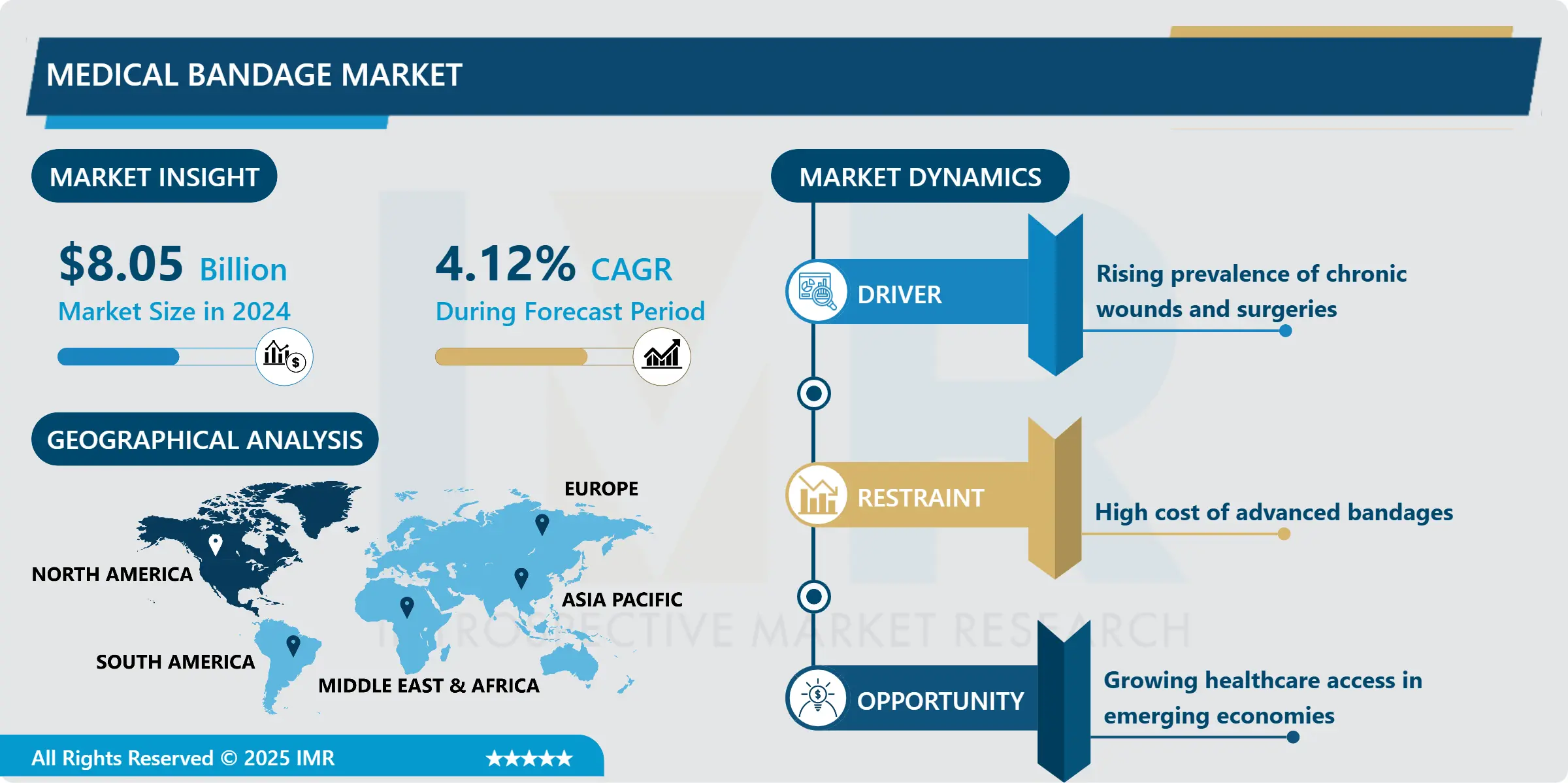
Medical Bandage Market Size Was Valued at USD 8.05 billion in 2024, and is Projected to Reach USD 12.55 billion by 2035, Growing at a CAGR of 4.12% from 2025-2035.
- Market Size in 2024: USD 8.05 billion
- Projected Market Size by 2035: USD 12.55 billion
- CAGR (2025–2035): 4.12%
- Leading Market in 2024: North America
- Fastest-Growing Market: Asia?Pacific
- By Application : The Medical tapes segment is anticipated to lead the market by accounting for 55% of the market share throughout the forecast period.
- By Type : The Traumatic wounds segment is expected to capture 40% of the market share, thereby maintaining its dominance over the forecast period.
- By Region: North America region is projected to hold 46.4 % of the market share during the forecast period.
- Active Players: 3M Company (USA), Acelity L.P. Inc. (USA), Andover Healthcare, Inc. (USA), B. Braun Melsungen AG (Germany), Beiersdorf AG (Germany), Other Active Players
Medical Bandage Market Synopsis:
The Medical Bandage Market refers to the global industry involved in the production, distribution, and sale of bandages used for wound care, injury support, and surgical applications. The market includes various types such as gauze bandages, adhesive bandages, elastic/compression bandages, cohesive bandages, and specialty bandages like antimicrobial or hydrogel-based products.
Medical Bandage Market Dynamics and Trend Analysis:
Medical Bandage Market Growth Driver - Rising prevalence of chronic wounds and surgeries
- The medical bandage market is growing steadily, and one of the main reasons is the rising number of chronic wounds and surgeries around the world. Many people today suffer from long-lasting wounds that take time to heal, such as diabetic foot ulcers, venous leg ulcers, and pressure sores. These types of wounds are common in people with diabetes, poor circulation, or who are bedridden for long periods.
- Diabetes is increasing rapidly, especially in developing countries. People with diabetes often develop foot ulcers, which require constant care and proper bandaging to prevent infection and speed up healing. Similarly, older adults and people with limited mobility are more likely to develop pressure sores, which also need regular dressing and protection.
- Apart from chronic wounds, the number of surgeries performed globally is also increasing. Every surgery requires wound care, and medical bandages are a basic yet essential part of the healing process after an operation. Hospitals and clinics rely on various types of bandages to cover surgical cuts, prevent infections, and support recovery.
- Because of these growing health issues, the demand for medical bandages both traditional types like gauze and modern ones with advanced healing materials is rising. This trend is pushing companies to innovate and meet the increasing global need for effective wound care products.
Medical Bandage Market Limiting Factor- High cost of advanced bandages
- One major challenge in the medical bandage market is the high cost of advanced bandages. While traditional bandages like cotton gauze or elastic wraps are affordable and widely used, newer types such as antimicrobial, hydrogel, foam, and smart bandages are much more expensive. These advanced products offer better healing, infection control, and comfort, but their price makes them hard to afford for many patients and healthcare providers, especially in low- and middle-income countries.
- Hospitals and clinics in developing regions often operate with limited budgets and may not be able to stock or prescribe these modern bandages regularly. As a result, many patients continue to rely on older, less effective wound care methods, which can slow healing and increase the risk of complications.
- In home care settings, the cost burden often falls directly on patients or families. Without insurance coverage or government support, many people cannot afford high-end bandaging products, even if they provide better outcomes.
- This price gap limits the widespread adoption of advanced wound care solutions and slows market growth in regions that need them the most. For the market to grow more evenly worldwide, manufacturers and health systems need to find ways to lower costs, increase affordability, or offer alternative solutions tailored to the economic realities of different regions.
Medical Bandage Market Expansion Opportunity - rowing healthcare access in emerging economies
- Growing healthcare access in emerging economies is creating a big opportunity for the medical bandage market. Countries in regions like Asia-Pacific, Latin America, and Africa are seeing rapid changes due to urbanization, rising incomes, and expanding healthcare services. As more people move to cities and governments invest in hospitals, clinics, and health programs, the demand for basic medical supplies including bandages is increasing.
- These regions are also facing a rise in chronic health conditions such as diabetes, heart disease, and obesity, which often lead to wounds that require long-term care. With more healthcare centres opening and awareness about proper wound care growing, the use of medical bandages is expected to rise significantly.
- Public health spending is also playing a key role. Many governments are increasing budgets for healthcare, improving access in rural and underserved areas, and launching programs focused on wound care, surgery, and emergency services. This is helping to make medical products, including modern bandages, available to more people than ever before.
- For manufacturers, these emerging markets offer a chance to expand their reach, create affordable products, and build local partnerships. As healthcare access continues to improve, so will the demand for high-quality, cost-effective bandaging solutions that support better treatment outcomes for a growing patient population.
Medical Bandage Market Challenge and Risk - Intense market competition and regulatory constraints
- The medical bandage market faces challenges from intense competition and strict regulations. In many developed countries, the market is already saturated with well-established companies offering a wide range of bandaging products. This makes it difficult for new players to enter and grow, as larger brands already dominate shelf space, hospital contracts, and customer trust.
- At the same time, companies looking to launch new or advanced bandages such as antimicrobial, hydrogel, or sensor-based products must go through complex and time-consuming regulatory approval processes. Health authorities like the FDA (in the U.S.) or EMA (in Europe) require thorough testing to ensure safety and effectiveness before allowing these products to be sold. Meeting these standards takes significant time, money, and expertise.
- These regulatory hurdles can slow down innovation, especially for smaller companies that may not have the resources to navigate the process. Even after approval, maintaining compliance with changing rules and international standards adds further cost and complexity.
- Together, heavy competition in mature markets and tight regulatory environments limit both new entries and the speed at which companies can bring innovative solutions to market. This creates a challenging environment, especially for startups or firms aiming to expand internationally.
Medical Bandage Market Segment Analysis:
Medical Bandage Market is segmented based on Type, Application, End-Users, and Region
By Type, Medical Bandage Segment is Expected to Dominate the Market During the Forecast Period
- Medical tapes are an important part of wound care and treatment. Their main job is to hold dressings, bandages, or medical tubes in place so they don’t move or fall off. This helps keep wounds clean, protected, and healing properly. These tapes are used in many settings, including hospitals, clinics, and home care.
- Most medical tapes are adhesive, meaning they stick to the skin easily but can also be removed without causing much pain or damage. They come in different types and materials to suit different needs. For example, fabric tapes are strong and flexible, making them good for areas that move a lot, like joints. Paper tapes are soft and breathable, often used for people with sensitive skin or for short-term use. Silicone tapes are gentle and ideal for delicate or healing skin because they stick well without pulling too much during removal.
- Medical professionals choose the type of tape based on the patient’s skin condition, how long the tape needs to stay on, and how much movement the area experiences. In home care, these tapes are often used for people recovering from surgery, taking care of wounds, or managing medical conditions that require regular dressing changes.
- Overall, medical tapes are a simple but essential tool in keeping dressings in place and helping wounds heal safely and comfortably.
By Application, Medical Bandage Segment Held the Largest Share in 2024
- The medical tapes segment is expected to lead the market, accounting for 55% of the total market share during the forecast period. This dominance is mainly due to the widespread use of medical tapes in both clinical and home care settings. Medical tapes are essential for securing dressings, IV lines, catheters, and other medical devices to the skin, making them a basic yet vital part of patient care.
- Their ease of use, availability in various materials (such as paper, fabric, and silicone), and suitability for different skin types have made them highly preferred by healthcare professionals. They are used across a wide range of applications from post-surgical care to wound dressing and emergency first aid in hospitals, clinics, ambulatory centres, and even at home.
- In addition, the rising number of surgeries, aging population, and increasing prevalence of chronic diseases (such as diabetes and pressure ulcers) are further driving the demand for medical tapes. These trends are expected to support the steady growth of this segment over the coming years.
- As a result, the medical tapes segment will likely maintain its leading position in the market, driven by its essential role in wound management and its broad application in daily medical procedures.
Medical Bandage Market Regional Insights:
North America is Expected to Dominate the Market Over the Forecast Period
- North America is the largest market for medical bandages in the world. This is mainly because the region has a strong and advanced healthcare system, especially in countries like the United States and Canada. Hospitals and clinics in North America are well-equipped and regularly perform a high number of surgeries and medical procedures, all of which require proper wound care using different types of bandages.
- Another big reason for the high demand is the aging population. Older people are more likely to suffer from chronic wounds like pressure ulcers, diabetic foot ulcers, and skin injuries. As the number of elderly patients increases, so does the need for regular and effective wound care. North America also has a high rate of chronic conditions such as diabetes and obesity. These health problems often lead to wounds that need special care and protection, increasing the demand for both traditional and advanced bandage products.
- In addition, the region is home to many leading medical companies like 3M, Johnson & Johnson, and Cardinal Health. These companies continue to develop new types of bandages, such as antimicrobial and smart bandages, which improve healing. Because of high health awareness, strong hospital networks, and constant innovation, North America will likely remain a key driver in the global medical bandage market for years to come.
Medical Bandage Market Active Players:
- 3M Company (USA)
- Acelity L.P. Inc. (USA)
- Andover Healthcare, Inc. (USA)
- B. Braun Melsungen AG (Germany)
- Beiersdorf AG (Germany)
- BSN Medical GmbH (Germany)
- Cardinal Health, Inc. (USA)
- Coloplast A/S (Denmark)
- Derma Sciences, Inc. (USA)
- Dynarex Corporation (USA)
- Essity AB (Sweden)
- Integra LifeSciences Corporation (USA)
- Johnson & Johnson (USA)
- Karl Otto Braun GmbH & Co. KG (Germany)
- Lohmann & Rauscher GmbH & Co. KG (Germany)
- McKesson Corporation (USA)
- Mediplast AB (Sweden)
- Medline Industries, Inc. (USA)
- Medtronic plc (Ireland)
- Mercator Medical S.A. (Poland)
- Miro Verbandstoffe GmbH (Germany)
- Mölnlycke Health Care AB (Sweden)
- Nitto Denko Corporation (Japan)
- Paul Hartmann AG (Germany)
- Smith & Nephew plc (United Kingdom)
- Systagenix Wound Management, Ltd. (United Kingdom)
- Toilex India Pvt. Ltd. (India)
- Winner Medical Group Inc. (China)
- Yunnan Baiyao Group Co., Ltd. (China)
- Zee Medical, Inc. (USA)
- Other Active Players
|
Medical Bandage Market |
|||
|
Base Year: |
2024 |
Forecast Period: |
2025-2035 |
|
Historical Data: |
2018 to 2023 |
Market Size in 2024: |
USD 8.05 billion |
|
Forecast Period 2025-35 CAGR: |
4.12 % |
Market Size in 2035: |
USD 12.55 billion |
|
Segments Covered: |
By Type |
|
|
|
By Application
|
|
||
|
By End-user |
|
||
|
By Region |
|
||
|
Growth Driver: |
|
||
|
Limiting Factor |
|
||
|
Expansion Opportunity |
|
||
|
Challenge and Risk |
|
||
|
Companies Covered in the Report: |
|
||
Chapter 1: Introduction
1.1 Scope and Coverage
Chapter 2:Executive Summary
Chapter 3: Market Landscape
3.1 Market Dynamics and Opportunity Analysis
3.1.1 Growth Drivers
3.1.2 Limiting Factors
3.1.3 Growth Opportunities
3.1.4 Challenges and Risks
3.2 Market Trend Analysis
3.3 Industry Ecosystem
3.4 Industry Value Chain Mapping
3.5 Strategic PESTLE Overview
3.6 Porter's Five Forces Framework
3.7 Regulatory Framework
3.8 Pricing Trend Analysis
3.9 Intellectual Property Review
3.10 Technology Evolution
3.11 Import-Export Analysis
3.12 Consumer Behavior Analysis
3.13 Investment Pocket Analysis
3.14 Go-To Market Strategy
Chapter 4: Medical Bandage Market by Product Type (2018-2035)
4.1 Medical Bandage Market Snapshot and Growth Engine
4.2 Market Overview
4.3 Medical Tapes
4.3.1 Introduction and Market Overview
4.3.2 Historic and Forecasted Market Size in Value USD and Volume Units
4.3.3 Key Market Trends, Growth Factors, and Opportunities
4.3.4 Geographic Segmentation Analysis
4.4 Medical Bandages
Chapter 5: Medical Bandage Market by Application (2018-2035)
5.1 Medical Bandage Market Snapshot and Growth Engine
5.2 Market Overview
5.3 Surgical Wound
5.3.1 Introduction and Market Overview
5.3.2 Historic and Forecasted Market Size in Value USD and Volume Units
5.3.3 Key Market Trends, Growth Factors, and Opportunities
5.3.4 Geographic Segmentation Analysis
5.4 Traumatic Wound
Chapter 6: Medical Bandage Market by End-use (2018-2035)
6.1 Medical Bandage Market Snapshot and Growth Engine
6.2 Market Overview
6.3 Hospitals
6.3.1 Introduction and Market Overview
6.3.2 Historic and Forecasted Market Size in Value USD and Volume Units
6.3.3 Key Market Trends, Growth Factors, and Opportunities
6.3.4 Geographic Segmentation Analysis
6.4 Retail
Chapter 7: Company Profiles and Competitive Analysis
7.1 Competitive Landscape
7.1.1 Competitive Benchmarking
7.1.2 Medical Bandage Market Share by Manufacturer/Service Provider(2024)
7.1.3 Industry BCG Matrix
7.1.4 PArtnerships, Mergers & Acquisitions
7.2 3M COMPANY (USA)
7.2.1 Company Overview
7.2.2 Key Executives
7.2.3 Company Snapshot
7.2.4 Role of the Company in the Market
7.2.5 Sustainability and Social Responsibility
7.2.6 Operating Business Segments
7.2.7 Product Portfolio
7.2.8 Business Performance
7.2.9 Recent News & Developments
7.2.10 SWOT Analysis
7.3 ACELITY L.P. INC. (USA)
7.4 ANDOVER HEALTHCARE
7.5 INC. (USA)
7.6 B. BRAUN MELSUNGEN AG (GERMANY)
7.7 BEIERSDORF AG (GERMANY)
7.8 BSN MEDICAL GMBH (GERMANY)
7.9 CARDINAL HEALTH
7.10 INC. (USA)
7.11 COLOPLAST A/S (DENMARK)
7.12 DERMA SCIENCES
7.13 INC. (USA)
7.14 DYNAREX CORPORATION (USA)
7.15 ESSITY AB (SWEDEN)
7.16 INTEGRA LIFESCIENCES CORPORATION (USA)
7.17 JOHNSON & JOHNSON (USA)
7.18 KARL OTTO BRAUN GMBH & CO. KG (GERMANY)
7.19 LOHMANN & RAUSCHER GMBH & CO. KG (GERMANY)
7.20 MCKESSON CORPORATION (USA)
7.21 MEDIPLAST AB (SWEDEN)
7.22 MEDLINE INDUSTRIES
7.23 INC. (USA)
7.24 MEDTRONIC PLC (IRELAND)
7.25 MERCATOR MEDICAL S.A. (POLAND)
7.26 MIRO VERBANDSTOFFE GMBH (GERMANY)
7.27 MÖLNLYCKE HEALTH CARE AB (SWEDEN)
7.28 NITTO DENKO CORPORATION (JAPAN)
7.29 PAUL HARTMANN AG (GERMANY)
7.30 SMITH & NEPHEW PLC (UNITED KINGDOM)
7.31 SYSTAGENIX WOUND MANAGEMENT
7.32 LTD. (UNITED KINGDOM)
7.33 TOILEX INDIA PVT. LTD. (INDIA)
7.34 WINNER MEDICAL GROUP INC. (CHINA)
7.35 YUNNAN BAIYAO GROUP CO.
7.36 LTD. (CHINA)
7.37 ZEE MEDICAL
7.38 INC. (USA)
7.39 AND OTHER ACTIVE PLAYERS.
Chapter 8: Global Medical Bandage Market By Region
8.1 Overview
8.2. North America Medical Bandage Market
8.2.1 Key Market Trends, Growth Factors and Opportunities
8.2.2 Top Key Companies
8.2.3 Historic and Forecasted Market Size by Segments
8.2.4 Historic and Forecast Market Size by Country
8.2.4.1 US
8.2.4.2 Canada
8.2.4.3 Mexico
8.3. Eastern Europe Medical Bandage Market
8.3.1 Key Market Trends, Growth Factors and Opportunities
8.3.2 Top Key Companies
8.3.3 Historic and Forecasted Market Size by Segments
8.3.4 Historic and Forecast Market Size by Country
8.3.4.1 Russia
8.3.4.2 Bulgaria
8.3.4.3 The Czech Republic
8.3.4.4 Hungary
8.3.4.5 Poland
8.3.4.6 Romania
8.3.4.7 Rest of Eastern Europe
8.4. Western Europe Medical Bandage Market
8.4.1 Key Market Trends, Growth Factors and Opportunities
8.4.2 Top Key Companies
8.4.3 Historic and Forecasted Market Size by Segments
8.4.4 Historic and Forecast Market Size by Country
8.4.4.1 Germany
8.4.4.2 UK
8.4.4.3 France
8.4.4.4 The Netherlands
8.4.4.5 Italy
8.4.4.6 Spain
8.4.4.7 Rest of Western Europe
8.5. Asia Pacific Medical Bandage Market
8.5.1 Key Market Trends, Growth Factors and Opportunities
8.5.2 Top Key Companies
8.5.3 Historic and Forecasted Market Size by Segments
8.5.4 Historic and Forecast Market Size by Country
8.5.4.1 China
8.5.4.2 India
8.5.4.3 Japan
8.5.4.4 South Korea
8.5.4.5 Malaysia
8.5.4.6 Thailand
8.5.4.7 Vietnam
8.5.4.8 The Philippines
8.5.4.9 Australia
8.5.4.10 New Zealand
8.5.4.11 Rest of APAC
8.6. Middle East & Africa Medical Bandage Market
8.6.1 Key Market Trends, Growth Factors and Opportunities
8.6.2 Top Key Companies
8.6.3 Historic and Forecasted Market Size by Segments
8.6.4 Historic and Forecast Market Size by Country
8.6.4.1 Turkiye
8.6.4.2 Bahrain
8.6.4.3 Kuwait
8.6.4.4 Saudi Arabia
8.6.4.5 Qatar
8.6.4.6 UAE
8.6.4.7 Israel
8.6.4.8 South Africa
8.7. South America Medical Bandage Market
8.7.1 Key Market Trends, Growth Factors and Opportunities
8.7.2 Top Key Companies
8.7.3 Historic and Forecasted Market Size by Segments
8.7.4 Historic and Forecast Market Size by Country
8.7.4.1 Brazil
8.7.4.2 Argentina
8.7.4.3 Rest of SA
Chapter 9 Analyst Viewpoint and Conclusion
Chapter 10 Our Thematic Research Methodology
10.1 Research Process
10.2 Primary Research
10.3 Secondary Research
Chapter 11 Case Study
Chapter 12 Appendix
12.1 Sources
12.2 List of Tables and figures
12.3 Short Forms and Citations
12.4 Assumption and Conversion
12.5 Disclaimer
|
Medical Bandage Market |
|||
|
Base Year: |
2024 |
Forecast Period: |
2025-2035 |
|
Historical Data: |
2018 to 2023 |
Market Size in 2024: |
USD 8.05 billion |
|
Forecast Period 2025-35 CAGR: |
4.12 % |
Market Size in 2035: |
USD 12.55 billion |
|
Segments Covered: |
By Type |
|
|
|
By Application
|
|
||
|
By End-user |
|
||
|
By Region |
|
||
|
Growth Driver: |
|
||
|
Limiting Factor |
|
||
|
Expansion Opportunity |
|
||
|
Challenge and Risk |
|
||
|
Companies Covered in the Report: |
|
||


