




Instant Payment Market Synopsis
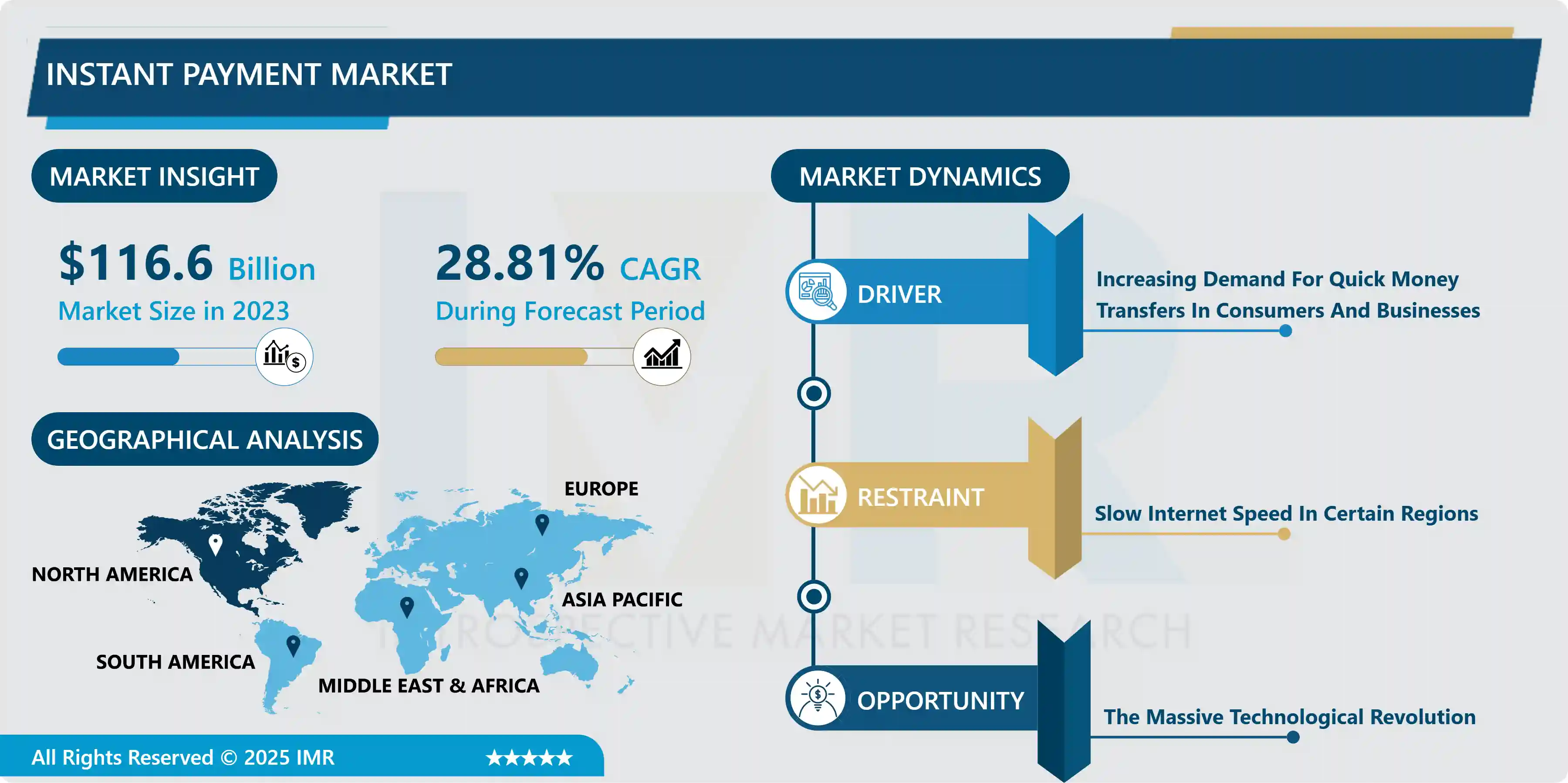
The global Instant Payment Market was valued at USD 116.6 billion in 2023 and is expected to reach USD 1138.27 Billion by the year 2032, at a CAGR of 28.81%.
Instant payment (sometimes called real-time payment or faster payment) is a way to exchange money and process payments that allows money to be transferred between bank accounts almost instantly, instead of the usual one to three business days.
Many countries have adopted instant payment systems and many instant payment systems and platforms are currently being developed worldwide as the need for faster and more reliable transactions has grown. Widespread penetration of smartphones, high-speed internet, and cloud-based solutions that improve the payment experience across multiple industries such as BFSI, Retail, Manufacturing Healthcare, etc. drives the growth of the instant payment market.
The government invests huge capital in instant payments, which makes the payment process easier for end users. Financial institutions and research and development programs have helped reform the industry and accelerate the growth of the instant payment market.
Due to the growing need for faster and more reliable transactions, many countries have established instant payment systems, and many instant payment systems and platforms are currently being developed around the world. In some countries, it is possible to pay instantly with a mobile phone, offering the same speed and convenience as cash.
 The Instant Payment Market Trend Analysis
Increasing Demand For Quick Money Transfers In Consumers And Businesses
- The increasing demand for fast money transfers has been a major driver for the growth of the instant payment market. Both consumers and businesses have realized the benefits of instant payments, resulting in adoption and market acceleration. Instant payment solutions offer a quick and easy way to transfer money. Traditional methods such as bank transfers or checks can be time-consuming and cause delays. Instant payments enable near real-time transfers, allowing individuals and businesses to receive money instantly, improving overall convenience and liquidity.
- Furthermore, instant payment solutions, often integrated with mobile wallets or peer-to-peer payment apps, allow people to easily send money to friends, family, or acquaintances. This ease of use and convenience has led to the widespread use of instant payments for everyday things such as splitting bills, repaying loans, or making informal payments. Also, the ability to make instant payments is very useful for businesses, especially in industries where speed and efficiency are critical. Express payments speed up payments, improve cash flow management and reduce the need for credit or late payments. It can simplify supply chains, improve business relationships and improve overall operational efficiency.
The Massive Technological Revolution
- The technological revolution has led to the development of innovative payment technologies, including real-time payment systems, mobile payment applications, digital wallets, and blockchain solutions. These advances enable fast and seamless payment transactions, providing convenience and efficiency to businesses and consumers.
- The widespread use of smartphones and internet connections has accelerated the growth of mobile and digital payments. Instant payment solutions use mobile devices and digital platforms to enable real-time money transfers, eliminating the need for traditional payment methods such as checks or cash. This has changed the way people make payments and created new opportunities for instant payment service providers. Additionally, consumers, today expect fast, convenient, and secure payment options. The technological revolution has influenced consumer behavior and there is a growing preference for instant gratification and instant transactions. Instant payment solutions meet changing consumer expectations and offer a seamless payment experience.
- The growth of e-commerce and online shopping has also increased the demand for instant payment solutions. Consumers expect fast and hassle-free payment processes for their online purchases. Instant payment options enable instant authorizations and payment transactions, reducing the friction of the e-shopping experience.
Segmentation Analysis Of The Instant Payment Market
The Instant Payment market segments cover the Nature of Payment, Deployment Mode, Enterprise Size, and End-User. By Nature of Payment, the Person-to-Business (P2B) segment is Anticipated to Dominate the Market Over the Forecast period.
- P2B payments refer to financial transactions between businesses and customers (such as recipient or source). A key factor in the development of the segment is the constant growth of mobile phone transactions and online shopping. Continued growth in e-commerce and e-commerce is expected to support the development of the segment. P2B payments allow businesses to improve customer satisfaction.
- The P2B structure accelerated with changes in regulatory reforms. Paying bills online and in stores promises the next huge wave of volume needed to keep real-time costs cheaper than cards. The growing trend of cloud-based real-time payment solutions is due to their flexibility to provide real-time payment information to retailers. The growing adoption of digital payment methods in major retail stores across the globe is expected to drive the market during the forecast period.
Regional Analysis of The Instant Payment Market
Asia Pacific is Expected to Dominate the Market Over the Forecast Period.
- The market growth in this region is driven by the huge population of the region, which affects the number of transactions, and domestic and international companies investing in the region. In the APAC region, the rate of growth can be attributed to several different factors such as the adoption of advanced technology, economic development, increased digitization, and heavy investment in real-time payment solutions and service providers.
- APAC countries, particularly China, South Korea, and Singapore, have been at the forefront of technological development and digital innovation. They have developed robust digital payment ecosystems, including real-time payment infrastructures and mobile payment platforms, which have accelerated the adoption of instant payment solutions.
- Additionally, mobile adoption and usage have grown rapidly in APAC. This has created a favorable environment for the adoption of mobile instant payment solutions. Mobile wallets and payment apps have gained significant popularity in China and India, among others, which has boosted the growth of instant payment services. Real-time payments were commonly used in Asia-Pacific in 2022, with transactions in India being almost five times higher than in China. For instance, according to Statista, India is the highest number of real-time payment transactions in 2022 which drives the growth of the market in this region.

Covid-19 Impact Analysis On Instant Payment Market
- Due to market restrictions and logistics bans imposed by governments, Covid-19 has affected several global markets, reorganizing supply chains. However, some markets benefited from the course of the pandemic. Covid-19 contributed to the growth of the instant payment market by expanding competition and introducing free payments. Covid-19 has accelerated the process of change, including the transition from a cash economy to a cashless economy. At the height of Covid-19, e-commerce and digital payment platforms have also expanded their space to viral areas. The rapid digitization of many companies, industries, and retail outlets is also behind the widespread adoption of instant payment options, which increases sales in the instant payment market.
- In addition, the COVID-19 epidemic forced banks and customers to react quickly to the limitations of physical user interfaces. As a result, the adoption of instant payments by bank customers has accelerated. Although significant, the shift to instant digital payments has been far less dramatic than most anticipated. Banks have kept at least some of their branches open and reduced office staff and opening hours and limited the number of customers they can accept. As a result, digital acceleration due to the pandemic will help banks and other financial institutions lower costs and provide a better customer experience, which improves Net Promoter Score and increases customer lifetime value.
Top Key Players Covered in The Instant Payment Market
- ACI Worldwide (US)
- FIS (US)
- Mastercard (US)
- Temenos (Switzerland)
- Worldline (France)
- PayPal(US)
- Fiserv (US)
- Visa (US)
- FSS (India)
- Montran (US)
- REPAY (US)
- Icon Solutions (UK)
- Apple (US)
- Ant Financial (China), and Other Major Players
Key Industry Developments in the Instant Payment Market
- In April 2023, Visa announced a strategic collaboration with PayPal and Venmo to initiate the pilot of Visa+, an innovative service designed to facilitate swift and secure money transfers between various person-to-person (P2P) digital payment applications. Later in the same year, users of Venmo and PayPal in the United States will have the capability to seamlessly transfer funds between the two platforms.
- In April 2023, CRED unveiled its UPI-based P2P payments, presenting a new payment option for its users. This feature allows CRED members to utilize the 'pay anyone' functionality through their contact list, phone numbers, or UPI IDs
- In April 2023, The Federal Reserve announced the launch of FedNow, a new real-time payments service that will enable faster and more secure financial payments for consumers and businesses. This system has the potential to revolutionize how people make payments in the US by providing instantaneous transfer of funds between banks in a matter of seconds, available 24 hours a day, 365 days a year.
- In January 2023, ACI Worldwide announced the launch of ACI Instant Pay, a new real-time payments solution that enables merchants in the U.S. to accept online, mobile and in-store payments instantly. The expansion of ACI's real-time payments software solutions to merchants reinforces ACI’s global leadership in powering domestic and pan-regional real-time schemes reaching billions worldwide.
- In March 2022, the Reserve Bank of India (RBI) launched an instant payment system "UPI 123PAY" for feature phone users. The new Unified Payments Interface (UPI) will allow India's 40 crore feature phone users to access the payment service in a more secure manner.
|
Global Instant Payment Market |
|||
|
Base Year: |
2023 |
Forecast Period: |
2024 - 2032 |
|
Historical Data: |
2017 to 2023 |
Market Size in 2023: |
USD 116.6 Billion |
|
Forecast Period 2024-32 CAGR: |
28.81 % |
Market Size in 2032: |
USD 1138.27 Billion |
|
|
By Nature of Payment |
|
|
|
By Deployment Mode |
|
||
|
By Enterprise Size |
|
||
|
By End User |
|
||
|
By Region |
|
||
|
Key Market Drivers: |
|
||
|
Key Market Restraints: |
|
||
|
Key Opportunities: |
|
||
|
Companies Covered in the Report: |
|
||
Chapter 1: Introduction
1.1 Scope and Coverage
Chapter 2:Executive Summary
Chapter 3: Market Landscape
3.1 Market Dynamics
3.1.1 Drivers
3.1.2 Restraints
3.1.3 Opportunities
3.1.4 Challenges
3.2 Market Trend Analysis
3.3 PESTLE Analysis
3.4 Porter's Five Forces Analysis
3.5 Industry Value Chain Analysis
3.6 Ecosystem
3.7 Regulatory Landscape
3.8 Price Trend Analysis
3.9 Patent Analysis
3.10 Technology Evolution
3.11 Investment Pockets
3.12 Import-Export Analysis
Chapter 4: Instant Payment Market by Nature of Payment (2018-2032)
4.1 Instant Payment Market Snapshot and Growth Engine
4.2 Market Overview
4.3 Person-to-Person (P2P)
4.3.1 Introduction and Market Overview
4.3.2 Historic and Forecasted Market Size in Value USD and Volume Units
4.3.3 Key Market Trends, Growth Factors, and Opportunities
4.3.4 Geographic Segmentation Analysis
4.4 Person-to-Business (P2B)
4.5 Business-To-Person (B2P)
4.6 Other
Chapter 5: Instant Payment Market by Deployment Mode (2018-2032)
5.1 Instant Payment Market Snapshot and Growth Engine
5.2 Market Overview
5.3 Cloud
5.3.1 Introduction and Market Overview
5.3.2 Historic and Forecasted Market Size in Value USD and Volume Units
5.3.3 Key Market Trends, Growth Factors, and Opportunities
5.3.4 Geographic Segmentation Analysis
5.4 On-Premises
Chapter 6: Instant Payment Market by Enterprise Size (2018-2032)
6.1 Instant Payment Market Snapshot and Growth Engine
6.2 Market Overview
6.3 Small and Medium-Sized Enterprises (SMEs)
6.3.1 Introduction and Market Overview
6.3.2 Historic and Forecasted Market Size in Value USD and Volume Units
6.3.3 Key Market Trends, Growth Factors, and Opportunities
6.3.4 Geographic Segmentation Analysis
6.4 Large Enterprises
Chapter 7: Instant Payment Market by End User (2018-2032)
7.1 Instant Payment Market Snapshot and Growth Engine
7.2 Market Overview
7.3 BFSI
7.3.1 Introduction and Market Overview
7.3.2 Historic and Forecasted Market Size in Value USD and Volume Units
7.3.3 Key Market Trends, Growth Factors, and Opportunities
7.3.4 Geographic Segmentation Analysis
7.4 Retail and E-Commerce
7.5 Government
7.6 IT and Telecommunications
7.7 Energy and Utilities
7.8 Others
Chapter 8: Company Profiles and Competitive Analysis
8.1 Competitive Landscape
8.1.1 Competitive Benchmarking
8.1.2 Instant Payment Market Share by Manufacturer (2024)
8.1.3 Industry BCG Matrix
8.1.4 Heat Map Analysis
8.1.5 Mergers and Acquisitions
8.2 DYNACAST INTERNATIONAL (U.S)
8.2.1 Company Overview
8.2.2 Key Executives
8.2.3 Company Snapshot
8.2.4 Role of the Company in the Market
8.2.5 Sustainability and Social Responsibility
8.2.6 Operating Business Segments
8.2.7 Product Portfolio
8.2.8 Business Performance
8.2.9 Key Strategic Moves and Recent Developments
8.2.10 SWOT Analysis
8.3 ARC GROUP WORLDWIDE (U.S.)
8.4 PHILLIPS-MEDISIZE (U.S.)
8.5 SMITH METAL PRODUCTS (U.S.)
8.6 NETSHAPE TECHNOLOGIES (U.S.)
8.7 PARMATECH CORPORATION (U.S.)
8.8 TRITECH TITANIUM PARTS (U.S.)
8.9 CYPRESS INDUSTRIES (U.S.)
8.10 ATW COMPANIES (U.S.)
8.11 BRITT MANUFACTURING (U.S.)
8.12 CMG TECHNOLOGIES (UK)
8.13 DEAN GROUP INTERNATIONAL (UK)
8.14 GKN PLC (UK)
8.15 REAL TECHNIK AG (AUSTRIA)
8.16 PARMACO METAL INJECTION MOLDING AG (SWITZERLAND)
8.17 CERATIZIT S.A.(LUXEMBOURG)
8.18 SINTEX (CHINA)
8.19 FUTURE HIGH-TECH (CHINA)
8.20 TEKNA. (CHINA)
8.21 EPSON ATMIX CORPORATION (JAPAN)
8.22 HITACHI METALS LTD. (JAPAN)
8.23 INDO-MIM PVT (INDIA)
8.24
Chapter 9: Global Instant Payment Market By Region
9.1 Overview
9.2. North America Instant Payment Market
9.2.1 Key Market Trends, Growth Factors and Opportunities
9.2.2 Top Key Companies
9.2.3 Historic and Forecasted Market Size by Segments
9.2.4 Historic and Forecasted Market Size by Nature of Payment
9.2.4.1 Person-to-Person (P2P)
9.2.4.2 Person-to-Business (P2B)
9.2.4.3 Business-To-Person (B2P)
9.2.4.4 Other
9.2.5 Historic and Forecasted Market Size by Deployment Mode
9.2.5.1 Cloud
9.2.5.2 On-Premises
9.2.6 Historic and Forecasted Market Size by Enterprise Size
9.2.6.1 Small and Medium-Sized Enterprises (SMEs)
9.2.6.2 Large Enterprises
9.2.7 Historic and Forecasted Market Size by End User
9.2.7.1 BFSI
9.2.7.2 Retail and E-Commerce
9.2.7.3 Government
9.2.7.4 IT and Telecommunications
9.2.7.5 Energy and Utilities
9.2.7.6 Others
9.2.8 Historic and Forecast Market Size by Country
9.2.8.1 US
9.2.8.2 Canada
9.2.8.3 Mexico
9.3. Eastern Europe Instant Payment Market
9.3.1 Key Market Trends, Growth Factors and Opportunities
9.3.2 Top Key Companies
9.3.3 Historic and Forecasted Market Size by Segments
9.3.4 Historic and Forecasted Market Size by Nature of Payment
9.3.4.1 Person-to-Person (P2P)
9.3.4.2 Person-to-Business (P2B)
9.3.4.3 Business-To-Person (B2P)
9.3.4.4 Other
9.3.5 Historic and Forecasted Market Size by Deployment Mode
9.3.5.1 Cloud
9.3.5.2 On-Premises
9.3.6 Historic and Forecasted Market Size by Enterprise Size
9.3.6.1 Small and Medium-Sized Enterprises (SMEs)
9.3.6.2 Large Enterprises
9.3.7 Historic and Forecasted Market Size by End User
9.3.7.1 BFSI
9.3.7.2 Retail and E-Commerce
9.3.7.3 Government
9.3.7.4 IT and Telecommunications
9.3.7.5 Energy and Utilities
9.3.7.6 Others
9.3.8 Historic and Forecast Market Size by Country
9.3.8.1 Russia
9.3.8.2 Bulgaria
9.3.8.3 The Czech Republic
9.3.8.4 Hungary
9.3.8.5 Poland
9.3.8.6 Romania
9.3.8.7 Rest of Eastern Europe
9.4. Western Europe Instant Payment Market
9.4.1 Key Market Trends, Growth Factors and Opportunities
9.4.2 Top Key Companies
9.4.3 Historic and Forecasted Market Size by Segments
9.4.4 Historic and Forecasted Market Size by Nature of Payment
9.4.4.1 Person-to-Person (P2P)
9.4.4.2 Person-to-Business (P2B)
9.4.4.3 Business-To-Person (B2P)
9.4.4.4 Other
9.4.5 Historic and Forecasted Market Size by Deployment Mode
9.4.5.1 Cloud
9.4.5.2 On-Premises
9.4.6 Historic and Forecasted Market Size by Enterprise Size
9.4.6.1 Small and Medium-Sized Enterprises (SMEs)
9.4.6.2 Large Enterprises
9.4.7 Historic and Forecasted Market Size by End User
9.4.7.1 BFSI
9.4.7.2 Retail and E-Commerce
9.4.7.3 Government
9.4.7.4 IT and Telecommunications
9.4.7.5 Energy and Utilities
9.4.7.6 Others
9.4.8 Historic and Forecast Market Size by Country
9.4.8.1 Germany
9.4.8.2 UK
9.4.8.3 France
9.4.8.4 The Netherlands
9.4.8.5 Italy
9.4.8.6 Spain
9.4.8.7 Rest of Western Europe
9.5. Asia Pacific Instant Payment Market
9.5.1 Key Market Trends, Growth Factors and Opportunities
9.5.2 Top Key Companies
9.5.3 Historic and Forecasted Market Size by Segments
9.5.4 Historic and Forecasted Market Size by Nature of Payment
9.5.4.1 Person-to-Person (P2P)
9.5.4.2 Person-to-Business (P2B)
9.5.4.3 Business-To-Person (B2P)
9.5.4.4 Other
9.5.5 Historic and Forecasted Market Size by Deployment Mode
9.5.5.1 Cloud
9.5.5.2 On-Premises
9.5.6 Historic and Forecasted Market Size by Enterprise Size
9.5.6.1 Small and Medium-Sized Enterprises (SMEs)
9.5.6.2 Large Enterprises
9.5.7 Historic and Forecasted Market Size by End User
9.5.7.1 BFSI
9.5.7.2 Retail and E-Commerce
9.5.7.3 Government
9.5.7.4 IT and Telecommunications
9.5.7.5 Energy and Utilities
9.5.7.6 Others
9.5.8 Historic and Forecast Market Size by Country
9.5.8.1 China
9.5.8.2 India
9.5.8.3 Japan
9.5.8.4 South Korea
9.5.8.5 Malaysia
9.5.8.6 Thailand
9.5.8.7 Vietnam
9.5.8.8 The Philippines
9.5.8.9 Australia
9.5.8.10 New Zealand
9.5.8.11 Rest of APAC
9.6. Middle East & Africa Instant Payment Market
9.6.1 Key Market Trends, Growth Factors and Opportunities
9.6.2 Top Key Companies
9.6.3 Historic and Forecasted Market Size by Segments
9.6.4 Historic and Forecasted Market Size by Nature of Payment
9.6.4.1 Person-to-Person (P2P)
9.6.4.2 Person-to-Business (P2B)
9.6.4.3 Business-To-Person (B2P)
9.6.4.4 Other
9.6.5 Historic and Forecasted Market Size by Deployment Mode
9.6.5.1 Cloud
9.6.5.2 On-Premises
9.6.6 Historic and Forecasted Market Size by Enterprise Size
9.6.6.1 Small and Medium-Sized Enterprises (SMEs)
9.6.6.2 Large Enterprises
9.6.7 Historic and Forecasted Market Size by End User
9.6.7.1 BFSI
9.6.7.2 Retail and E-Commerce
9.6.7.3 Government
9.6.7.4 IT and Telecommunications
9.6.7.5 Energy and Utilities
9.6.7.6 Others
9.6.8 Historic and Forecast Market Size by Country
9.6.8.1 Turkiye
9.6.8.2 Bahrain
9.6.8.3 Kuwait
9.6.8.4 Saudi Arabia
9.6.8.5 Qatar
9.6.8.6 UAE
9.6.8.7 Israel
9.6.8.8 South Africa
9.7. South America Instant Payment Market
9.7.1 Key Market Trends, Growth Factors and Opportunities
9.7.2 Top Key Companies
9.7.3 Historic and Forecasted Market Size by Segments
9.7.4 Historic and Forecasted Market Size by Nature of Payment
9.7.4.1 Person-to-Person (P2P)
9.7.4.2 Person-to-Business (P2B)
9.7.4.3 Business-To-Person (B2P)
9.7.4.4 Other
9.7.5 Historic and Forecasted Market Size by Deployment Mode
9.7.5.1 Cloud
9.7.5.2 On-Premises
9.7.6 Historic and Forecasted Market Size by Enterprise Size
9.7.6.1 Small and Medium-Sized Enterprises (SMEs)
9.7.6.2 Large Enterprises
9.7.7 Historic and Forecasted Market Size by End User
9.7.7.1 BFSI
9.7.7.2 Retail and E-Commerce
9.7.7.3 Government
9.7.7.4 IT and Telecommunications
9.7.7.5 Energy and Utilities
9.7.7.6 Others
9.7.8 Historic and Forecast Market Size by Country
9.7.8.1 Brazil
9.7.8.2 Argentina
9.7.8.3 Rest of SA
Chapter 10 Analyst Viewpoint and Conclusion
10.1 Recommendations and Concluding Analysis
10.2 Potential Market Strategies
Chapter 11 Research Methodology
11.1 Research Process
11.2 Primary Research
11.3 Secondary Research
|
Global Instant Payment Market |
|||
|
Base Year: |
2023 |
Forecast Period: |
2024 - 2032 |
|
Historical Data: |
2017 to 2023 |
Market Size in 2023: |
USD 116.6 Billion |
|
Forecast Period 2024-32 CAGR: |
28.81 % |
Market Size in 2032: |
USD 1138.27 Billion |
|
|
By Nature of Payment |
|
|
|
By Deployment Mode |
|
||
|
By Enterprise Size |
|
||
|
By End User |
|
||
|
By Region |
|
||
|
Key Market Drivers: |
|
||
|
Key Market Restraints: |
|
||
|
Key Opportunities: |
|
||
|
Companies Covered in the Report: |
|
||


