




Implantable Loop Recorders Market Synopsis:
Implantable Loop Recorders Market Size Was Valued at USD 1.55 Billion in 2024, and is Projected to Reach USD 4.47 Billion by 2035, Growing at a CAGR of 10.1% From 2025–2035.
The implantable loop recorder (ILR) market is experiencing strong growth due to several important factors. These include advancements in ILR technology, a rising number of people with heart rhythm disorders (arrhythmias), increased use of remote monitoring, greater awareness of heart health, and higher global healthcare spending. ILRs are small medical devices implanted under the skin to continuously track the heart's electrical activity. They are especially useful for detecting and monitoring conditions like atrial fibrillation, bradycardia, tachycardia, and unexplained fainting.
As the global population ages, the number of people suffering from cardiovascular diseases and arrhythmias continues to grow. This has created a greater need for reliable tools that can help doctors diagnose and manage these conditions more effectively. ILRs offer long-term monitoring, which is important when symptoms do not occur regularly or are hard to detect during short-term tests.
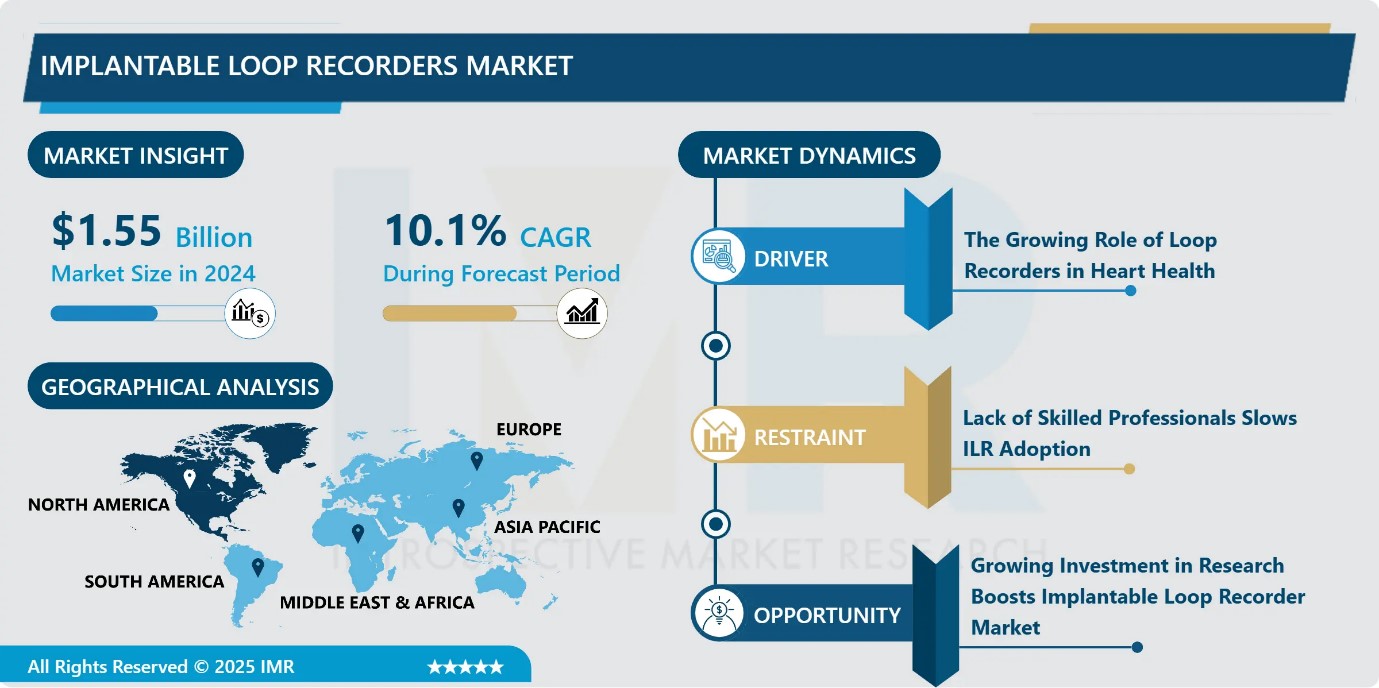
Implantable Loop Recorders Market Growth and Trend Analysis:
Implantable Loop Recorders Market Growth Driver- The Growing Role of Loop Recorders in Heart Health
- The implantable loop recorders industry is experiencing several notable trends that are shaping its growth and development. Factors such as technological innovation in ILR design, growing adoption of remote monitoring and telemedicine solutions, rising prevalence of cardiovascular disease, and surging demand for integrated Artificial intelligence (AI) in healthcare and machine learning, among other factors are propelling the industry growth.
- Further, the increasing adoption of remote monitoring and telemedicine solutions is driving demand for ILRs with remote monitoring capabilities. Remote monitoring allows healthcare providers to remotely access and review patients cardiac data, reducing the need for frequent in-person clinic visits and enabling proactive management of cardiac arrhythmias. Telemedicine platforms facilitate virtual consultations, enabling patients to receive personalized care and support from healthcare providers without the need for face-to-face appointments.
- Moreover, the shift towards value-based care and outcomes driven healthcare models is driving the adoption of ILRs as part of comprehensive care management strategies. ILRs enable early detection of cardiac arrhythmias, facilitating timely intervention and preventing adverse cardiovascular events, thereby improving patient outcomes, and reducing healthcare costs associated with hospitalizations and emergency department visits.
Implantable Loop Recorders Market Limiting Factor - Lack of Skilled Professionals Slows ILR Adoption
- Lack of Skilled Professionals Slows Down the Use of Implantable Loop Recorders. The major challenge in using implantable loop recorders (ILRs) is the lack of skilled healthcare professionals. These devices are very useful for tracking heart rhythm problems, but they require trained experts who know how to read and understand the data they collect. Without proper knowledge and training, it's hard to use ILRs correctly and make the right decisions for patient care.
- In many areas, especially in developing countries or rural regions, there is a shortage of doctors and medical staff with the necessary training. Advanced medical education and specialized programs are often not available or hard to access in these places. As a result, even if hospitals have ILRs, they may not use them fully or correctly because they don’t have trained staff.
- This shortage of skilled professionals limits how widely ILRs can be used. To improve this, more training programs, online courses, and support from healthcare companies are needed. By helping more doctors and nurses learn how to use ILRs, more patients can benefit from better heart monitoring and care.
Implantable Loop Recorders Market Expansion Opportunity- Growing Investment in Research Boosts Implantable Loop Recorder Market
- Increasing investment in research and development (R&D) is playing a key role in the growth of the global implantable loop recorder (ILR) market. As healthcare challenges continue to rise worldwide, both governments and private organizations are putting more money into developing new medical technologies. This includes creating better and more advanced ILRs for monitoring heart health.
- There is also a growing interest in personalized medicine treatments and devices designed to meet the specific needs of individual patients. This trend is encouraging researchers to develop ILRs that can be customized to offer better monitoring for each person’s unique heart condition.
- Overall, increased R&D investment is leading to smarter, more effective ILRs, which is helping the market grow and improve care for patients with heart rhythm problems.
Implantable Loop Recorders Market Challenge and Risk- High Cost of Devices
- One of the main problems with implantable loop recorders (ILRs) is that they are very expensive. These devices are helpful for finding and tracking heart rhythm problems, but their high cost makes it hard for many hospitals and clinics to buy and use them.
- In places with limited money for healthcare like developing countries or small clinics the cost of buying and using ILRs can be too much. This means that even though these devices could really help patients, many people don’t have access to them. Hospitals may not be able to afford the device itself, the surgery to place it, or the follow-up care.
- Because of this, fewer people can benefit from the early detection and monitoring that ILRs provide. To fix this issue, there needs to be a focus on making these devices more affordable and creating programs or support to help hospitals in low-income areas use them. Lowering the cost could help more patients around the world get better heart care.
Implantable Loop Recorders Market Segment Analysis:
Implantable Loop Recorders Market is segmented based on Type, Application, End-Users, and Region
By Type, Implantable Loop Recorders Market segment is expected to dominate the market during the forecast period
- In 2024, the automatic recorders segment held the largest share of the market, accounting and is expected to grow the fastest in the coming years. Automatic recorders are devices that monitor and record the heart’s electrical activity continuously without needing manual help. They are mainly used for patients with irregular heart rhythms, or arrhythmias, and are valuable because they can automatically start recording when they detect abnormal heart activity. This helps doctors catch irregular heartbeats that don’t happen all the time and might otherwise go unnoticed.
- On the other hand, the manual recorders segment is also expected to grow steadily during the forecast period. These devices require a healthcare professional or the patient to manually activate the recording. Manual recorders are often used in hospitals or clinics for short-term monitoring when patients show signs of heart issues. Although they don’t offer continuous monitoring like automatic devices, they are flexible and useful for temporary checks
By Application, Implantable Loop Recorders Market segment held the largest share in 2024
- Atrial fibrillation (AF) became the biggest part of the implantable loop recorder (ILR) market. Atrial fibrillation is a common heart condition where the upper chambers of the heart beat irregularly and often too fast. This can cause serious health problems like stroke or heart failure. Because of these risks, early and accurate detection is very important. ILRs are small devices placed under the skin that can monitor the heart's rhythm over a long period. They help doctors find hidden or occasional heart problems that might not show up during regular check-ups.
- The second largest part of the ILR market is for cardiac syncope, which is when people faint because of irregular heart rhythms. These episodes can be hard to explain without proper monitoring. ILRs are often used to figure out the cause of these unexplained fainting spells. This proves that ILRs are very useful in identifying the cause of symptoms and helping doctors choose the best treatment. Overall, ILRs are becoming an important tool in heart care, especially for conditions like atrial fibrillation and cardiac syncope, where constant monitoring can lead to better and faster diagnosis and treatment.
Implantable Loop Recorders Market Regional Insights:
- North America held the largest share, In the implantable loop recorders (ILRs) market in accounting the global market. This strong position is mainly due to the high number of people with heart-related diseases and a growing aging population, both of which increase the demand for reliable heart monitoring tools. The United States, in particular, is known for its early adoption of advanced medical technologies, and ILRs are becoming a regular part of heart care in hospitals and clinics. These small devices, which are placed under the skin, help doctors monitor a patient's heart rhythm continuously over time, especially in cases where symptoms like fainting or irregular heartbeat occur randomly.
Implantable Loop Recorders Market Active Players:
- Abbott (USA)
- Angel Medical Systems, Inc. (USA)
- Becton Dickinson and Company (USA)
- Biomerica, Inc. (USA)
- Biotronik (Germany)
- Boston Scientific Corporation (USA)
- Boston Scientific Corporation (USA)
- Cook Medical (USA)
- Dexcom (USA)
- Edwards Lifesciences Corporation (USA)
- GE Healthcare (USA)
- Hologic (USA)
- Intuitive Surgical (USA)
- Johnson & Johnson (USA)
- Koninklijke Philips N.V. (Netherlands)
- Medtronic (USA)
- MicroPort Scientific Corporation (China)
- Mindray (China)
- Nihon Kohden Corporation (Japan)
- Olympus Corporation (Japan)
- Roche Diagnostics (Switzerland)
- Siemens Healthineers (Germany)
- Smith & Nephew (UK)
- St. Jude Medical (USA)
- Stryker Corporation (USA)
- Terumo Corporation (Japan)
- Vectorious (Israel)
- Zimmer Biomet (USA)
- Other active players
|
Implantable Loop Recorders Market |
|||
|
Base Year: |
2024 |
Forecast Period: |
2025-2035 |
|
Historical Data: |
2018 to 2023 |
Market Size in 2024: |
USD 1.55 Billion |
|
Forecast Period 2025-35 CAGR: |
10.1% |
Market Size in 2035: |
USD 4.47 Billion |
|
Segments Covered: |
By Type |
|
|
|
By Application |
|
||
|
End Use
|
|
||
|
By Region |
|
||
|
Growth Driver: |
|
||
|
Limiting Factor |
|
||
|
Expansion Opportunity |
|
||
|
Challenge and Risk |
|
||
|
Companies Covered in the Report: |
|
||
Chapter 1: Introduction
1.1 Scope and Coverage
Chapter 2:Executive Summary
Chapter 3: Market Landscape
3.1 Market Dynamics and Opportunity Analysis
3.1.1 Growth Drivers
3.1.2 Limiting Factors
3.1.3 Growth Opportunities
3.1.4 Challenges and Risks
3.2 Market Trend Analysis
3.3 Industry Ecosystem
3.4 Industry Value Chain Mapping
3.5 Strategic PESTLE Overview
3.6 Porter's Five Forces Framework
3.7 Regulatory Framework
3.8 Pricing Trend Analysis
3.9 Intellectual Property Review
3.10 Technology Evolution
3.11 Import-Export Analysis
3.12 Consumer Behavior Analysis
3.13 Investment Pocket Analysis
3.14 Go-To Market Strategy
Chapter 4: Implantable Loop Recorders Market by Activation (2018-2035)
4.1 Implantable Loop Recorders Market Snapshot and Growth Engine
4.2 Market Overview
4.3 Automatic Recorders
4.3.1 Introduction and Market Overview
4.3.2 Historic and Forecasted Market Size in Value USD and Volume Units
4.3.3 Key Market Trends, Growth Factors, and Opportunities
4.3.4 Geographic Segmentation Analysis
4.4 Manual Recorders
Chapter 5: Implantable Loop Recorders Market by Application (2018-2035)
5.1 Implantable Loop Recorders Market Snapshot and Growth Engine
5.2 Market Overview
5.3 Atrial Fibrillation
5.3.1 Introduction and Market Overview
5.3.2 Historic and Forecasted Market Size in Value USD and Volume Units
5.3.3 Key Market Trends, Growth Factors, and Opportunities
5.3.4 Geographic Segmentation Analysis
5.4 Cardiac Arrhythmia
5.5 Cardiac Syncope
Chapter 6: Implantable Loop Recorders Market by End Use (2018-2035)
6.1 Implantable Loop Recorders Market Snapshot and Growth Engine
6.2 Market Overview
6.3 Hospitals
6.3.1 Introduction and Market Overview
6.3.2 Historic and Forecasted Market Size in Value USD and Volume Units
6.3.3 Key Market Trends, Growth Factors, and Opportunities
6.3.4 Geographic Segmentation Analysis
6.4 Cardiac Centres
Chapter 7: Company Profiles and Competitive Analysis
7.1 Competitive Landscape
7.1.1 Competitive Benchmarking
7.1.2 Implantable Loop Recorders Market Share by Manufacturer/Service Provider(2024)
7.1.3 Industry BCG Matrix
7.1.4 PArtnerships, Mergers & Acquisitions
7.2 ABBOTT (USA)
7.2.1 Company Overview
7.2.2 Key Executives
7.2.3 Company Snapshot
7.2.4 Role of the Company in the Market
7.2.5 Sustainability and Social Responsibility
7.2.6 Operating Business Segments
7.2.7 Product Portfolio
7.2.8 Business Performance
7.2.9 Recent News & Developments
7.2.10 SWOT Analysis
7.3 ANGEL MEDICAL SYSTEMS
7.4 INC. (USA)
7.5 BECTON DICKINSON AND COMPANY (USA)
7.6 BIOMERICA
7.7 INC. (USA)
7.8 BIOTRONIK (GERMANY)
7.9 BOSTON SCIENTIFIC CORPORATION (USA)
7.10 COOK MEDICAL (USA)
7.11 DEXCOM (USA)
7.12 EDWARDS LIFESCIENCES CORPORATION (USA)
7.13 GE HEALTHCARE (USA)
7.14 HOLOGIC (USA)
7.15 INTUITIVE SURGICAL (USA)
7.16 JOHNSON & JOHNSON (USA)
7.17 KONINKLIJKE PHILIPS N.V. (NETHERLANDS)
7.18 MEDTRONIC (USA)
7.19 MICROPORT SCIENTIFIC CORPORATION (CHINA)
7.20 MINDRAY (CHINA)
7.21 NIHON KOHDEN CORPORATION (JAPAN)
7.22 OLYMPUS CORPORATION (JAPAN)
7.23 ROCHE DIAGNOSTICS (SWITZERLAND)
7.24 SIEMENS HEALTHINEERS (GERMANY)
7.25 SMITH & NEPHEW (UK)
7.26 ST. JUDE MEDICAL (USA)
7.27 STRYKER CORPORATION (USA)
7.28 TERUMO CORPORATION (JAPAN)
7.29 VECTORIOUS (ISRAEL)
7.30 ZIMMER BIOMET (USA)
7.31 AND OTHER ACTIVE PLAYERS
Chapter 8: Global Implantable Loop Recorders Market By Region
8.1 Overview
8.2. North America Implantable Loop Recorders Market
8.2.1 Key Market Trends, Growth Factors and Opportunities
8.2.2 Top Key Companies
8.2.3 Historic and Forecasted Market Size by Segments
8.2.4 Historic and Forecast Market Size by Country
8.2.4.1 US
8.2.4.2 Canada
8.2.4.3 Mexico
8.3. Eastern Europe Implantable Loop Recorders Market
8.3.1 Key Market Trends, Growth Factors and Opportunities
8.3.2 Top Key Companies
8.3.3 Historic and Forecasted Market Size by Segments
8.3.4 Historic and Forecast Market Size by Country
8.3.4.1 Russia
8.3.4.2 Bulgaria
8.3.4.3 The Czech Republic
8.3.4.4 Hungary
8.3.4.5 Poland
8.3.4.6 Romania
8.3.4.7 Rest of Eastern Europe
8.4. Western Europe Implantable Loop Recorders Market
8.4.1 Key Market Trends, Growth Factors and Opportunities
8.4.2 Top Key Companies
8.4.3 Historic and Forecasted Market Size by Segments
8.4.4 Historic and Forecast Market Size by Country
8.4.4.1 Germany
8.4.4.2 UK
8.4.4.3 France
8.4.4.4 The Netherlands
8.4.4.5 Italy
8.4.4.6 Spain
8.4.4.7 Rest of Western Europe
8.5. Asia Pacific Implantable Loop Recorders Market
8.5.1 Key Market Trends, Growth Factors and Opportunities
8.5.2 Top Key Companies
8.5.3 Historic and Forecasted Market Size by Segments
8.5.4 Historic and Forecast Market Size by Country
8.5.4.1 China
8.5.4.2 India
8.5.4.3 Japan
8.5.4.4 South Korea
8.5.4.5 Malaysia
8.5.4.6 Thailand
8.5.4.7 Vietnam
8.5.4.8 The Philippines
8.5.4.9 Australia
8.5.4.10 New Zealand
8.5.4.11 Rest of APAC
8.6. Middle East & Africa Implantable Loop Recorders Market
8.6.1 Key Market Trends, Growth Factors and Opportunities
8.6.2 Top Key Companies
8.6.3 Historic and Forecasted Market Size by Segments
8.6.4 Historic and Forecast Market Size by Country
8.6.4.1 Turkiye
8.6.4.2 Bahrain
8.6.4.3 Kuwait
8.6.4.4 Saudi Arabia
8.6.4.5 Qatar
8.6.4.6 UAE
8.6.4.7 Israel
8.6.4.8 South Africa
8.7. South America Implantable Loop Recorders Market
8.7.1 Key Market Trends, Growth Factors and Opportunities
8.7.2 Top Key Companies
8.7.3 Historic and Forecasted Market Size by Segments
8.7.4 Historic and Forecast Market Size by Country
8.7.4.1 Brazil
8.7.4.2 Argentina
8.7.4.3 Rest of SA
Chapter 9 Analyst Viewpoint and Conclusion
Chapter 10 Our Thematic Research Methodology
10.1 Research Process
10.2 Primary Research
10.3 Secondary Research
Chapter 11 Case Study
Chapter 12 Appendix
12.1 Sources
12.2 List of Tables and figures
12.3 Short Forms and Citations
12.4 Assumption and Conversion
12.5 Disclaimer
|
Implantable Loop Recorders Market |
|||
|
Base Year: |
2024 |
Forecast Period: |
2025-2035 |
|
Historical Data: |
2018 to 2023 |
Market Size in 2024: |
USD 1.55 Billion |
|
Forecast Period 2025-35 CAGR: |
10.1% |
Market Size in 2035: |
USD 4.47 Billion |
|
Segments Covered: |
By Type |
|
|
|
By Application |
|
||
|
End Use
|
|
||
|
By Region |
|
||
|
Growth Driver: |
|
||
|
Limiting Factor |
|
||
|
Expansion Opportunity |
|
||
|
Challenge and Risk |
|
||
|
Companies Covered in the Report: |
|
||


